Reports from eastern Indiana and Ohio suggest indicate some recent impressive black cutworm pheromone trap catches, reminding us that it is time to start thinking about this pest in certain situations.

Reports from eastern Indiana and Ohio suggest indicate some recent impressive black cutworm pheromone trap catches, reminding us that it is time to start thinking about this pest in certain situations.

In the center of this photograph, see an aerial view of true armyworm damage of forage. (Photo Credit: Alex Helms, Assistant Director of Purdue Agricultural Centers)

The first week of May certainly didn’t feel like May as temperatures ended up 5-10 deg F below normal across the state (Figure 1).

After another rainy start to the week, some of you may be ready for a few dry days to get out in the garden or field to start planting.

North central entomologists, led by Dr. Anthony Hanson at UMN, have developed a survey to assess the needs for future alfalfa weevil applied research and extension topics. Pyrethroid resistance is a concern and one of the topics we are trying to assess with this survey. If you haven’t already, please click the link or scan the QR code below and add your input. It takes only a couple of minutes and will be used to guide our efforts on applied research! Take the survey

Although we are in a cool weather period and many crops have not yet been planted, alfalfa weevil are active and feeding. Pest managers throughout the state should be watching for this pest and preparing to treat if necessary. They are highly cold tolerant, so these cool nights will not slow them down. As I wrote here about a month ago, rotating insecticides is highly recommended as well as doing a post-spray survey (i.e. Did it work? Are the larvae dead?). Even varying the pyrethroid of choice is better than doing the same thing every year. There are also non-pyrethroid options for control of this pest. See the alfalfa weevil management recommendations, here. Producers can manage this pest most effectively by utilizing heat unit accumulations data (base 48°F) to determine when sampling should begin and when an action should be taken. The map below, current as of May 1, 2026,[Read More…]

It is time to keep an eye on wheat for diseases and scab risk. There are a number of foliar diseases in wheat to watch out for. These include – leaf, strip and stem (Fig. 1A, B, C), Septoria leaf spot and tan spot (Fig. 2A, B). A number of resources are available to help distinguish wheat leaf diseases and “Identifying Rust Diseases of Wheat and Barley” and Crop Protection Network Encyclopedia Wheat plant samples can always be submitted to the Purdue Plant Pest Diagnostic Lab for disease identification and confirmation. Wheat in southern Indians was flowering (Feekes 10.5.1) when I was in our plots in Vincennes on Saturday (April 25), which is a week or so earlier than I expected. Our plots in West Lafayette were at Feekes 9 (ligule of last leaf just visible). During flowering (anthesis, Fig 3A) warm, wet weather with high relative humidity will favor[Read More…]

I would like to remind everyone on the resources available for monitoring field crop diseases here in Indiana as planting progresses. The Purdue Field Crop Pathology Team will be tracking diseases across Indiana and will post updates here in Pest & Crop, on our website https://indianafieldcroppathology.com/ and with the Crop Protection Network Crop Lookout Tool (https://cropprotectionnetwork.org/crop-lookout). You can also follow me on X @DTelenko. National disease tracking and prediction programs are place to monitor for some the more economically important diseases in the U. S., such as Fusarium head blight in wheat (Fig. 1), wheat stripe rust (Fig. 1), southern rust of corn, and tar spot (Fig 2). In addition, the Crop Protection Network site hosts collaborative outputs on important issues affecting field crops in the U. S. and Canada, this site has numerous resources and fungicide efficacy tables for corn, soybean, and wheat. There are also a few other[Read More…]

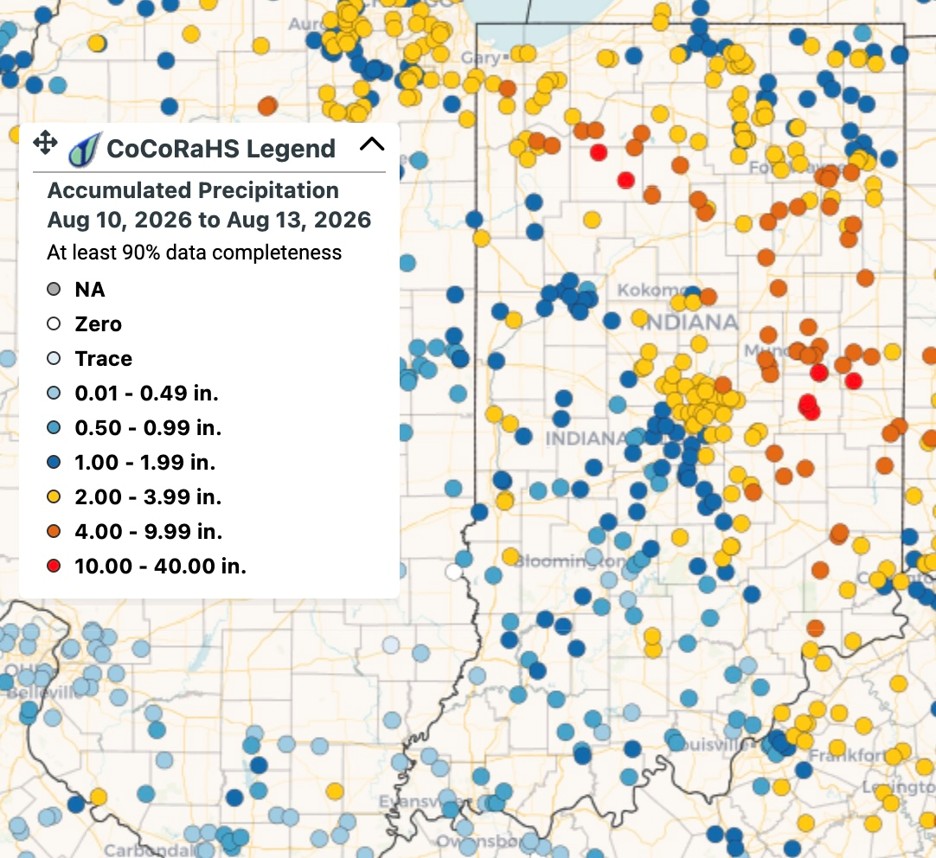
Indiana saw a lot of precipitation the early part of this past week with rainfall totals ranging from 0.5” or greater in the northern and far southwestern counties to over 5” in south-central Indiana. In fact, an observer just south of Bedford, IN reported a combined total of 5.80”! Figure 1 shows the 2-day total amounts from volunteer CoCoRaHS observers – illustrating how valuable their contributions are to precipitation monitoring. CoCoRaHS – which stands for Community Collaborative Rain, Hail, and Snow network – is a volunteer, citizen science program where anyone with interest in the weather and providing data to a larger community can sign up to take daily precipitation observations and report findings online or through a mobile map. Data is then collected nationally and made publicly available for the public to see and use. Programs such as the National Weather Service, state climatologists, emergency managers, and local communities[Read More…]

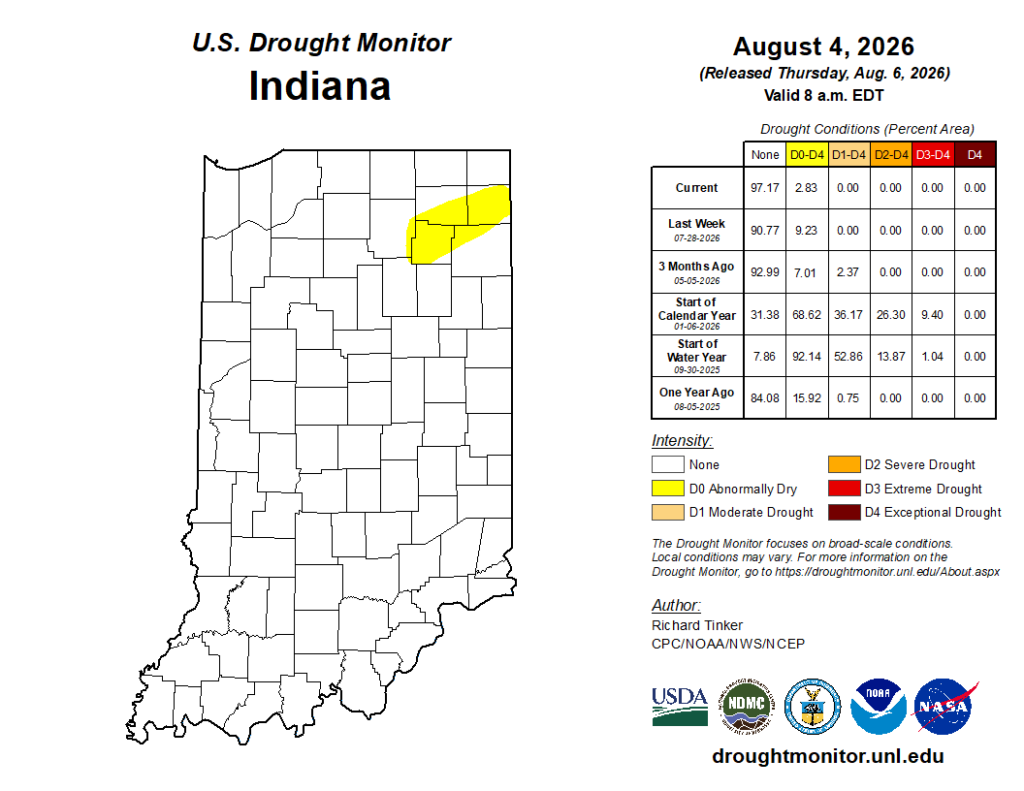
For at least 100 straight weeks (since mid-July 2024!) counties in north-central Indiana (from about Newton and Benton counties in the west to Allen, Adams, and Jay counties in the east) have been in some level of dryness.
© 2026 Purdue University | An equal access/equal opportunity university | Copyright Complaints | Maintained by Pest&Crop newsletter
If you have trouble accessing this page because of a disability, please contact Pest&Crop newsletter at luck@purdue.edu.