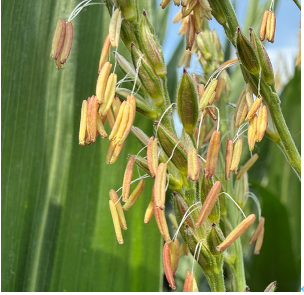
Throughout July in Indiana, tassels begin to emerge above the corn canopy, signaling the start of pollination. Although pollination lasts only about one to two weeks, it is one of the most critical stages of corn development because it determines kernel set and largely establishes the crop’s yield potential. Corn is also highly vulnerable during this period, often experiencing its greatest yield loss per day when exposed to stresses such as drought or hail. Corn is a monoecious species, meaning each plant produces both male (tassel) and female (silks) flowers. Therefore, successful pollination depends on pollen being released from the tassel and reaching receptive silks at the right time. Any stress that disrupts the synchronization between pollen shed and silk emergence can reduce kernel set and ultimately decrease grain yield. One of the most recognizable structures during corn pollination is the anther or the small, dangling structures that hang from[Read More…]