Throughout July in Indiana, tassels begin to emerge above the corn canopy, signaling the start of pollination. Although pollination lasts only about one to two weeks, it is one of the most critical stages of corn development because it determines kernel set and largely establishes the crop’s yield potential. Corn is also highly vulnerable during this period, often experiencing its greatest yield loss per day when exposed to stresses such as drought or hail. Corn is a monoecious species, meaning each plant produces both male (tassel) and female (silks) flowers. Therefore, successful pollination depends on pollen being released from the tassel and reaching receptive silks at the right time. Any stress that disrupts the synchronization between pollen shed and silk emergence can reduce kernel set and ultimately decrease grain yield.
One of the most recognizable structures during corn pollination is the anther or the small, dangling structures that hang from the tassel during pollen shed (Figure 1). Although they may look insignificant, anthers play a critical role in successful pollination because they produce and release the pollen required for fertilization and kernel development. Once fully emerged and mature, anthers release pollen through pores located at their tips. Research has shown that a single corn tassel typically produces approximately 6,000 to 7,000 anthers, with each anther releasing roughly 4,000 to 7,000 pollen grains. As a result, an individual corn plant can produce between 2 and more than 30 million pollen grains. The central branches of the tassel generally produce the greatest amount of pollen, while the lower branches contribute less. This seemingly excessive pollen production is characteristic of wind-pollinated crops such as corn, where only a small fraction of pollen grains successfully land on receptive silks. After anthers have completed pollen shed, they dry, detach from the tassel, and are commonly found scattered across corn leaves, on the soil surface, or on your hat and shirt when you walk a pollinating corn field.
Once an anther emerges, it typically releases most of its pollen within approximately three minutes. Although an individual tassel generally completes pollen shed over about seven days, the majority of pollen is released during the first two to three days after anther emergence. Weather conditions can also influence the timing of pollen shed. When anthers become wet from rainfall or heavy dew, they temporarily stop releasing pollen until they dry. As a result, on humid mornings with heavy dew, pollen shed is often delayed until the foliage and tassels have dried. Under favorable conditions, pollen shed is typically greatest during the morning hours, generally between 8:00 and 11:00 a.m. Releasing pollen earlier in the day helps maximize pollen viability by avoiding the higher temperatures and lower humidity commonly experienced during the afternoon. The next time you walk through a corn field during pollination, take a moment to look closely at the anthers hanging from the tassel. These small structures may be easy to overlook, but they play a critical role in successful pollination, kernel set, and ultimately the yield potential of every corn plant.
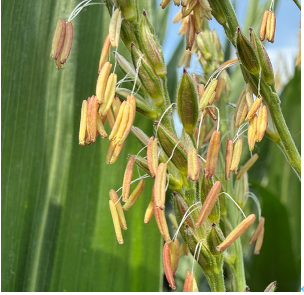
Figure 1. Visual presence of fully extended anthers on the tassel of a pollinating corn plant. West Lafayette, IN 2026.
Additional References:
Goss, J.A. (1968). Development, physiology, and biochemistry of corn and wheat pollen. The botanical review. 34:333-359. doi: 10.1007/BF02985391
Van Hout, R., M. Chamecki, G. Brush, J. Katz, and M.B. Parlange. (2008). The influence of local meteorological conditions on the circadian rhythm of corn pollen emission. Agricultural and Forest Meteorology. 148:2088-1092.
Nielsen, R.L. (2018). Tassel emergence and pollen shed. Corny News Network. Purdue Univ. Ext. https://extension.entm.purdue.edu/newsletters/pestandcrop/article/tassel-emergence-pollen-shed/