In the last week, much of Indiana has received the remnants of Hurricane Beryl, with various locations receiving rainfall totals of 3-4+ inches of rain.
5 articles tagged "corn yield".
The cost of seed corn represents 17% of farmers’ variable cost of production, second only to the cost of nitrogen (N) fertilizer.
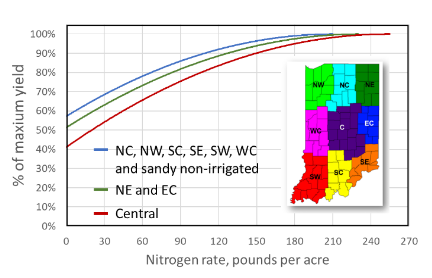
Corn yield response to increasing nitrogen (N) rate follows the Law of Diminishing Returns – as higher and higher increments of N are applied, the increase in grain yield becomes smaller and smaller (Figure 1). Eventually, maximum yield occurs and applying more N does not increase yield any further.
Corn yield response to increasing nitrogen (N) rate follows the Law of Diminishing Returns – as higher and higher increments of N are applied, the increase in grain yield becomes smaller and smaller (Figure 1). Eventually, maximum yield occurs and applying more N does not increase yield any further.
This report summarizes corn yield response to fertilizer nitrogen (N) rate in field scale trials conducted around the state of Indiana since 2006. These results are applicable to N management programs that use efficient methods and timings of N fertilizer application.