Last week’s article gave a corn leaf aphid (CLA) primer and introduction, as several observations were reported in Indiana corn and sorghum fields. This isn’t uncommon, and typically these infestations don’t really go anywhere in terms of impacting the crop.
But in at least some fields, populations are causing visible plant stress. We still have a long way to go in the yield determination story on corn, so stress at this time of year is cause for concern. Calls and observations from both north-central and eastern Indiana indicate populations of aphids that are so high they are covering the upper leaves of plants. If nothing else, where there is an aphid, light is not reaching that plant. Add in the nutrients that aphids are removing from the plant during the sensitive period of grain fill, and you have a recipe for potential yield loss.
As with many insects that colonize fields by air, infestations are likely to be patchy. An entire field loaded with CLA is not common. Scouting is the only way to determine what the levels are, and where. Aphids cue in on subtle differences between hybrids, and even within hybrids they are responsive to plant nutrition and will do particularly well on stressed plants, where key amino acids tend to be more available to them as they feed. Amino acids are used to make protein, which in turn can be used to make more aphids! Sugars are usually abundant for aphids, hence all the sticky honeydew they excrete onto leaves. Protein is what they really want!
Heavy aphid infestations often fall victim to a combination of predators, parasitoids and especially fungal pathogens. This often happens when populations are very high so it’s not always advisable to wait until “nature takes its course”. Again, the best approach is to get out and examine fields in person. Heavy aphid infestations on upper leaves and tassels will be very apparent. How many aphids is too many? Unfortunately, I cannot give you a number – there is no solid threshold for CLA in corn after fertilization (they are not usually pests at this time), but when plants are stressed, it may be time to act.
When the question about which pesticides to apply is raised, there are many options – mostly pyrethroids. While we don’t recommend specific products, you do often get what you pay for in the insecticide world. Expecting the cheapest generic to perform as well as a product that costs 3-4X more is not realistic.
No matter what insecticide is chosen, the key component is coverage. These insecticides must contact the aphids, where they sit. Unlike many other insect pests, aphids hardly move at all and aren’t likely to walk over pesticide residues. Ensure you are using the correct rate and enough water to achievr coverage of the leaves where aphids are most abundant. And as always, do a post check to see if it worked. Happy scouting!
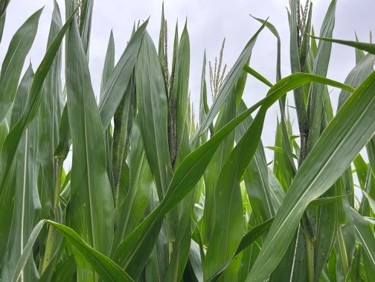
A heavy CLA infestation on corn tassels and upper leaves. Photo by Marty Park
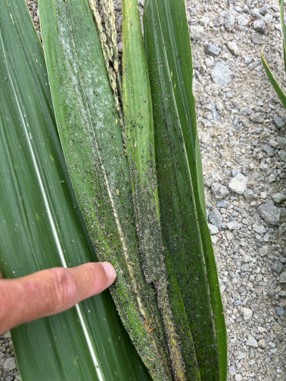
Aphids, their cast skins, honeydew and sooty mold are all prevalent on this leaf.
Photo by Marty Park