Many areas of Indiana experienced excessive rainfall from mid-May through late June (Figure 1), with some locations receiving more than 10–15 inches of rain between May 31 and June 29. As a result, many corn fields that got off to a good start initially appeared healthy and uniform are now exhibiting symptoms of prolonged soil saturation and waterlogging, including uneven growth, stunting, leaf yellowing, and necrosis (Pictures 1 and 2). These symptoms are typically most severe in poorly drained fields and fine-textured, high-clay soils where excess water persists for extended periods. As saturated conditions continue across much of the state, many growers are questioning how these conditions will affect corn growth, development, and yield potential. This article explains how flooding and soil waterlogging impact corn physiology and productivity, discusses the potential yield consequences, and highlights the key symptoms and recovery indicators to monitor throughout the remainder of the growing season.
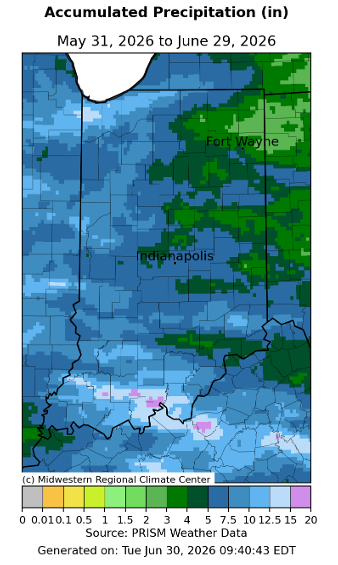
Figure 1. Map of Indiana accumulated precipitation (in) from May 31st through June 29th. Data and figure generated from the Midwest Regional Climate Center (https://mrcc.purdue.edu/newclimate/maps/gridded).
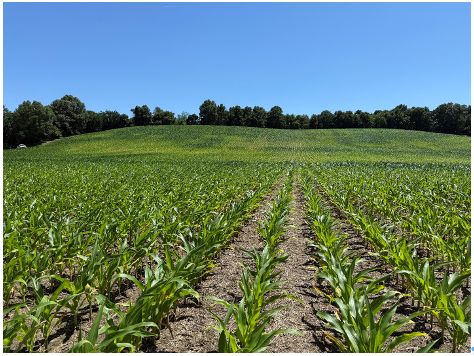
Picture 1. Evidence of corn stunting, uneven growth, and yellowing due to excessive rainfall and soil waterlogging in Dubois County, Indiana. Photo taken June 2, 2026.
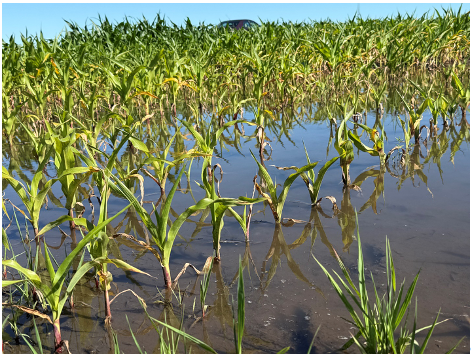
Picture 2. Standing water and flood damaged corn on June 23rd, 2026 in West Lafayette, IN.
Two primary factors determine the severity of corn injury and potential yield loss following flooding or soil waterlogging: (1) the crop growth stage when saturation occurs and (2) the duration of the saturated conditions. In general, younger corn plants are more susceptible to flooding stress than older plants. Before the V6 growth stage (six collared leaves), the growing point remains below the soil surface, making developing plants particularly vulnerable to prolonged soil saturation. When soils become saturated, oxygen is rapidly depleted (often within 48 hours) reducing root respiration, growth, and overall function. As root activity declines, the plant’s ability to absorb water and nutrients is impaired, resulting in the yellowing, stunting, and uneven growth commonly observed following excessive rainfall. Continued soil saturation further increases root injury, reducing water and nutrient uptake even after standing water has disappeared. Consequently, corn plants may exhibit symptoms typically associated with drought stress, including leaf rolling and wilting, despite abundant soil moisture. These symptoms occur because damaged roots are unable to supply sufficient water to meet the plant’s demand.
The length of time soils remain saturated is equally important. As the duration of flooding or waterlogging increases, the likelihood of plant injury and yield loss also increases. Research conducted in Missouri demonstrated that corn exposed to waterlogged conditions at the V6 growth stage for just one day experienced approximately a 10% yield reduction, while seven days of waterlogging resulted in a 36% yield loss. Overall, the authors estimated that waterlogging at V6 reduced yield by approximately 7 – 11 bushels per acre for each day soils remained saturated (Kaur et al., 2020). These findings highlight the importance of both crop growth stage and flooding duration when evaluating the potential impact of excessive rainfall on corn productivity. However, these yield loss estimates are would be lower in older corn plants due to better tolerance of saturated conditions, while in younger corn this length of flooding would likely result in plant death. In addition, yield losses are going to vary based on soil drainage, soil type, and management practices.
Additional concerns associated with flooding and waterlogged soils include nitrogen (N) loss through leaching and denitrification. These processes can substantially reduce N availability, particularly in fields that received large rainfall amounts over a short period. As a result, N deficiency symptoms may become more pronounced as the season progresses. Fortunately, corn can often respond to supplemental or “rescue” N applications well into the growing season, with responses documented through the R1 (silking) and R2 (blister) growth stages when N deficiencies are present. In general, corn plants with adequate N availability prior to flooding tend to be more resilient and experience less yield loss than plants that were already N deficient before saturated conditions occurred.
Flooding and prolonged soil waterlogging can have lasting effects on corn performance beyond the initial injury. Sediment deposits on leaves may temporarily reduce photosynthesis, while prolonged stress increases the risk of crown and stalk rots, late-season lodging, and drought stress later in the season due to compromised root systems. Although many corn plants recover well once soils dry, oxygen is restored, and root growth resumes, prolonged saturation can result in lasting reductions in root development and plant biomass that ultimately limit yield potential. As the season progresses, growers should continue scouting affected fields for persistent nutrient deficiencies, uneven growth, disease development, and standability issues, while evaluating whether supplemental nutrient applications are needed before the crop enters the reproductive growth stages.
Additional Resources:
Kaur, G., G. Singh, P.P. Motavalli, K.A. Nelson, J.M. Orlowski, and B.R. Golden. (2020). Impacts and management strategies for crop production in waterlogged or flooded soils: A review. Agron. J. 112:1475-1501. https://acsess.onlinelibrary.wiley.com/doi/full/10.1002/agj2.20093
Nielsen, R.L. (2025). Effects of flooding or ponding on corn prior to tasseling. Corny News Network. Purdue Univ. Ext. https://www.agry.purdue.edu/ext/corn/news/timeless/pondingyoungcorn.html