Corn growth stages are quite variable across Indiana but several areas with early planted corn are reaching tassel. Tar spot has been confirmed in 5 Indiana counties as well as several other Midwestern states and that means we need to start to monitoring for disease to make an informed decision if a fungicide is necessary. The cool and wet conditions in May and most of June have led to increased foliar disease on the lower canopies, but recent hot conditions have started to reduce the risk of tar spot development in some areas therefore it is important to get out and scout. As a reminder for disease to occur, three things need to be present 1. Pathogen, 2. Host, and 3. Favorable Environment. The major diseases we monitor in Indiana such as gray leaf spot, northern corn leaf blight, northern corn leaf spot, and tar spot all might start to make an appearance in the next couple of weeks, depending on weather conditions (Figures 1 and 2).
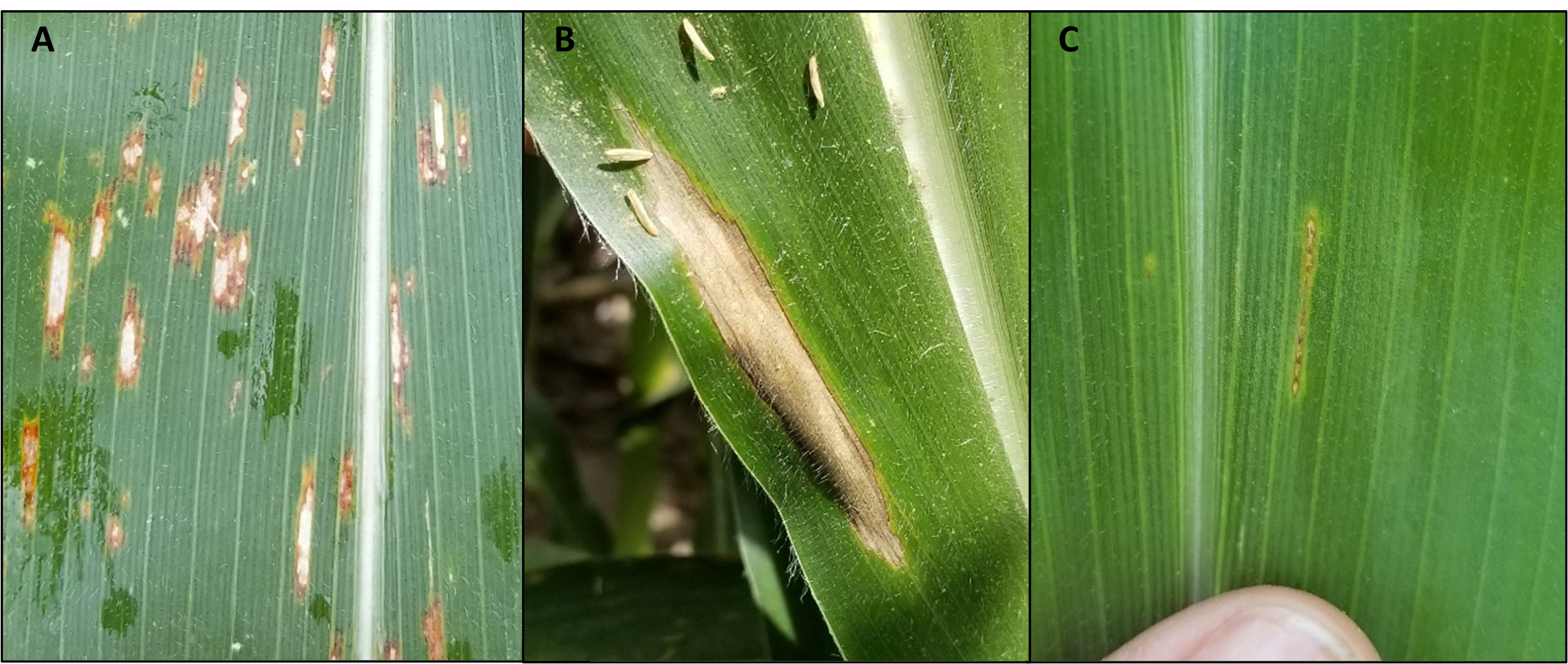
Figure 1. Examples of A-gray leaf spot, B-northern corn leaf blight, and C-northern corn leaf spot lesions on a corn leaf. (Photo Credit: Darcy Telenko)
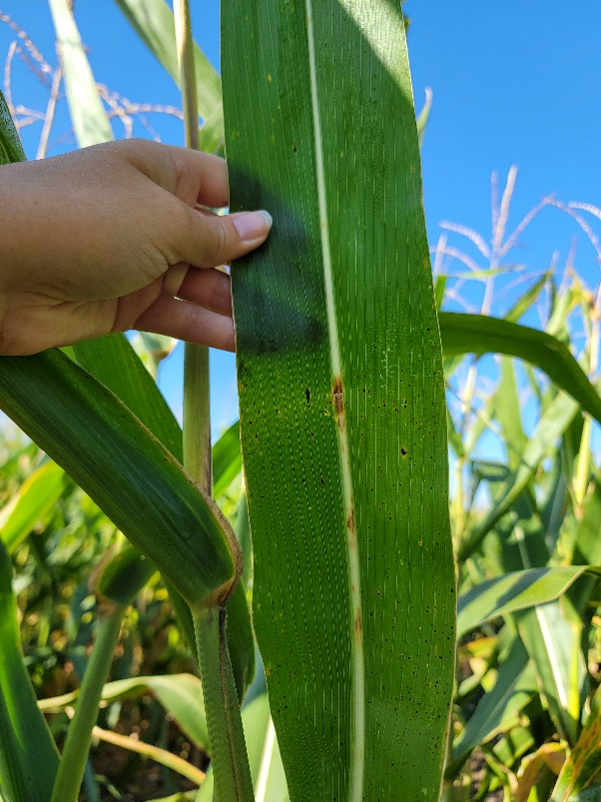
Figure 2. Example of corn infected by tar spot. The spots (stroma) will be embedded in the leaf, raised (bumpy to the touch), and will not rub/wash off. In addition, they may be surrounded by a slight halo. (Photo Credit: Morgan Goodnight)
Tar spot continues to be a concern this season. Tar spot may be hard to find early Figure 2 shows how small the initial tar spot lesions (stroma) will be. Previously, we usually found the stroma in fully-expanded leaves, knee to hip height in the canopy. We will continue to monitor for disease and keep you updated. Again, the recent hot weather may push off the disease in some areas. See the forecast from the Crop Risk Tool for July 1, as some areas in the central and northern regions remain at moderate to high risk (Fig. 3).
A few recommendations when using the Crop Risk Tool
- If you have a history of the tar spot it is time to keep an eye out and make an informed management decision.
- First, corn is susceptible to tar spot from V10-R3, so if your corn is not at V10, then you are not at the predicted risk threshold yet
- The Crop Risk Tool initially tells you to get out and scout – we have time to apply fungicides if we find tar spot in the lower canopy.
- Our recent research has shown that making an application just after first detection is effective – you just need to be scouting for those early lesions.
- But if you wait until we have significant disease in the upper canopy, then a fungicide application may be too late at that time.
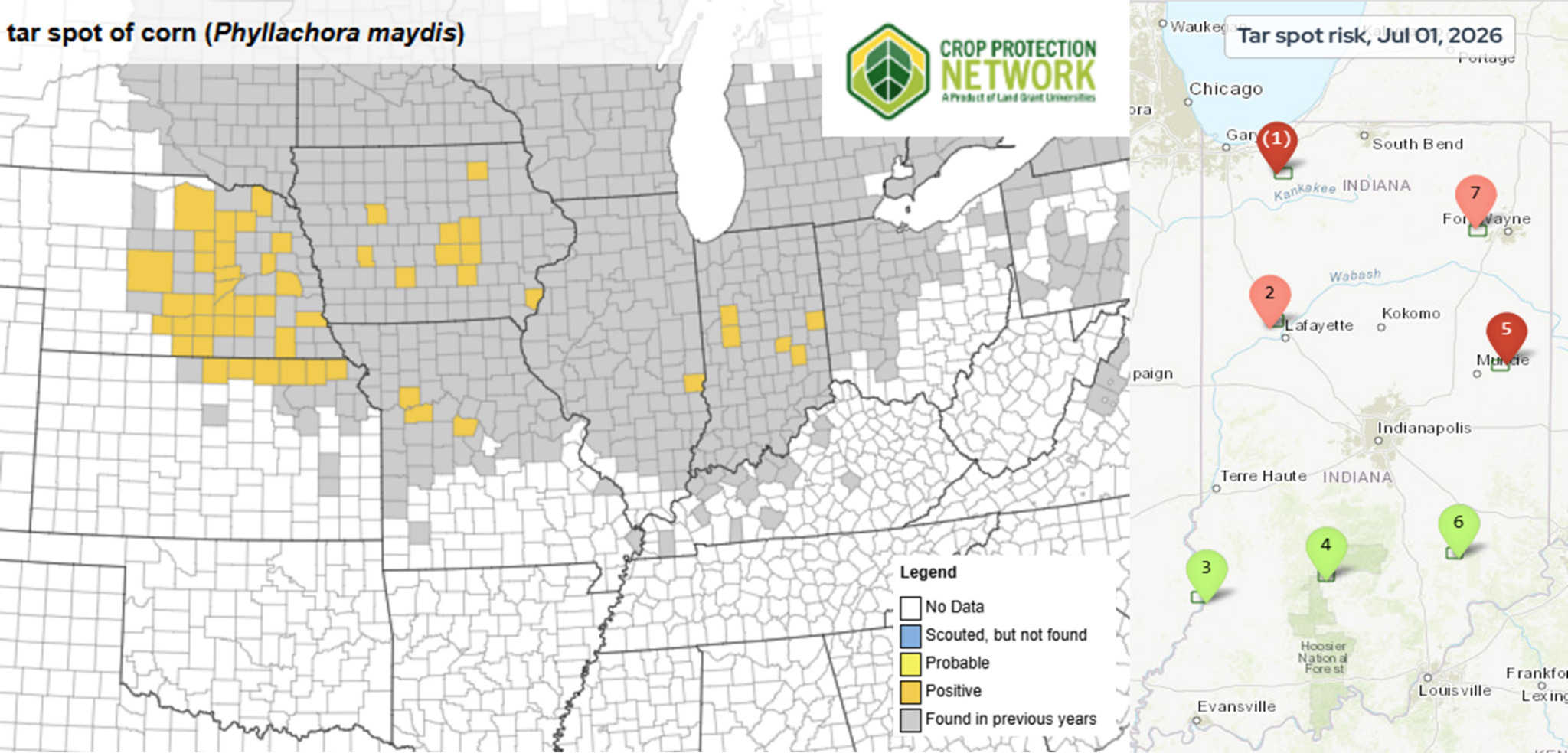
Figure 3. Tar spot map for July 1, 2026 (source https://cropprotectionnetwork.org/maps/tar-spot-of-corn) and Crop Risk Tool forecast from July 1, 2026. Red and pink colors indicate favorable environmental conditions for tar spot if corn at V10 or older. Source: Crop Risk Online Tool, Crop Protection Network.
I know the next question – should I be putting out a fungicide?
Research has shown the best return on investment in making a fungicide application in corn occurs when the fungal diseases are active in the corn canopy. It is important to keep scouting.
A well-timed, informed fungicide application will be important to reduce disease severity when it is needed, and we recommend holding off until diseases are active in your field and corn is at least nearing VT/R1 (tassel/silk) or even R2 (blister). Scouting will be especially important with variable rains in the forecast, but the hot weather seems to be sticking around, which may push off disease development.
A number of fungicides are highly efficacious against tar spot here in Indiana when applied from tassel (VT) to R2 (milk). I would recommend picking a product with multiple modes of action. The national Corn Disease Working Group has developed a very useful fungicide efficacy table for corn diseases (see link).
https://cropprotectionnetwork.org/publications/fungicide-efficacy-for-control-of-corn-diseases
We will continue keeping a close eye on tar spot. Please help us track tar spot, contact me if you suspect a field has tar spot and/or send a sample to the Purdue PPDL for confirmation. Research funding from the Indiana Corn Marketing Council is supporting sample processing, therefore there will be no charge for corn tar spot samples submitted to the clinic. Please wrap the leaves in newspaper, ship in a large envelope, and ship early in the week. If you are sending samples from multiple locations, please label them and provide the date collected, hybrid if known, field zip code or county, and previous crop.
Mail to: Plant and Pest Diagnostic Laboratory, LSPS-Room 116, Purdue University, 915 W. State Street, West Lafayette, Indiana 47907-2054. The lab is operating and the building is open. If dropping off a sample is more convenient than shipping, please call or email the lab prior to stopping by Phone – 765-494-7071 or Email – ppdl-samples@purdue.edu.
In addition, the 2026 tar spot and southern rust maps are live and will be updated when a positive county confirmation is detected. If you are interested in up-to-date information on the current detection of these diseases, the maps are available on the front page of our Extension website https://indianafieldcroppathology.com/
If you have any question please contact Darcy Telenko (dtelenko@purdue.edu/764-496-5168) or PPDL (ppdl-samples@purdue.edu/765-494-7071)