The increasing adoption of early-planted soybean in Indiana, and throughout the Corn Belt, prompts the question of whether herbicide programs should remain the same as those used for later planting dates. In particular, two relevant questions arise with the selection of soil residuals: (1) Does planting earlier increase the risk of soybean injury from soil-residual herbicides? and (2) Should herbicide programs be adjusted to account for weeds that emerge earlier in the spring?
Injury risk from soil residual herbicides
In general, the potential for soybean injury from soil-residual herbicides increases under cold temperatures, heavy rainfall after application, and in coarse soils with low organic matter. Relatively cooler soil temperatures delay the soybean germination and emergence process, which prolongs the period of time the cotyledons and hypocotyl are moving through the herbicide zone near the soil surface. This extended period can increase the extent of herbicide absorbed into the soybean seedling. Rainfall is necessary to move residual herbicides into the weed germination zone. However, heavy rainfall immediately after application can increase soybean injury due to excessive herbicide uptake by seedlings. Soil type also plays a major role. Coarser soils with lower organic matter bind less herbicide. In these situations, adjusting rates according to the herbicide label is important to minimize the potential for soybean injury while maintaining extended residual weed control. Soybean grows best at air temperatures between 77 and 86°F. When temperatures are cooler, soybean seedlings metabolize residual herbicides more slowly and may result in compromised growth (Figure 1). Despite the increased potential for injury from residual herbicides in early-planted soybean, the yield benefits, such as extended growth during early-season vegetative stages and after flowering, higher pod numbers, and increased grain yield, outweigh the visual injury and stand loss observed during early soybean development that may occur from common soil residual herbicides in soybean (Figure 2).
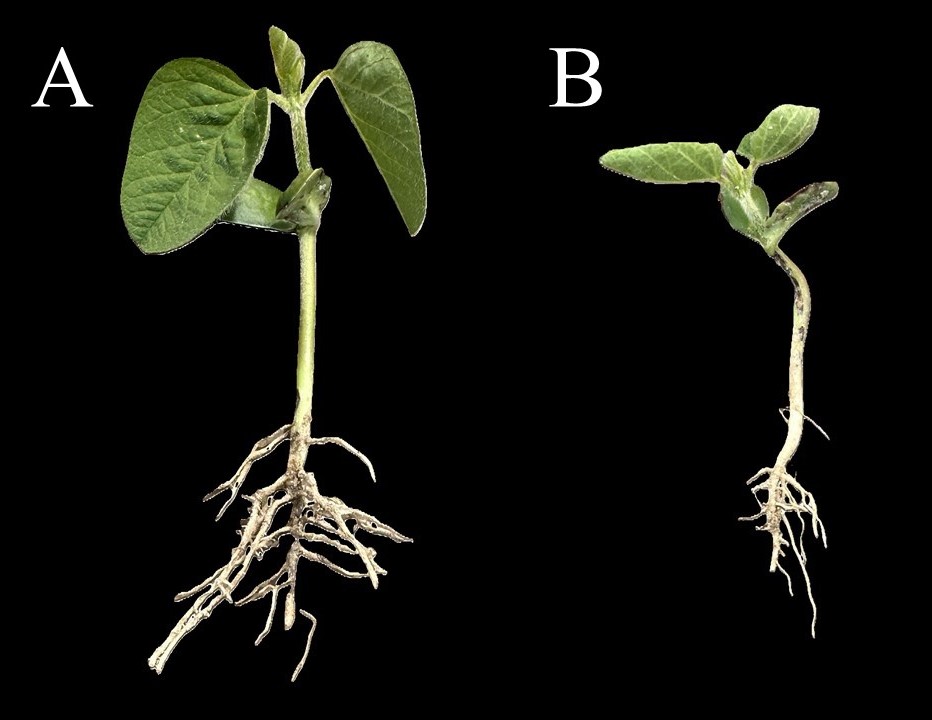
Figure 1: Soybean with no residual herbicide application (A) compared to soybean exhibiting injury caused by cool, wet conditions following an early spring Fierce XLT application at 4.5 oz/acre (B).

Figure 2: Increased soybean yield with early planting in northwest, west-central, and southeast Indiana. Bars within a location with the same letter are not different (P ≤ 0.05).
Herbicide programs and weed shifts in early-planted soybean
The germination of summer annual weeds is influenced by both soil moisture and temperature, with soil temperature representing the most limiting factor for early spring emergence. As a result, weeds species competing with soybean during early planting can differ from what we see with later planting dates. Early planting may increase competition from species such as giant ragweed and common lambsquarters, which have earlier and narrower germination windows than weeds like waterhemp. For example, a recently developed weed emergence forecasting tool [Weed Emergence Scouting Tool (WEST), https://mrcc.purdue.edu/WEST-Desktop] estimates first emergence for giant ragweed at 120 growing degree days (Base48), while waterhemp’s first emergence threshold is 425 growing degree days. Because of this shift, selecting effective soil-residual herbicides based on the weeds most likely to emerge first becomes important.
Early soybean planting may result in increased competition with these early-emerging weeds requiring more careful selection of our soil residuals. For example, Group 15 herbicides, including pyroxasulfone (Zidua/Anthem) and s-metolachlor (Dual Magnum), provide strong preemergence control of small-seeded broadleaf weeds such as common lambsquarters and waterhemp. However, the Group 15 herbicides are largely ineffective on giant ragweed. For early-planted soybean in fields with giant ragweed, residual herbicide selection should specifically target this species. Herbicide premixes such as Zidua PRO, Fierce XLT, and Tendovo, which contain Group 2 herbicides like imazethapyr (Pursuit), chlorimuron (Classic), and cloransulam (FirstRate), respectively, can provide more effective control of giant ragweed.
In summary, selecting effective residual premix herbicides based on the expected weed species competing with soybean during early crop growth is essential for optimized weed management. Premixes containing three soil-residual herbicides are preferred to manage herbicide-resistant weeds and to broaden the weed control spectrum. Additionally, to prevent yield loss from weed competition and to avoid increases in the weed seedbank, growers should be aware that a second POST herbicide application may be required in early-planted soybean due to the extended growing season, especially in fields infested with waterhemp or Palmer amaranth.