The recent heavy rains throughout much of Indiana have resulted in some flooded fields. This often suggests questions about what is happening to insects below the ground: Are they drowning? Can they “hold their breath” until the water recedes? Or are they even breathing at all?
The answer depends on both the insect species and life stage. In general, the egg stage is highly resistant to drowning or freezing because it is not respiring much, if at all, and overwintering eggs contain little water to freeze. But once the eggs hatch and larvae emerge, they are vulnerable to a wide range of abiotic factors, including drowning.
| GDD Accumulations For Corn Rootworm Egg Hatch (Base 52°F) Tippecanoe Co., Indiana | ||||
|---|---|---|---|---|
| Date | Min Temp (°F) | Max Temp | DAILY DD | TOTAL DD |
| 2026-05-25 | 49.9 | 80.6 | 13.4707 | 658.681 |
| 2026-05-26 | 55.9 | 78.7 | 15.248 | 673.966 |
| 2026-05-27 | 64.0 | 82.1 | 21.037 | 695.003 |
| 2026-05-28 | 58.3 | 83.8 | 19.0312 | 714.034 |
| 2026-05-29 | 57.1 | 82.5 | 17.8012 | 731.835 |
| 2026-05-30 | 55.8 | 80.1 | 15.9484 | 747.783 |
| 2026-05-31 | 53.5 | 80.1 | 14.7772 | 762.561 |
| 2026-06-01 | 60.9 | 76.0 | 16.4224 | 778.983 |
| 2026-06-02 | 55.6 | 78.8 | 15.1876 | 794.171 |
| 2026-06-03 | 51.6 | 82.7 | 15.1854 | 809.356 |
| 2026-06-04 | 57.3 | 83.9 | 18.622 | 827.978 |
| 2026-06-05 | 64.8 | 83.5 | 22.1506 | 850.129 |
| 2026-06-06 | 68.5 | 85.5 | 25.024 | 875.153 |
| 2026-06-07 | 67.4 | 85.3 | 24.3658 | 899.519 |
| 2026-06-08 | 70.5 | 80.8 | 23.6224 | 923.141 |
| 2026-06-09 | 72.0 | 86.3 | 27.172 | 950.313 |
| 2026-06-10 | 71.2 | 89.4 | 28.3162 | 978.629 |
The case of the western corn rootworm larvae (still a key pest in parts of the US but greatly reduced in prevalence and severity in Indiana) is one that comes up often when these conditions hit. Egg hatch is temperature-driven and usually occurs in late May and early June. It’s been warm this year, particularly over the last 2 weeks or so, and we are slightly ahead of a typical year:
Key DD (Degree Day) Milestones & Scouting Tips
- Start of Hatch: 600 to 650 GDD
- Peak Hatch (50%): 684–767 GDD range
- Root digs/scouting larvae: Begin 7-10 days after peak hatch
As the table above shows, we are beyond peak hatch throughout Indiana. If rootworms are present in a field, feeding has begun so if you are inclined to dig roots and look for larvae on susceptible hybrids, it is a good time to do so.
Getting back to the topic of saturated soils and RW larvae, it is likely that the recent heavy rains took a toll on the late emergers. The peak hatch estimate above represents 50% emergence, so there are just as many emergers on the other side of that curve.
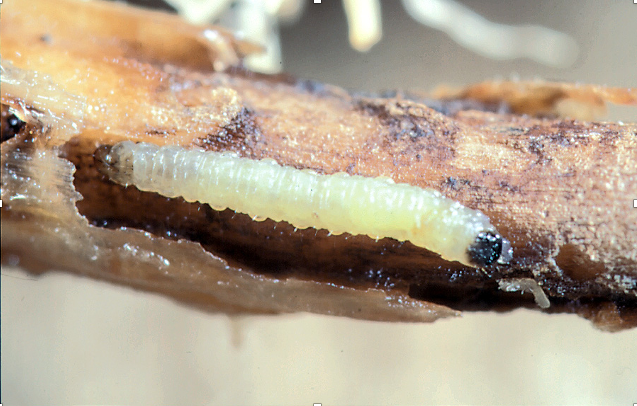
3rd and final instar larva of corn rootworm and feeding damage
Rootworm larvae do breathe air and they need to find a corn plant (no other plants will do) and feed soon after emergence. Although it’s impossible to know how many rootworms (and other insects) were impacted by heavy rains and standing water, we know that larvae can drown in saturated soils and can also have difficulty locating and moving to corn roots in these soils, as they use odor cues to find those roots. Those cues are likely much more difficult to pick up, perhaps impossible, without air passages in soil. So, while not quite an apocalypse for corn rootworms, this is likely a very significant challenge to a happy, safe and chilled out larval lifestyle for many.
Although insects are likely the least of most people’s concerns as they look out onto waterlogged and stressed crops, hopefully this is one small silver lining.