During the week of August 11, much of Indiana received excessive to record-setting rainfall (Figure 1). Portions of eastern Indiana, for example, received more than 13 inches of rainfall, setting local rainfall records and producing conditions rarely or ever experienced in the region. The 2026 growing season continues to be characterized by highly variable and extreme weather events, particularly during the latter half of the growing season. These conditions have introduced questions about how excessive rainfall, saturated soils, and also extended cloudy weather may influence corn grain fill, yield, stalk quality, and harvestability. Therefore, this article helps to provide insights on the late-season impacts of these weather events and also what Indiana corn farmers should be paying attention to as harvest season approaches.
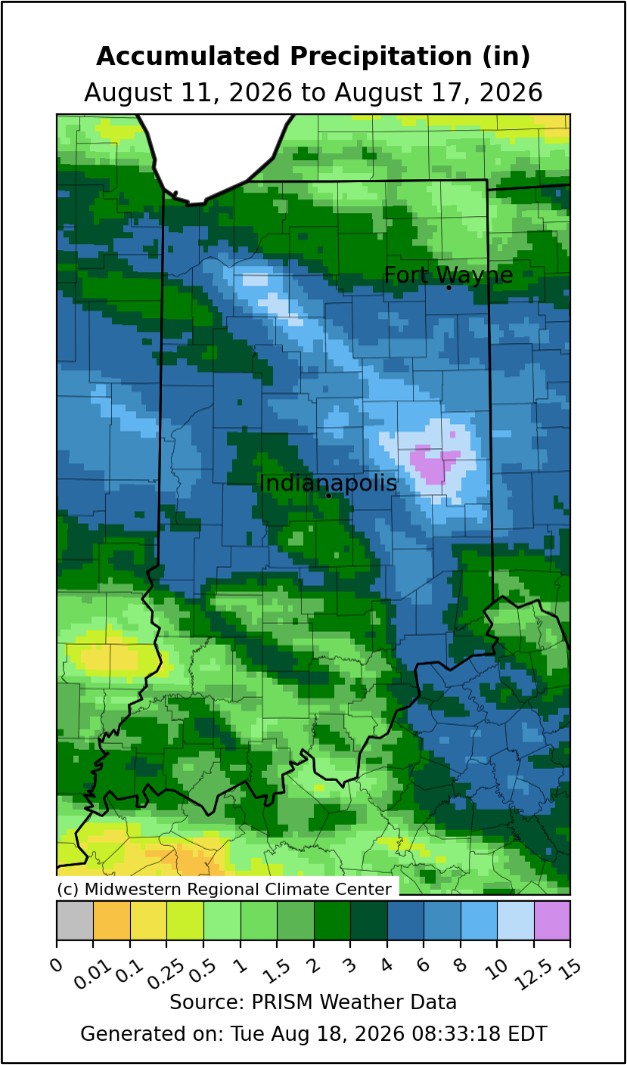
Figure 1. Indiana accumulated precipitation from August 11 through August 17th, 2026. Data and figure were generated by the Midwest Regional Climate Center (mrcc.purdue.edu).
Excessive Rainfall and Saturated Soils
One small sliver of hope is that corn is generally less susceptible to waterlogging and saturation during reproductive development than during early vegetative growth, but prolonged late-season saturation and flooding is not harmless. For example, a corn flooding response review by Kaur et al. (2019) reported that a six-day waterlogging period beginning 10 days after tasseling reduced corn grain yield by approximately 13%. Similarly, recent research by Huang et al. (2022) similarly found that corn at the R3 (milk) stage was less sensitive to waterlogging than corn at growth stage V3, V6, or VT; however, yield losses increased substantially as the duration of waterlogging increased. In that study, eight and ten days of waterlogging beginning at R3 reduced grain yield by approximately 16% and 25%, respectively. Prolonged R3 waterlogging also reduced leaf area, chlorophyll content, aboveground biomass, and harvest index, while reductions in kernel weight were observed even with shorter periods of waterlogging. These results highlight that although corn becomes more tolerant of saturated conditions as it progresses into reproductive development, extended waterlogging during R3 and grain fill can still reduce plant photosynthetic output, kernel weight, and ultimately grain yield. Overall, from published research found it seems that flooding and waterlogging that persists >4 to 5 consecutive days can reduce corn yield during late-season grain fill stages, with percent yield losses increases as flooding duration increases and the earlier the flooding occurs during the grain filling period. However, it remains challenging to pinpoint exact yield losses because injury severity depends on several factors, including duration of saturation, crop growth stage, soil drainage, and temperature.
Overall, the primary problem associated with saturated soils is not simply too much water; rather, it is too little oxygen surrounding the corn root system. When soil pore space remains filled with water, oxygen availability declines rapidly, restricting root respiration, water and nutrient uptake, and energy production. Soil temperature can further influence the severity of flooding injury, as warmer soils accelerate oxygen depletion; therefore, flooding that occurs under higher temperatures typically results in more rapid oxygen deprivation and greater plant stress.
Maintaining root function remains important during late-season reproductive development because the plant is still accumulating kernel dry matter and nutrients during grain fill. Therefore, prolonged saturation can reduce nutrient uptake, accelerate plant stress and senescence, and potentially limit the plant’s ability to maintain a healthy, photosynthetically active canopy which is required for optimal grain fill.
Flooding can also create additional problems when water moves across fields. Mud and sediment deposited on leaves can reduce photosynthetically active leaf area if deposits remain for multiple days after the water recedes (Picture 1). Soil and debris deposited on plant tissues may also increase the potential for certain diseases. Furthermore, these concerns become even greater when floodwater reaches the ear. Submerged ears and persistent moisture and sediment within the husk can increase the risk of ear rot and kernel mold development as harvest approaches.
Cloudy Days and Reduced Solar Radiation: The Other Side of the Problem
Persistent rainy weather often brings another potential stress that is easy to overlook and often difficult to quantify: persistent cloudy days and reduced solar radiation (e.g., sunlight). From July 31 through August 17, central Indiana experienced approximately a 20% reduction in daily solar radiation compared with the five-year average, with individual rainy days experiencing reductions of 60–80% (Figure 2). This is important because solar radiation, along with water and nutrients, is one of the most important inputs needed for optimal grain fill and yield production in corn.
Corn depends on intercepted photosynthetically active radiation (about 50% of the total solar radiation) to drive photosynthesis and produce the carbohydrates needed to support kernel development and grain fill. Cloudy weather can substantially reduce the photosynthetically active radiation reaching the crop canopy. For example, research summarized in a recent weather stress review article by Ortez et al. (2023) reported reductions in photosynthetically active radiation of approximately 23% during partly cloudy conditions, 52% during cloudy conditions, and 62% during rainy conditions. Overall, a few cloudy days are unlikely to cause a significant or measurable yield penalty by themselves. Yet, the greater concern is persistent below-normal solar radiation lasting several days to a week or longer while the crop still has substantial grain fill remaining.
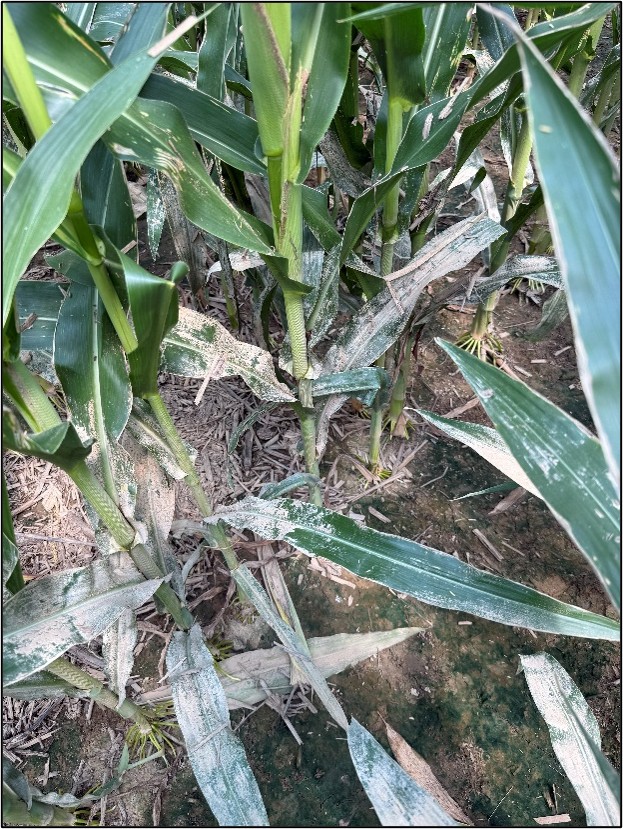
Picture 1. Incidence of mud and sediment on late-season corn leaves following flooding in SW Indiana in 2026. Photo by Isaac Schroeder, Winfield United.
For example, crop-model simulations cited in the same published review estimated that reducing daily solar radiation by 46% for seven consecutive days during the R4 growth stage (dough) reduced corn grain yield by approximately 5.2%. This example is particularly relevant to prolonged cloudy weather because it demonstrates that even relatively short periods of substantially reduced radiation (7 – 10 days) can influence final yield when they coincide with active grain filling.
The impact of reduced sunlight also depends heavily on when it occurs. Near pollination and during early kernel development, reduced photosynthesis can interfere with kernel set and increase kernel abortion. However, once corn reaches growth stages R3 (milk) to R5 (dent), kernel number is largely established and yield increasingly depends on kernel dry matter accumulation and final kernel weight. Therefore, prolonged cloudy conditions later in grain fill are more likely to reduce kernel weight than kernel number.
A previous field demonstration in Indiana by Pioneer (https://www.pioneer.com/us/agronomy/reduced-solar-radiation-on-corn.html) further illustrates this relationship. Solar radiation was intentionally reduced by approximately 70% at different reproductive stages. Shading during pollination caused severe pollination failure, while shading during R2 and early R3 increased kernel abortion. In contrast, shading during R4 and R5 primarily reduced kernel weight, resulting in yield reductions of 51% and 21%, respectively, while also reducing stalk strength. However, these shade treatments were much more severe than typical cloudy weather and were conducted at a single location in one year. Thus, these yield-loss percentages should not be directly applied to Indiana fields experiencing cloudy conditions. Instead, the results demonstrate the importance of adequate solar radiation throughout grain fill, and that prolonged reductions in sunlight during late summer have the potential to reduce kernel weight, final grain yield, and stalk strength.
Stalk Quality Degradation with Late-Season Stress
One important factor to pay attention with persistent waterlogging and cloudy weather is the potential for poor stalk health heading into harvest. The developing ear represents a very strong carbohydrate sink. When the photosynthetically active canopy cannot produce enough carbohydrates to satisfy kernel demand, the plant can increasingly remobilize stored carbohydrates from stalk tissues to the developing kernels. In other words, the plant begins using some of its stored reserves to maintain grain fill. This process is often referred to as stalk cannibalization. Although this remobilization can help support kernel development when current photosynthesis is inadequate, excessive depletion of stalk reserves can weaken stalk tissues and reduce standability.
This becomes particularly important following extended periods of both wet and cloudy weather. Saturated soils may have already compromised root health and anchorage, while reduced photosynthesis caused by deposited sediment on the leaves and/or reduced sunlight increases reliance on stored stalk carbohydrates. This combination may leave areas in the state with weaker stalks aboveground and compromised roots belowground, potentially increasing lodging risk as harvest approaches.
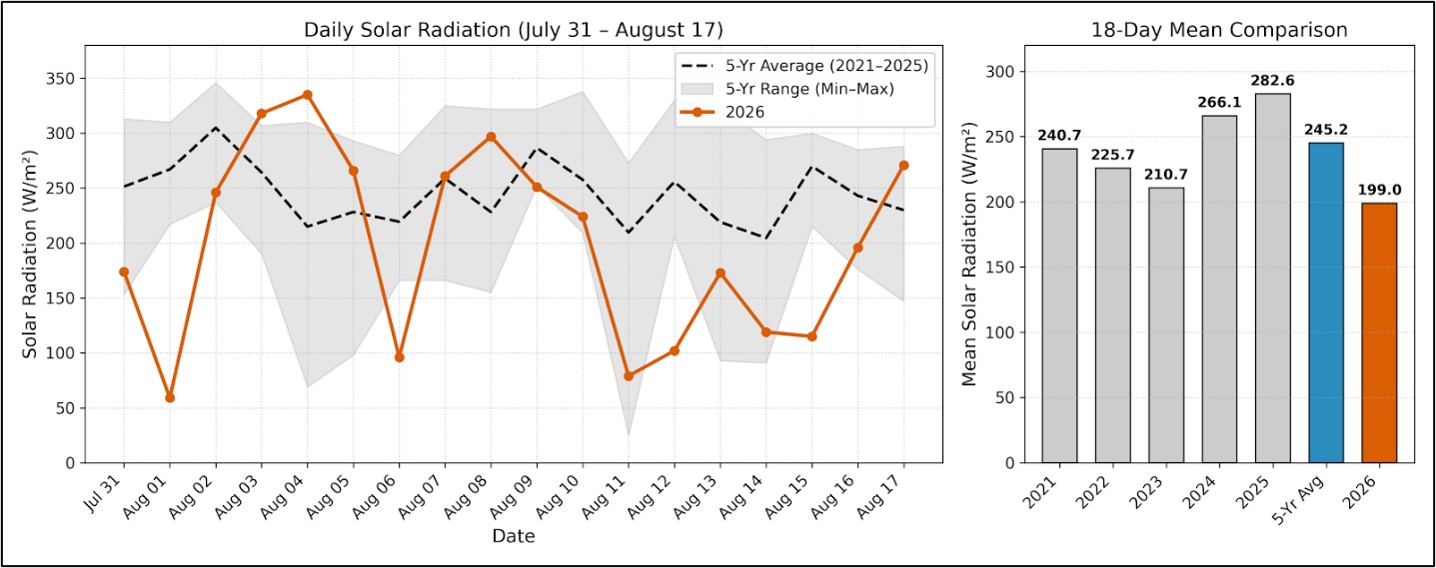
Figure 2. Daily and mean solar radiation (W/m2) trends and comparisons from July 31 through August 17, 2021-2026. Data was sourced from the Midwest Regional Climate Center (mrcc.purdue.edu) and was collected from the weather station at the Agronomy Center for Research and Education (ACRE) in West Lafayette, IN.
What Should Farmers Watch as Harvest Approaches?
Following extended wet and cloudy periods, scouting should shift toward evaluating how well plants are finishing grain fill and whether overall plant heath, stalk, root, and ear quality are beginning to deteriorate. It will be important to pay attention to fields that experienced prolonged ponding or saturation, especially those with poor drainage. Scout for premature leaf senescence, ear rots and kernel molds, disease development, weak stalks, and root deterioration. Fields where ears were partially or completely submerged deserve additional attention because prolonged moisture and contamination within the husk may increase yield and grain-quality concerns.
Stalk strength should also be evaluated before harvest. Pinch lower stalk internodes or use a push test to identify plants that have lost structural integrity. Fields with substantial stalk deterioration or root lodging should be prioritized for earlier harvest, particularly if additional wind or rainfall events are forecast.
Summary
Overall, for corn in the mid to late grain fill stages during August and early September, occasional rainfall and cloudy days are generally not a major concern, and rainfall may be beneficial where soil moisture is limiting. However, the risk increases when prolonged rainfall keeps soils saturated while persistent cloud cover substantially reduces solar radiation. Under these conditions, several stresses can occur simultaneously. Saturated soils reduce oxygen availability and root function, potentially restricting water and nutrient uptake. Cloudy weather reduces incoming solar radiation and therefore the amount of photosynthesis occurring within the canopy. Reduced photosynthesis means less carbohydrate production to support kernel dry-matter accumulation. If kernel demand remains high, the plant may increasingly remobilize stored carbohydrates from the stalk, potentially reducing stalk strength. Continued rainfall can then delay field drying and harvest, extending the period that weakened plants must remain standing.
Ultimately, the important question following prolonged wet and cloudy weather is not simply “How much rain did we receive?” Instead, consider how long soils remained saturated, how much solar radiation was reduced, what growth stage the crop was in, how much grain filling remains, and how well the plants maintain green leaf area, root function, and stalk integrity. An extended grain-fill period can be beneficial, but only when the crop has sufficient sunlight, water, nutrients, and healthy leaf area. For fields subjected to extended saturation and reduced sunlight in late summer, careful scouting and monitoring of stalk quality, ear health, and standability will be especially important as harvest approaches.
References and Additional Information:
Emmert, D. Effects of reduced solar radiation on corn growth and yield. Pioneer Agronomy. https://www.pioneer.com/us/agronomy/reduced-solar-radiation-on-corn.html
Huang, C., Y. Gao, A. Qin, Z. Liu, B. Zhao, D. Ning, S. Ma, A. Duan, and Z. Liu. 2022. Effects of waterlogging at different stages and durations on maize growth and grain yields. Agric. Water. Mgmt. 261:107334. https://doi.org/10.1016/j.agwat.2021.107334
Kaur, G., G. Singh, P.P. Motavalli, K.A. Nelson, J.M. Orlowski, and B.R. Golden. 2020. Impacts and management strategies for crop production in waterlogged or flooded soils: A review. Agron. J. 112:1475-1501. https://acsess.onlinelibrary.wiley.com/doi/pdf/10.1002%2Fagj2.20093
Nielsen, R.L. 2014. Flood or ponding damage to corn late in the growing season. Corn News Network. Purdue Univ. Agronomy. http://www.kingcorn.org/news/timeless/FloodDamageLateCorn.html
Ortez, O.A., A.J. Lindsey, P.R. Thomison, J.A. Coulter, M. Singh, D.R. Carrijo, D.J. Quinn, M.A. Licht, and L. Bastos. 2023. Corn response to long-term seasonal weather stressors: A review. Crop Sci. 63:3210-3235. https://acsess.onlinelibrary.wiley.com/doi/pdfdirect/10.1002/csc2.21101