Overview
Cover crops play an important role in resilient agricultural systems by improving soil health, reducing erosion, increasing water retention, and helping suppress weeds (Figure 1). Many cover crop options are available, with cereal rye being one of the most commonly used in the Midwest. As we approach the growing season, a common question arises: when is the right time to terminate cover crops? This is an important consideration to maintain crop yield, while maximizing weed suppression capabilities.
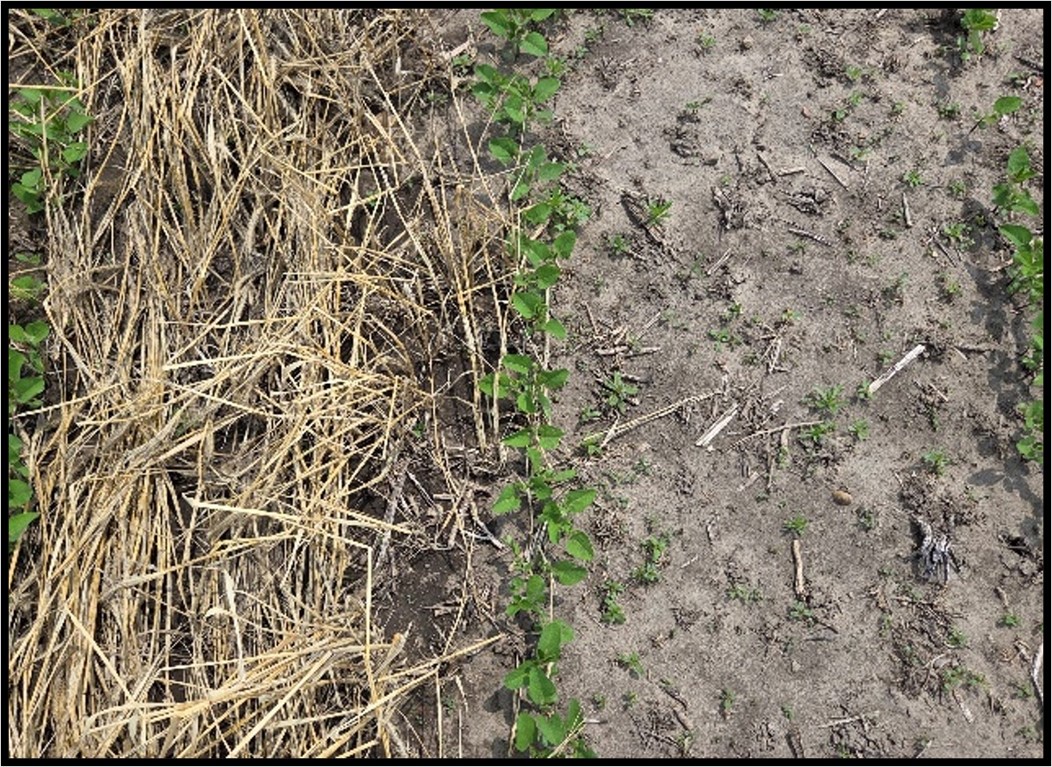
Figure 1. The ability of cover crops (cereal rye) to suppress weed emergence (left) compared with abundant weed emergence when no cover crop is employed (right).
Weed Suppression
Delaying cover crop termination as much as is feasible can be beneficial from a weed management standpoint. Allowing the cover crop to grow longer increases biomass production, leading to greater weed suppression. Previous research suggests that about 4,500 pounds of biomass per acre can reduce waterhemp density by 50% or more. Collaborative research led by the University of Wisconsin–Madison Weed Science team involving Purdue and multiple other universities, identified that this amount of biomass can typically be achieved when cereal rye reaches approximately 30 inches in height when using seeding rates of about 60 pounds per acre. Therefore, terminating cereal rye at or beyond this height may optimize weed suppression. Additionally, applying a residual herbicide at termination can further improve weed control, including lengthened control of problematic summer annual weeds like waterhemp (Figure 2).

Figure 2. Reduction in pigweed (waterhemp and Palmer amaranth) density counts when combining PRE residual herbicides with cover crop usage. Figure courtesy of Dr. Rodrigo Werle, Extension Weed Scientist, University of Wisconsin-Madison.
Termination Timing
For corn, delaying cereal rye termination to at- or after-planting can be a concern because it strongly competes for nitrogen. In general, it is recommended to terminate cereal rye approximately two weeks before planting corn to avoid negative growth and yield limiting impacts. Alternatively, the Midwest Cover Crops Council recommends planting oats or radish as the cover crop of choice when rotating to corn and applying starter fertilizer to help minimize the risk of nutrient deficiencies. If utilizing these cover crop species, termination timing can occur up to corn planting.
For soybean, research has shown a wider window for effective termination with some farmers choosing to plant green, which involves planting soybean directly into a standing cover crop prior to termination (Figure 3). Recent collaborative research conducted across soybean producing states has shown that terminating cereal rye up to the soybean cotyledon stage resulted in significant improvements in waterhemp suppression while not impacting soybean yield.

Figure 3. Soybean planted into cereal rye cover crop terminated at planting (planting green). The picture was taken two weeks after planting.
Regardless of cropping system, the absolute latest that cover crop termination can occur is immediately when transitioning into a reproductive growth stage (i.e., for cereal rye, right at anthesis). This helps ensure a greater likelihood of termination success regardless of the method used. However, as previously mentioned, successful implementation into weed management programs has occurred when terminating cereal rye at a 30” height, and this earlier timing can make sure there is not too much biomass that may hinder effective planting of the cash crop (i.e., resulting in poor soil to seed contact and/or open seed furrows).
Methods for Cover Crop Termination
Cover crops can be terminated using herbicides, tillage, mowing, winterkill, or roller-crimping, with herbicides being the most common approach. The timing of termination strongly influences herbicide selection. If termination occurs after cash crop emergence, options will be limited to herbicides that are selective for the cash crop. In addition to terminating the cover crop, the herbicide applied may also control weed escapes. Therefore, it is important to consider the entire scenario (cover crop species and height, weed species present, and the cash crop being planted) when selecting the most appropriate herbicide program.
Overall, glyphosate is a good option for terminating multiple cover crop species, and its performance can typically be improved when combined with other herbicides. Cereal rye and oats are terminated successfully with glyphosate. The addition of glufosinate may further improve control and help manage weeds that are resistant to glyphosate; however, be aware of season use limitations in-crop if using glufosinate in a burndown. Crimson clover and Austrian winter pea can be terminated with a combination of glyphosate and 2,4-D. As mentioned earlier, including a residual herbicide in the mixture can provide extended weed control, especially on problematic summer annual weeds like waterhemp. However, one note to make, some herbicide combinations can be antagonistic, particularly when applied in less-than-ideal weather conditions (cool and wet). For example, atrazine has been shown to negatively impact glyphosate activity when trying to terminate cereal rye (Figure 4). Finally, always ensure that the herbicides used are labeled for burndown, preplant, or preemergence applications for the cash crop you intend to plant, and make sure to observe any necessary plant back intervals. For more information on recommended herbicide tank-mixtures for cover crop termination or burndown applications, please see the 2026 Weed Control Guide, which can be found here: https://extensionpubs.osu.edu/category-2c-agricultural-weed-control-2026/.

Figure 4. Some herbicide mixes can cause antagonism in our burndowns, particularly if weather conditions are less than ideal. For example, in this image, atrazine can negatively impact glyphosate when trying to terminate cereal rye. Image courtesy of Dr. Travis Legleiter, Extension Weed Scientist, University of Kentucky.
Additional information:
- Elucidating waterhemp (Amaranthus tuberculatus) suppression from cereal rye cover crop biomass
- Influence of cover crop termination strategies on weed suppression, concentration of residual herbicides in the soil, and soybean yield
- Midwest Cover Crop Council – Indiana Cover Crop Recipe – Post Soybean, Going to Corn: Use Oats/Radish
- Midwest Cover Crop Council – Indiana Cover Crop Recipe – Post Wheat, Going to Soybean or Corn: Use Oats and Radish Mix
- Midwest Cover Crop Council – Termination
https://www.midwestcovercrops.org/termination/
- Terminating Cover Crops – Successful Cover Crop Termination with Herbicides https://www.extension.purdue.edu/extmedia/ws/ws-50-w.pdf