As shown by the degree-day accumulations below, Japanese beetle adults are emerging throughout the state and the first few traces of feeding can be found in soybeans and corn. This will continue for the next several weeks, and the adults will live through much of the month of August. It isn’t uncommon for beetle emergence to spike shortly after a rainfall, as this softens up the soil for their climb to the surface.
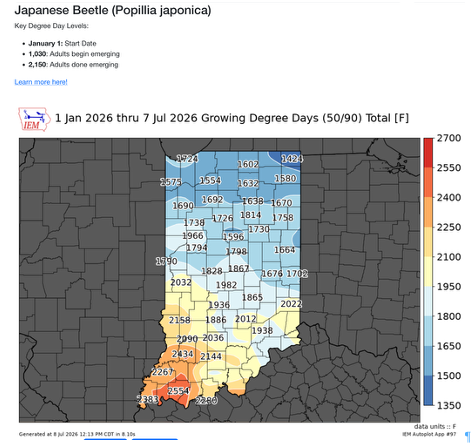
Today’s adults are the product of eggs that were laid by female beetles last summer. After eggs hatched last year, the grubs immediately began to feed on roots and (mostly) decaying organic matter in the soil. They continue their feeding from late summer into the fall; this is not economically important damage – the grubs are small and the plants and root systems are large and well-developed by this point. The grubs overwinter several inches deep in the soil (not vulnerable to cold winters) and return to near the soil surface to feed early in spring, when they can sometimes cause problems for seedlings beginning to establish themselves.
Adult Japanese beetles will feed on more than 300 different species of plants, including many around the home and garden, including turfgrass. Trapping for the beetles may not be the best approach in these environments as it can sometimes make problems worse.
On soybeans and other cultivated crops, defoliation (leaf tissue removal) usually looks much worse than it is and is largely confined to edges. The beetles often congregate in several areas of a soybean field, feeding on and mating in the upper canopy while they bounce back and forth between field margins and other host plants. This is often observed by producers driving by field margins. The beetles iridescent, metallic color catches the attention of those doing “windshield” field inspections. Closer inspections may reveal that weeds, for example along the fence lines, are being fed upon as well.
Remember that soybeans have an amazing capacity to withstand considerable defoliation before economic losses occur – looking through a skeletonized soybean leaf from above reveals that many other leaves just below are intact and intercepting the sunlight that gets through the holes, resulting in minimal penalty to the plant. The impact of defoliation is greatest during flowering and pod fill because of the importance of leaf area to photosynthesis, and ultimately to yield. Therefore, thresholds are different at different times – nearly 30% defoliation before bloom or 10% defoliation from bloom to pod fill can be tolerated before yields are economically affected. This average defoliation must occur on the whole plant, not just the upper canopy.
In corn, Japanese beetle feeding on corn silks is usually minimal and spotty. Again, field inspections will often reveal that this feeding is not prevalent much beyond field borders. If beetles are feeding on corn silks, an insecticide should be applied only if silks are being cut off to less than 1/2 inch before 50% pollination has taken place. This level of damage has been rare in recent years. Beetles are often attracted to dead or dying silks to feed; fields that are obviously beyond 50% pollination.
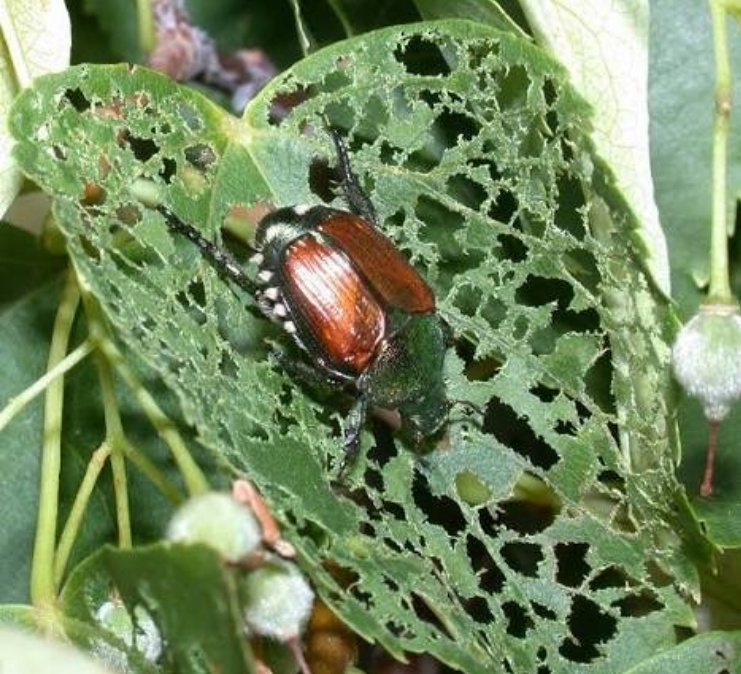
Japanese beetle defoliation can be patchy and severe. While the leaf shown likely exceeds the 30% defoliation threshold, remember that the economic threshold is calculated over the entirety of the plant – many leaves below will have little to no feeding.