Southern Indiana experienced wet feet for much of May with totals from 6 to nearly 12 inches. Meanwhile, parts of northern Indiana and Illinois were parched and even registering on the drought monitor near the end of May and first week of June. The weather pattern has flipped between southern and northern Indiana through June. Intense storms have been cycling through dumping 2 to 5 inches in single events to total 8 to 15 inches of rain in the worst areas (Figure 1). In these same areas, the rainfall is 200 to 300% of 30-year normal (Figure 2).
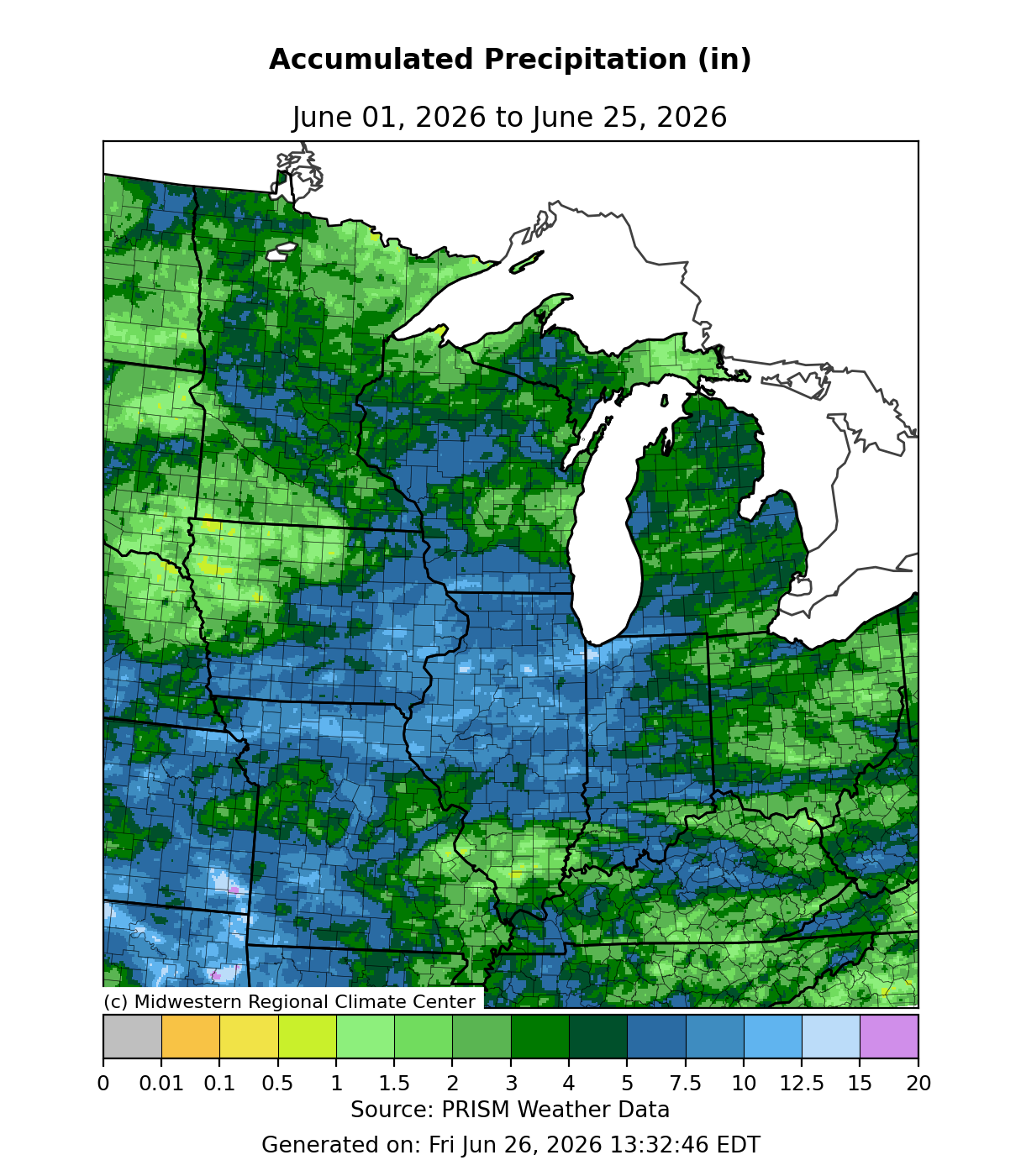
Figure 1. Accumulated rainfall across Midwest from June 1 to June 25, 2026. Generated through Midwest Climate Center.
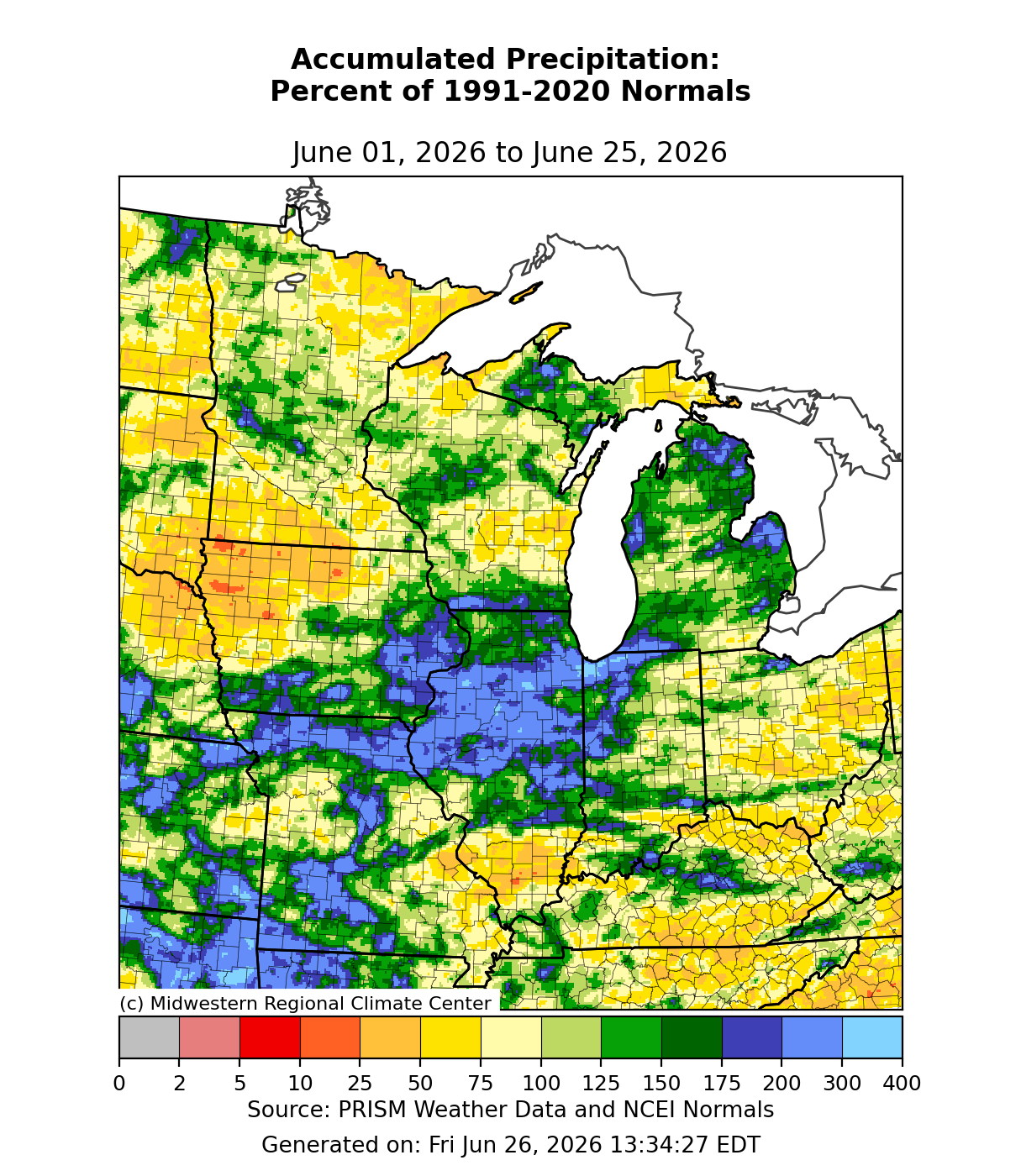
Figure 2. Percent of 30-year average rainfall across Midwest from June 1 to June 25, 2026. Generated through Midwest Climate Center.
Needless to say, many fields of soybean are struggling with wet feet (Figure 3). Chances are you will see the off-green to highlighter green soybeans throughout the fields where the field has been saturated to ponded. Saturated soils will limit oxygen supply to soybean roots and Bradyrhizobia. Soybeans grow and develop by burning plant energy (photosynthates) with the assistance of oxygen. Thus, soybean (and rhizobia) growth is limited under wet conditions. In fact, nodules can die under prolonged saturation and limit N supply.
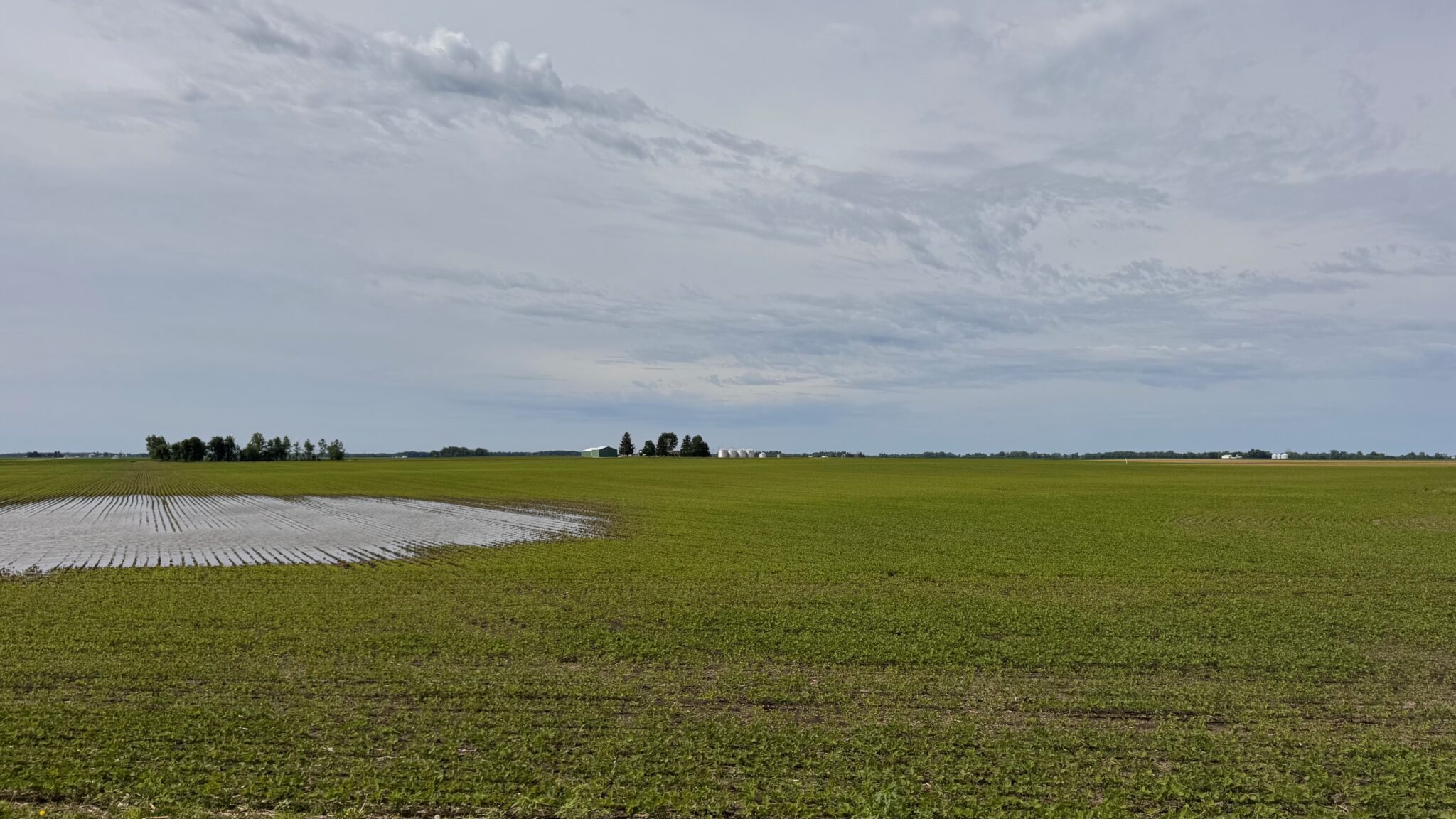
Figure 3. Field variation of soybean due to saturated and ponded conditions, June 13, 2026. Off-green to highlighter green soybeans have undergone saturated to ponded conditions to the point of causing root and nodule death. Dark green soybeans would be the more normal areas of growth and development.
I suggest digging up the plants in these fields to assess if the nodules are white, red, or dead. White nodules are immature, but developing. Red or pinkish interior of the nodules indicates that N fixation has started. Brown to mushy nodules are dead and will not supply N. Young soybeans, V2 to V3, may only have three to five actively-fixing nodules (pink to red interior). Soybeans from V4 and onward should have eight or more actively-fixing nodules with more nodules developing. Nutritional analyses of the most recent mature leaves of soybean will help to pinpoint if N or another nutrient is deficient.
Under normal growing conditions, soybeans accumulate ~10 lb N/acre by V4 then accumulate another ~3 lb N/acre daily until R2 (full bloom). Thus, soybeans normally accumulate another 60 lb N/acre by R2 (full bloom). Nitrogen stress during this period will impact yield.
We have tried rescue treatments under similar situations in 2015 when we received nearly 20 inches of rain in June up near LaCrosse (Figure 4). We had a uniformly, poor-looking soybeans (Figure 5) that we evaluated 18 treatments to rescue the soybeans that were off-green with compromised root system compared to those soybeans that were normal (Figure 6).
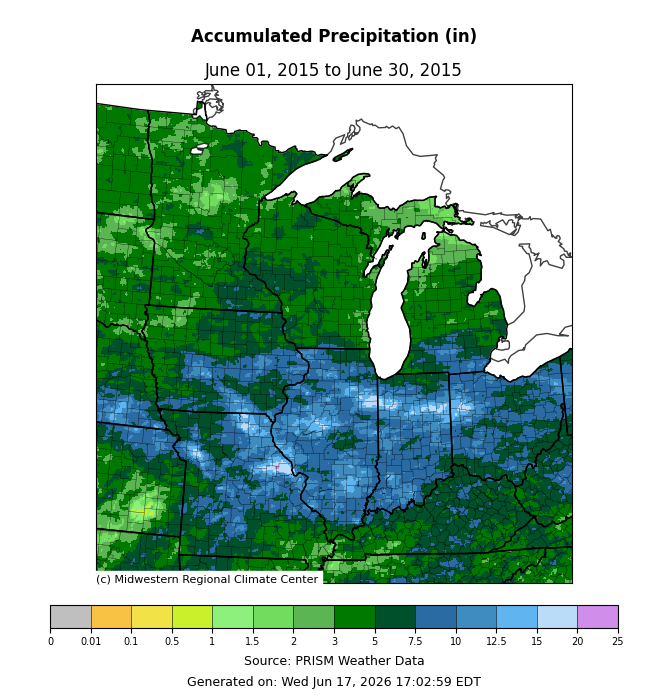
Figure 4. Total rainfall in June 2015 that caused waterlogged soils and soybeans in many areas of the Midwest. Generated through Midwest Climate Center.
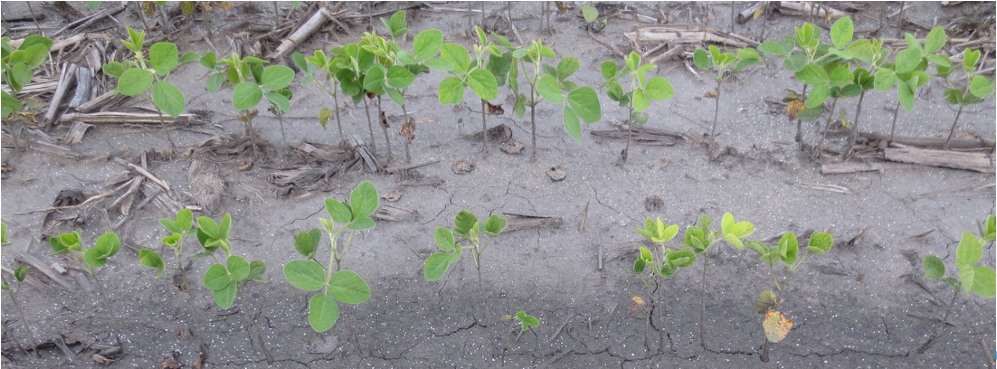
Figure 5. Soybeans (V4) compromised from 20 inches of rain in June 2015 near LaCrosse, IN.
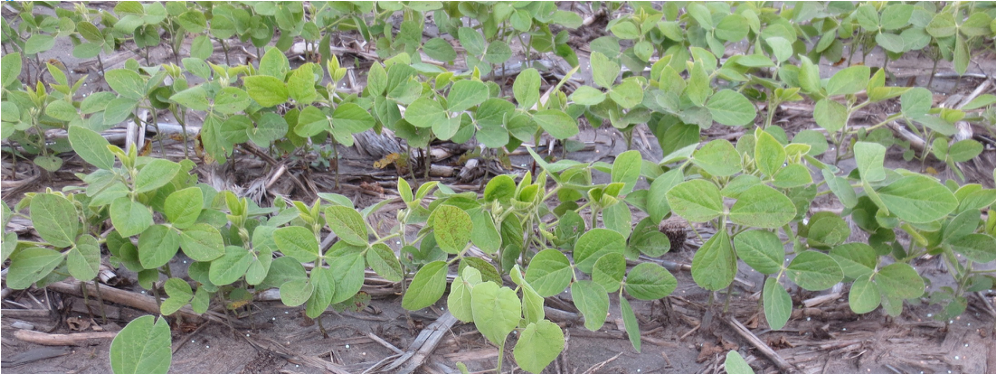
Figure 6. Soybeans (also V4) that were healthy and not compromised from the same 20 inches of rain in June 2015 near LaCrosse, IN.
We evaluated N-based treatments; individual foliar sprays of nutrients, fungicides, and growth regulators; and tank mixes of some of those foliar sprays (Figure 7). The N-based treatments were to provide the shot in the arm since we were compromised on nodule and N supply. Urea was applied at 40 and 20 lb of N/ac with no yield effects. Granular AMS (21-0-0-24S) was applied at two different rates 20 and 10 lb N/ac, which were the only treatments to increase yield above the untreated control (UTC) (Figure 7). These are also the only treatments that supplied sulfur (23 and 11.5 lb S/ac, respectively).
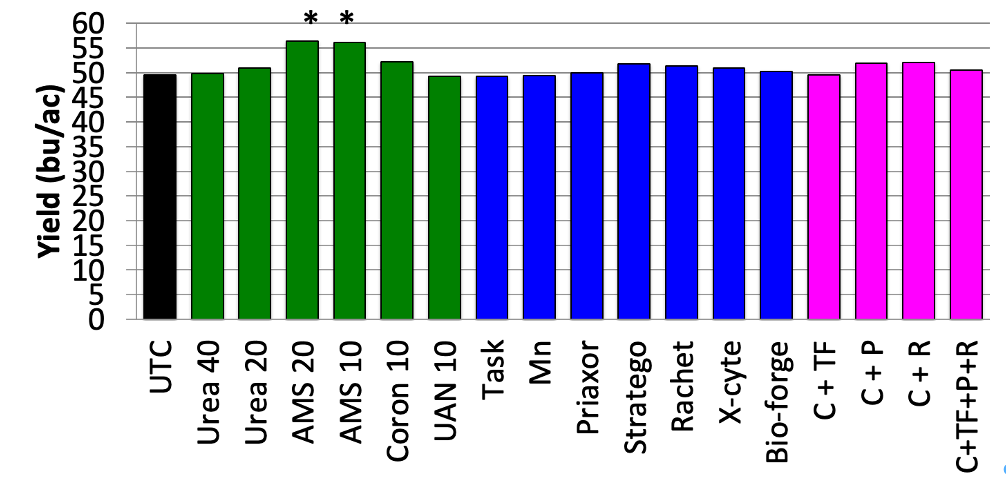
Figure 7. Rescue treatments applied July 2, 2025 to V4 soybeans (uniformly poor and off-green) near LaCrosse, IN. AMS 20 and AMS 10 were the only treatments that increased yield above UTC.
Please note this was our first glimpse into soybean response to sulfur (S). In fact, this site has become our S-deficient site to evaluate S management of soybean. Thus, it is difficult to tease out if the rescue treatment for soybeans under saturated conditions was beneficial because of the saturated conditions that compromised root development, nodulation, and N fixation OR if it was beneficial because the field is responsive to sulfur treatments year in and year out.
In another waterlogged field in 2015 near West Lafayette, we evaluated a few treatments due to limited space of uniformly poor soybeans with only 4 replications. In this small trial, we did not see differences in yield with urea at 40 lb N/ac, foliar nitrogen at 10 lb N/ac, multi-nutrient foliar feed, or foliar fungicide. We did not evaluate any sulfur treatments in that trial, but it will be evaluated this year.
If you are considering any rescue treatments of soybean, please be sure to assess the root system and nodule activity (or the lack thereof). If you deem a field worthy of rescuing or trying to rescue some of it, I would start with a S and/or N+S based approach to stimulate nodulation (S is needed as a co-factor) and to provide a shot in the arm for the limited N supply until N fixation takes over. It is reasonable to use 10 to 20 lb S/ac from a soluble source like granular AMS or pelletized gypsum. If you use granular AMS, 8.8 to 17.5 lb N/ac would also be supplied. If you would like to increase the N portion applied, I suggest using urea to reach a total of 40 lb N/ac. We do not want to overload the field with N to the point of delaying nodulation and N fixation.