Although not a pest in all of the state, the Western bean cutworm (WBC) has been in an issue for Indiana producers for 20 years – the first recorded adult capture was documented in the Pest&Crop newsletter on July 7 2006 both in pheromone traps and black light traps, at PPAC in Wanatah, and NEPAC in Columbia City, respectively. Here is a screenshot from that old Pest&Crop newsletter
Since then, we answered the last question – it has become a permanent pest in Indiana. However, it’s pest status would likely be best defined as “minor” as it’s moved between a key pest in the region in the 2010-2013 period to an occasional concern.
We now know that some traited corn hybrids (including those expressing the Vip3A trait) are highly effective against this pest, while those that expressed the Cry1F trait alone were not (these single trait options should not be planted WBC management, or any pest management for that matter).
We have also demonstrated good success with well-timed insecticide applications for control of larvae – I recall personally a few occasions with very high egg deposition (over 20% of plants), that was followed by timely pyrethroid application and finding no evidence of WBC feeding later that season in the field. Remember that larvae need to move from egg masses to leaf axils to feed and if fresh spray residues are in their path, they will not survive. The scouting and spraying approach has proven effective and should remain so this season.
I documented in P&C a few weeks ago a May capture of an early WBC adult – we know flights are underway and that WBC moths typically exhibit a long and extended flight period. Those in high-risk areas, i.e., sandy soils, high moth flight and WBC history, should be gearing up for field scouting of vulnerable (i.e. non-traited) cornfields, as many have been doing for years.
Scouting should begin once moths are being captured nightly. In five different areas of a field, inspect 20 consecutive plants for egg masses which are laid on the upper surface of the top leaves of corn and/or larvae that may have hatched and crawled to the whorl and begun to feed. This video will provide a refresher.
Usually the top surface newest, vertical leaf is the best place to look. Young larvae
need pollen to survive, and female moths are most attracted to cornfields that are just about to pollinate. Female moths will lay eggs on whorl stage corn. Damage from larvae, as they feed deep in the whorl (attacking the tassel to get at pollen), will resemble
corn borer or fall armyworm damage. Initially that damage will be subtle and not economically important, as the larvae grow so will their appetite – they eventually move into the developing ear, where they cause damage and can open the ear up to infection by ear rot fungi.
For a large assortment of WBC information, resources, and some old but excellent videos, visit here
Finally, now is a good time to take a look at the Handy Bt Trait Table, compiled and maintained by Chris Difonzo at MSU; you can always find an updated version here.
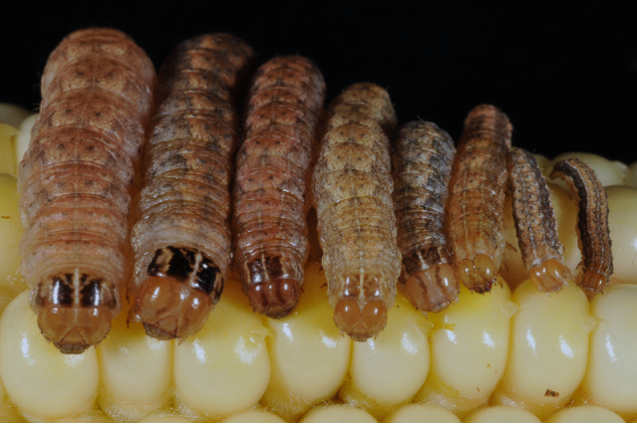
Early instars (left) are lacking the identifying black rectangles behind the head capsule that develop with older larvae (right). (Photo Credit: John Obermeyer)