Although we are in a cool weather period and many crops have not yet been planted, alfalfa weevil are active and feeding. Pest managers throughout the state should be watching for this pest and preparing to treat if necessary. They are highly cold tolerant, so these cool nights will not slow them down.
As I wrote here about a month ago, rotating insecticides is highly recommended as well as doing a post-spray survey (i.e. Did it work? Are the larvae dead?). Even varying the pyrethroid of choice is better than doing the same thing every year. There are also non-pyrethroid options for control of this pest. See the alfalfa weevil management recommendations, here.
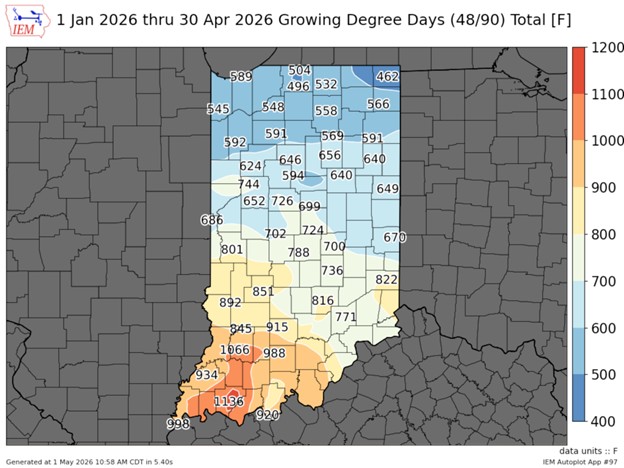
Producers can manage this pest most effectively by utilizing heat unit accumulations data (base 48°F) to determine when sampling should begin and when an action should be taken. The map below, current as of May 1, 2026, shows that peak feeding is underway statewide, including the northern counties where we produce a lot of alfalfa. Check it anytime by clicking here – a variety of other pests are tracked at this site as well.
Key Degree Day Levels:
• January 1: Start Date
• 300: Egg hatch
• 575: Peak larval feeding
The management guidelines listed below should be used to determine when alfalfa weevil should be controlled. Note that 50% tip feeding is the threshold.
Alfalfa Weevil Management Guidelines
| Heat units | % Tip feeding | Advisory |
| 200 | Begin sampling. South facing sandy soils should be monitored earlier. | |
| 300 | 25 | Re-evaluate in 7-10 days using the appropriate HU or treat immediately with a residual insecticide if 3 or more larvae are noted per stem and % tip feeding is above 50%. |
| 400 | 50 | Treat immediately with a residual insecticide. |
| 500 | 75 | Treat immediately. |
| 600 | 75+ | If cutting delayed more than 5 days, treat immediately. |
| 750 | If harvested or harvesting shortly, return to the field in 4 -5 days after cutting and spray if 1) there is no regrowth and weevil larvae are present OR 2) feeding damage is apparent on 50% of the stubble and weevil larvae are present. |

Alfalfa weevil adult
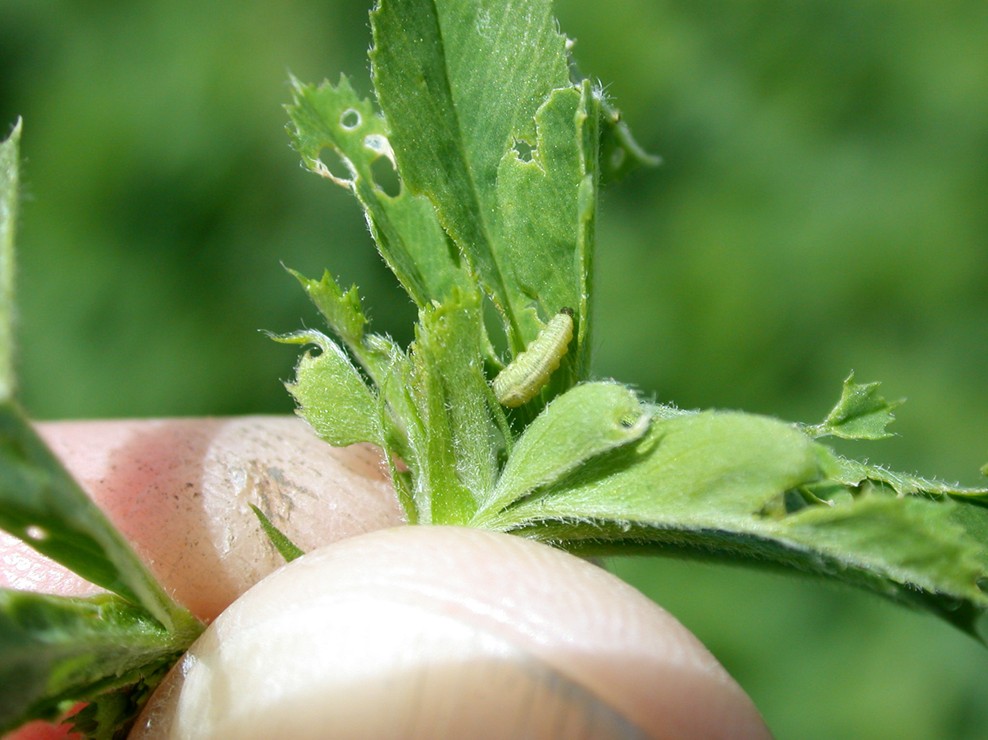
Alfalfa weevil larva and tip feeding. Unrolling of leaves will be necessary to view the larvae.