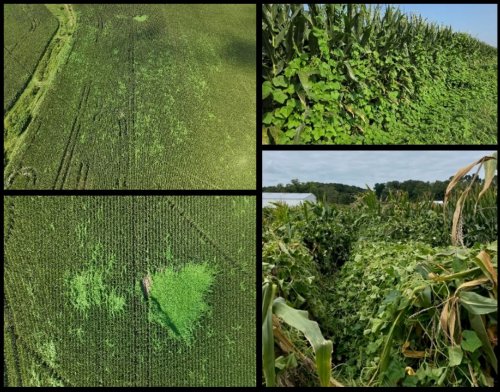
Fig. 1. Photos of burcucumber (Sicyos angulatus) infesting Indiana corn fields.
Burcucumber (Sicyos angulatus) has become increasingly prevalent and troublesome in Indiana corn (Fig. 1 and 2). I continue to get reports from across the state dealing with this weed looking for solutions. Previous research has demonstrated that it can decrease corn grain and silage yields on average by approximately 20% (Averill et al., 2022; Esbenshade et al., 2001a; Messersmith et al., 2000). In addition to yield loss, its aggressive vining growth habit enables it to climb corn plants, causing severe lodging, harvest delays, and mechanical interference that increases fuel use, grain loss, and equipment wear. A single burcucumber vine can attain a fresh weight as high as 190 lbs and produce nearly 80,000 seeds (Smeda and Weller, 2001). As a result, even low infestations can substantially reduce harvest efficiency and profitability.
Despite these impacts, effective management options remain limited. Current research and herbicide programs used have been designed for early-season control and fail to suppress late emerging burcucumber (Esbenshade et al., 2001a; Messersmith et al., 1999). Germination occurs throughout the growing season across a wide range of environmental conditions, including heavily shaded-full corn canopy environments, creating a challenging management scenario (Esbenshade et al., 2001b; Mann et al., 1981; Önen et al., 2018).
Due to these challenges and without identifying new, validated management strategies, burcucumber infestations are likely to continue expanding, threatening yield, harvestability, and profitability in our corn acres. To address one aspect of this challenge, we have initiated on-farm research, funded through the Indiana Corn Marketing Council, to identify the best late-season burcucumber management options to reduce vegetation for increasing harvestability, while simultaneously reducing seed production and viability limiting seed return to the soil seedbank.
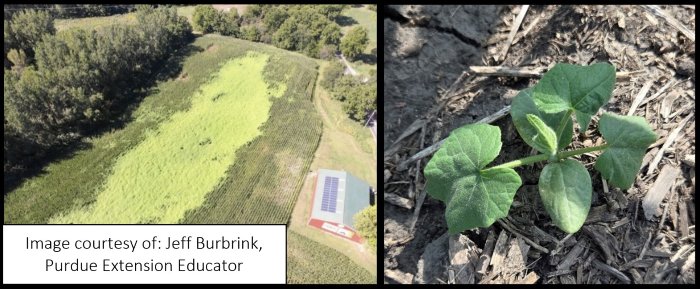
Fig. 2. Photos of burcucumber (Sicyos angulatus) during first emergence (right) and an infestation at the end of the season (left).
This project was specifically created as a result of feedback from many Indiana corn growers, agronomists, and applicators (all of you currently reading this!) voicing concern over this increasingly problematic weed. By identifying better methods for reducing burcucumber vegetation, this project will address challenges such as pulling corn down, combine feederhouse plugging, equipment entanglement (sprayer and irrigation pivots, Fig. 3), and corn ear loss. Through better understanding of the impacts of late season herbicide applications on burcucumber seed production, we will also address the long-term feasibility of combating this weed and enhance profitability in subsequent production years. Overall, stay tuned for results as we’re actively looking to find options to get burcucumber better under control and address your concern.
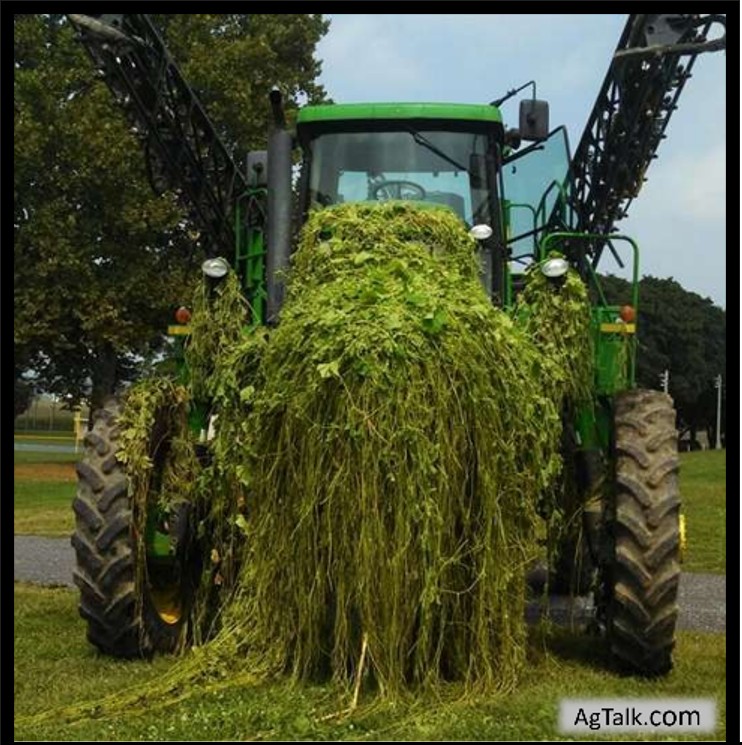
Fig. 3. Burcucumber (Sicyos angulatus) vines tangled on a sprayer. Image courtesy of AgTalk.com.
Along this same vein, because our current understanding of the burcucumber problem is based on anecdotal feedback received, several weed scientists across the corn belt are interested in obtaining more concrete information and concerns about this weed directly from you. As a result, we have created a short survey that we would appreciate you taking the time to complete. The survey is open to all row crop agricultural individuals that wish to respond. Information gathered will allow us to further and better address your burcucumber-related concerns by prioritizing future university research and Extension efforts.
The survey includes questions detailing if this weed is currently problematic for you, how concerning it might be, current distribution, and current management tactics used. If you do choose to participate, we appreciate your feedback and all information will be kept confidential to the extent allowed by applicable State and Federal law. No names, contact information, precise locations, or computer IP addresses will be collected. By completing the survey, you are agreeing to allow the use of your responses for research purposes. If you do not wish to complete the survey, your refusal to do so will have not any effect on your relationship with Purdue University. To opt out of taking the survey, simply do not complete the survey.
Please follow the link below or scan the QR code to access the survey. It should take approximately 5 minutes to complete.

If you have questions or concerns about this study (STUDY2026-00000875), you may contact Dr. Thomas “Tommy” Butts at (765) 494-0598 or by email at buttst@purdue.edu. If you have questions about your rights while taking part in the study or have concerns about the treatment of research participants, please call the Human Research Protection Program at (765) 494-5942, email (irb@purdue.edu) or write to: Human Research Protection Program – Purdue University Seng Liang Wang Hall, 516 Northwestern Ave., West Lafayette, IN 47906. To report anonymously via Purdue’s Hotline, see www.purdue.edu/hotline.
Thank you for taking the time to complete the survey, we look forward to your insightful responses, and thank you for reading!
Dr. Tommy Butts
Purdue University
Extension Weed Scientist buttst@purdue.edu
(765) 494-0598
References
Averill, K.M., Westbrook, A.S., Morris, S.H., Kubinski, E., DiTommaso, A., 2022. Silage corn yield is reduced by burcucumber competition and drought in New York State. Weed Technology 36, 86–92. https://doi.org/10.1017/wet.2021.80
Esbenshade, W.R., Curran, W.S., Roth, G.W., Hartwig, N.L., Orzolek, M.D., 2001a. Effect of row spacing and herbicides on burcucumber (Sicyos angulatus) control in herbicide-resistant corn (Zea mays). Weed Technology 15, 348–354. https://doi.org/10.1614/0890-037X(2001)015%255B0348:EORSAH%255D2.0.CO;2
Esbenshade, W.R., Curran, W.S., Roth, G.W., Hartwig, N.L., Orzolek, M.D., 2001b. Effect of establishment date and crop competition on burcucumber fecundity. Weed Science 49, 524–527. https://doi.org/10.1614/0043-1745(2001)049%255B0524:EOEDAC%255D2.0.CO;2
Mann, R.K., Rieck, C.E., Witt, W.W., 1981. Germination and emergence of burcucumber (Sicyos angulatus). Weed Science 29, 83–86. https://doi.org/10.1017/S0043174500025881
Messersmith, D.T., Curran, W.S., Hartwig, N.L., Orzolek, M.D., Roth, G.W., 1999. Evaluation of several herbicides for burcucumber (Sicyos angulatus) control in corn (Zea mays). Weed Technology 13, 520–524. https://doi.org/10.1017/S0890037X00046133
Messersmith, D.T., Curran, W.S., Roth, G.W., Hartwig, N.L., Orzolek, M.D., 2000. Tillage and herbicides affect burcucumber management in corn. Agronomy Journal 92, 181–185. https://doi.org/10.2134/agronj2000.921181x
Önen, H., Farooq, S., Tad, S., Özaslan, C., Gunal, H., Chauhan, B.S., 2018. The influence of environmental factors on germination of burcucumber (Sicyos angulatus) seeds: Implications for range expansion and management. Weed Science 66, 494–501. https://doi.org/10.1017/wsc.2018.20
Smeda, R.J., Weller, S.C., 2001. Biology and control of burcucumber. Weed Science 49, 99–105. https://doi.org/10.1614/0043-1745(2001)049%255B0099:BACOB%255D2.0.CO;2