As the 2026 corn growing season approaches, conversations across Indiana and the broader Corn Belt are once again centering on one of the most important management periods of the year, planting. While weather patterns, soil conditions, and individual farm logistics will vary, the decisions made during planting will set the stage for everything that follows. From the moment the seed leaves the planter and enters the soil, the crop’s yield potential is being shaped, for better or worse, by how well early-season stresses are managed.
A successful start begins with recognizing that uniform, rapid emergence is the foundation of high-yielding corn. Corn plants that emerge at different times compete unevenly for light, water, and nutrients, and even small differences in emergence can reduce yield potential across a field. Conditions at planting play a major role in determining how uniformly a stand develops and establishes. Soil temperature, soil moisture, seed-to-soil contact, and seed depth all interact to influence how quickly and consistently seedlings emerge. Cool and highly variable soil temperatures, especially when hovering near the lower end of the acceptable range (e.g., 50 degrees F), can delay emergence, prolong seedling exposure to various stressors, and lead to uneven stands. Similarly, inconsistent soil moisture caused by residue cover, variable soils, or fluctuating weather can delay some plants relative to others. Poor seed-to-soil contact due to residue interference, sidewall compaction from planting in wet conditions, or improper furrow closure can further compound these issues. Even seed depth, if inconsistent, places seeds into different temperature and moisture environments, increasing variability in germination and early growth.
Planting date decisions add another layer of complexity to corn management. In Indiana, the window most often associated with maximum yield potential generally spans from late April through early May, with that window tending to open slightly earlier in southern regions and slightly later in northern areas. Research indicates that yield potential typically begins to decline gradually when planting is delayed beyond early May, with steeper losses possible as planting moves toward the end of the month and into June (Figure 1). These reductions are commonly linked to a shortened growing season, greater risk of heat and moisture stress during pollination, and increased pest and disease pressure later in the summer. It is important to remember, however, that planting date affects potential yield, not guaranteed yield. Unlike soybean, where earlier planting often delivers a clearer and more consistent yield advantage, recent corn research from central Indiana has shown that the highest relative yields frequently occur at a second planting timing in early May rather than the very earliest dates (mid-April). This highlights that the yield benefit from pushing corn planting early is often smaller, and in some cases negative, compared with the stronger early-planting response typically observed in soybean.
Soil temperature also often becomes the headline metric each spring, with many growers waiting for soils to reach around 50 degrees F before starting. While this threshold is useful, it is only part of the equation. Corn requires a certain accumulation of heat units to emerge, and if soils linger at the lower end of the acceptable temperature range, emergence can be slow, leaving seedlings exposed to early-season stresses for a longer period of time. Warmer average soil temperatures after planting can drastically shorten the time to emergence and improve stand uniformity. Therefore, for the 2026 season, attention should be given not just to the temperature on the day of planting, but to the broader weather forecast in the days that follow.
Lastly, planter performance ties all of these factors together. The planter’s job is to place every seed at a consistent depth, consistent moisture, in firm contact with the soil, and with uniform spacing from its neighbors. As equipment decisions are made ahead of the 2026 season, investments should be guided by specific stand establishment challenges already observed in individual fields. Issues with inconsistent depth may point to the need to evaluate row-unit downforce systems. Problems with residue interference, poor furrow closure, or sidewall compaction may signal that row cleaners or closing wheel systems require adjustment or upgrading. Just as importantly, routine maintenance remains critical. Worn components, improperly adjusted systems, and overlooked mechanical issues can undermine planting performance as much as, or more than, the absence of the latest technology.
Ultimately, success in the 2026 corn season will depend on balancing timeliness with field conditions. In many cases my motto with continue to be “chase conditions, not calendar date” in the spring, which is often easier said than done. High yields are built on uniform stands that emerge quickly and evenly, supported by careful attention to soil conditions, weather forecasts, and planter performance. Rather than focusing on a single date or a single soil temperature reading, growers who integrate all of these factors into their planting decisions will be best positioned to protect yield potential from the very first days of the growing season.
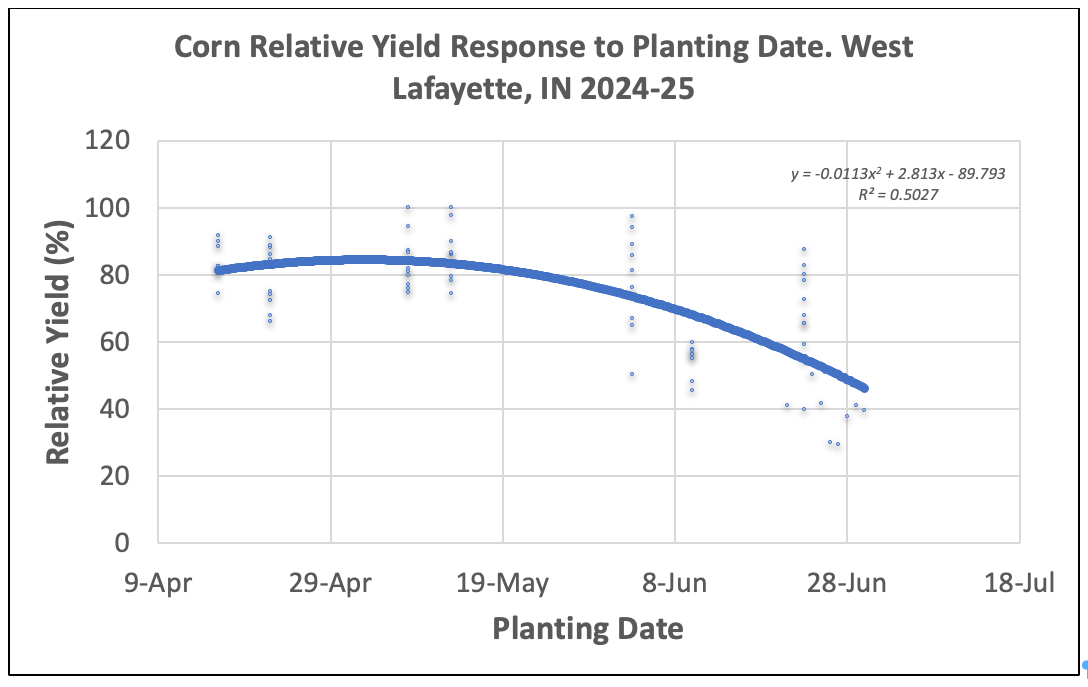
Figure 1. Corn relative yield (%) response to planting date. West Lafayette, IN 2024-25. Data combined across years and hybrid types used in the replicated research trial.