Common Name: Hymenopteran parasites
Scientific Name: Braconidae and Ichneumonidae
Status: Beneficial parasitoid
Beneficial Stage: Larval
Biology: The term 'parasitic wasps' refers to a large group of hymenopterans that are primarily parasitic on other arthropods. Parasitoid wasps are very diverse in their size, biology, life cycle, and the hosts that they infest. The smallest known insects are parasitic wasps called fairyflies. These are less than 1/50 in, and live entirely inside the eggs of another insect. At the opposite extreme, some Ichneumonid wasps parasitize large grubs or wood borers and may be more than 3 inches long.
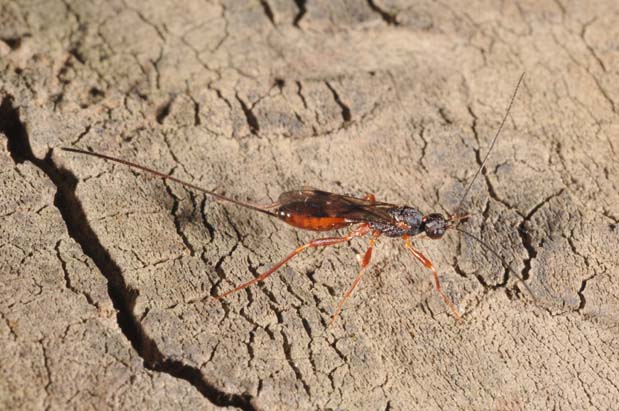
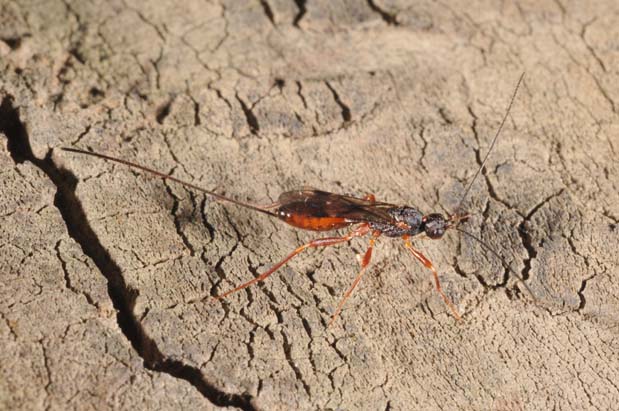
Two parasitic wasp families in particular, Braconidae and Ichneumonidae, are considered very beneficial to agriculture because they lay their eggs on the bodies of pests insects (hosts), the eggs hatch and the larvae consume the host from the inside. By the time that these parasitoids complete development, the host insect is dead and the wasps emerge to seek another. Most are small wasps, ranging in size from 1/10 to 1/2 inch in length. Braconids, as a group, are usually smaller than Ichneumonids but both are normally black or brown in color, and some have yellow, orange, or red accents. They have very long antennae and the ovipositor is also long and readily apparent.
Parasitic wasps was best known for their control of caterpillars, however, they also infest flies, sawflies, wood boring beetles, weevils, leafmining insects, true bugs, and ants. The generation time of most parasitic wasps is relatively short, often in the range of 10-30 days. Many larvae form a silken cocoon on the outside of the carcass.
Value: Many species of parasitic wasps can be used successfully as biological control agents in controlling pests. Unlike other wasps, parasitic wasps cannot sting people.
|