
Cooley
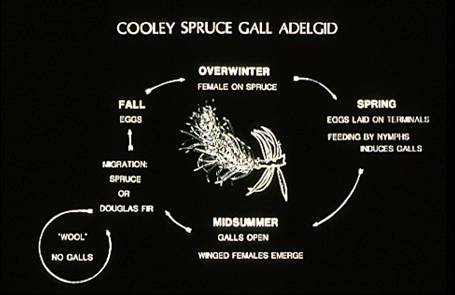
Spruce Gall Adelgid Life Cycle
| Cooley Spruce
Gall Adelgid Adelges cooleyi (Gillette) |
|
| Order and
Family:� Homoptera: Adelgidae |
|
| Host Plant
where galls produced: Spruce |
|
| Alternate
Host Plant with no galls produced: �Douglas-fir |
|
| Damage and
Diagnosis: This cone-like gall is�
produced on the tips� of
new growth of Colorado blue, Sitka and Engelmann spruces (fig. 27).� The gall is green or purplish in color, 1
to 2 inches long, 1/2 to 3/4 inches in diameter and resembles a small
pineapple in an early stage of development.�
Galls turn brown and are easily visible in winter.� On Douglas-fir, needles become twisted and
yellowed (fig. 27). |
|
| Biology:
This insect takes two years to complete its life cycle on Douglas-fir and
spruce.� Winged adults fly from
Douglas-fir to spruce in late July.�
Adults lay eggs on spruce that hatch into nymphs that spend the winter
on spruce twigs.� Nymphs become active
on spruce in early spring just before the buds break.� They develop into adults in May that lay
eggs on twigs.� When these eggs hatch
nymphs crawl to the base of spruce needles and cause them to produce the
characteristic galls.� In mid-summer,
galls on spruce open to release winged adults that fly to Douglas-fir to lay
eggs.� These eggs hatch into nymphs
that overwinter on Douglas-fir.�� After
bud break, nymphs become active and start to distort leaves.� They develop into wingless adults in
May.� These adults produce offspring
that become winged, and wingless adults in July.� Wingless adults remain on Douglas fir and
winged adults fly to spruce to complete the cycle. |
|
| Control on
Spruce:� The presence of old galls
on spruce in the winter suggests that infested Douglas-fir are near enough
for adelgids to have laid eggs on spruce the previous summer.� Scout spruce to target trees that need
treatment. Apply broad spectrum insecticides to tthe plant just prior to
budbreak to kill nymphs that wintered on the plant as eggs.� By killing these nymphs you prevent adults
from laying the new generation of eggs on young needles,where galls are
formed in late May. Pruning out old galls makes the plant look nice but does
not control the problem. |
|
| Control on
Douglas-fir:� Look for signs and
symptoms that nymphs are present on twigs.�
Early signs include the production of waxy fibers by young nymphs.
Later in spring needles begin to twist and yellow.� Applications of insecticidal soap or oil
can effectively control the nymphs and prevent further twisting.� Broad spectrum insecticides are also
effective. |
|
| General
control comments: Do not interplant spruce and Douglas fir, since they
are alternate hosts of the Cooley spruce gall adelgid. |