


Pest & Crop Newsletter, Entomology Extension, Purdue University


Western Bean Cutworm Damaging Northwestern Indiana Fields - (John Obermeyer and Christian Krupke)
- Moth flight and egg laying is nearly complete, now it's the larva's turn.
- Larval damage seems most severe in sandier areas of NW counties.
- At this point in time, most larvae have entered the ear, presenting control challenges.
- Consider the factors listed below before attempting treatments.
Field visits last week to northern Jasper County opened our eyes to the high amount of damage taking place in some northwestern Indiana cornfields. Plants/ears infested in these fields ranged from 20 to over 50%, some with multiple larvae. Too, we have heard of similar type infestations in Lake and Pulaski Counties. It is difficult to assess at this time how widespread and severe the damage is throughout this area of higher moth captures (see following map). Presently there is a high correlation of western bean cutworm infestations to sandy soils.
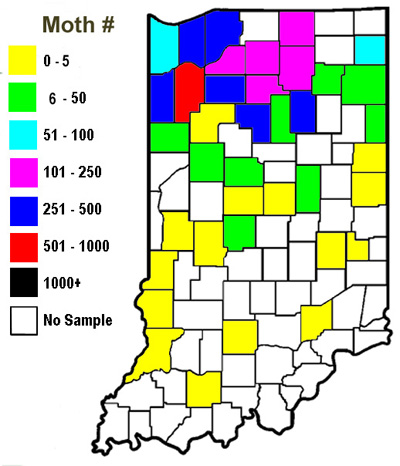
2009 Western Bean Cutworm Moth Captures, as of August 10
Many competent pest managers in northern Indiana counties have been tracking this pest throughout the moth flight and egg laying period, and now are scouting for the larvae. Many are frustrated because egg masses found were well below the 5% plants infested threshold, but are now heavily infested with larvae. This obviously reflects poorly on their diligent efforts and our attempts to share learned knowledge from colleagues in the western Corn Belt. Appears as though we are all on a steep learning curve in trying to understand why established sampling protocol for Nebraska may need to be tweaked in the future.
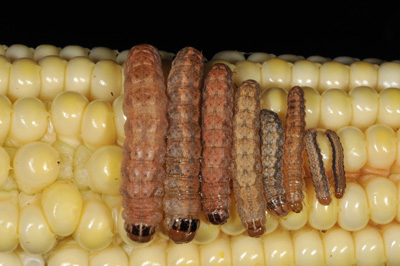
Varying sizes of WBC larva from the same field, note the "black rectangles" are absent in small larvae
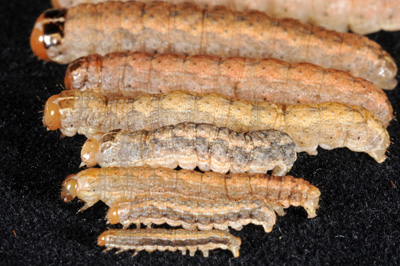
Color variation in varying sizes of larvae, note the noticeable striping in small larvae
The current challenge is to identify fields that are infested, assess the size and location of the larvae, and determine if treatments are warranted. In at least five different areas of the field, carefully examine the ear and ear zone of 20 consecutive plants. Include the secondary ear in your examination. Determine the percent plants infested and the size and activity of the larvae. This will require peeling back the husk over the ear tip to view for a worm and/or frass/damage. Also carefully pullback leaves and leaf sheaths adjacent to the ear. Again you may find larvae, and entrance holes into the side of the ear. Smaller larvae, <1”, seem to be more active in and out of the ear. Larger larvae seem content to remain in the ear and feed on kernels. Entomologists from Nebraska have stated that as temperatures increase, the larvae are more likely to remain inside the ear.
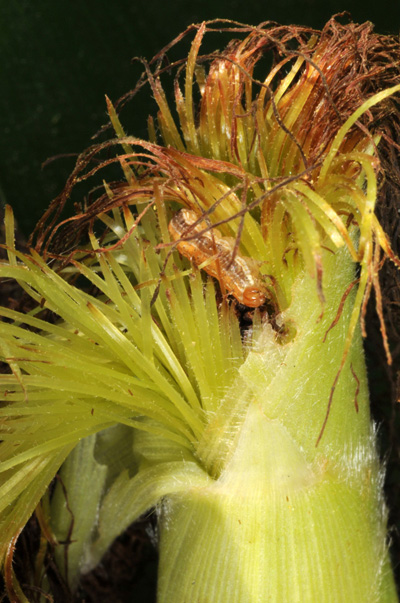
Young larva in the ear tip, still vulnerable to insecticide, but not for long
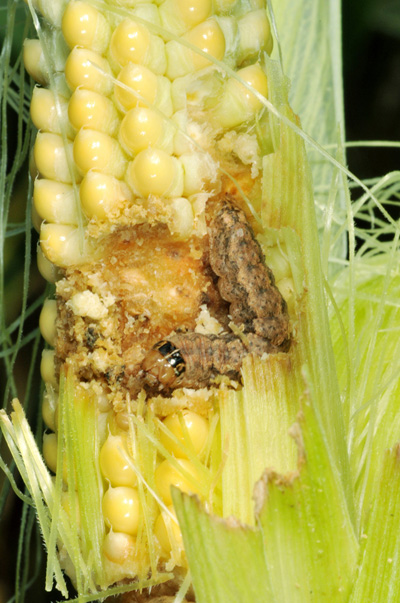
This larva in a popcorn ear, will not be controlled with insecticide
Treatment for field corn at this time is ill-advised, high value food-grade corn may be a different matter. We have received reports from folks that treated last week (Aug. 3) and were pleased with the results (please follow the Restricted Entry Interval that is on the product’s label). Since that time, larvae have grown and temperatures are higher. Consider the following before treating:
• Control, in corn that has already pollinated, will likely be less than 50%.
• 1 larva/ear at dent stage corn is approximately equal to a 4 bushel/acre loss (Nebraska and Iowa data).
• Ear damage opens the door for molds, a concern in food grade corn.
• Larvae in the ear will NOT be controlled, larvae exposed or that exit the ear can be.
• Larvae become less mobile as temperatures increase.
• Increased carrier volume will improve the canopy penetration into the ear zone.
• Insecticides will provide about a week of efficacy, give or take a few days depending on the environment (e.g., heat, sunshine).
• Pre-Harvest intervals for insecticides, on the label, must be followed (most are 21 to 30 days).
• Cry1A (YieldGard®) does not prevent or control western bean cutworm, Cry1F (Herculex®) does.
• Approved insecticides, their rates, and pre-harvest intervals can be viewed at: <http://extension.entm.purdue.edu/publications/E-219.pdf>, look under western bean cutworm.
We appreciate so many that have called, emailed, and visited with us concerning this relatively new pest of Indiana. Please continue to do so (765-494-8761) as we all learn together about this pest’s distributions and impact on our crops. Happy Scouting!

Click here to view the Black Light Trap Catch Report

Time to Think About Parking the Herbicide Sprayer – (Tom Jordan, Glenn Nice, Bill Johnson, and Tom Bauman)
There are a number of crop samples coming into the Diagnostic Clinic, particularly soybean samples with herbicide injury. This brings up the thought that, with the majority for the crop setting pods, it is time to stop spraying herbicides. The Liberty Link beans should not be sprayed once they start blooming, and the Roundup Ready beans should not be sprayed once they start setting pods. Also, many of the contact type herbicides should not be used at this time. Leaf burn on mature leaves of soybean plants is much worse than injury to younger plants that are still growing and will put on several more nodes of leaves. Most weeds now growing above full-season soybeans are much taller than the label recommends spraying, and will probably not be killed anyway.
Double-cropped soybeans and some of the very late planted full-season beans may still be at a stage that is within label. But, even then, you need to look at the weed heights to determine if they are within label recommendation. There are certain cases where herbicides are still needed. Examples are when there are morningglories or burcucumber problems in a field that need to be control to prevent total crop loss. Look for herbicides that are effective on these weeds and are not off-label. For many; however, the next best time to control some of these big weeds is at preharvest when bean pods are mature and leaves are dropping. Check the herbicide label for application restrictions before spraying any herbicide.
While not everyone is far enough along to think about parking their sprayer, for most, it probably will not pay to continue spraying at this time.

Sudden Death Syndrome in Soybean – (Kiersten Wise)
The Indiana State Fair began last week in Indianapolis, and true to its nickname, the “state fair disease” or sudden death syndrome (SDS) is now being reported on soybean in Indiana. The fungus that causes SDS, Fusarium virguliforme, infects soybean early and symptoms are typically expressed later in the growing season. The southeastern corner of the state has had ample rainfall this year as soybean entered into flowering and pod development, and severe symptoms of SDS are appearing in fields in the lower corner of the state. Many soybeans throughout Indiana were planted into cool wet soils this spring, and growers should be watching for symptoms of SDS over the next few weeks.
Symptoms of SDS include interveinal yellowing and necrosis (Figure 1). Veins of the infected plants will remain green. Leaflets will curl or shrivel and drop off with only the petiole remaining attached. If symptomatic plants are pulled from the soil and split down the stem, the lower stem will have a dark or discolored cortex, while the pith will remain white or light brown.
SDS is a disease that is best managed through preventative methods. Producers are encouraged to plant varieties that are less susceptible to SDS in fields with a history of the disease. SDS is typically more problematic in early-planted soybeans. Planting fields with a history of SDS last may reduce the risk for SDS, but when we have an unusually cool spring, soil conditions may still favor disease development. Foliar fungicide applications are not recommended for management of SDS.
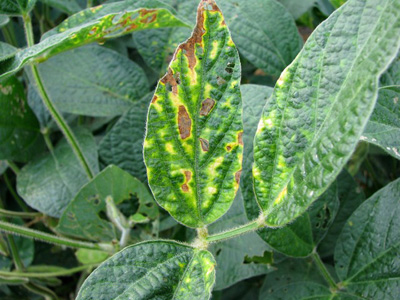
Figure 1. Bacterial blight on soybean leaves (Picture Courtesy: G. Shaner)
White Mold of Soybean – (Kiersten Wise)
Over the last week we have observed and heard of several soybean fields in western and southwestern Indiana that have white mold present (Figure 1). Several of these fields are south of I-74 in an area that does not have frequent white mold outbreaks in Indiana. Additionally, producers in areas that typically battle white mold, such as the northeast corner of Indiana, are not observing white mold in their fields. This pattern of disease is most likely influenced by the cool temperatures and frequent rains we had in the southwestern portion of the state as soybeans began flowering. Conditions favoring disease development and information on disease identification were discussed in a previous article: <http://extension.entm.purdue.edu/pestcrop/2008/issue21/index.html#white>
Figure 1. White mold on soybean. The cottony white fungal growth present on lower stems is characteristic of the disease The majority of fields with confirmed white mold are past growth stage R3, and although growers are interested in managing the disease, foliar fungicide applications at this point may not be beneficial in reducing disease severity. Two products are currently labeled for use against white mold (Topsin-M and Domark), however, timing is critical with a foliar fungicide application for white mold control because the fungicide must be able to penetrate the canopy and protect the soybean flowers. Previous research from the University of Illinois indicates that the optimum timing for a foliar fungicide application of Topsin-M to manage white mold is at R1 (1). It is important to note that fungicides containing a strobilurin mode of action such as Headline, Quadris, Quilt, and Stratego, are NOT labeled for use on white mold.
Producers should consider planting less susceptible soybean varieties in fields with a history of white mold. In areas where severe white mold is reported, it may be useful to plant soybeans in wider row spacings (30 inch) and use lower seeding rates at planting to promote air movement in the canopy.
For more information about white mold please check out the following articles:
1. Conditions Favorable for Sclerotinia Stem Rot (White Mold) on Soybean, University of Illinois <http://ipm.illinois.edu/bulletin/article.php?id=1195>
2. Purdue Extension Bulletin BP-43-W. Diseases of Soybean: White Mold
<http://www.ces.purdue.edu/extmedia/BP/BP-43-W.pdf>
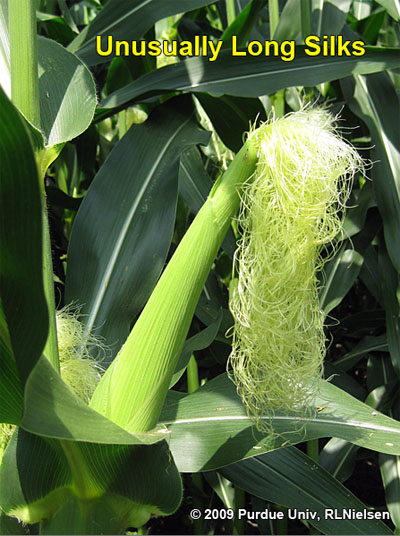
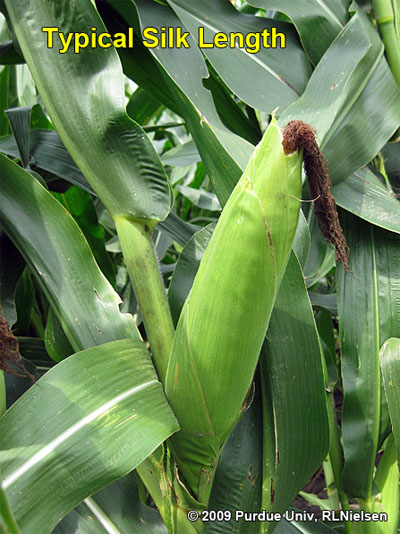
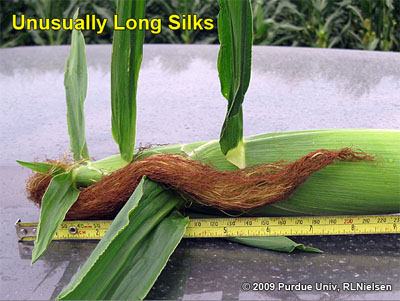
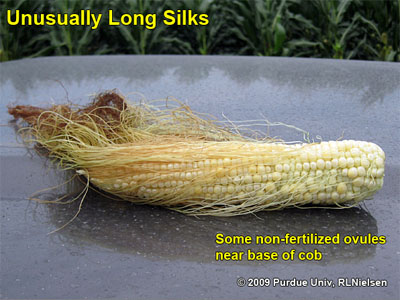
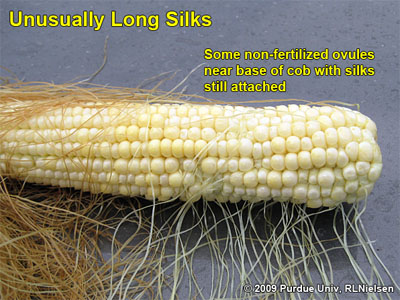
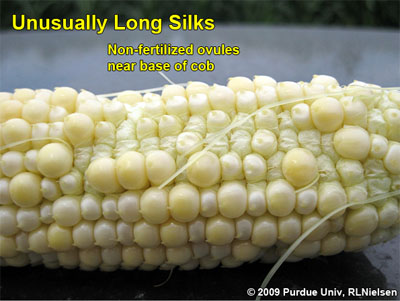
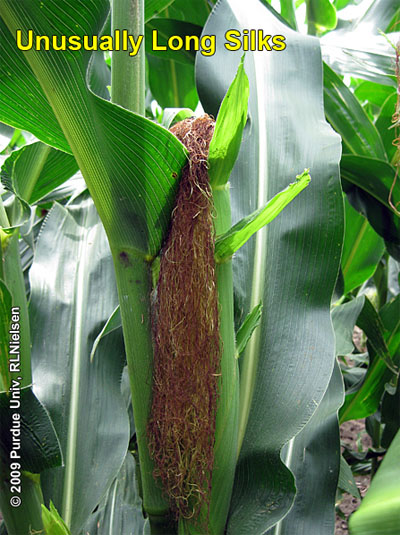
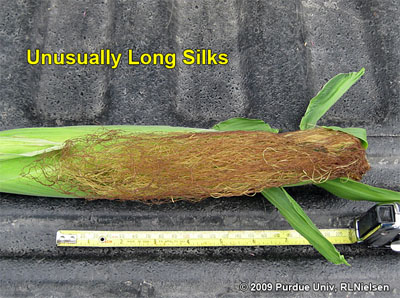
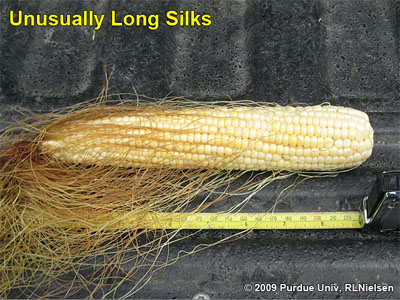
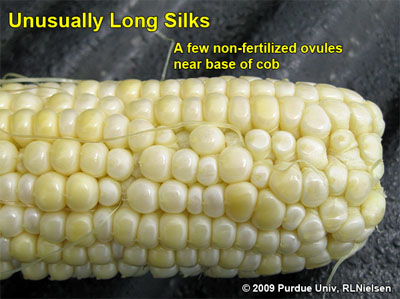
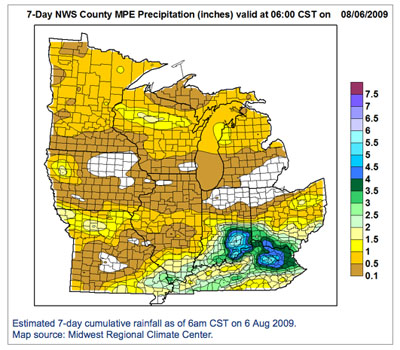
3. University of Wisconsin’s Soybean Plant Health Site: The other day, a patron of Rudy’s Bar and Grill walks in with an ear of corn that exhibits long, flowing locks of blonde silks tumbling down the sides of the husk leaves and asks two questions: “Why are the silks so long?” and “Do such long silks bode ill for the success of corn pollination?” Both questions suggest that the guy has some experience thinking about sex in a corn field and understands that silks are the functional stigmas of the female flowers of a corn plant. Each silk connects to an individual ovule (potential kernel). A given silk must be pollinated in order for fertilization of the ovule to occur and a kernel develop. The guy also seems to know that emerged silks are typically only 2 to 3 inches long; not 6 to 9 inches long like those on the ear he brought in. Silks begin elongating from the ovules near the base of an ear shoot sometime around leaf stage V12 to V14, followed sequentially from base to tip of ear by silk elongation from the remaining ovules of the ear shoot. The silks from ovules near the base of the cob are typically the first to emerge through the husk leaves; followed sequentially by the remaining silks over a 4 to 8 day period. Without pollination, silk elongation will slow to a stop within about 9 days after emergence. Emerged silks initially lengthen from 1 to 2 inches per day, but then slow over the next few days due to natural aging or the inhibition caused by “captured” pollen grains as they germinate and initiate pollen tubes that penetrate the silk and elongate toward the ovule. The latter inhibition of silk elongation occurs at least within 12 hours of pollination, if not earlier. Most of us “gray beard” agronomists were taught that full tassel emergence (growth stage VT) often occurred 2 to 3 days before the first emergence of silks (growth stage R1). In fact, the verbatim definition of the VT stage from Ritchie et al. (1993) is “The VT stage is initiated when the last branch of the tassel is completely visible and the silks have not yet emerged.” Pollen shed often began before or just at the timing of silk emergence. Corn field aficionados will tell you that the timing of tassels/pollen shed/silking has changed somewhat in some of today’s hybrids. In my own demo plots at the Purdue Crop Diagnostic Training & Research Center in recent years, it is not uncommon for silks to begin emerging before the tips of the tassels are evident. It is not unheard of for pollen shed to begin 2 to 4 days after the beginning of silk emergence. Furthermore, genetic improvement for drought tolerance in some hybrids appears to have also resulted in more robust silk growth in the absence of drought conditions (personal communication, K. Cavanaugh, Becks Hybrids). Cool temperatures and ample soil moisture promote sustained silk elongation in the absence of typical hot, dry July conditions. Coupled with hybrids that may silk one or more days prior to pollen shed from the tassel, silk lengths can become quite impressive. This year, I have measured exposed silks as long as nine inches. Can there be a downside to such wonderfully long, voluptuous, silky...........silks? Well, yes, there is a risk that kernel set near the base of the cob may suffer if the initial emerged silks deteriorate enough prior to pollen shed that they become non-receptive. Kernel set near the butt end of the cob may also suffer if later-emerging silks from higher up on the ear “shade” or otherwise obstruct the initial emerged silks from “capturing” pollen. The images below illustrate the potential for non-pollinated areas near the base of the cob in a hybrid that silked several days prior to the beginning of pollen shed in my plots at the Agronomy Farm this year. The images below illustrate another example of unusually lengthy silks from the same hybrid, but with only minor kernel set problems. Thus, the existence of unusually long silks by themselves do not automatically result in poor kernel set. Bottom Line? While unusually long silks are, well, unusual, don’t get overly dejected about the prospects of poor kernel set as a consequence. Time spent now walking fields during the early stages of grain fill may help provide an overview of the extent of the problem if any. Related References Bassetti, Paolo and Mark Westgate. 1993. Emergence, Elongation, and Senescence of Maize Silks. Crop Sci. 33:271-275. Cárcova, J., B. Andrieu, and M.E. Otegui. 2003. Silk Elongation in Maize: Relationship with Flower Development and Pollination. Crop Sci. 43:914-920. Nielsen, RL (Bob). 2007. Silk Emergence. Corny News Network, Purdue Univ. [online] <http://www.kingcorn.org/news/timeless/silks.html> [URL accessed 8/3/09]. Ritchie, S.W., J.J. Hanway, and G.O. Benson. 1993. How a Corn Plant Develops. Iowa State Univ. Sp. Rpt. 48 [online] <http://www.extension.iastate.edu/hancock/info/corn.htm> [URL accessed 8/8/09]. Sella Kapu, Nuwan Umantha. 2006. Pollination-induced inhibition of maize silk elongation. Ph.D. Dissertation, Penn. State Univ. Flood Damage to Corn Near Pollination or Beyond - (Bob Nielsen) Heavy rainfall earlier this week has caused record and near-record flooding of rivers, creeks, and streams throughout parts of southeastern Indiana. Large ponded areas exist in fields distant from floodwaters. The rains were accompanied by damaging winds. The consequences to grain yield and quality from the damage caused by such flooding/ponding and wind are difficult to pinpoint with much accuracy because little research exists that addresses these chance-occurring yield-limiting factors. Risks and expectations, however, can be outlined. • Crops inundated by standing water at this time of the year typically do not survive as long as those similarly affected earlier in the season due to the warmer air and soil temperatures. Oxygen deprivation in saturated soils quickly causes significant deterioration and death of above- and below-ground plant tissue. Affected crops may only survive a few days with the 90-degree temperatures that are forecast for the coming weekend. • Further physical crop damage (soil erosion, washing away of plants, lodging of plants, and plant tissue damage) occurs from the force of the flowing water on land adjacent to flooded creeks and rivers as well as from any debris caught up in the floodwaters. • Deposits of sediment and crop residues that remain on crop plants once the water recedes can either outright smother any surviving plants or greatly reduce their ability to capture sunlight and photosynthesize carbohydrates. • Mud and crud that cakes the leaves and stalks encourage subsequent development of fungal and bacterial diseases in damaged plant tissue. In particular, bacterial ear rot often develops when flood waters rise up to or above the developing ears of corn plants (Nielsen, 2003a; Nielsen & Ruhl, 1998). • Crops that technically survive less severe bouts of ponding and saturated soils nevertheless suffer significant damage to their root systems. The immediate effects will be stunting of plant development. In the longer term, root systems compromised by ponding and saturated soils today will be less able to sustain the crops during the remainder of the grain filling period. The effects of such compromised root systems will be more dramatic if hot and dry conditions prevail over coming weeks. • For corn, damage to its root system today will predispose the crop to the development of root and stalk rots later by virtue of the photosynthetic stress imposed by the limited root system during the important grain filling period following pollination. Monitor affected fields later in August and early September for the possible development of stalk rots and modify harvest-timing strategies accordingly. • Loss of soil nitrate nitrogen in saturated soils due to denitrification or leaching processes is undoubtedly occurring at significant rates. Estimates of nitrate-N loss due to waterlogged soil conditions are at least five percent per day given the current warm soil temperatures (Hoeft, 2002). Effects of such nitrogen loss on crops this late in the growing season are difficult to estimate, but, coupled with significant root damage by saturated soils, will contribute to increased stress in corn during the remainder of the grain filling period. • Assessing the effects of hail damage to corn can be challenging. Important factors include the amount of defoliation and stalk bruising caused by the hail stones relative to the growth stage of the crop. While hail damage can result in severe yield losses in corn, most of the time the human eye perceives greater damage than truly exists. Browse the two references listed below (Nielsen, 2001; Vorst, 1993) on hail damage assessment for more information. • Wind damage to corn occurs either as stalk breakage (aka “green snap”) or root lodging (plants uprooted and laying nearly flat to the ground). The yield effect of “green snap” damage depends on the percentage of field affected and whether the stalk breakage occurs above or below the ear, but is usually serious regardless. Obviously, stalk breakage below the ear results in zero yield for that plant. Stalk breakage above the ear results in significant yield loss due to the loss of upper canopy photosynthesis capacity for that plant. Root lodged corn will recover or straighten up to varying degrees depending on the growth stage of the crop. Generally, younger corn has a greater ability to straighten up with minimal “goose-necking” than older corn. Yield effects of root lodging depend on whether soil moisture remains adequate for root regeneration, the severity of root damage due to the uprooting nature of root lodging, and the degree of “goose-necking” that develops and its effect on the harvestability of the crop. Key Source of Information Purdue Univ. 2009. Crop Management Information for Flood-Damaged Field Crops. A feature of KingCorn.org, Purdue University. [online] <http://www.kingcorn.org/cafe/flood> [URL accessed 8/7/09]. Related References Hoeft, Robert. 2002. Predicting/Measuring Nitrogen Loss. Univ. of Illinois Pest & Crop Bulletin (5/17/02). [online] <http://www.ag.uiuc.edu/cespubs/pest/articles/200208n.html> [URL accessed 8/7/09]. Nielsen, Bob. 2001. Hail Damage in Corn: Moving Beyond Grief to Damage Assessment.Corny News Network, Purdue Univ. [online] <http://www.kingcorn.org/news/articles.01/Hail_Damage-0606.html> [URL accessed 8/7/09]. Nielsen, R.L. (Bob). 2003a. Bacterial Ear Rot in Corn Due to Flooding. Corny News Network, Purdue Univ. [online] <http://www.kingcorn.org/news/articles.03/EarRot-0720.html> [URL accessed 8/7/09]. Nielsen, R.L. (Bob). 2003b. Corn & Soybean Loss From Floods & Ponding. Corny News Network, Purdue Univ. [online] <http://www.kingcorn.org/news/articles.03/Flooding-0717.html> [URL accessed 8/7/09]. Nielsen, RL (Bob) and Gail Ruhl. 1998. Bacterial Ear Rot in Flooded Corn. Corny News Network, Purdue Univ. [online] <http://www.kingcorn.org/news/articles.98/p&c9828.html> [URL accessed 8/7/09]. NOAA-MRCC. 2009. Midwest Climate Watch. Midwest Regional Climate Center. [online] <http://mcc.sws.uiuc.edu/cliwatch/watch.htm> [URL accessed 8/7/09]. Roth, Greg and others. [date not avail.] Managing Flood Damaged Crops. Penn. State Univ. [online] <http://cornandsoybeans.psu.edu/flood_damaged_crops.cfm> [URL accessed 8/7/09]. Thomison, Peter, Pierce Paul, and Dennis Mills. 2007. Late Season Flood Damage to Corn: Management Considerations. C.O.R.N. Newsletter, Ohio State Univ. [online] <http://corn.osu.edu/story.php?setissueID=200&storyID=1224> [URL accessed 8/7/09]. Vorst, Jim. 1993. Assessing Hail Damage to Corn. Purdue Univ. Extension Publication NCH-1. [online] <http://www.agcom.purdue.edu/AgCom/Pubs/NCH/NCH-1.html> [URL accessed 8/7/09]. 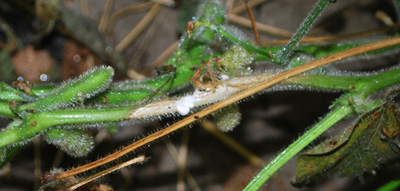

Unusually Long Silks in Corn - (Bob Nielsen)