


Pest & Crop Newsletter, Entomology Extension, Purdue University


Soybean Aphids Found in Indiana- (Christian Krupke)
- Very low populations in isolated sentinel fields.
- Most IN soybeans are in early-mid R-stages, aphids are a potential threat to yield until grown state R6.
- Weekly scouting until R6 is advised.
Thanks to our network of scouts, Purdue farm managers, and extension educators, we have been keeping tabs on soybean aphid numbers throughout the state. As we stated in earlier P&C issues, aphids have been scarce in the Midwest this year. However, over the past several days we have found our first aphids in sentinel plots in Indiana. Two locations reported aphids – one in LaPorte county (where we typically spot aphids first), and one in Jennings county, which is somewhat surprising, since aphids don’t typically show up down south until they are more established in the northern part of the state. Numbers are very low (less than 10 aphids/plant) right now, and a look at the nationwide map (go to <http://www.sbrusa.net>, select “Soybean Aphid” from the dropdown menu at the top right) reveals that the “feeder states” for Indiana, to the north and west of us are also reporting similarly low numbers. The majority of Indiana soybean fields do not have a single aphid in them at this point, which is a welcome bit of good news in a tough year.
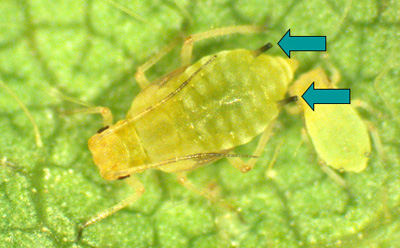
Soybean aphid, arrows pointing toward cornicles
What does this mean? It is looking less and less like outbreaks will occur in 2009. With each passing week of low numbers, the odds of reaching the 250-aphid threshold decrease dramatically. Despite having cool conditions that favor aphid development during the past few weeks, the aphids are running of time to infest and damage crops. Once soybeans reach growth stage R6 (full seed), we are out of the woods in terms of yield loss and although we have a few weeks to go, things are looking promising, mainly due to the fact that aphid numbers are uniformly low both in-state and in states surrounding us.
Having said that, do keep an eye out in your fields – a weekly scouting trip is cheap insurance and checking 20 plants throughout the field is sufficient to get a read on what is happening out there. Most of you remember what the aphid looks like, but just in case you need a refresher, the photos below will help. Pay special attention to the black cornicles (or “tailpipes) on the back of the aphid – these are diagnostic. Any aphid found on soybeans with this feature is certainly the soybean aphid.
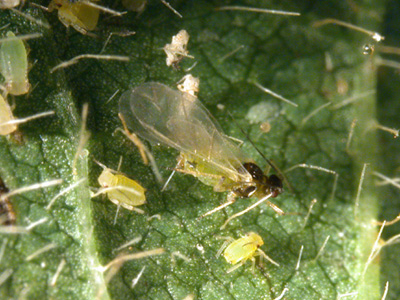
Winged soybean aphid, surrounded by immatures

Western Bean Cutworm Flight Declines Slightly, Eggs Can Now Be Found On Tasseling Corn- (Christian Krupke and John Obermeyer)
- Egg scouting is necessary to determine the need for treatments.
- Moth counts down this week, peak flight may be past for this year.
- Fields slated for fungicide application should be scouted before insecticides are included.
Captures reported on the Western Bean Cutworm Monitoring Network website: <http://www.ent.iastate.edu/trap/westernbeancutworm/> have tapered off in most sites, though we are still capturing moths each night in most traps. Check the website and look for a trapping site near you to get an idea of local pressure. This is an important year for this pest - even if we don’t catch another moth this season, this will mark the highest numbers of moths/trap in our 4 years of trapping for this new migrant.
Indiana corn is at a wide range of growth stages this year, but much of the crop is currently at or near the tassel stage. Research has shown that female moths prefer corn in this stage, and will usually lay eggs on or near the unfolding leaves near the tassel. Scouting should happen now – once the tiny larvae enter the plant they are very difficult to find and all but impossible to control using foliar sprays. 5% of plants with eggs and/or larvae is the treatment threshold.
There are no short-cuts for this pest – walking fields is essential to determine the need for treatments. Remember that only corn varieties containing the Cry1F (Herculex) trait for lepidopteran pest control will help as far as transgenics go. If you do not have this trait in your hybrids, you have no in-plant protection from WBC.
Foliar insecticides are the only in-season treatment option. Recommended foliar insecticides for western bean cutworm can be viewed at <http://extension.entm.purdue.edu/publications/E-219.pdf>. Check last week’s issue for more on this pest and scouting.
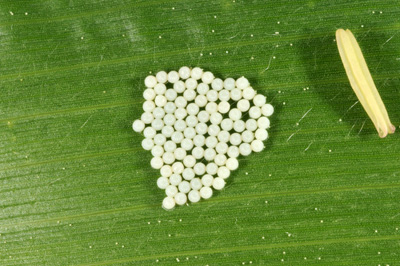
Fresh laid egg mass
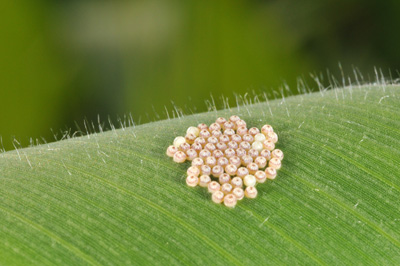
Developing egg mass
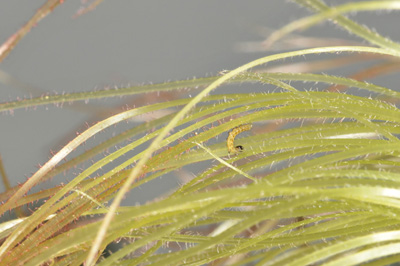
Newly hatched larva within the silks
Nematode Updates - (Jamal Faghihi, Christian Krupke and Virginia Ferris)
Corn Nematodes - As we suggested in an earlier edition of Pest&Crop, corn nematodes have been a problem this year. We have already received more corn samples this year than during the last five years combined. The continuation of a cool and somewhat wet season so far has provided ideal conditions for the Needle nematode to cause substantial damage in sandy soils of Indiana (Figure 1 & 2). By this time of the year, we normally don’t see the Needle nematode in soil samples. But, this has been far from a normal year. We continue to find a few Needle nematodes in some of the samples from soils that have not experienced temperatures above 85°F for a sustained period of time. We have found three species of corn parasitic nematodes (Needle, Lance, and Lesion) in the majority of the samples. Lance and Lesion nematodes will continue their feeding throughout the season while Needle nematode damage should stop as they begin to disappear. We expect to continue finding Lance and Lesion nematodes in roots and soil samples. We have found another species of nematode called Spiral nematode in many of the corn samples. This nematode feeds on corn roots but it causes yield loss only when hundreds of these are found in 100cc of soil.
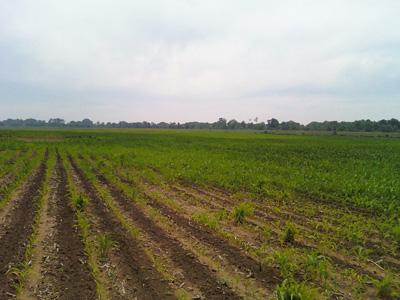
Figure 1. Above ground symptoms of a corn field infested with Needle, Lance, and Lesion nematodes (Photo Credit: Betsy Bower)
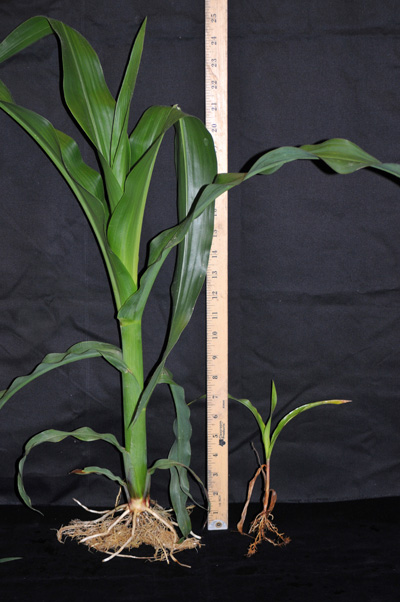
Figure 2. Corn plant infested with Needle nematodes (right) and a healthy corn plant (left) of the same age.
We are often asked about the threshold levels of the corn parasitic nematodes. Some threshold levels were established in late 70’s and we continue to rely on these numbers as a guideline until new thresholds, based on current research, are established. At the present time, we use the following guidelines to determine whether nematodes might affect corn yields in Indiana.
If you continue to experience problems in corn, you may wish to send the entire root system with adjacent soil to the Nematology Laboratory (address below) at Purdue University for analysis. Samples must be kept cool and prevented from drying. Soil samples must be taken from a depth of 4-6 inches, as close as possible to the infected plants. It is essential to enclose as many fine roots as possible with soil surrounding the infected plant. A more detailed sampling procedure can be found on the following website: <http://www.entm.purdue.edu/nematology/samples.html>.
Soybean Cyst Nematode - Soybean Cyst Nematode (SCN) continues to be a problem in soybeans. So far this year, because soybeans have not been under moisture stress, the typical symptoms of SCN damage might not be present. The SCN symptoms usually appear as patches of yellow and stunted soybeans. However, this is the best time of the year to observe this pest if nematodes are present on the roots. The white and yellow female bodies, which form the cysts when they die, should be visible on the soybean roots. To see these cysts, dig the soybean plants out of the ground with a shovel and dip in a bucket of water to observe the new cysts. Care must be taken when digging the plants as the cysts are loosely attached to the soybean roots. Locating the young cysts on the roots is especially important in resistant soybeans, as this is the best indicator of their true resistance.
We have been warning you in our previous articles that the field populations of SCN in Indiana are changing in ways that render the most common source of resistance to SCN (PI 88788) less effective. Other researchers in the region have reported similar trends. With funding from the North Central Soybean Research Program we have established large field plots in areas where we know the PI88788 type of resistance is no longer effective. These plots are planted with commercial soybean cultivars with PI88788, Peking and CystX® sources of resistance along with a susceptible cultivar. So far, the visual symptoms from these plots are indicative of their source of resistance. The two cultivars with either the Peking or CystX® source of resistance have no sign of SCN symptoms and the plants look healthy. However, both the cultivar with the PI88788 source of resistance and the susceptible cultivar are showing typical SCN symptoms (Figure 3). We will follow these plots throughout the season and will report on changes if they occur.
We continue to emphasize the importance of soil tests as the only accurate way to know whether the numbers of SCN are changing and whether a resistant variety is still working. Growers need to understand that genetic shifts in SCN populations are gradual and they should not wait for yield losses before determining that a change in the SCN population has occurred. If genetic determination (HG-type or race test) has been performed for a field population in the past, you might want to repeat the test after about four soybean crops to measure any possible changes. If no genetic profile exists for a field, one must be established so future comparisons are possible. In other words, simply planting SCN varieties said to be resistant is not the final solution to the SCN problem. The management of this highly adaptable pest is an ongoing and dynamic situation that requires constant vigilance.
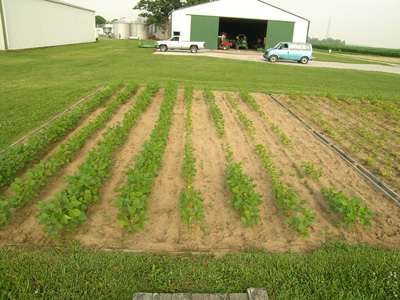
Figure 3. A heavily SCN infested small plot planted with two rows each (from left to right) of commercial cultivars of CystX®, Peking and PI88788 sources of resistance. The last two rows are planted with a susceptible cultivar.
The best way to manage SCN over the years is to monitor your populations by sampling each field at least every four years. You can sample the soil anytime of the year and get an accurate understanding of the cyst population. This is a very crucial step in SCN management and should not be neglected. We provide this service to soybean growers at the cost of $10/sample, for which the submitter will receive a bill unless we are instructed otherwise. For more information on other services that we provide you may visit our Nematology website: <http://www.entm.purdue.edu/nematology/>.
If you have any questions about plant parasitic nematodes, you can contact Jamal Faghihi at 765-494-5901 or send an email to jamal@purdue.edu. Soil samples for nematode analysis can be sent to: Nematology Laboratory, Department of Entomology, Purdue University, Smith Hall, 901 W. State Street, West Lafayette, IN 47907-2089. The cost for nematode analysis for each sample remains at $10/sample.
Click here to view the Black Light Trap Catch Report

Cool Temperatures: Good News Or Bad News For Corn? - (Bob Nielsen)
The recent spate of unusually cool temperatures has been welcomed by county fairgoers, but some of the guys sitting around the back table at the Chat ‘n Chew Cafe are wondering whether it is good news or bad news for a corn crop that has already experienced its fair share of stress this year. In all honesty, we can only speculate on the answer because it is so unusual for such temperatures to occur in mid-July that there is very little precedence to go by.
Potentially Good News
• Considering that the much of state’s late-planted corn crop is just now moving into the critical pollination stage, cooler temperatures are preferable to stressfully hot temperatures.
• Ditto for earlier-planted corn that is now in the early stages of grain fill.
• The rate of development of certain leaf diseases, like gray leaf spot, may slow down.
• Cool temperatures equal fewer heat units (GDD) per day. That translates into slower corn development and will further delay the progress of much of the state’s crop that was planted weeks later than normal to begin with and whose silking progress statewide was already 2 weeks behind the 5-year average.
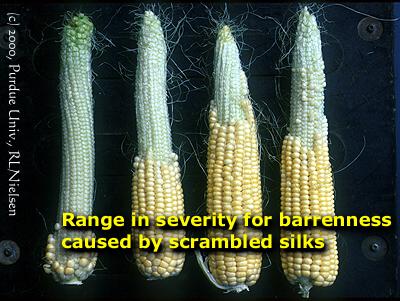
• Unusually cool temperatures prior to silk emergence may result in the occurrence of the “silk balling” phenomenon, whereby silk elongation is interrupted or altered, resulting in a mass of scrambled silks near the tip of the cob that never fully emerge from the husk. The consequence of such scrambled silks is poor kernel set.
Related References
Nielsen, RL (Bob). 2000. Scrambled Silks, Anyone? Corny News Network, Purdue Univ. Online at <http://www.kingcorn.org/news/articles.00/SilkBalling-0718.html> [URL accessed 7/21/09].
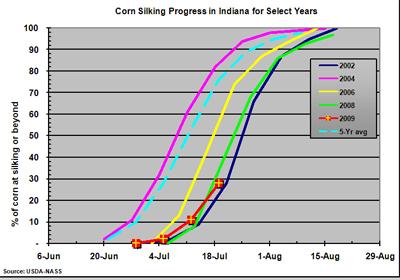
Silking Progress as of 7/19/2009
Scrambled Silks, Anyone? - (Bob Nielsen)
- Scrambled silks, aka silk ‘balling’, can result in poor kernel set.
- Recent night temperatures may be conducive to scrambled silks in 2000.
This article is admittedly fearmongering on the part of your friendly neighborhood corn specialist, but I figure it is my prerogative and responsibility to do so when I believe conditions are ripe for the development of a potential crop problem. If the problem does not occur, then growers will be relieved and they will forget I said anything about it. If the problem does occur, then I will look pretty smart for having forecast its development.
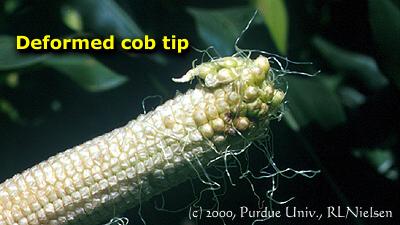
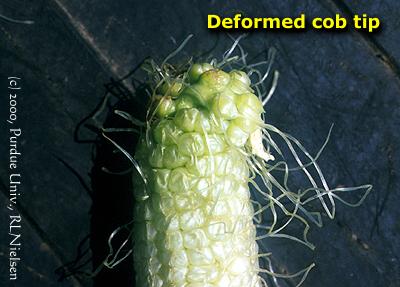
The potential problem of which I speak is a phenomenon traditionally called ‘silk balling’. I prefer the name ‘scrambled silks’ because I think it is more descriptive. The problem is one in which silk elongation, prior to their emergence from the husk leaves, is interrupted or altered, resulting in a mass of scrambled silks near the tip of the cob that never fully emerge from the husk. Obviously, any silks that fail to emerge from the husk will not exposed to any pollen and consequently will not contribute to the formation of kernels on the cob. The net result is some degree of barrenness on the cob and, consequently, lower yield.
Scrambled silks is a relatively infrequent problem and its causes are not well understood. Some believe that the occurrence of cool nights (low 60’s or cooler) prior to silk emergence plays a role in the development of scrambled silks. Others believe that rapid changes in temperature patterns (e.g., very warm to very cool) prior to silk emergence encourages the problem. Hybrids with naturally tighter husks seem to be more susceptible to developing scrambled silks.
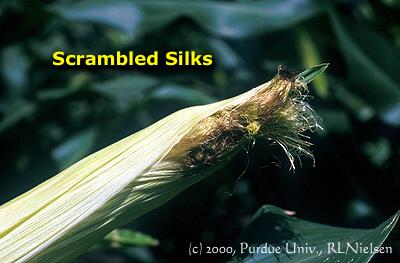
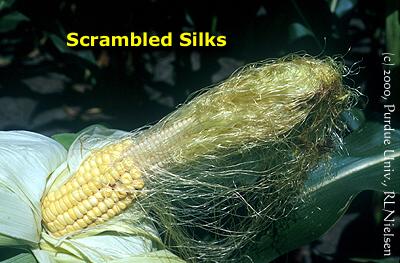
Given these opinions on temperature factors that may contribute to the problem, one could speculate (some would say fearmonger) that recent unusually cool nights throughout the central and northern parts of Indiana, plus the current forecast for more of the same, may lead to an increased occurrence of scrambled silks this year.
Unfortunately, there is nothing you can do about preventing or avoiding the problem. Nonetheless, it would be prudent to walk some of your fields during or after pollination and look for evidence of the problem. Typically, the severity of the resulting poor kernel set is low and concentrated near the tip end of the cob. However, I’ve seen situations in the past where scrambled silks resulted in severe barrenness in nearly 1/3 of the plants in a field.
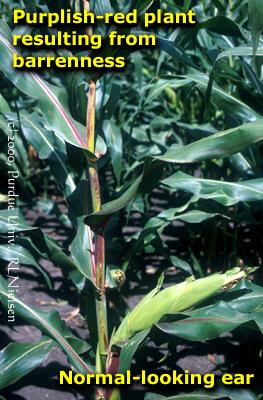
If you don’t have time to walk your fields right now, any affected plants will likely raise red flags later on in the grain filling process. By this, I mean that any plants severely afflicted with barrenness will eventually develop purpling or reddening of leaf midribs, leaf sheaths and other plant parts.
The reasons for this discoloration are similar to those for purple corn earlier in the growing season. An otherwise healthy plant whose ear is highly barren of kernels is a plant that is overproducing photosynthate (source) relative to the demands of existing kernels (sink). The excess sugars in the leaves and stalk trigger the formation of anthocyanin pigments in the plant tissues, especially in those hybrids with quite a few of the purpling genes. The similarity to early season purple corn is in the connection between excess plant sugars and anthocyanin production. Early in the season, excess plant sugars often result when root development is hindered for some reason.