



Pest & Crop Newsletter, Entomology Extension, Purdue University

- Lower Western Corn Rootworm Beetle Numbers
- Western Bean Cutworm Moth Flight Quite Impressive
- Black Light Trap Catch Report

Lower Western Corn Rootworm Beetle Numbers - (Christian Krupke and John Obermeyer)
- Emergence continues, but far lower populations of adults than in recent years.
- Many NW IN fields are pollinating, yet few beetles spotted.
- Emergence is delayed, due to cool spring conditions, but this alone does not explain low numbers.
Last week we talked about the reduction in local populations of western corn rootworms. Since then, we’ve spoken to several IN and IL growers and consultants that are noticing the decline as well. The question is: “Why?”
There are likely several factors at play. In Indiana, we had very heavy rains in early June during 2008 that likely drowned many larvae. This was followed by low adult numbers in the late summer and fall of last year – likely leading to lower egg loads. This spring, planting was delayed by frequent storms in both IL and IN, along with cool temps throughout the region. Both these factors probably combined to lower larval pressure on corn this year (partly because corn was planted late, and partly due to larvae once again drowning following rain events).
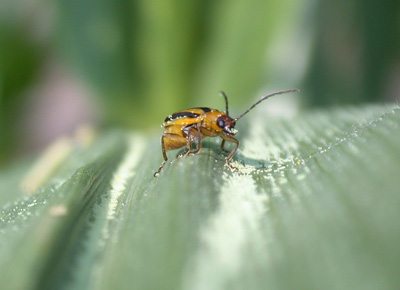
Lonely western corn rootworm beetle feeding on pollen
However, there may be something else at work here: We are in Year 6 of ever-increasing adoption of highly effective Bt hybrids for WCR control. Although stacking of traits makes it difficult to split up Bt-RW vs. Bt-Leps, 57% of corn planted in the US in 2008 contained at least one Bt toxin (USDA-NASS database). We know that these hybrids typically cause 90%+ mortality in RW larvae, so perhaps we are seeing the beginning of a population decline? It is an open question, with not much more than anecdotal evidence to go on. But the demise of the European corn borer as a key pest may offer some guidance here. The Bt toxins for this pest are higher in dose, typically leading to mortality in over 98% of insects that contact it. However, ECB have several dozen other potential hosts, including many common weeds such as ragweed. Yet, throughout most of the country, ECB is now an afterthought in discussions of corn pests.
In contrast, corn rootworms are essentially limited to corn as a host – meaning that over 50% of their potential host plants are toxic to them. Could we be seeing the early signs of population-level effects of extensive Bt corn adoption? We don’t know the answer, but it is worth thinking about. We welcome your observations and perspectives on this issue. It is difficult, if not impossible, to tease apart environmental and agronomic factors in a pest with such a huge range. But it’s reasonable to expect that continued adoption and effectiveness of Bt corn may cause a reduction of WCR populations on an area-wide scale. This makes it even more critical that we continue to be good stewards of this highly-effective technology – plant a refuge!

Western Bean Cutworm Moth Flight Quite Impressive - (Christian Krupke, John Obermeyer)
- Egg scouting is necessary to determine the need for treatments.
- Moths will continue to fly for a couple of weeks, though peak flight is happening now.
- Fields already slated for fungicide application should be scouted before insecticides are included.
During the last few nights (July 13-15), captures of western bean cutworm moths in pheromone traps have surged. Captures reported on the Western Bean Cutworm Monitoring Network website <http://www.ent.iastate.edu/trap/westernbeancutworm/> of dozens of moths each night have not been unusual, especially in northwestern and north central Indiana counties. The biggest surprise is the low captures in states west of us, especially Iowa and Wisconsin. Seems as though they like our Hoosier Hospitality!
NOW is the time for all good scouts to come to the aid of their cornfield!
Corn that is near, or at tassel, should be monitored for egg masses. Eggs are usually found on the top leaf surface on the upper leaves of the plant. Concentrate on the leaves wrapped around the soon to emerge tassel - there the egg masses may be on the bottom of the leaf because of the upright orientation. Fresh egg masses are white, and progressively darken to deep purple just before hatch in about a week. Obviously, the window for scouting and treatment is short. After hatching, the minute larvae devour the remaining eggshell (so egg masses disappear) and crawl to protected areas such as the whorl or leaf axils. In the whorl, the larvae feed on leaf tissue and could easily be confused with other insect pests such as fall armyworm. In corn that is tasseling, larvae will feed on pollen in the leaf axils. Eventually, larvae will enter the ear by following the silks down to the kernels. Larvae within the ear are protected from insecticide applications, so scouting and timely treatment are a must for this pest.
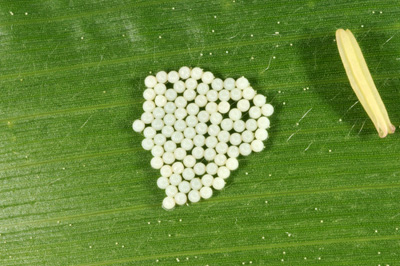
Fresh laid egg mass
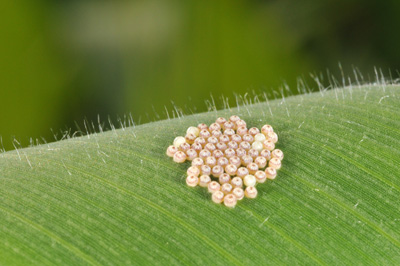
Developing egg mass
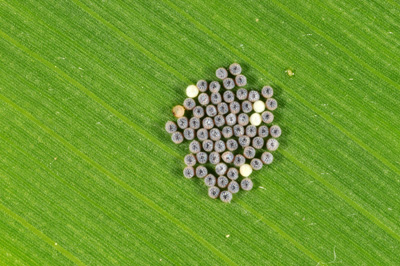
Egg hatch within hours
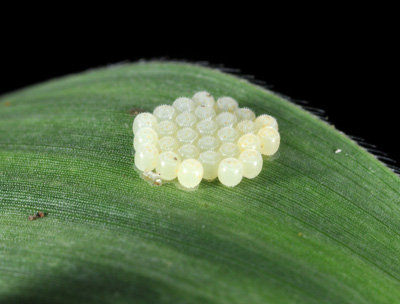
Barrel-shaped stink bug eggs, with a ring of decorative beading, are often confused with a WBC egg mass
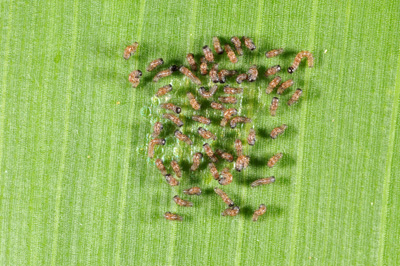
Newly hatched larvae eating their egg shell
Fields with at least 5% of plants with egg masses and/or young larvae, without the Cry1F (Herculex 1) trait, should be considered for treatment. Ideally, this could be aerially applied in combination with fungicide that has already been prescheduled. We continue to discourage indiscriminate use of insecticides (and fungicides) just because western bean cutworm moths are being captured. Consultants within the high moth capture areas are seeing tremendous variability between egg mass counts within neighboring fields.
Recommended foliar insecticides for western bean cutworm can be viewed at <http://extension.entm.purdue.edu/publications/E-219.pdf>.
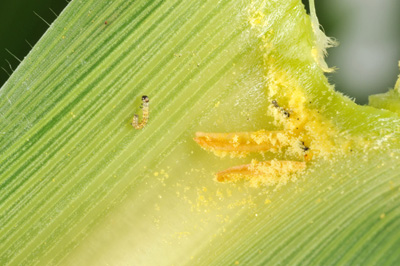
Larva in the leaf axil feeding on pollen
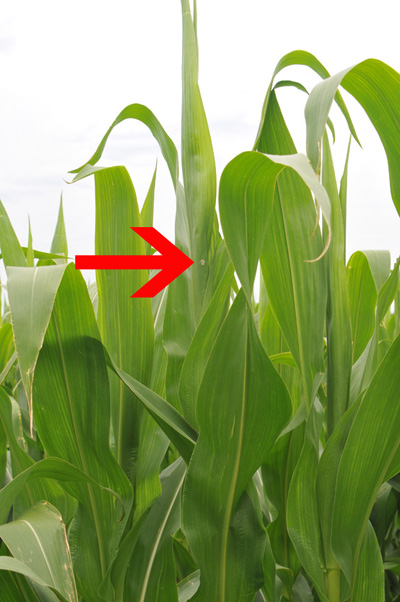
Arrow pointing to egg mass on upper leaf
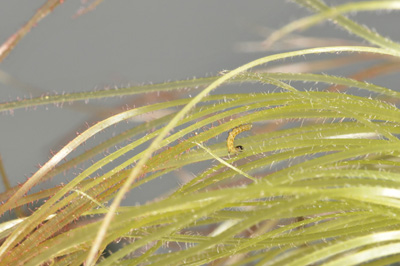
Newly hatched larva within the silks
Click here to view the Black Light Trap Catch Report

Should We Be Concerned About Arrested Ears in 2009? – (Kiersten Wise and Bob Nielsen)
More and more tassels are appearing in cornfields across Indiana, and when tassels appear, questions about foliar fungicide applications are sure to follow. These questions have prompted us to remind producers about the arrested ear phenomenon that has been documented over the last several years (Nafziger, 2008; Nielsen, 2007; Nielsen et. al., 2008).
In 2008, results from a demonstration plot at the Purdue Diagnostic Training Center indicated that pre-tassel applications of pesticides mixed with a non-ionic surfactant (NIS) will cause arrested ear symptoms in hybrid corn <http://www.agry.purdue.edu/ext/corn/news/articles.08/arrestedears-1209.html>. These results are to be interpreted cautiously due to the fact that it was a non-replicated demonstration plot. However, we revisit this issue in 2009 because many fields are uneven due to the less than ideal conditions at planting, and growth stages may vary widely within a single field.
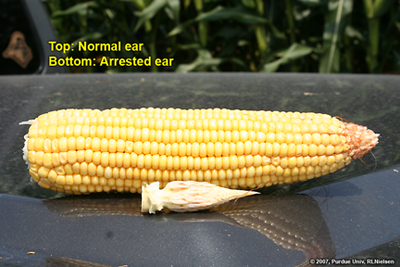
The results of the 2008 Purdue demonstration trial indicate that pre-tassel applications of fungicide alone to hybrid corn will not result in arrested ears (Nielsen et. al., 2008). The arrested ear symptoms were only observed when fungicide applications contained NIS or crop oil concentrate, or if fungicides were mixed with additional pesticides. Pre-tassel applications of fungicide are allowed according to the fungicide label, and may be justified in cases where a significant level of disease is present on the ear leaf or above in fields that have not yet tasseled. This said, we have not yet observed fields in Indiana that have this level of disease present.
If NIS or crop oil concentrate will be included in a fungicide application, we recommend waiting until the entire field has tasseled to apply the fungicide. This should minimize the likelihood that arrested ears will appear in fields in 2009.
Nafziger, Emerson. 2007. Unexpected Problems of Corn Ear Development. The Bulletin, Univ. of Illinois. [on-line]. Available at <http://www.ipm.uiuc.edu/bulletin/article.php?id=836>.
Nielsen, R.L., Wise, K.A., and Gerber, C. 2008. Arrested Ears Resulting From Pre-Tassel Applications of Pesticide & Spray Additive Combinations. Corny News Network, Purdue Univ. [on-line]. Available at <http://www.agry.purdue.edu/ext/corn/news/articles.08/arrestedears-1209.html>.
Nielsen, R.L. 2007. Symptomology of Arrested Ear Development in Corn. Corny News Network, Purdue Univ. [on-line]. Available at <http://www.kingcorn.org/news/articles.07/ArrestedEars-0904.html>.
Soybean Rust Update – (Kiersten Wise)
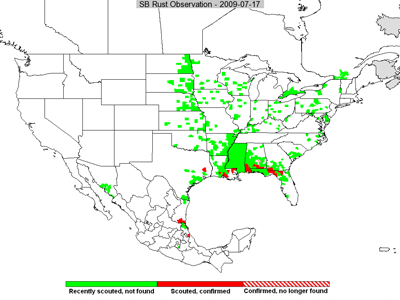
Soybean rust is active in the southern U.S., and has been confirmed on kudzu in 5 states across the southeast, and on soybean in Alabama and Louisiana and Florida. Dry conditions have slowed the initial movement of soybean rust, and soybean rust levels remain low across the southeast.
Purdue cooperators are currently monitoring 12 soybean sentinel plots across Indiana. Support for this program in 2009 is made possible by the Indiana Soybean Alliance and the North Central Soybean Research Program. Indiana sentinel plot samples are monitored weekly for soybean rust and other foliar diseases of soybean.
There are several ways to stay up-to-date on soybean disease development and soybean rust monitoring in Indiana. Weekly updates are recorded on the Purdue toll-free soybean rust hotline at 1-888-RUST (4656), or you can track the movement of soybean rust at <http://www.sbrusa.net>.
This year, producers can also subscribe to the Indiana soybean disease update list serve, at <https://lists.purdue.edu/mailman/listinfo/indiana-soybean-update>. This email alert service will provide convenient and timely updates on soybean disease monitoring in Indiana, and also provide information on spray applications if soybean rust were to reach Indiana at a critical time during the growing season.

Weather is unavailable due to technical difficulties.
