


Pest & Crop Newsletter, Entomology Extension, Purdue University

- Western Corn Rootworm Beetles Emerging
- Rootworm Larval Damage Appears Lower This Season
- Preventive Insecticide Sprays for Corn Discouraged
- Black Light Trap Catch Report

Western Corn Rootworm Beetles Emerging - (Christian Krupke, John Obermeyer, and Larry Bledsoe)
- Western rootworm adults have been spotted in many areas of the state.
- Beetles should not be a concern until fields are pollinating.
- Late planted/replanted fields could be a “trap crop” for beetles and egg laying.
Western corn rootworm beetles are beginning their annual emergence from the soil in Indiana. The male beetles are generally first to emerge and feed for several days until females begin emerging a few days later. Females mate, then feed and disperse, sometimes over long distances.
After emerging, beetles will begin to feed on corn leaves if pollen is not available. Leaf feeding damage is of no economic importance. However, pollinating plants with high beetle populations could suffer economic losses from the beetles clipping silks prior to the completion of pollination. Pest managers should closely watch their fields for this type of feeding activity when pollination begins.
Adult beetles survive for several weeks and are consistently attracted to pollen sources throughout their lifespan. Therefore, late-planted fields are particularly susceptible to silk-clipping in areas with large beetle populations. Because of this year’s staggered planting and replanting, this year may be more unpredictable than most – there is some early corn, but the vast majority in much of Indiana was planted late. Depending upon how many beetles are generated by the early-planted corn, these delayed areas should be closely watched for silk clipping. For additional information on rootworm beetles and their control, see Extension Publication E-219-W, Corn Insect Control Recommendations - 2009, which can be viewed at <http://extension.entm.purdue.edu/publications/E-219.pdf>.
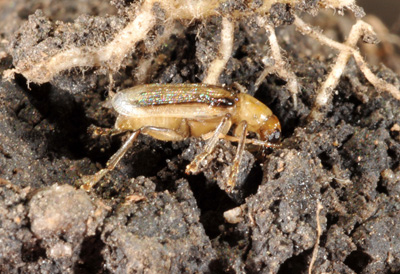
Western corn rootworm beetle emerging from the soil
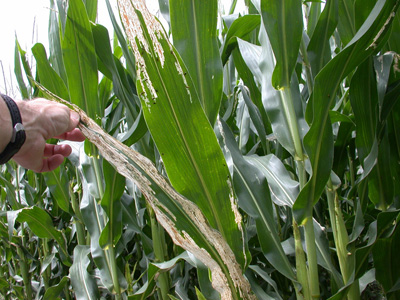
Beetles and leaf feeding

Rootworm Larval Damage Appears Lower This Season - (Christian Krupke, John Obermeyer, and Larry Bledsoe)
- Some root lodging is being seen.
- Rootworm feeding will continue for 2-3 weeks.
- Root damage + windstorms = a producer’s worst nightmare.
Peak corn rootworm feeding is likely here, and so far few incidents of severe corn lodging have been reported. Other Midwestern states are reporting the same. Several areas that we monitor closely each year are showing dramatically reduced larval populations. Unless plant fall over, most root damage goes unnoticed until harvest, so digging and inspecting roots in high-risk fields is still possible.
The worst-case scenario is that several factors will “collide” in the next week or two to cause significant lodging. First, much of the population are now full-sized larvae, which means they eat more and usually feed at the critical nodal root area. Nodal root systems are necessary for anchoring the plant, especially when rapid vegetative growth occurs just before pollination. The final X-factor is windstorms moving through the state combined with significant rainfall. Reduced and poorly anchored root systems will cause plants to topple in fast-moving storm fronts. Lodging causes extreme physiological stress on plants, especially as they attempt to pollinate. In addition, root regrowth, the plant’s attempt to recover from feeding damage, pulls carbohydrates away from vital top and ear growth.
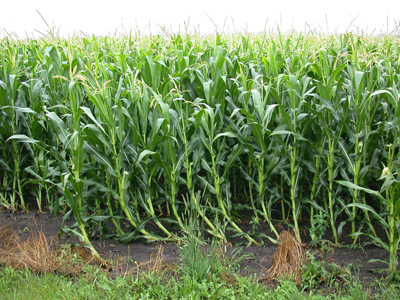
This field deserves some inspection!
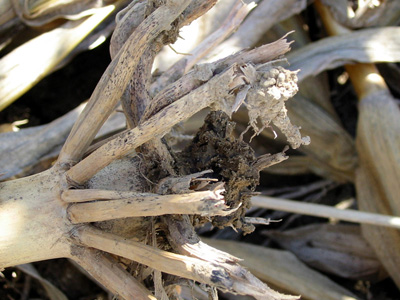
Please don't send decayed roots like this at harvest asking for rootworm diagnosis
back to top
Preventive Insecticide Sprays for Corn Discouraged - (Ric Bessin, University of Kentucky Extension Entomologist)
The following is reprinted with permission from the Kentucky Pest News, Number 1203, July 7, 2009.
Initially some growers began spraying fungicides preventively on corn, now some are considering adding an insecticide to the mix. I am recommending that growers NOT apply insecticide preventively without scouting information to justify their need. Pest populations must be above an economic threshold in order for the use of an insecticide to be justified. Simply breaking even economically should be the goal of using an insecticide, growers should manage their insecticide applications such that they return a profit on their investment.
Unnecessary use of insecticides has the potential to cause more harm than good, as non-target insects will also be impacted. This includes depletion of natural enemies of the pests and insect pollinators. These natural enemies are working to reduce the magnitude of pest problems we encounter. Reducing the number of natural enemies may allow pest populations to increase more rapidly in the future.
Pest populations vary from field to field and from year to year. In addition to pest populations varying in time and space, corn that is in different stages of growth will also vary in attractiveness to egg laying by insect pests. So planting date of a particular field and those around it will play key roles in determining which fields are more or less attractive to the pests and likely to develop ‘treatable‘ infestations. Individual field should be scouted to determine the level and stages of insect pests. Keep in mind that there are stages of the pests that are vulnerable to insecticide applications, and stages that are protected from sprays.
Five reasons to only use insecticides in corn when pests exceed economic thresholds:
• To get a positive economic return on the use of insecticides sprays.
• To avoid unnecessary losses to natural enemies of pests.
• To avoid unnecessary losses to insect pollinators during pollen shed.
• To delay/prevent the development of insecticide resistance.
• Most of the corn is already protected from late-season lepidopteran pests through BT technology, particularly late-planted corn.
Scouting guidelines and economic thresholds are available through the Kentucky IPM website <http://www.uky.edu/Ag/IPM/ipm.htm>. Use of scouting and thresholds has been shown to be the most economical approach on average and is strongly encouraged. This year, growers should be keeping a close eye on southwestern corn borer and European corn borer populations, particularly in late planted fields, over the next four to five weeks.
Click here to view the Black Light Trap Catch Report

Reed Canarygrass Explosion in Indiana - (Glenn Nice, Bill Johnson, Tom Jordan, and Tom Bauman)
You may have seen patches of a tall grass growing in the ditches of many of Indiana’s roads. It appears to be more prevalent this year than normal. This is reed canarygrass (Phalaris arundinacea L.). Figure 1 was taken along a drainage canal in Pulaski County, but reed canarygrass can easily be found along lakes and in the ditches throughout the state.
Description
Reed Canarygrass is a North American/Eurasian perennial that prefers wet-soils and can spread by underground rhizomes. It can grow 2 to 5 feet tall, although some report it up to 9 feet tall. Leaves are 3.5 to 10 inches long and 0.5 to 1.25 inches wide with the sheaths shorter than the internodes. The small membrane at the base of the leaf blade, the ligule, is 0.1 to 0.25 inches long, membranous and obtuse. In the publication “Reed canary grass (Phalaris arundinacea)” the Minnesota Department of Natural Resources points out that Reed canarygrass can be confused with bluejoint grass (Calamagrostis Canadensis (Michx.) Beauv.). This web publication reports that the two can be told apart by the fact that reed canarygrass has a highly transparent ligule. The inflorescence can be slightly variable, sometimes spreading or narrow often green then turning a straw color (Figure 2). The narrowing of the inflorescence might be a result of dry down occurring after seed have been released or as the soils become dry. The panical is 3 to 8 inches long and dense with 0.5 to 1.5 inch long branches. Blooming generally occurs early summer.
Aggressive Nature
Reed Canarygrass is no stranger to Indiana. A survey of the Purdue University herbarium revealed 21 specimens from Indiana counties dating as far back as 1933. One specimen from New York State was submitted in 1877. Reed canarygrass has been used for pastures that have experienced flooding or are predominantly wet soils; it has also been used in landscaping. In landscaping it is known as “ribbon grass” or “gardener’s garters.” It is speculated that the introduction of Eurasian biotypes or hybrids of the native and Eurasian biotypes may have lead to increased aggressiveness. It is known to spread quickly and produce monocultures in wetland areas.
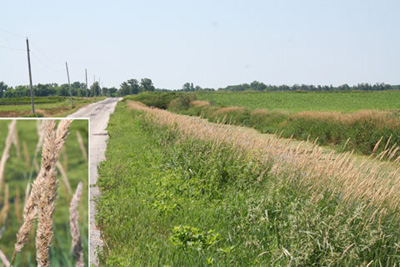
Figure 1. Reed canarygrass along a drainage canal in Pulaski County and Figure 2 is a closeup of seed head, post seed release
Control
Cultural control includes limiting nutrient inputs and sedimentation in wet land environments. Small patches can be dug up. Care should be taken to excise all of the plant for small portions of rhizomes can resprout and form new colonies. Bag and remove plant material to avoid spread. Flooding has been reported to drown colonies. Noah et. al., (2008) reported an overall reed canarygrass cover decrease of 41% to 44% when using flooding. Mowing and burning have been reported to be inconsistent; however, in a study conducted in Washington State, mowing reed canarygrass close to ground level (approx 0.5 inch) two to three times in a year provided 72% and 73% control up to 17 months after planting of two native tree species. In the same study, spot spraying with glyphosate provided 94% and 96% control. Chemical control includes glyphosate products such as Rodeo and Accord. Products with glyphosate are considered to be non-selective and will injure other desired species; however, in a heavy monoculture situation broadcast applications are often required. There are many glyphosate products on the market, thus it is important to use a product that is labeled for wetland areas.
Habitat at (2 lb ai imazapyr) or Arsenal (2 lb ai imazapyr) at 3 to 4 pt/A can control reed canarygrass; however. Arsenal does not allow applications directly to water. Habitat can be used on private property with “…waters that are still, such as ponds, lakes and drainage ditches where there is minimal or not outflow to public waters [Habitat label, 2009, BASF].” Application on public waters will require permits within your state.
References:
1. “An Illustrated Flora of the Northern United State and Canada” N. Britton and A. Brown. 1970. Vol. 1 p. 170. Dover Publications Inc., New York.
2. Aquatic Invasive Species: Reed Canary Grass. Anonymous. 2005. Indiana Department of Natural Resources. Accessed 6/24/09. <http://www.in.gov/dnr/files/REED_CANARY_GRASS.pdf>.
3. Reed canary grass (Phalaris arundinacea). C. Reinhardt and S. Galatowitsch. 2000. Minesota Department of Natural Resources. Accessed 6/24/09.
<http://www.dnr.state.mn.us/invasives/terrestrialplants/grasses/reedcanarygrass.html>.
4. Ornamental Grasses: Ribbon Grass Phalaris arundinacea. Annonymous. University of Illinois Extension. Accessed 6/24/09. <http://urbanext.illinois.edu/grasses/ribbon_grass.cfm>.
5. Vegetation management guideline: reed canary grass (Phalaris arundinacea). Max Hutchison. 1990. Illinois Nature Preserves Commission. Accessed 6/24/09. <http://www.inhs.uiuc.edu/chf/utreach/VMG/rcanarygr.html>.
6. The Replacement of Wetland Vegetation by Reed Canarygrass (Phalaris arundinacea). D.A. Maurer, R. Lindig-Cisneros, K.J. Werner, S. Kercher, R. Miller, and J.B. Zedler. 2003. Ecological Restoration. 21:116-119.
7. First-year responses to managed flooding of lower Columbia river bottomland vegetation dominated by Phalaris arundinacea. J.J. Noah, J.A. Yeakley, and E.M. Stewart. 2008 Wetlands volume 28.
8. Managing Reed Canarygrass (Phalaris arundinacea) to Aid in Revegetation of Riparian Buffers. T.W. Miller, L.P. Martin, and C.B. MacConnell. 2008. Weed Technology 22:507-513.

Points to Consider for Fungicide Applications in Corn - (Kiersten Wise)
It is the time of year when we are receiving more and more questions regarding the benefits of a fungicide application in corn. The most frequent question we receive is “Should I spray a fungicide?” Although this seems like a straightforward question, the answer is complex. There are many factors to consider when making the decision on if and when to apply a fungicide to hybrid corn.
One important point to note is that university researchers have not seen consistent yield benefits from foliar fungicide applications in corn (Figure 1). In other words, we see a lot of variation in the yield response from a fungicide application, and a foliar fungicide application has not been profitable in every situation. This said, we know that there are certain factors that influence disease development and understanding these factors can aid in making a decision on whether or not to apply a fungicide:
1. Hybrid susceptibility. Hybrids vary in their susceptibility to foliar diseases of corn, and hybrids susceptible to diseases such as gray leaf spot are at a greater risk of disease development than hybrids with moderate or high levels of disease resistance.
2. Previous crop and cropping system. Most of the fungal diseases, such as gray leaf spot, survive from year to year on crop residue, and planting corn-on-corn, and planting corn into high levels of corn residue (no-till) will increase the likelihood that disease will develop.
3. Late planting. Research from Iowa State University has demonstrated that late-planted corn (which describes most of the Indiana corn in 2009) is at higher risk of gray leaf spot development.
4. Favorable weather conditions. Foliar diseases, like gray leaf spot, require high humidity, moisture and moderate to warm temperatures for disease development.
5. Level of disease in the field. This is a crucial factor when deciding to apply a fungicide, however, it is not always considered due to equipment or labor availability, etc. Scouting fields around V10 to V14, or prior to tassel emergence, can help determine the level of disease pressure in a field. This factor could make the difference in whether or not a fungicide application will pay at the end of the season.
Unfortunately, there are no hard and fast rules as to how much disease in a field is necessary to “pull the trigger,” but there are guidelines that were established based on work from Gary Munkvold at Iowa State. These guidelines are based on a combination of the number of infected plants observed in a field and hybrid susceptibility:
1. If 50% of the plants in a field have disease lesions present on the third leaf below the ear leaf or higher prior to tasseling, AND the hybrid is rated as susceptible, or moderately susceptible, a fungicide application should be considered.
2. If the hybrid is rated as moderately resistant and disease is present on the third leaf below the ear leaf on 50% of plants prior to tasseling, AND additional factors or conditions that favor disease development are present (see above factors), a fungicide application should be considered.
3. Resistant hybrids should be scouted for disease problems, but fungicide applications to these hybrids are generally not recommended, and will not consistently result in a yield increase.
These points have been outlined in past Pest&Crop newsletters, and also by many other university researchers around the Midwest.
The factors that we described above influenced the response we observed from fungicide applications in research that was conducted in Jennings, Randolph, and Tippecanoe counties in Indiana last year. When we compare the results across previous crop and hybrid susceptibility, we see that the corn-on-corn trial planted to a more susceptible hybrid had the highest level of foliar disease, and the greatest average yield response to a fungicide application (Table 1).
A final point is that some level of disease can be found in a field, but the decision to spray should be based on the disease present, as well as the factors discussed above. For instance, we have seen a lot of Anthracnose leaf blight this spring, and it has been confused with gray leaf spot in some cases. We are just now starting to see early lesions of gray leaf spot on some susceptible hybrids and we recommend scouting fields to determine the level of disease present. Common rust is also a disease that may be present on ear leaves or above at this point in the season, but it rarely causes serious yield loss, and a few lesions of common rust on a leaf will not justify a fungicide application. Additional information on common rust and southern rust will be discussed in next week’s Pest&Crop newsletter.
| Table 1. Summary of results from 2008 Purdue corn fungicide trials. | ||||
| Location | Hybrid Resistance (GLS, Rust) | Previous Crop | Disease Severity of Untreated Control | Avg. Yield Response Compared to Untreated Control* |
| Tippecanoe Co. | 6,6 | Soybean | 9% | 5.9 bu/A |
| Randolph Co. | 6,6 | Wheat | 7.8% | -10.6 bu/A |
| Jennings Co. | 5,4 | Corn | 21% | 16.5 bu/A |
| *Yield response averaged across three fungicides: Headline at 6 oz/A; Built at 14 oz/A; Stratego at 10 oz/A. Fungicides were applied at VT-R1. | ||||
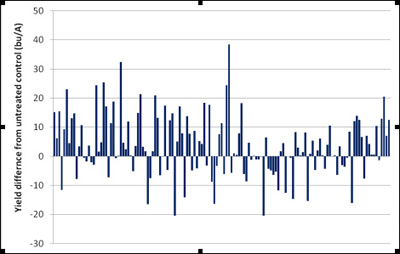
Figure 1. Summary of results from 2008 university corn fungicide trials. Results presented are from 68 trials conducted across 13 states and Ontario. (Data compiled by G. Shaner).

Ragged Leaf Edge Symptom in Corn - (Bob Nielsen)
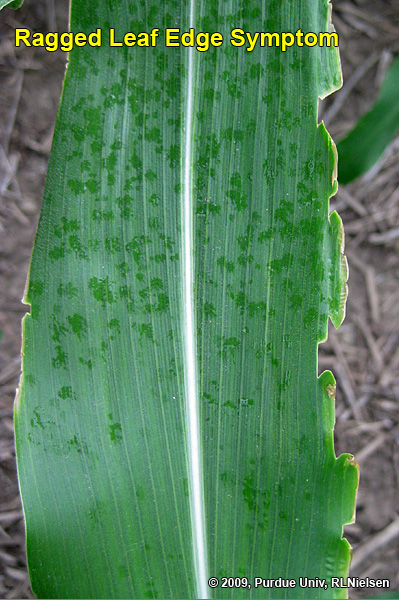
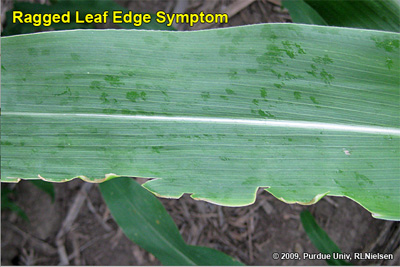
The coffeeshops and Internet chat rooms are abuzz these days with talk about an odd leaf symptom that has shown up in quite a few corn fields over the past several weeks. Affected leaves exhibit a ragged or notched edge that looks a little like somebody did a poor job at attempting to cut paper dolls out of the leaves. There was one descriptive comment from an Internet post that it “looks like some kids found an old set of ear notchers left over from the “Hog” days.”
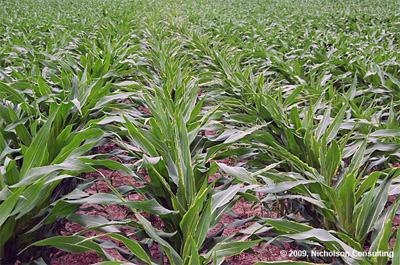
Sometimes the notching occurs only on one leaf edge with the other normal, other times the notching occurs on both leaf edges. The symptom seems to be most commonly reported on corn that is well into its rapid growth phase (sometime after leaf stage V7). While it is tempting to blame this symptom on the feeding activities of certain insects (e.g., armyworm, stinkbug, corn borer), the symptomology is different. Some have also blamed nutrient deficiencies (e.g., calcium) for the symptom.
The ragged leaf edge symptom seems to occur more commonly in some hybrid families than others. Indeed, feedback from some of my seed industry colleagues indicates that the ragged leaf edge symptom is a genetic characteristic that seems to express itself during periods of rapid crop development. The thought is that, for some unknown reason, the edges of one or more leaves deep down in the whorls of plants become “sticky” and so the leaves cannot unwrap normally during their continued expansion from the whorl. The leaf edges become damaged as the leaves continue to unwrap; thus leading to the ragged or notched leaf edge symptom when fully emerged from the whorl.
This symptom is likely only a genetic oddity with little consequence to further development of the crop canopy. The percent loss in photosynthetic leaf represented by these ragged leaf edges is minor and will likely have no effect on ultimate grain yield of the plant.