


Pest & Crop Newsletter, Entomology Extension, Purdue University

- Guilt By Association, Critters and Dead/Dying Seedlings
- Oops...I Forgot the Insecticide on the Refuge Corn
- Time to Scout for Black Cutworm
- Accumulated Heat Units (Base 50)
- Black Light Trap Catch Report
- Prevalent Purple Plants Possibly Puzzle Producers
- Delayed Planting May Be Belssing in Disguise for Soybeans

Guilt By Association, Critters and Dead/Dying Seedlings– (John Obermeyer and Larry Bledsoe)
- Numerous pest and non-pests are being found in poor emerging/growing fields.
- Some animals are feeding on dead/decaying plant material.
- A plethora of pests are being reported, even where seed-insecticides have been used.
Finally the sun is out, fields are drying, and temperatures are increasing. As pest managers inspect crops that have been subjected to an extended period of poor growing conditions, a multitude of critters are being found in the soil. Some are known pests and several are being falsely accused of causing stand reductions.
It’s not a wireworm: Millipedes are wireworm-like arthropods (like insects, they belong to the Phylum Arthropoda-means "jointed foot"), having two pair of legs per body segment that move quickly above and below the ground. They have become more prevalent since the advent of no-till. When found, their numbers are often high. Millipedes typically feed as scavengers, feeding on dead or decaying materials often associated with seedling blights. They have rarely been documented as pests of corn. Several pest managers have reported numerous millipedes in and around corn kernels/sprouts that have been in the ground for two or more weeks. The opportunistic millipedes were hollowing out these "blank" kernels that were in early stages of decay.
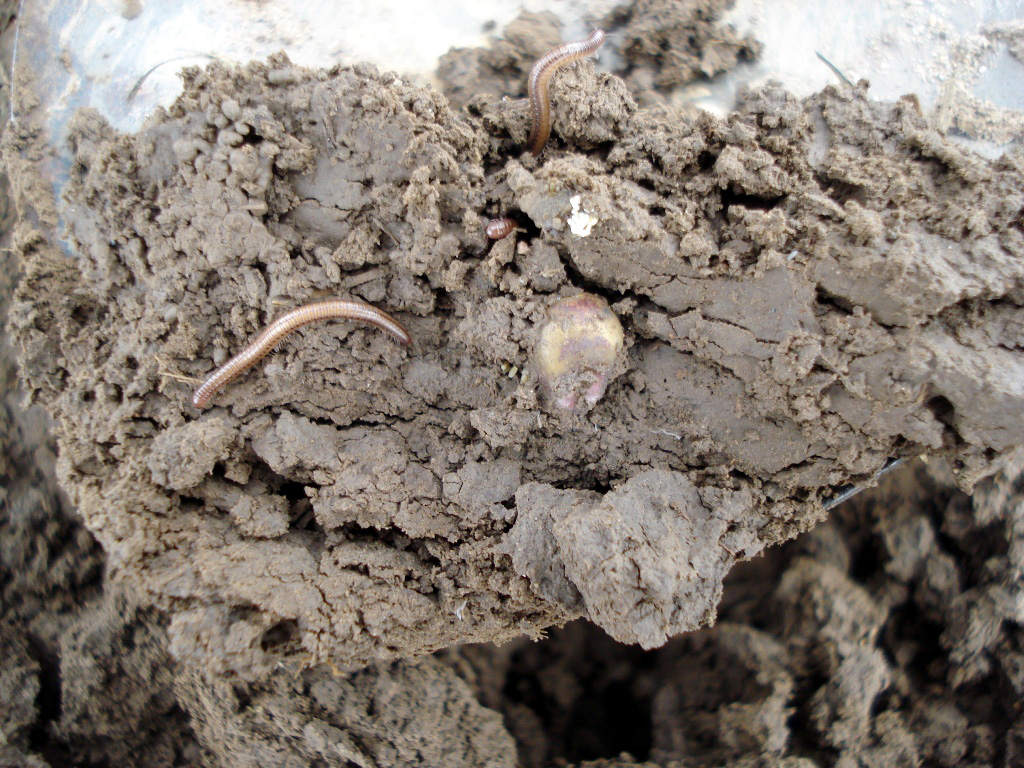
Millipedes and decaying seed in high residue field (Photo Credit: Betsy Bower)
It’s not a nematode: Juvenile ("baby") earthworms and potworms are closely related and common animals found in soils. They are small, colorless, and often less than 1/4 inch long (taxonomic Phylum containing segmented worms). As you would expect, these worms feed on damaged and decaying plant remains, not live tissue. Therefore they are closely associated with the decaying plant parts and surrounding soil and often wrongly accused of damaging seedlings. Pest managers should keep an open mind when diagnosing field problems. As one submitter confessed, he was so convinced that it was an insect problem and therefore looked for anything moving when he couldn't find grubs or wireworms.
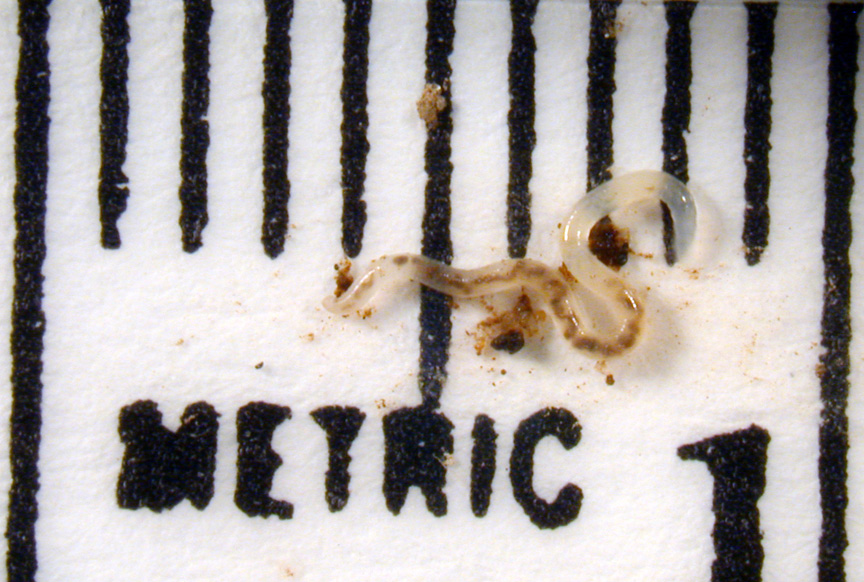
Potworm, small and nearly translucent
Many other critters, e.g., mites, symphylans, and springtails, are being observed on or around rotting seeds/seedlings. They are small, some fast moving, and certainly unfamiliar to most. They are not causing the poor emergence/growth, but taking advantage of weak and dying plants in various stages of decay.
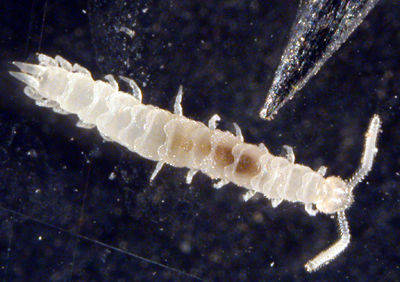
Garden symphylan next to pin point
The real McCoy’s of early-season damage: grubs, wireworms, seedcorn maggots, and cutworms are all being reported from throughout the state with varying degrees of damage. This doesn’t come as a surprise, considering once again the growing conditions this spring. One message that has been repeated is that the low rates of seed-applied insecticides (i.e., Cruiser and Poncho) are not preventing economic stand losses from grubs, wireworms and cutworms. The product label specifies "protection," from these early season pests. The problem is that these systemic insecticides require a vigorously growing plant for uptake, yet they are most needed when the environment is not conducive to growth. This paradox will no doubt be remembered and discussed after this growing season.

Oops…I Forgot the Insecticide on the Refuge Corn – (John Obermeyer)
Some producers have come to the realization that in the hectic pace of planting their Bt-RW corn that the soil insecticide for the 20% refuge was neglected. The good news is that a rescue treatment is possible, the bad news is that it requires another trip to the field.
Liquid insecticides (i.e., Furadan, Lorsban) can be applied at post-emergence or cultivation-time. Hopefully the refuge is well marked to help locate the unprotected corn. Shortly before or during rootworm egg-hatch, the end of May/early June, drop nozzles should be directed toward the base of the corn plants with the labeled rate of insecticide. Following-up with cultivation, if possible, will incorporate the insecticide and promote the establishment of brace roots. Weather is often a limiting factor in getting post-emergence insecticides applied in a timely manner.
Liquid nitrogen can be included with this post-emergence application, being cautious to keep the spray off the foliage in order to not burn the leaves. In this day of high fuel prices, it would be tempting to combine the insecticide with a post-applied herbicide. This is unwise, as broadcasting the insecticide will result in poor rootworm control. Again, the insecticide needs to be concentrated near the base of the plant.
Time to Scout for Black Cutworm – (John Obermeyer)
- Leaf feeding is possible in many areas of Indiana.
- Plant cutting could be happening in southern counties.
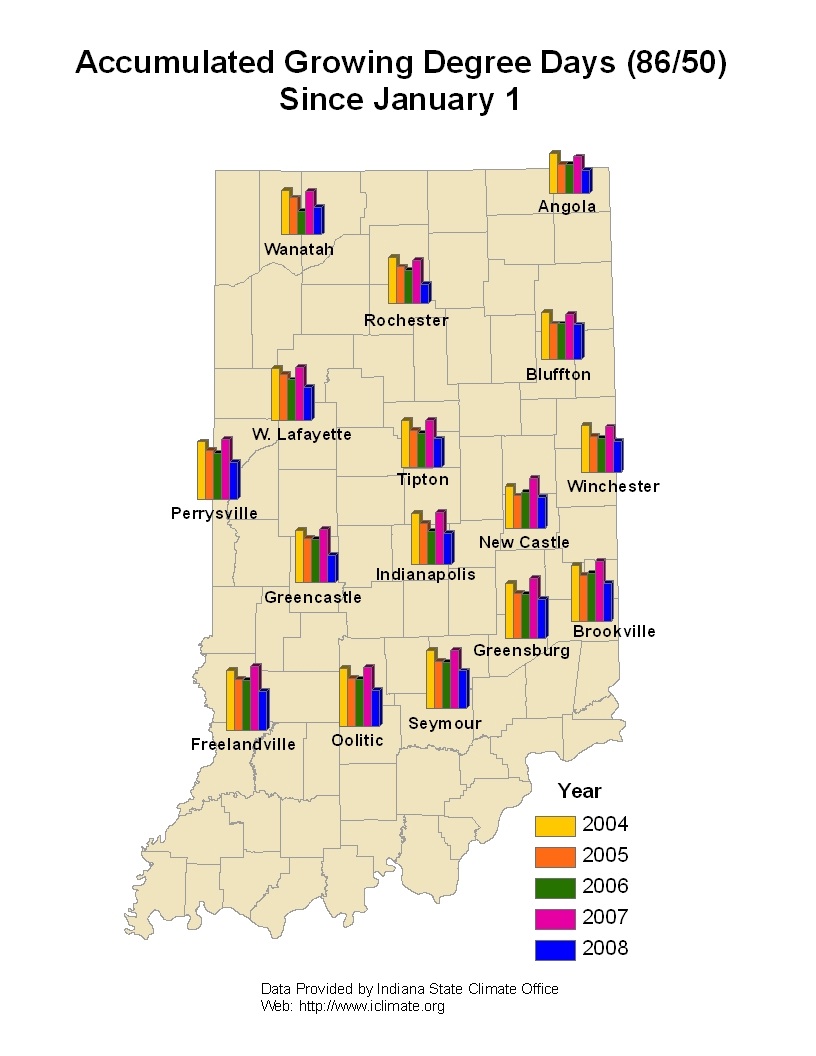
As previously mentioned in past issues, the threat for black cutworm damage is low this year, but a few reports have been received of feeding activity. Please refer to the accompanying map that represents heat unit accumulations from April 11, date of the highest number of moths captured in one given night.
HU50 is the temperature we use to track the development of the black cutworm from the time of an intensive capture to first cutting/damage. Based on the growth development model, it takes approximately 300 heat units (50?F base) from egg hatch to early 4th instar; this is when black cutworm larvae begin to cut plants. Some leaf injury may be present before then. Using pheromone trapping of moths and tracking of heat unit accumulations for first cutting is not an exact science, but does give us a good indication of what to expect. It is not possible to predict if individual fields will be infested. Happy scouting!

Click here to view the Black Light Trap Catch Report

Snagged Wheat Heads - (Gregory Shaner)
- Heads of some varieties get snagged as they emerge from the boot.
I had a call earlier this week about wheat heads that were bent over. Several growers had called a county extension office about this problem and wondered if some disease had caused it. Sometimes the wheat head snags as it emerges from the boot (the flag leaf sheath). Instead of emerging from the top of the boot, the head emerges from the side. The tip awns remain caught in the flag leaf collar (the junction between the leaf blade and the leaf sheath). As the peduncle elongates the head bends at some point. This condition probably does no real damage. As the peduncle continues to elongate, the tip awns are pulled free and the head emerges fully. For a time the head will be bent over, but eventually straightens out. This condition is most often seen on varieties that have short tip awns. Fully awned varieties or awnless varieties don’t get snagged. The figures below show a head with short tip awns and a head that has snagged as it emerges. It is possible that cool weather during head emergence aggravates the problem. When it’s cool, the heading process is slower, so it takes longer for the head to get past this snagging stage.
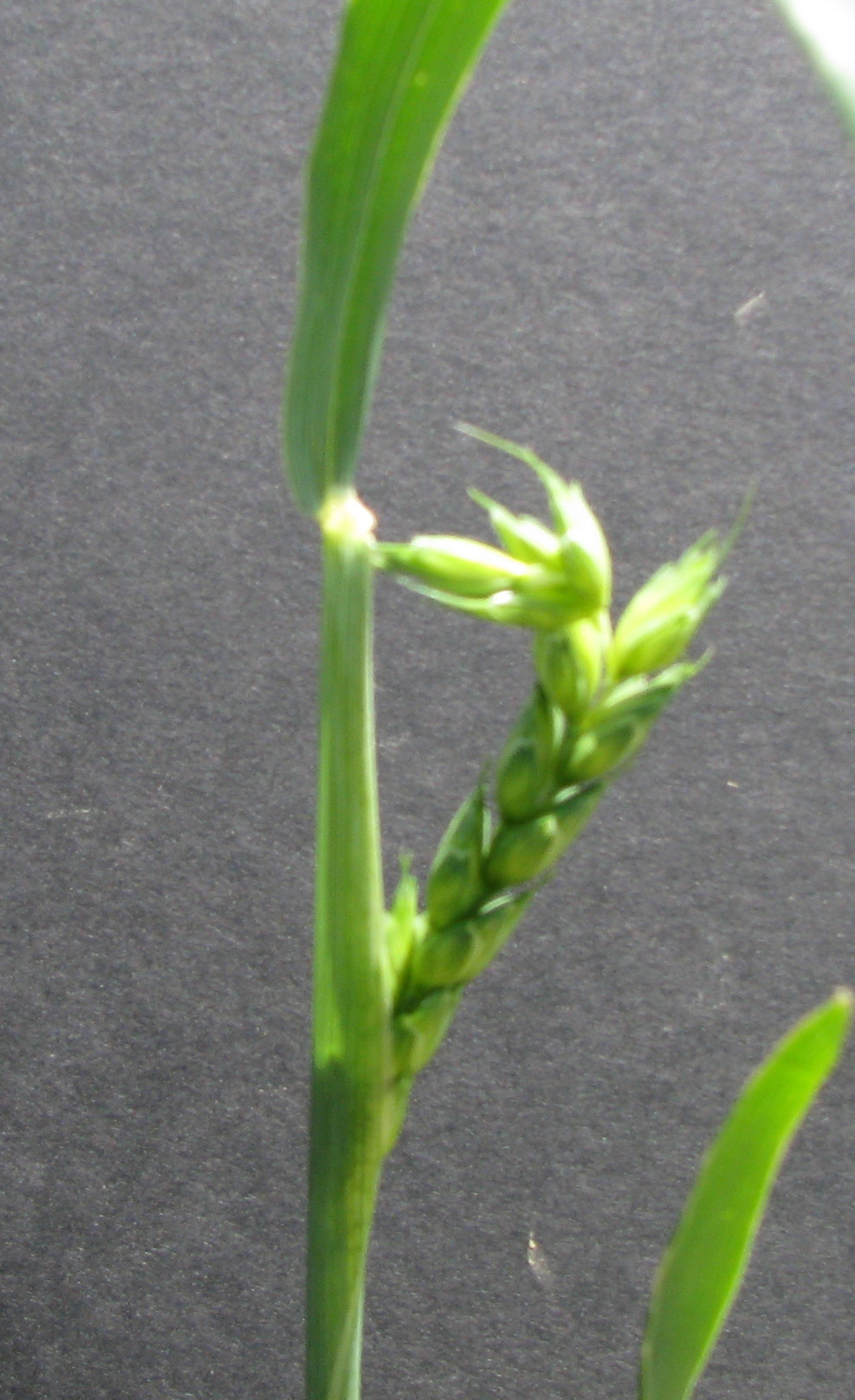
Wheat head that has snagged as it emerges. Instead of emerging from the top of the boot, it has emerged from the side.
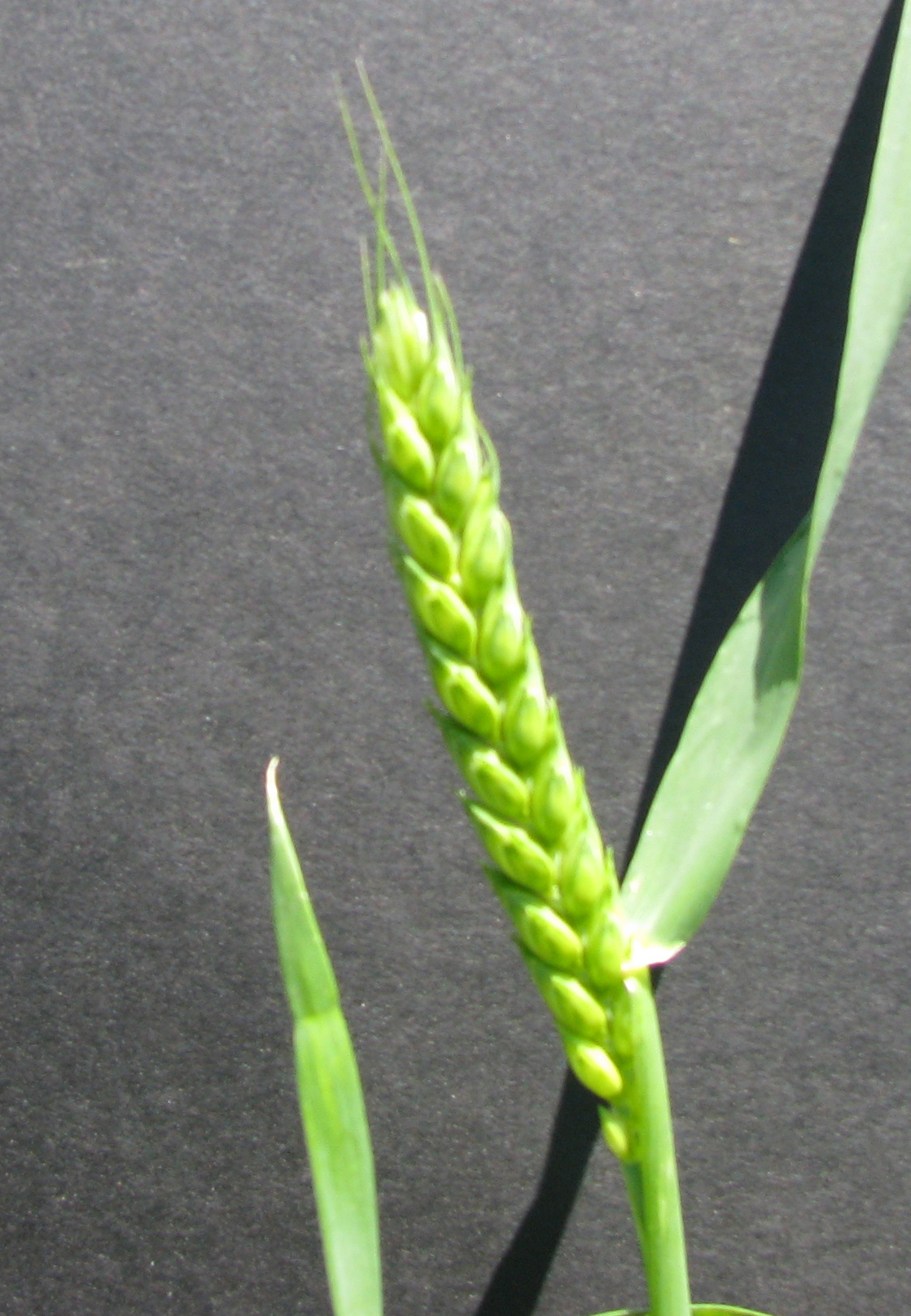
Wheat with short tip awns. Varieties that this trait are more likely to hang up in the
boot as they emerge.

Prevalent Purple Plants Possibly Puzzle Producers - (Bob Nielsen)
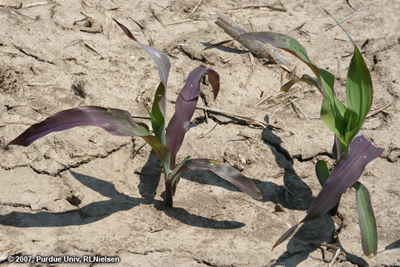
As folks trickle back into the Chat 'n Chew Café after several weeks of intensive planting efforts, conversations are beginning to drift toward the condition of the young crop. Some of the cafes regulars are reporting that whole fields have taken on noticeable shades of red and purple over the past week or so. Landlords and tenants alike are wondering what on earth is wrong with these fields.
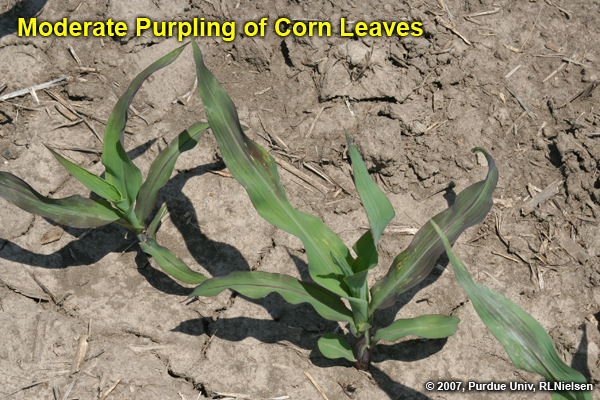
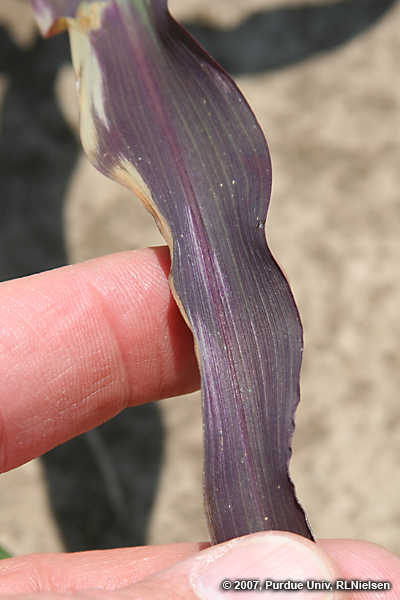
Purpling of corn plant tissue results from the formation of a reddish-purple anthocyanin pigments that occur in the form of water-soluble cyanidin glucosides or pelargonidin glucosides (Hak, 1998). A hybrid’s genetic makeup greatly determines whether corn plants are able to produce anthocyanin. A hybrid may have none, one, or many genes that can trigger production of anthocyanin. Purpling can also appear in the silks, anthers and even coleoptile tips of a corn plant.
Well, you may say, that’s fine but what triggers the production of the anthocyanin in young corn at this time of year? The answer is not clearly understood, but most agree that these pigments develop in young plants in direct response to a number of stresses that limit the plants’ ability to fully utilize the photosynthates produced during the day. These stresses include cool night temperatures, root restrictions, and water stress (both waterlogged and droughty conditions).
There’s no question that many cornfields throughout the state have suffered through wet soil conditions during the past several weeks. Furthermore, soil compaction (tillage- or planter-related) is more prevalent this year and that restricts the development of the initial root systems. The additional stresses imposed by recent relatively cool nights (upper 30’s to low 40’s) and several bright sunny days (high levels of visible and UV radiation) may be the final “triggers” that result in fields of pretty purple plants.
Since the anthocyanin occurs in the form of a sugar-containing glucoside, the availability of high concentrations of sugar in the leaves (photosynthesis during bright, sunny days) further encourages the pigment formation. If fields are stressed by other factors such as soil compaction, herbicide injury, disease damage, or insect injury, the purpling becomes even more pronounced.

It has been my experience that the combination of bright, sunny days and cool nights when corn ranges from V3 to V6 in development (3- to 6-leaf collar stages) most commonly results in plant purpling. Hybrids with more anthocyanin-producing genes will purple more greatly than those with fewer “purpling” genes. In most cases, the purpling will slowly disappear as temperatures warm and the plants transition into the rapid growth phase (post-V6).
I have rarely diagnosed phosphorus deficiency as the primary cause of purple plants early in the season. Nonetheless, cold or wet soils inhibit root development and can aggravate a true phosphorus deficiency situation, frequently causing even more intense leaf purpling.
What About Yield Losses? Does the leaf purpling lead to yield losses later on? The cause of leaf purpling, not the purpling itself, will determine whether yield loss will occur by harvest time.
If the main cause is the combination of bright, sunny days and cool nights, then the purpling will disappear as the plants develop further with no effects on yield. If the stress of restricted root systems is a major contributor to the purpling, then the potential effects on yield depend on whether the root restriction is temporary (e.g., cool temperatures & wet soils) or more protracted (e.g., soil compaction, herbicide injury). Plants can recover from temporary root restrictions with little to no effect on yield. If the root stress lingers longer, the purpling may continue for some time and some yield loss may result if the plants become stunted.
Related References
Chalker-Scott, Linda. 1999. Environmental Significance of Anthocyanins in Plant Stress Responses. Photochemistry and Photobiology 70(1): 1–9.
Christie, P.J., Alfenito, M.R., and Walbot, V. (1994). lmpact of low- temperature stress on general phenylpropanoid and anthocyanin pathways: Enhancement of transcript abundance and anthocyanin pigmentation in maize seedlings. Planta 194: 541-549.
Dixon, Richard A. and Nancy L. Paiva. 1995. Stress-lnduced Phenylpropanoid Metabolism. The Plant Cell 7:1085-1097. American Society of Plant Physiologists. [On-Line]. Available at <http://www.plantcell.org/cgi/reprint/7/7/1085>. [URL accessed 5/19/08].
Kim, Jae Hak. 1998. Maize Anthocyanin Pathway. Pennsylvania State Univ. [On-Line]. Available at <http://scripts.cac.psu.edu/courses/plphy/plphy597_hef1/mpath.html>. [URL accessed 5/19/08]. Editorial note: This link is for biochemistry fans!
Delayed Planting May Be Blessing in Disguise for Soybeans – (Ag Answers)
Even though planting soybeans earlier has been an increasing trend for growers, a Purdue University expert said this year’s delayed planting may be more beneficial than detrimental.
The abundance of rain that has washed over the Midwest has caused planting delays in many states. Indiana and Ohio have 19 percent and 21 percent, respectively, of the intended soybean crop planted, according to the latest report from U.S. Department of Agriculture’s National Agriculture Statistics Service. Combined, this means that nearly 7 million acres are not yet planted.
“But this late planting may be a blessing in disguise,” said Ellsworth Christmas, Purdue Extension soybean specialist. “Soybean seed quality is horrendous.
“Don’t get me wrong, there is some good quality seed, but an awful lot of it is just marginal. And that poor quality seed is at much greater risk to rot and disease, especially if it has to sit in the ground for several days.”
Purdue research shows that growers should plant soybeans between April 25 and May 10 to obtain the highest yield potential.
“We found that planting after May 10 leads to a .5 percent yield reduction per day,” said Andrew Robinson, agronomy student who examined the relationship between planting dates and yield. “And, planting after early June results in a yield reduction of 1 percent to 1.5 percent per day.”
Robinson and Christmas agree that if this is the case, with new crop soybeans at $12 a bushel and an average yield of 50 bushels per acre, a .5 percent yield reduction per day is a loss of .25 bushels per acre per day or $3 per acre per day. So for 1,000-acre soybean farm, that’s a loss of $3,000 a day that soybeans aren’t in the ground.
However, that may not hold true this year with the weather situation, Christmas said. But when the ground is ready, growers need to have their equipment ready, he added.
Robinson’s research showed that planting in late May or early June resulted in a 10 percent to 15 percent total decrease in yield.
“This could be attributed to having a shorter growing season and the length of day probably played an important role at inducing flowering earlier and causing the plant to develop quicker,” Robinson said.
Robinson’s two-year study confirms what farmers already suspected—planting soybeans earlier, but not too early, produces better yields.
Robinson planted soybeans in 2006 and 2007 on six different planting dates, starting at the end of March and planting one acre every two weeks through the first week of June. Three varieties were planted each time—an earlier maturing variety, an average maturing variety and a late maturing variety.
Robinson not only looked at the relationship between yield and planting date, but also how protein and oil content changed with the planting date. They observed that at earlier planting dates, oil content was higher than at later planting dates and that protein content was opposite.