


Pest & Crop Newsletter, Entomology Extension, Purdue University


Whorl Feeding Worms in Late Corn – (John Obermeyer and Larry Bledsoe)
- Ratty/messy whorl damage could be corn earworm or fall armyworm.
- Infestations are often spotty in fields, especially in developmentally delayed corn.
- Make certain worms are still in whorls and actively feeding.
- If necessary, spot treat with a high clearance rig using ample water.
The variability in corn maturities and heights, especially in flooded areas, this season “sets the stage” for whorl feeding worms. So far we have not received reports of larval damage; consider this a head’s up to pest managers that will be visiting corn for the remainder of the summer.
Late planted/developing corn is attractive to moths of several species, two of which create quite a mess in mid-late whorl corn. Corn earworm moths have been in abundance since early June (see Pest&Crop #11) and may have already infested/damaged areas of fields. This damage has been reported in Illinois. Likely fall armyworm moths have already arrived from southern region of the country, too being attracted to whorl stage corn in which to lay their eggs. Initially, hatched larvae of these species feed on the leaf surface within the whorl, causing a “windowpane” effect. Feeding by larger larvae appears as ragged-edged holes with excessive frass (worm poop) being quite evident. Feeding on cornhusks and kernels will also occur later in the season by these species.
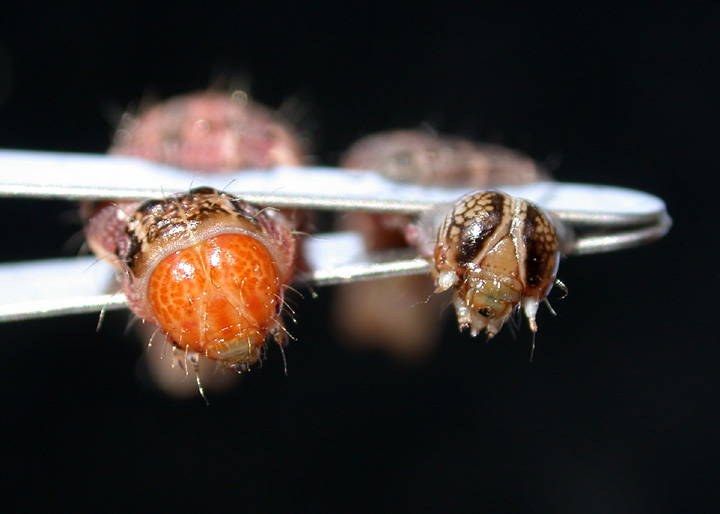
Corn earworm and fall armyworm heads, note the pronounced upside-down "Y"
shape on the fall armyworm (right)
If whorl damage is noted, sample by examining 20 consecutive plants in at least 5 areas of the field, including shorter corn in formally wet/ponded areas. Count and record the number of plants showing damage in each area. Determine the percentage of damaged plants for the field. Also, be sure to note whether the larvae are still present and feeding. It may be necessary to pull some whorls and unroll the leaves to find the larvae. Estimate the size (length) of several of the worms.
Distinguishing one species from another is not critical, as both will be similar in damage and control. Once worms are over 1-1/4 inch in length they are soon to complete their larval stage and feeding is nearing completion. Also, one should look for parasitized larvae having elongated white balls (eggs of a parasitic fly) usually near the back of the worm’s head. Parasitized larva will reduce feeding and eventually be killed.
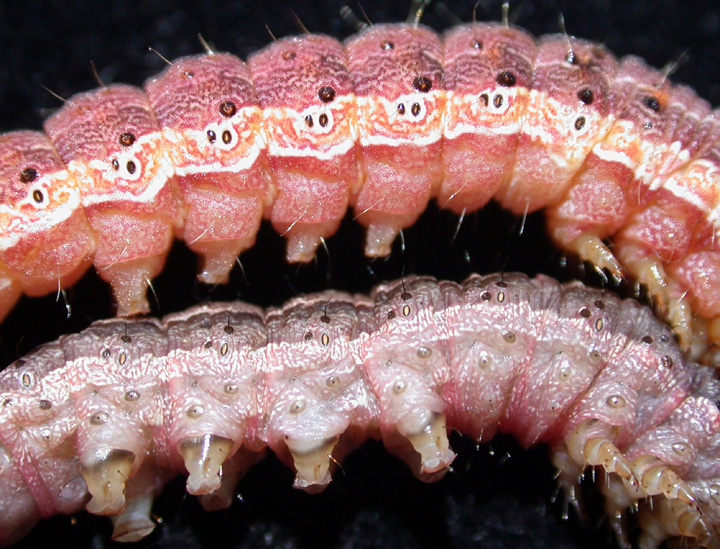
Sides of both corn earworm and fall armyworm, with 10X magnification, hairy skin is evident on the earworm (top), smooth skin on the fall armyworm (bottom)
In damaged cornfields where the yield is expected to be at least 60% of the normal yield, an insecticide may be necessary if 75% of the plants exhibit feeding damage and the larvae are less than 1-1/4 inch in length. If applying an insecticide, be sure to apply the insecticide in sufficient water to reach the target area. These species will often form a “plug” with their frass in the whorl, making it difficult for insecticide penetration. Ground sprays directed over the row are generally more effective than broadcast sprays. Aerial applications, because of the reduced carrier, are not recommended. Treatments to control these worms in ear tips are not effective. Because this damage is often spotty in fields, consider treating these areas with ground driven high-boys. For insecticides see Extension Publication E-219-W, Corn Insect Control Recommendations – 2008, which can be viewed electronically at <http://extension.entm.purdue.edu/publications/
E-219.pdf>.

Japanese and Rootworm Beetles - (John Obermeyer and Larry Bledsoe)
- Japanese beetle have been emerging for over a week.
- Western corn rootworm beetles have likely emerged in southern counties.
- Beetles should not be a concern until fields are pollinating.
- Pollinating areas of fields could be a "trap crop" for beetles.
Another season featuring the beetles we love to hate is beginning throughout the state, as emergence of Japanese beetle has begun. The western corn rootworm beetles are behind in development, but we expect emergence any day, if not already. Beetle emergence, mating, and egg-laying will continue through most of the summer for both species. Generally, the numbers of beetles noticed in a given field or location is an indication of the degree of feeding the grubs or rootworm larvae may have done.
After emerging, beetles will begin to feed on corn leaves if pollen or silks are not available. This leaf feeding damage may look dramatic in small areas of a field, but is usually of no economic importance. This year’s replanting will cause some fields to pollinate much later than most. These fields will act as “magnets,” attracting large numbers of beetles and need to be watched for silk clipping. If beetles are present and feeding on corn silks, an insecticide application should be considered only if 50% of the silks are being cut off to less than 1/2 inch before 50% pollination has taken place. Note, this threshold is NOT based on beetles per plant. In unevenly developing fields, areas that are pollinating first should be monitored separately for silk feeding. Still consider, only a 1/2 inch of silk from the tip of the husk is necessary for successful fertilization.

Corn rootworm beetles male (left) and female (right)

Update on Soybean Rust - (Kiersten Wise)
Over the last two weeks, there have been many questions about the status of soybean rust in the southern United States and what it means for the soybean crop in Indiana this year. Soybean rust has been present in the south in limited areas since this spring. Currently, there are several counties in Florida with confirmed soybean rust infections and limited infection areas have been reported in the southern parts of Alabama, Louisiana, and Texas. No rust has recently been reported in Georgia, Mississippi or Arkansas.
The weather forecast calls for humid, rainy, weather in the rust-infected regions of the southern states. These conditions favor disease development and spread, and soybean and kudzu are carefully monitored in these areas for rust infection. Double-crop soybean plantings began recently in Louisiana, Mississippi, and Arkansas, which could aid in the spread of spores to the Midwest if rust develops on soybeans in these states.
So what does this mean for Indiana growers? For now, the risk of rust in Indiana is minimal. However, it is important for us to keep an eye on the south and monitor the rust infections already present in the U.S. If rust infections begin to spread throughout Louisiana, Mississippi, and Texas, weather patterns such as rainstorms could carry rust spores north to Indiana. If a substantial number of rust spores remain viable during wind transport from the south during July and August, rust could develop on soybeans in Indiana at a time when it will cause economic damage.
Soybean sentinel plots have been planted in Indiana and many other states in the south and Midwest. Leaves are collected from the plots weekly, and inspected for disease. The sentinel plot monitoring program is meant to aid in early detection of soybean rust infections. Early detection of rust infections allows us to make disease management recommendations to growers if soybean rust appears at an economically important time. Here in Indiana, sentinel plot scouting began last week. Indiana also has several kudzu sites which will be sampled and examined for rust infection. We will continue to monitor rust development in the southern U.S. and watch for weather patterns that could bring spores north. For now though, the risk of soybean rust infection in Indiana is low.
For more information about soybean rust and updates on the spread of rust, visit the USDA ipmPIPE Website, available at <http://www.sbr.ipmpipe.org>. Information is also available on the Purdue toll-free soybean rust hotline at 866-458-RUST (7878). Information on the hotline is updated regularly throughout the growing season