


Pest & Crop Newsletter, Entomology Extension, Purdue University

- Stink Bug Damage in Corn
- Prepare Grain Bins for Wheat Harvest
- Soybean Aphid Update
- Black Light Trap Catch Reports

Stink Bug Damage in Corn – (John Obermeyer and Larry Bledsoe)
- Stink bugs are seldom seen, but damage can be dramatic when bugs are present.
- Late planting into wet soils where seed furrow doesn't close favors stink bug problem.
- Rescue treatments must be used before damage appears.
Reports and samples received indicate that stink bugs were busy this spring feeding on seedling corn. Perhaps now that fields are greening up, these occasional damaged early-whorl plants are being found. The situation that seems to favor the development of stink bug problems is where corn is no-tilled following small grains used as a winter cover crop or where planted into very weedy fields. When the cover crop or weeds are killed by herbicides, the stink bugs shift their feeding to the emerging corn.

Suckered plant damaged by stink bug
Stink bugs feed on corn by inserting their straw-like beak into the stalk while injecting an enzyme, which helps digest plant tissue. They prefer to feed in the area of the growing point. When seed slots are not properly closed during planting, stink bugs may feed on this vital tissue. It is important to remember that spiking corn plants are most vulnerable to attack and damage. By the time feeding symptoms appear, the damage has been done and the stink bugs are long gone. Symptoms include linear holes with a yellowish edge in the leaves, twisted or deformed stalks, plant suckering, and occasionally plant death. This damage can often be confused with many other causes, e.g., herbicide injury, rotary hoe, billbugs, etc.
Stink bug management opportunities for this year are past. Next year, remember that high-risk fields with prior history of stink bug damage and/or where stink bugs are noted during corn emergence, especially if seed-slots are not properly closed, may require a rescue treatment of a foliar insecticide.
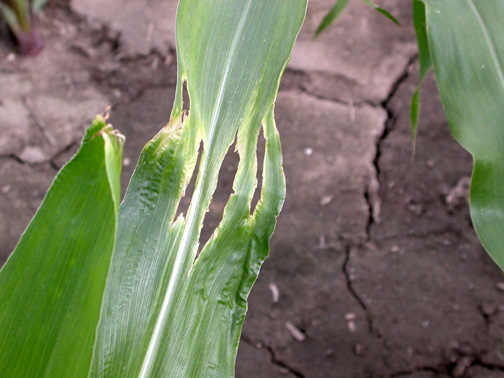
Linear holes on leaf with yellow "halo"

Prepare Grain Bins for Wheat Harvest - (Linda Mason)
- Stored grain insect infestations usually begin from poor sanitation.
- Procedures are given to prevent infestations.
- Now is the time to carry through these procedures.
The 2008 wheat harvest will soon be here. Preparing bins for storage now goes a long way toward preventing insect infestations during the summer. Several species of insects may infest grain in storage. The principal insects that cause damage are the adult and larval stages of beetles, and the larval stage of moths. Damage by these insects includes reducing grain weight and nutritional value; causing contamination (alive or dead); odor, mold, and heat damage problems that reduce the quality of the grain.
Newly harvested wheat may become infested with insects when it comes in contact with previously infested grain in combines, truck beds, wagons, other grain-handling equipment, augers, bucket lifts, grain dumps, or grain already in the bin. Insects may also crawl or fly into grain bins from nearby accumulations of old contaminated grain, livestock feeds, bags, litter, or any other cereal products.
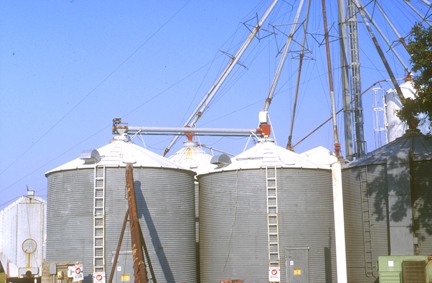
What's lurking in your grain bins?
Insect infestations can be prevented with good management practices. Now that many grain bins are empty, the following guidelines should be used before the 2008 grain is placed in bins:
• Brush, sweep out and/or vacuum the combine, truck beds, transport wagons, grain dumps, augers, and elevator buckets to remove insect-infested grain and debris.
• In empty bins, thoroughly sweep or brush down walls, ceilings, ledges, rafters, braces, and handling equipment and remove debris from bins.
• Inside cleaned bins, spray wall surfaces, ledges, braces, rafters, and floors with an approved insecticide, Storcide II® (chlorpyrifos-methyl (the active ingredient in Reldan - stored grain insecticide) and deltamethrin), Tempo SC Ultra® (cyfluthrin), Diacon II® (methoprene) or various diatomaceous earth (D.E.) products) creating a perimeter barrier. Outside, complete this barrier by treating the bases and walls up to 15 feet high, plus the soil around the bins. Storcide II must be sprayed in a downward spray only, and if treating the inside of structure, it can only be applied from the outside.
• Remove all debris from fans, exhausts, and aeration ducts (also from beneath slotted floors, when possible).
• Remove all debris from the storage site and dispose of it properly according to area, state, and/or federal guidelines (this debris usually contains insect eggs, larvae, pupae, and/or adults, ready to infest the newly harvested grain).
• Remove all vegetation growing within ten feet of the bins (preferably the whole storage area). Then spray the cleaned area around bins with a residual herbicide to remove all undesirable weedy plants.
• Repair and seal all damaged areas to the grain storage structure. This is not only to prevent insect migration into the bin, but also to prevent water leakage, which leads to mold growth.
• Do not store newly harvested grain on old grain already in storage.
• Whenever fans are not operated, they should be covered and sealed. This reduces the opportunity for insects and vertebrates to enter the bin through the aeration system.
When grain is placed in bin you may treat with an approved insecticide such as any of the D.E. products, Diacon or Storcide II. If grain is insect infested, fumigate to control existing populations and apply residual insecticide for long-term protection.
Soybean Aphid Update – (John Obermeyer)
Soybean aphid research has been in full swing since soybean emergence, so far one lonely aphid has been found in each of the last two weeks. Northern states are reporting a few more aphids, but still at extremely low numbers. So far, so good.

Lots of Weedy Soybean Fields – (Bill Johnson and Glenn Nice)
We have observed a number of fields where the giant ragweed is 1 to 4 feet tall and it appears the fields have not been sprayed yet. We have also observed a number of fields that have been sprayed and the giant ragweeds are alive and well. This seems like a good time to remind folks that we have glyphosate-resistant giant ragweed in at least 14 counties in Indiana and there is no doubt that giant ragweed management in soybeans has become a major challenge for Indiana growers. In addition, significant yield reductions (10% or more) occur when moderate to high densities of giant ragweed reach 9 inches in height. Use of a preplant or preemergence residual herbicides can delay the time that giant ragweeds reach that height by up to a week, but I suppose it is a bit late for this nugget of wisdom.
Our postemergence herbicide recommendations for giant ragweed management in Roundup Ready soybean in fields with a history of poor control is to use the maximum amount of glyphosate allowed by the label (1.5 lb ae/A) in the first treatment and be ready to respray in 3 weeks if needed. Keep in mind that the total amount of glyphosate that can be used between soybean emergence and R2 is 2.25 lb ae/A. We have also had some success on giant ragweed populations that are resistant to both glyphosate and ALS inhibitors with a tankmix of glyphosate and Flexstar or Phoenix/Cobra, followed by a second treatment of glyphosate about 3 weeks after the first treatment. It is important to note that the follow-up treatment must be applied in a timely manner – 3 weeks after the first treatment, not 5-6 weeks later when the ragweeds are poking out of the top of the canopy. It is also important to note that if your primary target is glyphosate-resistant giant ragweed, use an adjuvant system designed to maximize the activity of the tankmix partner on ragweed. If using Flexstar, add MSO and AMS. If you tank mix Phoenix or Cobra, add COC and AMS.
Another weed I am observing very frequently in soybean is volunteer corn. In our statewide weed survey we conducted in 2003, 2004, and 2005, the frequency of volunteer corn in Northern Indiana soybean fields has increased each year following increases in the adoption of glyphosate-resistant corn. Volunteer corn was present in 3% of the fields sampled in 2003 and increased to 5% in 2004, and 12% in 2005. Glyphosate-resistant corn in the U.S. increased to 11, 15, and 18% of planted corn acres in 2002, 2003, and 2004, respectively, and these percentages were strongly correlated (r=0.92) to the percentages of volunteer corn in following years. Another interesting observation from our field survey is that volunteer corn was twice as likely to be present in systems with tillage (10%) verses no-tillage (5%). In fields where volunteer corn was present, it was the only weed escape 26% of the time. Because glyphosate is used on a majority of soybean acres and volunteer corn is commonly found either by itself or with other weeds notably difficult to control with glyphosate, a majority of volunteer corn is likely found in soybean rotated with glyphosate-resistant corn. Growers with a glyphosate-resistant cropping system rotation, especially using tillage practices, should scout soybeans for volunteer corn prior to postemergence applications. In soybeans, the addition of Assure II/Targa, clethodim (Select/Arrow, others), Fusilade, Fusion in a tank-mix with glyphosate will help control volunteer corn in glyphosate-resistant soybeans.

Should Fungicides be Applied to Hail-Damaged Corn? - (Kiersten Wise and Greg Shaner)
- Hail damage does not make corn more vulnerable to leaf diseases that can be controlled by fungicide treatment.
- Fungicide applications may not increase yield of hail damaged corn.
Corn in some areas of Indiana was recently damaged by hail. We have heard recommendations to spray the damaged corn with a fungicide. Presumably the argument is that corn damaged by hail is more vulnerable to infection by various pathogens, or that it is important to aid the plant in recovery. To assess the validity of either of these arguments, first consider the damage done directly by hail. Hail can obliterate the growing point of a plant, in which case the plant is lost and fungicide will not bring it back. Hail also lowers yield potential through defoliation, which compromises the size of the photosynthetic factory, which ultimately provides the material that fills the grain. Yield loss depends on the stage of crop growth when the hail hits and the severity of defoliation (the percentage of leaf area removed). For a given degree of defoliation, damage increases as corn approaches the VT stage of growth (tasseling), and then declines. Most corn that sustained hail damage this past weekend was probably in the V6 to V9 stages of growth (leaf collar method). Hail adjustors use the droopy leaf method, which adds about 2 leaves to the above leaf collar stages. At the 8- to 11-leaf stages of growth, the reduction in yield potential is 11% to 22% if plants are completely defoliated. Yield reduction is 3% to 7% if plants are 50% defoliated. Even if corn at early vegetative stages is severely defoliated, plants will put out many new leaves before tasseling and silking. Refer to Bob Nielsen's article about hail damage and how to assess it in the Agronomy Tips section of this newsletter.
Does hail damage increase the risk of subsequent disease? There is no evidence that plants defoliated by hail are at greater risk of infection by leaf pathogens. Spores of these fungi produce germ tubes, which penetrate leaves directly. They don’t require wounds to enter the plant. We are not aware of any evidence that defoliated plants are more susceptible to these diseases after infection. Thus, a hybrid’s resistance rating probably applies to a hail-damaged the same as to an uninjured plant. For example, if a hybrid has moderate resistance to gray leaf spot, it will have the same degree of resistance if it has been damaged by hail. The common smut fungus does infect through wounds, but this fungus is not listed on the labels of fungicides registered for use on corn.
Carl Bradley, an extension field crop disease pathologist at the University of Illinois, conducted an experiment last year in which he simulated hail damage by attacking corn at the tassel emergence stage with a weed eater. The next day he applied fungicides. Defoliation from “hail” reduced yield by 19%. Fungicides controlled gray leaf spot to an equal degree on both undamaged and “hail-damaged” corn, but did not improve yield. The results of this research can be found in the 2008 Illinois Crop Protection Technology Conference Proceedings (pages 81-85) at: <http://www.ipm.uiuc.edu/education/proceedings/>.
Whether a field would benefit from a fungicide application depends on the susceptibility of the hybrid to any of the leaf diseases we commonly encounter in Indiana (gray leaf spot, northern corn leaf blight, southern corn leaf blight, northern corn leaf spot, anthracnose leaf blight, common rust) and to weather from now through August. Corn residue in or near the field will also increase disease pressure (except for rust--winds carry spores of this fungus up from southern states). Shortly after the rains that lead to all the flooding, we had some hot, humid weather that was probably favorable for establishment of infection on lower leaves. For several days up until a couple of days ago, weather was not particularly favorable for leaf diseases. Nights were cool and relative humidity low. We are now returning to wetter and warmer conditions. If a field is planted to a hybrid susceptible to one or more leaf diseases, and corn residue is in or near the field, then a fungicide should be considered whether or not the field sustained hail damage. We see no reason to factor in hail damage per se as a reason to apply a fungicide. It is also important to remember that these fungicides typically only protect the plant for 14 days after application. If fungicides are sprayed now in the absence of disease and conditions favoring disease persist over the next three weeks, susceptible hybrids may require a second application of fungicide for disease control. The last issue of Pest&Crop Issue 12 contains suggestions for field scouting and for deciding if and when to apply a fungicide to hybrid corn.

Recovery From Hail Damage to Young Corn – (Bob Nielsen)
- Yield loss from hail damage is based on reductions in plant population and leaf area.
- Allow a damaged field enough time to demonstrate the degree to which it may recover from hail damage.
As is usual in Indiana, early summer thunderstorms rumbling across the state often include damaging hail. Looking out the kitchen window the morning after such a storm can be one of the most disheartening feelings in the world to a corn grower.
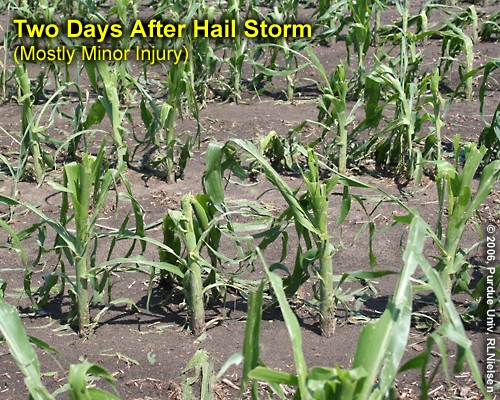
Yield loss in corn due to hail damage results primarily from 1) stand reduction caused by plant death and 2) leaf area reduction caused by hail damage to the leaves (Vorst, 1993). Assessing the yield consequences of hail damage in corn therefore requires that the severity of each of these factors be estimated.
Click for Hail Damage Photo Gallery <http://www.agry.purdue.edu/ext/corn/news/timeless/HailDamageYoungCornGallery.html>
Assessing Plant Survival
As with most early-season problems, evaluation of hail-damaged fields should not be attempted the day after the storm occurs because it can be very difficult to predict survivability of damaged plants by simply looking at the damage itself. Young corn has an amazing capacity to recover from early season damage but patience is required to allow the damaged plants enough time to visibly demonstrate whether they will recover or not. Damaged but viable plants will usually show noticeable recovery from the whorl within 3 to 5 days with favorable weather and moisture conditions.
One thing you can do shortly after the storm, however, is to evaluate the relative condition of the main growing point area of the stalk. The growing point, or apical meristem, of a young corn plant is an area of active cell division located near the tip of the pyramid-shaped top of the stalk tissue inside the stem of the plant (Nielsen, 2008b). The growing point region is important because it is responsible for creating all the leaves and the tassel of a corn plant.
Initially, the growing point is located below ground but soon elevates above ground beginning at about the 5th leaf collar stage. Slicing a stalk down the middle and looking for the pyramid-shaped upper stalk tissue can identify the vertical position of the growing point. If hail has damaged the growing point or cut off the stalks below the growing point, then those plants should be counted as victims and not survivors.
Remember that yield loss in corn is not directly proportional to the reduction in the number of plants per acre when the damage occurs early in the growing season (Table 1). The surviving plants surrounding an absent plant can compensate by increasing their potential ear size or by developing a second ear. A 25 percent reduction in plant population should reduce yield by less than 10 percent. A 50 percent reduction in plant population should reduce yield by less than 25 percent.
Assessing Defoliation Severity
Leaf damage by hail usually looks worse than it really is. Tattered leaves that remain green and connected to the plant will continue photosynthesizing. It takes a practiced eye to accurately estimate percent leaf death by hail. With that caution in mind, percent damage to those leaves exposed at the time of the hailstorm can be estimated and used to estimate yield loss due to defoliation alone.
The effects of leaf death on yield increases as the plants near silking, and then decreases throughout grain fill. Therefore, the grower needs to determine the leaf stage of the crop when the hail damage occurred.
Remember that leaf staging for the purposes of hail damage assessment is slightly different than the usual leaf collar method. The yield loss estimates listed in Table 2 are based on leaf stages as defined by the “droopy leaf” method (Nielsen, 2008a). If you are walking damaged fields many days after the storm, you can stage the crop that day and backtrack to the day of the storm by assuming that leaf emergence in corn occurs at the rate of about 1 leaf every 80 GDDs from emergence to V10 (ten fully visible leaf collars) or every 50 GDDs from V10 to the final leaf (Nielsen, 2008d).
Once percent leaf damage and crop growth stage have been determined, yield loss can be estimated by using the defoliation chart provided below in Table 2. This table is a condensed version of the season-long table published in the Purdue Extension publication ID-179, Corn and Soybean Field Guide or in NCH-1, Assessing Hail Damage in Corn (Vorst, 1993).
Assessing Consequences of Whorl & Stem Bruising
The eventual yield effects of severe bruising of leaf tissue in the whorl or the stalk tissue itself in older plants are quite difficult to predict. Consequently, it can be difficult to determine whether to count severely bruised plants as survivors or whether they should be voted off the field. The good news is that observations reported from an Ohio on-farm study suggest that bruising from hail early in the season does NOT typically result in increased stalk lodging or stalk rot development later in the season (Mangen & Thomison, 2001).
Early season bruising of leaf tissue or stem tissue may, however, have other consequences on subsequent plant development; the occurrences of which are hard to predict. Areas of bruised whorl leaf tissue often die and can then restrict continued expansion of whorl leaves, resulting in the type of ‘knotted’ whorl reminiscent of frost damaged plants. These same bruised leaves would be more susceptible to secondary invasion by bacteria contained in splashed soil that might have been introduced into the damaged whorls if the hailstorm was accompanied by driving rains.
If the plant tissue bruising extends as deep as the plant’s growing point, that important meristematic area may die; thus killing the main stalk and encouraging the development of tillers. If the plant tissue bruising extends into the area near, but not into, the growing point; subsequent plant development may be deformed in a fashion similar to any physical damage near the hormonally active growing point (stinkbug, stalk borer, drill bits used by malicious agronomists).
Example of Assessing Damage
Let’s say that your field of corn was at the 7-leaf stage (approximately V5 by the leaf collar method) when hail damage occurs. After walking the field several days later, you determine only 20,000 of your original 30,000 plants per acre will survive the hail damage. Let’s further assume that your original planting date was 25 April. Your surviving stand of 20,000 now has an upper yield potential of 92% of “normal” (Table 1). Therefore, the yield loss due to plant death itself would be about 8%.
Click here to see the table for "Expected Grain Yield Due to Various Planting Dates and Final Plant Populations".
Let’s also assume that you estimate the average percent leaf death by defoliation to be 50% (which to most of us would look devastating). The combination of leaf stage and percent defoliation would translate into an additional 2% yield loss (Table 2), resulting in a total estimated yield loss due to both stand reduction and defoliation of approximately 10%.
Table 2. Estimates of percent yield loss in corn due to leaf defoliation at selected leaf stages. |
||||
Leaf stagea |
25 |
50 |
75 |
100 |
Approximate % yield loss |
||||
| 7-leaf | 0 |
2 |
5 |
9 |
| 8-leaf | 0 |
3 |
6 |
11 |
| 9-leaf | 1 |
4 |
7 |
13 |
| 10-leaf | 1 |
6 |
9 |
16 |
| 11-leaf | 1 |
7 |
12 |
22 |
| 12-leaf | 2 |
9 |
16 |
28 |
| 13-leaf | 2 |
10 |
19 |
34 |
| 14-leaf | 3 |
13 |
25 |
44 |
aLeaf stage according to the “droopy leaf” method (see Nielsen, 2004a). The corresponding leaf stage according to the leaf collar method would be approximately 2 less than the “droopy leaf” values shown above (e.g., 7-leaf~V5). Adapted from the National Crop Insurance Association’s “Corn Loss Instruction” (Rev. 1994).
|
||||
Related References
Mangen, Todd and Peter Thomison. 2001. Early Season Hail Damage in Corn: Effects of Stalk Bruising and Tied Whorls. Ohio State Univ. Cooperative Ext. Service Special Circular 179-01. [On-Line]. Available at <http://ohioline.osu.edu/sc179/sc179_16.html> [URL accessed 6/1/08].
Nielsen, RL (Bob). 2008a. Determining Corn Leaf Stages. Corny News Network, Purdue Univ. [On-Line]. Available at <http://www.kingcorn.org/news/timeless/VStageMethods.html> [URL accessed 6/1/08].
Nielsen, RL (Bob). 2008b. Growing Points of Interest. Corny News Network, Purdue Univ. [On-Line]. Available at <http://www.kingcorn.org/news/timeless/GrowingPoints.html> [URL accessed 6/1/08].
Nielsen, RL (Bob). 2008c. Tips for Staging Corn with Severe Leaf Damage. Corny News Network, Purdue Univ. [On-Line]. Available at <http://www.kingcorn.org/news/timeless/VStagingTips.html> [URL accessed 6/1/08].
Nielsen, RL (Bob). 2008d. Use Thermal Time to Predict Leaf Stage Development in Corn. Corny News Network, Purdue Univ. [On-Line]. Available at <http://www.kingcorn.org/news/timeless/VStagePrediction.html> [URL accessed 6/1/08].
Thomison, Peter. 2008. Hail damage in corn. C.O.R.N. Newsletter, Ohio State Univ. [On-line]. Available at <http://corn.osu.edu/index.php?setissueID=238> [URL accessed 6/23/08].
Vorst, J.J. 1993. Assessing Hail Damage to Corn. Purdue Univ. Cooperative Ext. Service Publication NCH-1. [On-Line]. Available at <http://www.ces.purdue.edu/extmedia/NCH/NCH-1.html> [URL accessed 6/1/08].