


Pest & Crop Newsletter, Entomology Extension, Purdue University


Grubs, Hairy Butts Are Revealing – (John Obermeyer, Christian Krupke, and Larry Bledsoe)
- Early planting and cool soils increase the likelihood of grub damage.
- Soil type is another important variable.
- No rescue treatments are available for economic poplations.
- Insecticides labled for grub control or protection in corn are listed below.
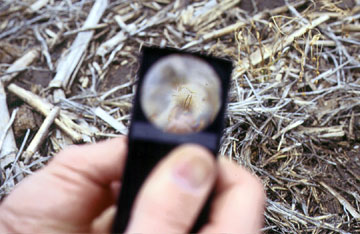
Viewing through a magnifying lens to identify grub species.
Several producers got off to a good start last week before the rains and storms hit on Friday. Indiana Agricultural Statistics estimates that 3% of Indiana’s corn has been planted. With the warm temperatures and moist soils, some of the corn is beginning to spike. Grub complaints typically increase in frequency with the earliest planted crop. Obviously there’s more to it than just planting date. Factors such as the field’s grub populations and soil type, coupled with spring growing conditions all play a part.
Seed already planted will likely be subjected to cooler soils and extended germination/emergence. If corn is slow to emerge and grubs are found nearby, it is often assumed that they are feeding on the seed/seedling. However, the reason for slow germination and emergence is usually cool soil temperatures, and not grub activity. Grubs may or may not be damaging the crop, remember that they too are less active in cool soils. Once soils warm up, grubs may begin feeding on roots, although they also feed on organic matter (O.M.) in the soil. The length of the feeding period and grub population will largely dictate whether economic damage will occur. In other words, the longer a grub is near the seedling, the greater the likelihood of damage. As indicated above, the chances of this interaction increase as soil temperatures decrease.
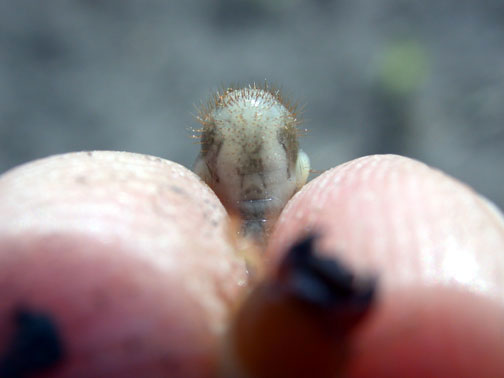
The "V" shaped hairs identify this grub as a Japanese beetle.
Japanese beetle is the predominant grub species found in field crops in Indiana. Eggs laid in the soil during late summer and early fall hatch into grubs that feed on living and decaying plant matter. Grubs overwinter as partially developed larvae 4 to 6 inches deep in the soil. Little is known or understood about their ability to withstand extremes in soil temperature, moisture, and freezing/thawing action through the winter months. Japanese beetle numbers from soybean sweeps taken last year indicate that statewide beetle populations were lower than normal.
Japanese beetle grubs feed on both living and dead plant material when they crawl to the upper soil profile in the spring. Soils low in O.M and crop residues will encourage grubs to move more horizontally in the soil profile until suitable food sources are found. Corn or soybean roots that they encounter will be fed upon. Should you scout a field suspected to have grub damage, be certain to inspect the soil between rows for grub presence, particularly in areas with high O.M. soil. However, grubs in low O.M. sandy or timber soils will concentrate in root zones because alternate food sources are scarce.
Since rescue treatments are not available for corn or soybean, the most effective way to control grubs is to apply protection at planting (see table below for corn). If an economically damaging grub population is observed in a field that has already been planted and the stand is threatened, a soil insecticide/insecticide treated seed could be used as part of a replant operation. Replanting, however, is not recommended unless a critical level of plants is being significantly damaged or destroyed by grubs. Remember that a number of factors can cause stand reductions. Be certain that the grubs are the primary cause of damage, and are actively feeding on the roots before making a replant decision.
Corn Insecticides Labled for Grubs at Planting* |
||
Product |
Label Claims |
Additional Label Notes |
| Aztec 2.1 & 4.67G | control |
|
| Capture 2 EC | control |
|
| Cruiser | protection |
Early season protection |
| Force 3G | control |
Use higher label rate in-furrow for heavy infestations |
| Fortress 2.5 & 5G | control |
In-furrow application provides optimal control. |
| Lorsban 4E | control |
|
| Lorsban 15G | control |
Control at 1.5X rootworm rate for severe infestations. |
| Poncho | protection |
Aid in the protection of seeds and seedlings against injury. |
| Regent | control |
|
| *Products labeled for grubs often do not perform satisfactorily under heavy infestations. If grubs are causing economic damage in feilds where products labeled for "control" are used, producers should be contacting their dealer and/or sales representative for a performance evaluation. Producers should be cautious using products labeled "protection" where higher grub pressure is expected. Be sure to read the label for use and application information. | ||

Alfalfa Weevil Management Guidelines and Control Products – (Christian Krupke, John Obermeyer and Larry Bledsoe)
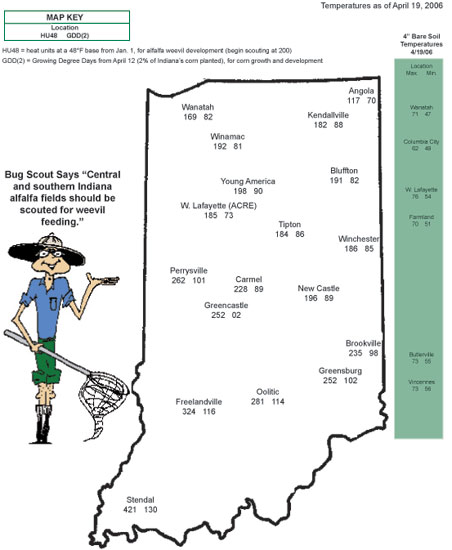
Pest managers in southern Indiana should now be scouting their alfalfa for leaf feeding from weevil larva. Frankie Lam, SW Indiana IPM Specialist, found over 60% tip feeding in an alfalfa field near Vincennes. This pest is often overlooked during the early spring planting season.
Producers can manage this pest most effectively by utilizing heat unit accumulations data (base 48°F) to determine when sampling should begin and when an action should be taken, The management guidelines listed below should be used to determine when alfalfa weevil should be controlled in southern Indiana. Refer to heat unit information in each week’s Pest&Crop “Weather Update.“
|
|
||||||||||||||||||||||||||||||||||||||||||||||||||||||
Armyworm and Cutworm Moth Flights, What’s Going On? - (Christian Krupke, John Obermeyer and Larry Bledsoe)
- Kentucky reporting large numbers of armyworm mothes.
- One trap in Indaiana is catching inordinate number of black cutworms.
- Crop scouting will be emphasized for the next several weeks!
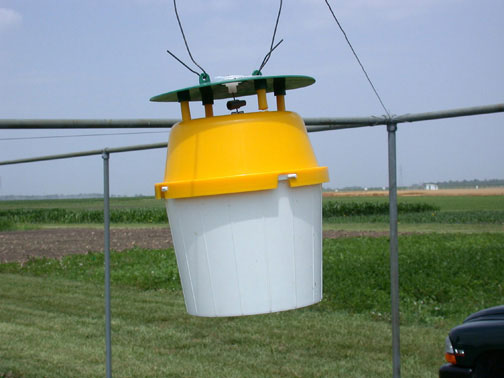
Universal or bucket pheromone trap.
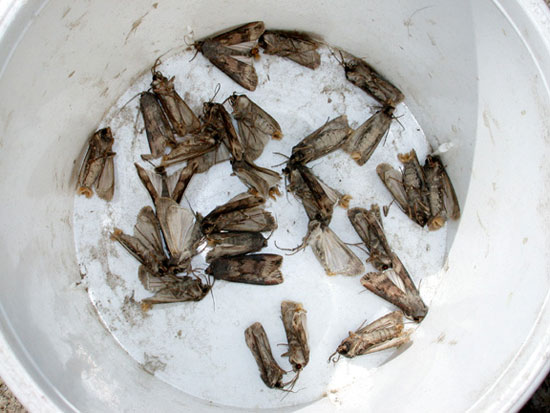
One night's catch of 28 moths in bucket trap.
Armyworm pheromone traps monitored by the University of Kentucky have been catching an impressive early moth flight for several weeks. Doug Johnson, UK Extension Entomologist, has been helpful in disseminating this information to alert of the potential impact this may have on hay, small grain, and corn crops. Our black light trapping at the Purdue Agricultural Research Centers, which began last week, doesn’t have us nearly as excited (see “Black Light Trap Catch Report”). If 2001 is our guide to determine a major armyworm outbreak, the next several weeks of black light catches will be important to watch. In the meantime, grassy crops in extreme southern Indiana should be monitored soon for leaf defoliation and small armyworm larvae hiding under the soil surface residues during the day. This is especially true where grass-hay and wheat are thick and lush, a favorite egg-laying location for moths.
As mentioned in last week’s Pest&Crop, black cutworm moths are being captured by our pheromone trap cooperators throughout the state. There have been a few intensive captures (9 or more moths captured in 2 consecutive nights) which has signaled the beginning of heat unit accumulations to predict the beginning of cutting. The unexplained phenomenon this past week has been the Obermeyer trap in Tippecanoe County. Though this trap is a universal or bucket trap, compared to most using the sticky-bottom wing trap, the pheromone is the same. The moth capture for the week was 129, with 5 nights of over 20. This is very high.
It seems as though the extreme storms that have moved through the Midwest in the last month have brought us an abundance of armyworm and black cutworm moths from the Southwestern United States. What this means to our crops will unfold in the next several weeks. Stay tuned and happy scouting!
Bug Scout
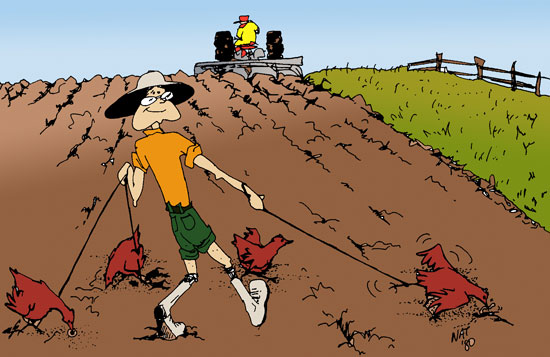
It's one way to get rid of grubs!

Trumpetcreeper, One Tough Plant – (Glenn Nice, Bill Johnson, and Tom Bauman)
Trumpetcreeper (Campsis radicans) is a native perennial vine that is often found climbing fences, electric wire or telephone poles and, on occasion, running along the ground when there is nothing to climb. Its common name is appropriate because its most distinguishing characteristic is its bright orange trumpet-like flower. The accompanying picture shows Japanese beetles enjoying a smorgasbord of trumpetcreeper flower. Trumpetcreeper vines can reach a length of up to 40 feet, and leaves are oppositely arranged on the stems, with oppositely arranged leaflets in a pinnately compound leaf. Each leaf can have seven to 15 leaflets and each trumpetcreeper flower can produce a long pod1.
Like several other problematic perennials, Canada thistle to name one, trumpetcreeper produces a deep root system that can produce new above ground stems. Although trumpetcreeper can reproduce by seed, it is believed that root stock is the dominate mechanism of proliferation. Root stocks cut 0.8 inches long can produce shoots eight weeks after planting2. Stems continue to emerge when root stock is buried up to nine inches deep; however, planting depths from three to nine inches did not have any effect on production of total above ground biomass2. To add to the fast spread of trumpetcreeper, it can also root where the stems touch soil. This would add to the ability to fragment into new plants.
For the most part in Indiana, trumpetcreeper is a weed that sits on the fence or the fringes of our row crops. Occasionally it can invade no-till fields, reducing soybean yield and becoming a nuisance at harvest time. It has been reported that 0.6 plants/yard2 can reduce soybean yield 18%3. In this study, a comparison between shallow and deep tillage, it was reported that there was no significant difference between the two methods two out of three years4. Over a three year period, the treatments that received shallow tillage tended to have increased biomass by 37% and treatments that received deep tillage treatments, decreased biomass by 26%2. The significance of these differences were not investigated across years. Often chemical control is needed to suppress trumpetcreeper growth.
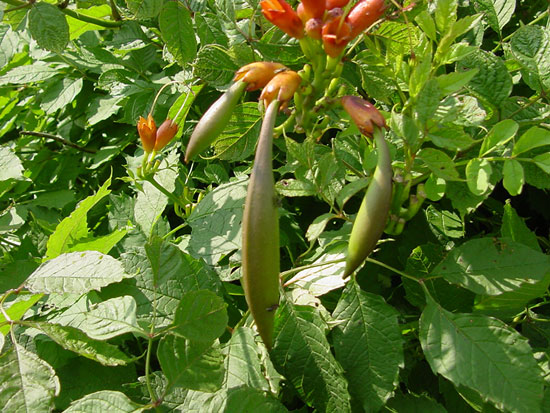
Japanese beetles feeding on trumpet creeper. (Photo source: Glenn Nice, Purdue University)
Many of the herbicides labeled for conventional soybean will provide suppression by burning or injuring the above ground portions of the plant. K. Bradley et. al., (2005) conducted research in Virginia with several herbicide treatments. The application of paraquat (Gramoxone Max®) before planting soybean followed by a postemergence application of either lactofen (Cobra®, Pheonix®), acifluorfen (Ultra Blazer®), fomesafen (Flexstar®, Reflex®), imazamox (Raptor®), or cloransulam (FirstRate®) failed to decrease trumpetcreeper density5.
In an earlier study by Bradley and Hagood (2001), the use of mesotrione (Callisto®) in corn postemergence provided a 70% reduction in trumpetcreeper population6. The use of dicamba (Banvel®, Clarity®) or dicamba plus mesotrione or pimsulfuron (Beacon) reduced trumpetcreeper population 60% or greater. Also like Canada thistle, controlling the underground portions of this plant is essential to achieve sufficient control. This requires a herbicide that will translocate into the underground portions of the plant.
Glyphosate is also often used to suppress trumpetcreeper. However, this is not a silver bullet against this plant either. Glyphosate (Roundup Weathermax®, Touchdown®, Glyphomax®, etc) at 0.74 or 1 lb. ai/A applied mid-July (Virginia) reduced densities 35 to 30%5. The application of glyphosate at 1 lb. ae/A (ae stands for “acid equivalent”) followed by a second application of 0.75 lb. ae/A reduced biomass 89%4. The use of split applications was reported to reduce biomass to acceptable amounts, 0.16, 0.14, and 0.06 oz. dry weight/yard(2) in three years, respectively4. It might be expected that, left unattended, the trumpetcreeper might return from surviving root stock buried deep, but long term results were not investigated.
Triclopyr plus 2,4-D (Crossbow®) can also be used to suppress/control trumpetcreeper in non-crop, fencerows and grass pastures. The use of 1.5% v/v mixture or a 6 qt./A broadcast rate or 4 qt./A on permanent pastures can provide approximately 60 to 79% control.
Controlling trumpetcreeper can be difficult and often frustrating. Results from using tillage and/or chemical control measures can be inconsistent depending on age of the plants and environmental conditions. Although they appear to feed on trumpetcreeper, I don’t believe we can rely on Japanese beetles to control this beautiful but pesky plant for us.
Reference:
(1) Trumpetcreeper or cow-itch: Campsis radicans. Accessed 3/13/06. Virginia Tech Weed Identification Guide. http://www.ppws.vt.edu/scott/weed_id/cmira.ht.
(2) Edwards, J.T. and L.R. Oliver. 2004. Emergence and growth of trumpetcreeper (Campus radicans) as affected by rootstock size and planting depth. Weed Technology 18:816-819.
(3) Edwards, J.T. and L.R. Oliver. 2001. Interference and control of trumpetcreeper (Campsis radicans) in soybean. Proceedings of the Southern Weed Science Society 54:130-131.
(4) Reddy, K.N. 2005. Deep tillage and glyphosate-reduced redvine (Brunnichia ovata) and trumpetcreeper (Campsis radicans) populations in glyphosate-resistant soybean. Weed Technology 19:713-718.
(5) K.W. Bradley, E.S. Hagood, Jr., P.H. Davis. 2004. Trumpetcreeper (Campsis radicans) control in double-crop glyphosate-resistant soybean with glyphosate and conventional herbicide systems. Weed Technology 18:298-303.
(6) K.W. Bradley and E.S. Hagood, Jr. Posted 2001, accessed 3/13/06. Identification and Control of Trumpetcreeper (Campsis radicans (L.) Seem ex Bureau) in Virginia. Virginia Cooperative Extension. http://www.ext.vt.edu/pubs/weeds/450-143/450-143.html.

Risk Model for Fusarium Head Blight of Wheat - (Gregory Shaner)
- We can get some advance notice of an epidemic.
Again this year, a weather-based risk model for Fusarium head blight (scab) of wheat is available on the internet. It can be accessed at http://www.wheatscab.psu.edu/. The model uses weather for 7 days up to the day of prediction to estimate the risk of an epidemic of scab. An epidemic occurs when severity of scab in a field is at least 10%. A severity of 10% means that 10% of the heads are completely blighted, 20% of the heads are 50% blighted, etc.
The web site contains background information about the disease, details of the model, and instructions for applying the model. The model is easy to use. You need to specify whether your crop is winter wheat or spring wheat, and then select the date at which the crop flowers. This year, the model can make predictions up to 2 days ahead of the actual calendar date.
Once you have entered the crop type and flowering date, the model displays a map of the eastern U.S. You can click on a state to see the color-coded model prediction. The state map includes county boundaries and weather stations. Clicking on a weather station will display model output details for that station. A new feature this year is a commentary box at the bottom of the screen. As wheat begins to flower in Indiana, I will update this commentary frequently.

Impact of Hail on Jointing Wheat - (Shawn P. Conley)
- Hail Events at Jointing Cause Minimal Damange to Wheat.
Recent severe weather has caused some damage to wheat fields in Indiana. Fortunately the majority of this damage has been cosmetic in nature. In central Indiana the wheat crop is between the hollow stem (Feekes 4-5; Zadoks 30) and the second detectable node (Feekes 7; Zadoks 32) growth stages. The majority of the hail damage that I have witnessed in central Indiana has been leaf shredding (Figure 1). Though this damage does constitute a loss in leaf area, a minimum of 3-5 leaves have yet to emerge from the wheat whorl. Fortunately, these leaves were protected from damage and should quickly overcome any loss in whole plant photosynthesis. These leaves are also the most vital when it comes to yield. Another common symptom caused by hail is stem bruising (Figure 2). If this injury occurs above the developing head, wheat will continue to grow though the injury (Figure 3). If this injury occurs below the developing head and is superficial as shown in Image 2 then the wheat crop should continue to develop without any problems. If the plant is girdled or if the stem is completely broken off, then that stem (head) is lost. In southern Indiana the wheat crop is further advanced and approaching flag leaf emergence (Feekes 9; Zadoks 39). At this growth stage yield loss caused by leaf shredding may be greater. The risk of yield loss due to head damage or stem breakage is also greater from flag leaf emergence forward.
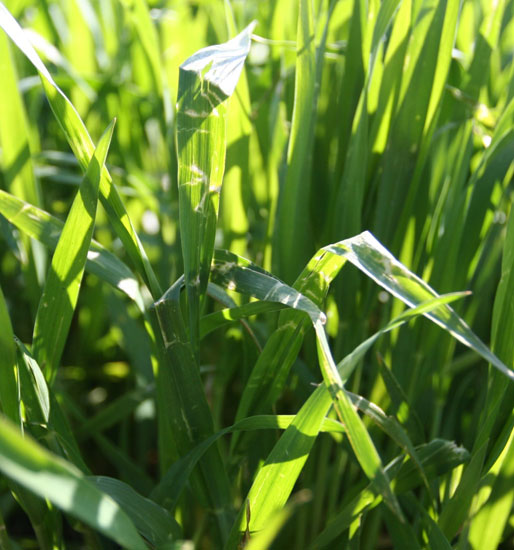
Figure 1. Hail leaf damage (shredding) to wheat
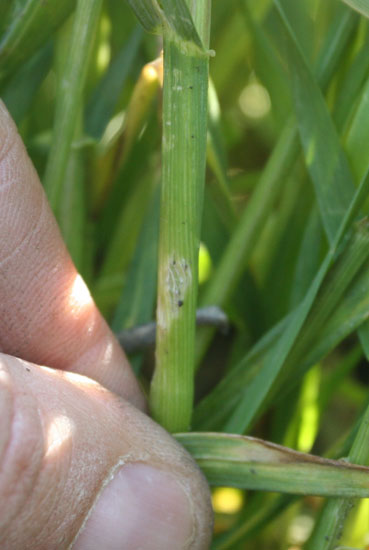
Figure 2. Hail stem injury to wheat
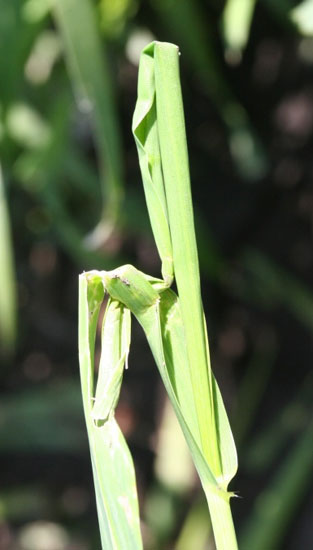
Figure 3. Wheat re-growth following stem damage above the wheat head