


Pest & Crop Newsletter, Entomology Extension, Purdue University


Black Cutworm Moths Blowing Into Indiana - (John Obermeyer, Christian Krupke, and Larry Bledsoe)
- Recent fronts have brought with them black cutworm moths.
- Timing of scouting can be improved by tracking heat unit accumulations.
- Scouting fields and treatng when necessary makes more sense than preventative applications of insecticides.
- Don't rely on insecticide-treated seed to prevent economic damage.
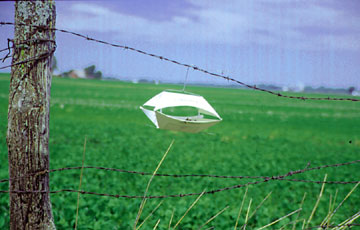
Black Cutworm pheromone trap
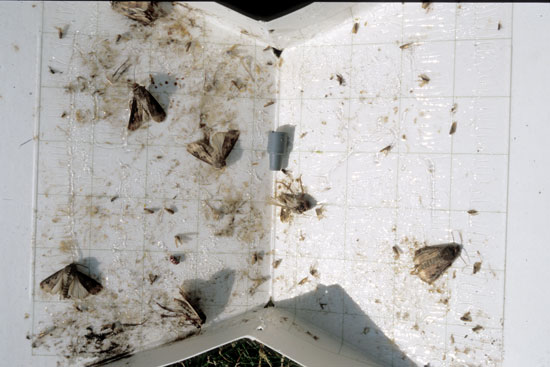
Pheromone trap bottom with captured black cutworms
Most of our dutiful trapping cooperators throughout the state captured black cutworm moths this past week - refer to the “Black Cutworm Adult Pheromone Trap Report” for details. This recent flush of moths is attributed to warm wind currents from the southwestern portions of the country.
Moth arrival, along with the use of heat units to predict the beginning of larval activity, gives us an indication of potential severity of the problem and locations of concern. Thus, we are able to predict with some degree of accuracy when and where crop damage is likely to occur based on these data. Refer to the “Weather Update” in future issues of the Pest&Crop as we track heat unit accumulations and predicted damage in your area.
Should one treat for black cutworm before or at planting? Because of the sporadic outbreak nature of this pest, the tried, true, and economic approach to black cutworm management is to scout fields, determine infestation and damage levels, and use a rescue treatment, if needed. Producers using insecticide-treated seed may have a false sense of security concerning black cutworm control. Certainly the systemic activity of these newer insecticides during the seedling stage should help suppress small larvae feeding on plants. However, this protection is short-lived and fields attracting egg-laying moths during multiple flights will likely experience significant damage and stand losses.

Alfalfa Weevil Damage Beginning in Southern Indiana - (John Obermeyer, Christian Krupke, and Larry Bledsoe)
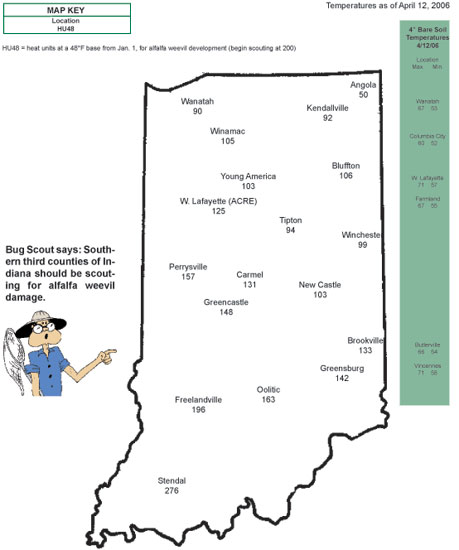
- Alfalfa weevil activity has begun.
- Scouting should begin now in southern Indiana.
- Damage and heat unit accumulations are th basis of management decisions.
The flowers are blooming, the farm equipment is rolling, and alfalfa weevil are beginning to feed…spring is here! Richard Huntrods, at Feldun Purdue Agricultural Center near Bedford, reported the beginning of alfalfa weevil feeding. This is as we would expect given the heat unit accumulations in those areas. In other words, it’s time to start scouting alfalfa for weevil damage in the southern counties of Indiana.
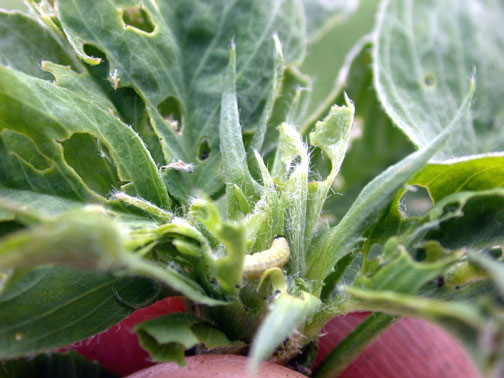
Close-up of stem tip with alfalfa weevil and damage
Field scouting for alfalfa weevil damage should begin when approximately 200 heat units, base 48°F, have accumulated from January 1 (see “Weather Update” for locations near you). Sampling a field to determine the extent of alfalfa weevil damage and average stage of weevil development is best accomplished by walking through the field in an “M-shaped pattern.” Ten alfalfa stems should be examined in each of 5 representative areas of the field for a total of 50 stems from the entire field. Consider that south facing slopes and/or sandy soils warm sooner and should be included in the sampling. Each stem should be examined for:
- Evidence of tip feeding by alfalfa weevil larvae
- Maturity of the stem (i.e., pre-bud, bud and/or flowers)
- Stem length
The average size (length) of weevil larvae should also be noted. Although large alfalfa weevil larvae are relatively easy to find, small larvae are difficult to see; thus, very close examination of leaves may be required to detect “pin-hole” feeding, small black fecal pellets and small off-white larvae.
By utilizing heat unit accumulation data to determine when sampling should begin and when management action should be taken, producers can get the greatest economic return. If the application of an insecticide is required early in the weevil season, producers have the option of using a material that has good residual action. Later in the season, short residual insecticides should be used and producers should pay close attention to harvest restrictions. Management guidelines, which are based on heat unit accumulations, will be given in next week’s Pest&Crop.
Calibrate Granular Insecticide Boxes Before Planting - (John Obermeyer, Christian Krupke, and Larry Bledsoe)
- Properly calibrate your insecticide boxes as you service and ready your planter this spring.
- Calibrate each unit.
Hopefully all producers have their planting equipment fine-tuned and ready for planting this spring. Just as it is important to have your planter units in good working order, your granular insecticide boxes should be cleaned, worn or broken parts replaced, and properly calibrated. The importance of this was recently brought to light while working with several producers on research trials in northwestern Indiana. For several years we calibrated producer’s granular applicators before planting and found that the settings change, even when using the same planter and product. Occasionally we find serious mechanical failures with boxes or foreign material (e.g., scraps of seed bags) impeding granular flow, causing significant misapplication. This in turn leads to potential for unprotected seed and subsequent crop losses.
Remember, each granular unit should be calibrated separately. Use calibration tubes and instructions supplied by the manufacturer or dealer for the insecticide of choice. To calibrate: 1) measuring off a distance of 500 feet along which the planter will travel at planting speed during the calibration process or operate the planter in a stationary position that allows one to simulate traveling 500 feet at planting speed, 2) set each application unit at some beginning setting (planter manual and/or insecticide label may help in this regard), 3) attach an insecticide collection device to each unit, 4) catch and weigh the insecticide that is metered out of each application unit over the prescribed distance, and 5) compare the amount of product caught for each unit with the amount that should be delivered over the prescribed distance (see following table).
| Row Rates of Granular Soil Insecticide | |
| Product | Ounces of captured/500 feet of row |
| Aztec 2.1G | 3.35 |
| Aztec 4.6G (Smartbox) | 1.5 |
| Force 3G | 2.0-2.5 |
| Fortress 2.5G | 3.0-4.5 |
| Fortress 5G (Smartbox) | 1.5-2.25 |
| Lorxban 15G | 4.0 |
When calibrating, don’t forget to operate the planter at planting speed. Once you determine the correct setting for each unit, check each unit one more time to make sure that you are getting a fairly consistent reading. Also, record the setting somewhere on the insecticide box (but remember that you will still need to recalibrate next year even if using the same product). We can’t stress enough the importance of proper calibration. Happy planting!
Click to see Table
Black Cutworm Adult Pheromone Trap Report
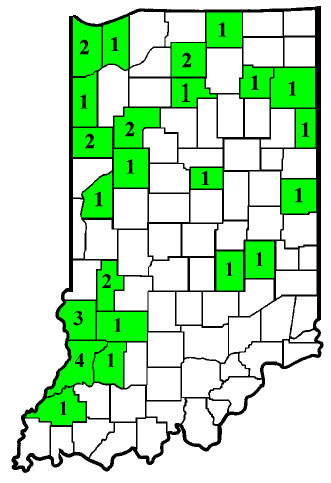

Oh it must be spring... look at the pretty black cutworm moths!

Shattercane Interference and Nitrogen Accumulation in Roundup Ready Corn – (Bill Johnson and Glenn Nice)
This article is the second in a series discussing the effects of weed interference in Roundup Ready corn on corn and weed nitrogen accumulation and corn yield. The goal of this series of articles is to raise awareness of the effects of early-season weed competition on corn in weed management systems that are heavily reliant on a postemergence herbicide that will control relatively large weeds. The information presented in this specific article would be would apply to use of glyphosate in Roundup Ready corn, Lightning in Clearfield corn, Liberty in Liberty Link corn, or Accent, Beacon, Steadfast, Option, or Equip in non-transgenic corn. All of these herbicides will control relatively large shattercane in corn unless the population is ALS resistant in which case the ALS herbicides will be less effective. Severe shattercane infestations in the eastern cornbelt are not as common as some other weeds such as foxtails, lambsquarters, and giant ragweed. However, our field surveys over the last three years have indicated that it is prevalent in almost every county sampled and Glenn and I receive a number of calls each year on shattercane management in corn. From a competitive standpoint, shattercane and johnsongrass would be similar in the amount of yield loss caused by interference in corn.
Prior to the introduction of Accent and Beacon about 15 years ago, shattercane was controlled in corn with preemergence herbicides and cultivation. Postemergence herbicides including Accent, Pursuit, Beacon, Steadfast, Option, Equip, Liberty, and glyphosate (Roundup/others) have been shown to be much more effective than soil-applied herbicides and cultivation for control of shattercane. The respective labels for most of these herbicides indicate that they can be applied to shattercane up to 12 inches tall. In production fields it is common to delay applications until plants are 12 to 18 inches. This delay in application timing is to ensure that most of the seedlings have emerged and there is adequate leaf area for spray coverage. The concern we have with applications to 12 to 18 inch tall plants is that even though effective control can be attained, yield loss had occurred due to weed interference and growers were unaware of it.
Shattercane is an especially competitive weed because plant heights can reach 10 feet, which results in crop shading, and the weed is similar to corn in growth and nutritional needs. There are few published references on shattercane interference in corn. Beckett et. al., (1988) reported that shattercane interference in corn resulted in a 22% to 75% reduction in grain yield. They also determined that on a per plant basis, shattercane is more than twice as detrimental to corn yield as giant foxtail.
Nitrogen is a major economic input and is utilized in the plant to produce enzymes and proteins. Nitrogen has been shown to be a critical factor in weed competition. Research has shown that weeds reduce not only crop grain yield, but also the amount of macronutrients found in the corn plant. Yield reductions due to weed interference are increased by nitrogen deficiencies. However, corn-weed interactions are complex and additional stresses, such as drought have varying effects on yield losses.
We conducted field experiments to determine the impact of shattercane interference on corn grain yield and nitrogen uptake on a silt loam soil with 2.6% organic matter (Hans and Johnson 2002). A glyphosate-resistant corn variety was planted and atrazine was applied premergence and used to control all weeds except shattercane. In essence, this system is similar to conditions experienced in production fields when all weeds are controlled by soil applied herbicides and shattercane comes through the soil applied herbicides and requires postemergence treatments to clean up the escapes.
Shattercane emerged at the same time as corn and our treatments consisted of glyphosate applied to various plots when shattercane was 3, 6, 9, 12, 15, or 18 inches tall (Table 1). After glyphosate applications to specific plots, those plots were hand-weeded weekly thereafter to maintain weed-free conditions after the early-season interference. Average shattercane density in this experiment was 18 plants per square foot. Corn tissue N content and yield is shown in Table 2.
Corn yields were quite different between years because of the drought that began in the latter half of the 1999 season and timely rainfall late in the 2000 season. Season-long shattercane interference resulted in an 85% yield loss in 1999 and a 43% yield loss in 2000 (Table 2). Yield reductions occurred when shattercane was allowed to remain with corn until 12 inches tall before herbicide treatment. In both years, late season corn biomass N content was highly correlated (r = 0.95 and 0.84, respectively) with corn yield. When shattercane was allowed to reach the maximum recommended height for nicosulfuron or primisulfuron application (12 inches), significant yield losses occurred and shattercane accumulated 10 and 20 lb N/A, while corn accumulated 10 and 16 lb N/A, respectively, in 1999 and 2000 (data not shown). This indicates that shattercane can accumulate significant amounts of N early in the season, similar to that reported for annual grasses in last weeks article.
In addition, when shattercane reached 12 inches in height in these experiments, corn was at the V8 stage in 1999 and the V6 stage in 2000. The maximum recommended growth stage for most ALS corn herbicides that control grasses is V6. This is the stage in which the number of kernels/cob is determined. Herbicide stress at this stage can result in fewer kernels/cob, malformed ears and yield loss in certain hybrids.
Corn yields were converted to a percentage of the weed-free treatment in each year and are shown in Figure 1. This graphic shows the relative corn yield at each shattercane removal timing in days after planting. This graphic shows that corn yield was reduced 0.66% per day for each day the herbicide application was delayed past the optimal stage which occurred about 20 to 30 days after planting. In terms of real numbers, in a field with a 200 bu/A yield potential, this equates to over 1 bu/A/day in yield loss if the optimal timing for removal is missed!
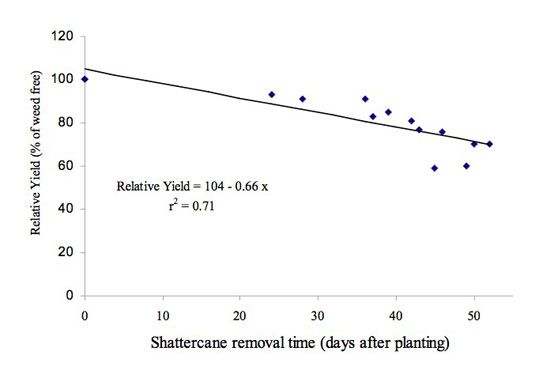
Figure 1. Percentage of maximum corn yield at time of shattercane removal.
The take home message from this study is that if soil-applied herbicides are not used or they have little or no effect on reducing shattercane infestations, regardless of the herbicide or herbicide-resistant variety used, shattercane should be controlled before it reaches 12 inches tall if the average density is 18 plants per square foot or greater to avoid yield losses. From a management standpoint there are a few soil applied herbicides which provide suppression of shattercane and could be effective in reducing early-season density and competitiveness. In the Weed Control Guide for Ohio and Indiana, we have listed the relative effectiveness of a number of soil applied herbicides for shattercane in the weed response table on page 37. Keep in mind that none of them will provide complete control and that use of the upper end of the labeled rate for a soil type will be required to provide any meaningful activity. Herbicides which contain a chloroacetamide {acetochlor, metolachlor, dimethenamid (Outlook), flufenacet (Define)} provide some suppression if the rate is near the upper end of the labeled use rate. In addition, for low cost shattercane suppression, Prowl would be economical to use in these situations, but keep in mind that Prowl cannot be incorporated or corn injury will occur. Balance Pro also provides some suppression and is a common tankmix partner with atrazine and atrazine premixes.
References
Beckett, T. H., E.W. Stoller, and L. M. Wax. 1988. Interference of four annual weeds in corn (Zea mays). Weed Sci. 36:764-769.
Hans, S. R., and W. G. Johnson. 2002. Influence of shattercane (Sorghum bicolor L. Moench.) on corn (Zea mays L.) yield and nitrogen accumulation. Weed Technol. 16:787-791
Poison Hemlock Control in Corn and Soybean – (Glenn Nice and Bill Johnson)
Poison hemlock’s toxic properties are famous. It was used to kill the Greek philosopher Socrates in 399 BC1. It has been the cause of poisoning in cattle, being lethal at a dose of 5.3 g of plant/kg of body weight2. For a more complete description of poison hemlock see the following article, Poison Hemlock – The Toxic Parsnip on the Purdue Weed Science web site http://www.btny.purdue.edu/weedscience/2003/Articles/PHemlock03.pdf.
Although Poison hemlock has been troublesome in pastures and rangeland for quite some time, it has typically sat beyond the borders of corn and soybean fields, being content to watch from railroad tracks and the ditch. This may no longer be the case. The adoption of no-till has promoted a weed shift favoring some of the perennials and biennials. Bill and I received several calls in 2005 regarding control of hemlock in row crops, particularly in soybean. Most often growers and applicators were concerned that glyphosate alone just prior to planting or as the 1st postemergence spray did not provide adequate control. During the week of March 27, we noticed that poison hemlock is actively growing in ditch banks and along field edges. So the purpose of this article is to provide some guidance on how to manage this weed.
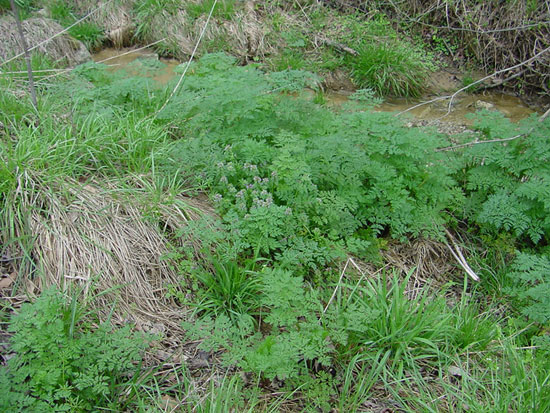 Poison hemlock rosettes.
 Taken in the early spring.
(Image source: Glenn Nice, Purdue University)
Poison hemlock is a biennial, meaning that it takes two years for it to complete its life cycle. The first year it exists as a low lying rosette (Figure 1.), then it will bolt after over wintering and be three to eight feet tall at maturity. Poison hemlock flowers in June or July and once seed is produced generally dies late July and August. We generally receive calls regarding the control of poison hemlock when it has reached maturity and is flowering out. Biennials are often more susceptible to chemical control in the first year of growth when they are rosettes3. Most glyphosate labels recommend applications from bud to flowering.
Control
Poison hemlock historically has not been a problem in corn and soybean. Because of this there is not a large body of research done on poison hemlock’s control in corn and soybean. If you have poison hemlock in your no-till field it is a good idea to add either dicamba or 2,4-D in your burndowns and to target poison hemlock in the first years growth, while it is still a rosette. Following are some of the options available to suppress or control poison hemlock in corn and soybean situations.
| Corn and soybean |
Burndown applications of glyphosate plus 2,4-D (1 lb ai/A) in the fall can control rosettes in the fall or in the early spring. Applications of 2,4-D of rates higher than 0.5 lb ai/A require a 30 days waiting period before planting soybean and 7 to 14 days before planting corn (see specific label for details). Glyphosate labels recommend applications from bud to flower. Glyphosate can also be used POST in RR soybean and corn. |
| Corn | Burndown or PRE applications of Basis (0.5 oz/A) plus 2,4-D LVE (1 pt/A) or Basis (0.3 to 0.5 oz/A) plus 2,4-D (1 pt/A) plus atrazine at 0.5 to 1 lb ai/A. There is a 7 to 14 day planting restriction when using 2,4-D to planting corn, see specific product label for details. Basis will provide some residual control of germinating poison hemlock. Burndown or POST applications of dicamba (0.5 pt/A) or 2,4-D can suppress to control poison hemlock. Dicamba provides good control where 2,4-D can provide fair control. Dicamba can be applied before planting and postemergence from spike to 36 inch tall corn or until 15 days before tassel emergence. Risks of injury increases after corn is eight inches tall, the use of drop nozzles are suggested. Drop nozzles should be used when applying 2,4-D (0.17 to 0.25 lb ai/A) after the corn is eight inches tall for added safety. |
| Soybean | Burndown applications of glyphosate (1 lb ae/A) plus 2,4-D (1 lb ai/A) ether in the fall or early spring on rosettes of can provide good control of poison hemlock. There is a 7 day waiting period after 2,4-D applications of 0.5 lb ai/A or less, but a 30 day waiting period with applications above 0.5 lb ai/A to plant soybean. Glyphosate can be used POST in RR soybean. |
Reference
Larry W. Mitich. 1998. Poison-hemlock (Conium maculatum L.). Weed Technology, Vol. 12:194-197.
J. Vetter. 2004. Poison hemlock (Conium maculatum L.). Food and Chemical Toxicology, Vol. 42 1373-1382.