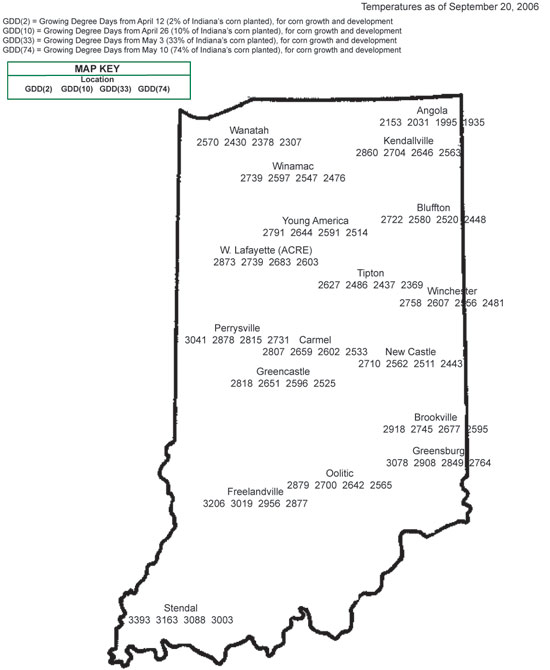



Pest & Crop Newsletter, Entomology Extension, Purdue University


Aphids in Fall Seeded Wheat – (John Obermeyer, Christian Krupke, and Larry Bledsoe)
- Aphids commonly infest wheat during fall.
- Aphids can be carriers and vactors of barely yellow dwarf virus.
- Planting after the Hessan fly-free date greatly reduces aphid infeestations.
- Treating for aphids, if necessary, should be done within the first few weeks of growth.
For the past several years we have gotten inquiries about aphids being found in wheat during the fall months. This is not a new, as aphids have always taken a liking to our fall seeded wheat – it is one of the only high-quality food sources available at that time of year. What is relatively new is the promotion of insecticide applications in late October and even November to control aphids. Much of this comes from producers that have ignored the Hessian fly-free dates for planting in order to get lush, green growth before winter sets in. Obviously, this “greener pasture” is a trap crop for hungry aphids.
Soon after wheat emerges, several aphid species migrate to and feed upon wheat leaves. Aphids suck plant juices with their straw-like mouthparts. This normally has very little effect on the growing plant, as moisture is usually not lacking in the fall. Most of these aphids feed on a variety of host plants, and the problem comes when aphids have first fed on other virus-infected grasses and then migrate to wheat, transmitting the disease. The most common virus disease transmitted to wheat by aphids is barley yellow dwarf (BYD). Because of the complexity of BYD and aphid/weather/host interactions, predicting the severity of disease is not possible even in high aphid infestation years.
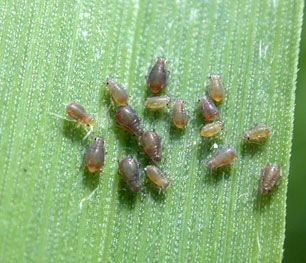
Bird cherry-oat aphid nymphs on wheat leaf.
Aphids stay active, feeding and moving in the fall, as long as temperatures stay at 50ºF or greater. After a killing frost, extended ≤32ºF, many aphids die and feeding drops drastically. Some aphids manage to survive even the coldest of winters under clumps of wheat, though their feeding ceases. This is why the incidence of BYD is greatly reduced when wheat is sown after the Hessian fly-free date (see Pest&Crop #22, September 8, 2006). This date is based upon the average projected date of killing frosts at a given latitude. These frosts dramatically decrease the numbers of Hessian flies and other pest insects. At the time of this writing (9/20/06), any wheat already planted in Indiana has a greater likelihood of high aphid and Hessian fly infestation.
Because it is not known from year to year how many, if any, aphids found in wheat are disease vectors, it must be assumed that they all are. Therefore, infestations must be caught and treated within the first few weeks of emergence if BYD is a concern. Treatment thresholds of 2-3 aphids/row foot have been suggested. Treatments late in October and November, even during an Indian summer, may kill aphids, but any BYD will have already been spread – meaning that this amounts to little more than a “revenge spray”.
Insecticidal seed treatments (i.e., Cruiser and Gaucho) are available for wheat. Minimal testing has been conducted with these products, though with their systemic activity they may work well against early aphid feeding. However, without detailed studies we cannot say with certainty whether these treatments would result in a net economic benefit. These products are worth considering however, if you meet the following conditions: wheat is under intensive wheat management (100+ bu/A), is a known BYD susceptible variety, is planted before the fly-free date, and/or you are able to accurately predict a warm fall and early winter (good luck with that last one).
Bottom line, early aphid scouting in wheat and planting after the fly-free date are the keys to preventing and/or accurately assessing an aphid infestation and potential risk to BYD transmission and spread. Happy scouting!

Furadan (carbofuran) Reregistration – (John Obermeyer and Christian Krupke)
All pesticides registered before 1984, must go through a re-registration process with EPA to show that they can be used without posing unreasonable risks to people or the environment. Furadan (carbofuran), which has been around since 1969, has just gone through this process. Furadan 4F, (you may recall we lost the use of Furadan 15G many years ago because of bird kills), isn’t used much in field crops but it has had its place (e.g., rescue treatment for corn rootworm).
Presently, EPA is proposing to cancel Furadan uses in corn (all), soybeans, and alfalfa. This is based on their assessment of ecological, occupational, and dietary risks. This finding is now open for public comment, until October 30 (go to http://www.epa.gov/fedrgstr/EPA-PEST/2006/August/Day-30/p14213.htm for more information). There is the possibility of litigation that may delay EPA’s immediate cancellation of this product. If there is a compromise between EPA and FMC, it would likely be a phase-out period of the product. However, it is safe to assume that carbofuran will not be an option in our IPM “toolbox” for the long-term.
Click for Table.
Black Light Catch Report.

Fall Applied Herbicides for Corn and Soybean in 2006 – (Glenn Nice and Bill Johnson)
- Trying to make the decision?
- When would I apply herbicides in the fall?
- How does the winter effect fall applied herbicides?
- What do I use for some of the major winter annuals?
- Fall applied programs for Indiana.
For those of you that use fall applied herbicide programs you are probably thinking about what might be available this year for products. For those of you who have not used a fall applied program before, you might be wondering if it is a good fit for you.
Trying to make the decision?
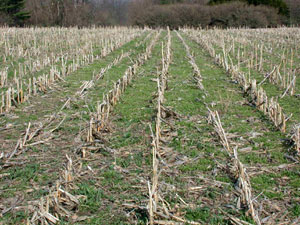
Weedy mats slow soil drying and warming in the spring.
Pros
The adoption of no-till and the recent mild winters have appeared to increase the amount of winter annual weeds in the Midwest. Many fields have a mat of chickweed, purple deadnettle, henbit, and whitlow grass in the spring. Two weeds that have become increasingly problematic are dandelion and cress leaf groundsel (butterweed). Both dandelion (Northeast Indiana) and cress leaf groundsel (Southern Indiana) can turn fields yellow in the spring. Research has demonstrated that dandelion can be more sensitive to effective herbicides when applied after a light frost. However, this would make for a small window of application in many years and possibly jeopardize control. Some biennials, such as musk thistle and poison hemlock were also bad this spring. Perennials such as common pokeweed also appeared to be on the increase these past couple of years. Many of these plants are often controlled more effectively in the fall, becoming less responsive to herbicides in the spring once they have started to bloom and increase in size.
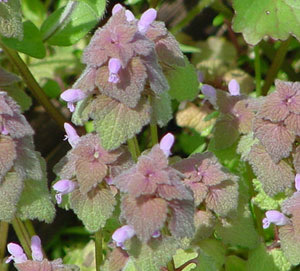
Purple Deadnettle
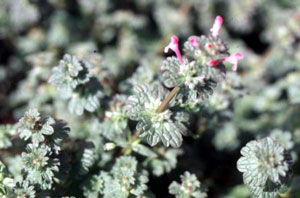
Henbit
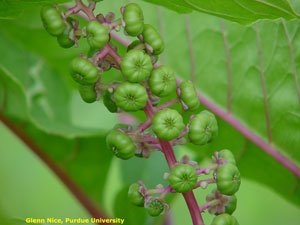
Pokeweed
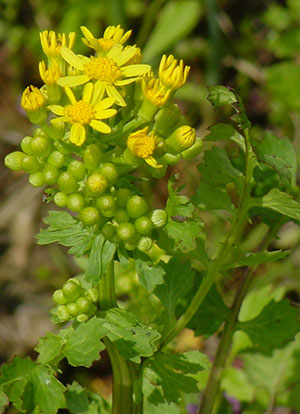
Cress Leaf Groundsel
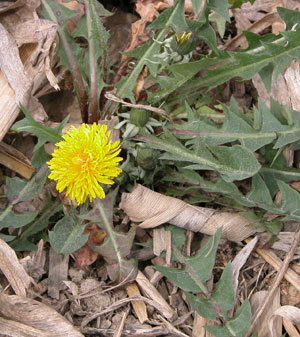
Dandelion
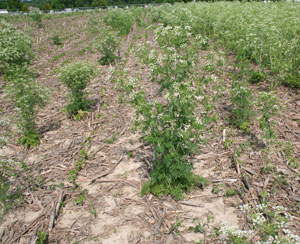
Poison Hemlock
A mat of vegetation in the spring can slow the drying and warming of the soil before planting thus delaying planting. In Indiana we also often have to deal with wet springs making it difficult to apply timely spring burndowns delaying planting further. In a few case, planting has to be done into a mat of winter annuals and/or summer annuals coming up in the spring or we use aggressive tillage to dry the soil, resulting in added cost, soil compaction, and fields prone to erosion if heavy rains fall soon after tillage. Thus, utilization of a fall herbicide application can be effective in providing winter annual free fields in the spring or and in most cases provide a wider window for planting.
Some research suggests that a field heavy with winter annual weeds can attract pests. Some winter annual weeds can serve as alternate hosts to soybean cyst nematode. Research being conducted at Purdue University is presently investigating optimum timing of fall applied herbicides to interfere with the nematode/weed interaction.
Cons
Fall applied programs may not be for everybody. If you are on highly erodible land and are not using a cover crop to prevent erosion it would not be beneficial in the long term to use a fall applied program.
In some cases, use of an inappropriate fall applied program can lead to needing a burndown in the spring, increasing costs and time inputs. The winter months that follow can have an effect on the germination patterns of the winter annuals and the persistence of the herbicide in the soil if a residual herbicide is used. Winters that are wet and mild can increase the microbial activity thus speed the break down of the herbicide in the soil.
Fields that have heavy common lambsquarter and giant ragweed pressure may require the use of a burndown in the spring under the following conditions. The use of a nonresidual herbicides or residual herbicides that do not provide good residual activity on common lambsquarter and giant ragweed in the fall will can provide good control of the winter annuals, but allow the soil to warm more quickly in the spring, thus summer annuals will emerge earlier in the spring.
In a few cases the use of a specific product will lock you into using a specific crop the following year. For example, the use of Canopy EX requires that soybean be planted the following year. The use of Simazine 4L requires that only corn be planted the following year.
One final con that was given to me at a field one year is that some producers winterize their spaying equipment before any chance of overnight frosts. The concern of having fluids freeze over night in the equipment’s plumbing could lead to extra time and money costs.
When would I apply the herbicides in the fall?
Several fall applied herbicides have fairly large application windows allowing weed size to be the timing criteria for application. Basis or Canopy EX can be applied anytime after harvest to before the ground freezes when weeds are less than 3 inches tall or 3 inches in diameter, but before the weeds bloom. Princep can also be applied after harvest to weeds less than 2 inches tall/wide. When winter annuals get larger, tank mixing of 2,4-D or glyphosate is common practice. The use of 2,4-D products and glyphosate products also have wide windows of application. The window of application generally depends on weed species and size. All herbicide programs should be applied before the ground freezes. This is for two reasons; 1) winter annuals have essentially shut down at this time and any herbicide application would have very little effect and 2) the possibility of off site movement of the herbicide increases when they are applied to frozen ground.
How does the winter effect fall applied herbicides?
After applying a fall applied herbicide program the winter weather will have some effect on both the herbicides that have residual activity and those that don’t. In the case of residual herbicides, mild wet winters promote microbial breakdown of herbicides resulting in reduced activity in the spring possibly requiring additional weed control efforts. On the flip side, a cold dry winter will reverse this effect. A mild winter can also have an effect on non-residual herbicides. Germination of winter annuals can still occur after an application in a mild winter also resulting needed efforts in the spring.
What do I use for some of the major winter annuals?
The use of 2,4-D is common, but it more than likely is combined with something else to provide a broader spectrum of control. Alone, 2,4-D is not highly effective on common chickweed and can be inconsistent on cress leaf groundsel (butterweed) once it starts to bolt. In most cases, the addition of Basis, Canopy EX (before soybean), Express, glyphosate, Simazine (before corn) or Valor are combined with 2,4-D to increase control of several of the winter annuals. Glyphosate products such as Roundup, Glyphomax, Touchdown, are often used in tank mixes due to glyphosate’s broad spectrum weed control and efficacy on many perennials. Below is a list of herbicides and/or tank mix options that are effective on many of the winter annuals that we have to deal with in Indiana.
Click for Table.
Fall applied programs labeled in Indiana.

A Problem With “Bouquets” - (Bob Nielsen)
An unusual oddity of corn growth and development has been reported in scattered fields throughout at least Indiana, Illinois, and Iowa in recent weeks.Years ago, I labeled this oddity a MESS (aka Multiple Ears on Same Shank) that was usually found only in the occasional corn plant along the edges of a field (Nielsen, 1999). This year, the oddity can be more accurately characterized as a problem because of the high percentages of plants affected in some fields.
Multiple ears on a single plant are not unusual, but the multiple ears usually develop separately from individual stalk nodes. The oddity/problem being reported this season is one of multiple ears that originate from individual nodes on a single ear shank.
First Comment: The fact that multiple ears can develop from a single ear shank in and of itself is not unusual. The ear shank is essentially a replica of the main stalk of the plant. The ear shank develops leaves like the main stalk. These husk leaves originate from individual nodes of the shank like the main leaves develop from individual stalk nodes. The ear shank terminates with a reproductive organ (the female ear) somewhat akin to the main stalk terminating with a reproductive organ (the male tassel). Additional ear shoots can develop from individual nodes of the ear shank like additional ear shoots that develop from individual nodes of the main stalk.
Second Comment: Normally the ear shank does not initiate these secondary ears or ears initiate but eventually cease development likely due to apical dominance from the apical ear.
Third Comment: What is unusual this year is the occurrence of a “bouquet” effect of 3 to 5 ears or more developing from an individual ear shank. Furthermore, and particularly disconcerting to growers, in many cases none of the multiple ears successfully pollinate and set kernels. In some cases, all of the multiple cobs are severely stunted as well. Where kernel set is nonexistent or very limited, the affected plants eventually turn red/purple in response to excessive photosynthate concentration in the leaves and stalk tissues. In some situations, as much as 30 to 50% of the plants in an area of a field are affected. Obviously, the yield loss in these severe situations will be dramatic.
Fourth Comment: The cause of this “bouquet” effect of multiple ears is not known. Some of us have been trying to compile background information from affected fields, but the number of affected fields has admittedly (and thankfully) been few. To my knowledge, there has yet been no single common thread identified among the affected fields. What I suspect is that a) some hybrids are genetically prone to developing multiple ears on a single ear shank and b) more than one external “trigger” enables the development of multiple ears to occur on these hybrids. Identifying the “trigger(s)” is the challenge.
For example, the “bouquet” effect is showing up in one of three hybrids I am using this year in my planting date demo plots at the Crop Diagnostic Training Center near West Lafayette (i.e., a hybrid apparently prone to multiple ears). Furthermore, the “bouquet” effect is more prevalent and severe in later planted plots where silk clipping by rootworm beetles prevented kernel set on the primary ear (i.e., possibly minimizing or negating apical dominance against secondary ears).
Final Comment: If you find this problem in your field, please contact me (rnielsen@purdue.edu) and share the relevant background information of the field with me.
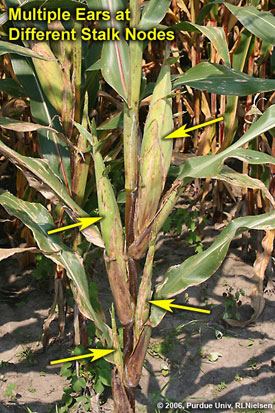
Multiple ears on single plant, but originating at different stalk nodes. This tpe of muliple ear development is not uncommon, though usually restricted to two or three nodes.
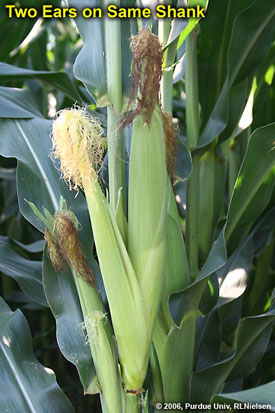
Multiple ears on single plant, but two originating from same stalk node. This type of multiple ear development is not as common.
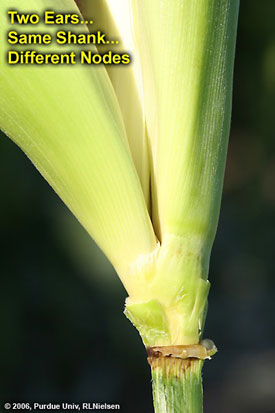
Even closer view of double ear at same ear shank. Second ear attached at lower shank node.
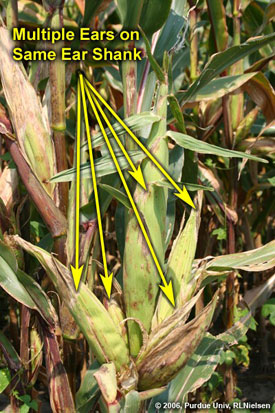
A "bouquet" of 5 ears originating from the same ear shank.
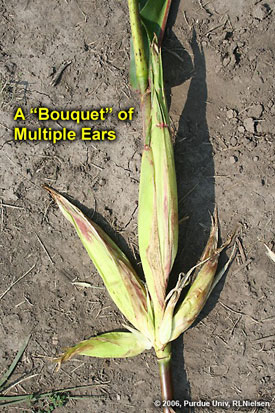
Closer view of a "bouquet" of 4 ears originating from same ear shank.
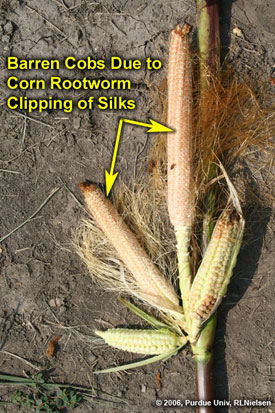
Husks removed from "bouquet" revealing barren cobs, the upper two of which resulted from persistent silk clipping by rootworm beetles.
Related References
Corn Yield Trends for Indiana: 1930 to 2006 - (Bob Nielsen)
Historical grain yields provide us with a glimpse of yields yet to come, although like the stock markets, past performance is no guarantee of the future. State average corn grain yields in Indiana have increased at a fairly constant 1.6 bushels per acre per year since 1930 primarily due to improved genetics and production technology (Figure 1). Some question whether the straight line relationship accurately reflects the trend in yield gain in recent years, but I believe yield trends calculated from relatively lengthy historical time-spans are more reliable for predicting near-term future yields than those calculated from relatively short time-spans (Nielsen, 2006).
For the past ten years (1996-2005), Indiana’s corn crop yield has split about even, with four of those years below trend and six above. The Sep 2006 USDA estimate puts the Indiana corn crop at 167 bushels per acre (bpa), or 12.5 percent above the 2006 trend line yield of 148.5 bpa and only 1 bpa below the record crop of 168 bpa established in 2004 (Figure 1). By comparison, recent years’ departures from trend yield (Fig. 2) were 2005 (+4.8%), 2004 (+15.7%), 2003 (+1.7%), 2002 (-14.8 %), 2001 (+11.2 %), and 2000 (+6.0 %). Preliminary (Sep 2006) yield estimates for each county in Indiana are available in text or graphical formats.
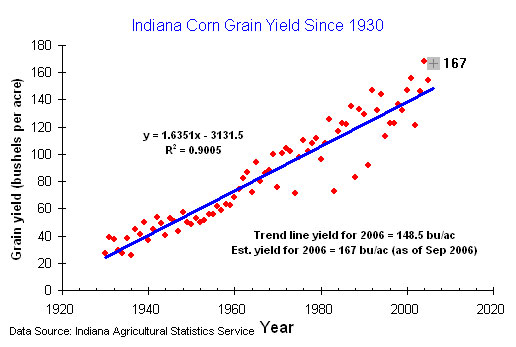
Figure 1. Corn yield trends for Indiana.
Annual grain yield estimates fluctuate above and below the trend line throughout the more than 70 year period of records (Figure 2), but four weather-related disaster years are especially noteworthy. Late planting plus early fall frosts in 1974 decreased state average corn yields 26% below the trend value for that year. Severe droughts in 1983, 1988 and 1991 resulted in yields 34%, 30% and 26% less than their respective trend values.
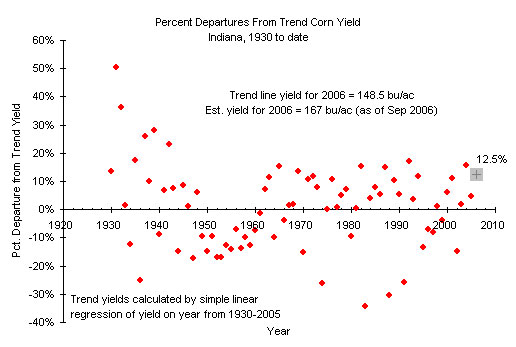
Figure 2. Indiana corn yied departures from trend yields.
Because the departures from trend for these four years are so dramatic, it is of some interest to calculate the trend line for corn grain yield without their inclusion. In so doing, the annual rate of yield increase is slightly greater (1.7 versus 1.6 bu/ac/yr) and the estimated trend yield for 2006 changes from 148.5 to 152.8 bpa. Such a modified trend line may offer more valid estimates of statewide yield potential in “normal” years. In this context, the current Indiana corn yield estimate of 167 bpa represents a 9.3% departure above trend yield.
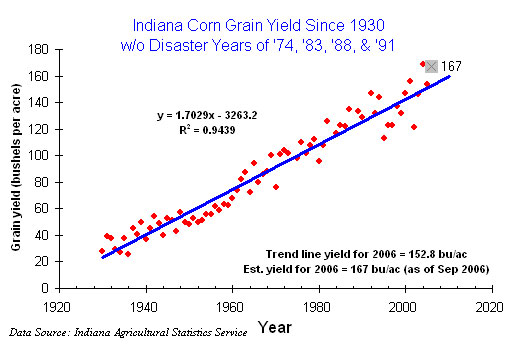
Figure 3. Corn yield trends for Indiana- No disasters.
The top five U.S. corn grain producing states are Iowa, Illinois, Nebraska, Indiana and Minnesota. According to the final USDA production estimates for 2005 (published Jan 2006), these five states (7.2 billion bushels) accounted for about 65 % of the total estimated grain yield for the U.S. in 2005 (11.1 billion bushels).
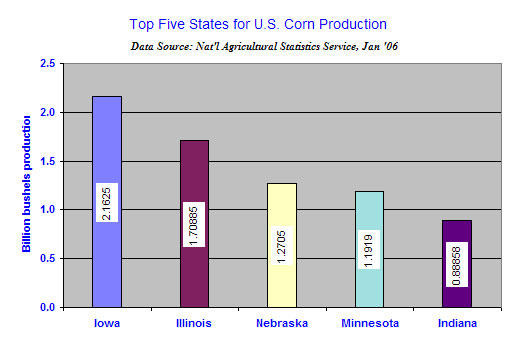
Figure 4. Top five U.S. states for Corn Production
For More Information...
For more statistics about Indiana agricultural production, browse the Web site of the Indiana Agricultural Statistics Service at http://www.nass.usda.gov/in/.
For more statistics on U.S. national crop production estimates, look at the National Agricultural Statistics Service Crop Production Web site.
Related References
Nielsen, R.L. (Bob). 2006. Corn Grain Yield Trends: Eyes of the Beholder. Corny News Network, Purdue Univ. Online at http://www.kingcorn.org/news/articles.06/YieldTrends-0615.html [URL verified 12 Sep 2006].
USDA-NASS. Jan 2006. Crop Production 2005 Summary. United States Dept. of Agr - Nat’l Ag. Statistics Service, Washington, D.C. Online at http://usda.mannlib.cornell.edu/usda/current/CropProdSu/CropProdSu-01-12-2006.pdf [URL verified 12 Sep 2006].
Late Season Corny Fearmongering - (Bob Nielsen)
The current near-record USDA-NASS corn yield estimate for Indiana of 167 bu/ac (USDA-NASS, Sep 2006) might lead one to believe that everything is hunky-dory with the state’s favorite crop. After all, that yield estimate is only 1 bushel shy of the all-time record yield established in 2004. Some prognosticators believe the yield estimate will go even higher as we move further into the fall harvest season.
In talking with the locals down at the Chat ‘n Chew Café over the past few weeks and based on my own wanderings in and out of corn fields, I would suggest that more problems exist in some fields than would be suspected by simply looking at the statewide yield estimate. Some of the issues that growers ought to be aware of include…
- Incomplete kernel set on ears is evident in quite a few fields; especially those late-planted or replanted fields (late May to mid June plantings). In some cases the problem lies in kernel abortion at the tips of ears, in other cases due to pollination problems (Nielsen, 2005a).
- Rapid senescence (death) of the crop canopy, especially the upper leaves, was very noticeable in many fields beginning mid- to late August prior to kernel black layer. The upper leaf death can be caused by a number of factors (Nielsen, 2005c), but regardless of the cause(s), rapid death of the crop canopy prior to kernel black layer (physiological maturity) can easily reduce yield in affected fields.
- Stalk rot is developing in some fields, either as random plants or as large areas within fields dying prematurely. The latter areas tend to be those where other stresses were prevalent during the grain fill period (Nielsen, 2005b). Given the risk of downed corn when a popup thunderstorm hits a field with severe stalk rot, it behooves growers to walk their fields and determine the presence and extent of severe stalk rot. Severely affected fields should be scheduled for earlier harvest to minimize the risk of downed corn later.
- Nitrogen loss became evident in some fields beginning back in about mid-August, as lower leaves and in some cases entire plants begin “firing” or turning yellow rapidly in response to deficient soil nitrogen levels. While this season’s frequent and ample rainfall provides much of the basis for the current high corn yield estimates, it is nevertheless true that a number of areas received numerous “goose-drownders” throughout the summer. Such heavy rainfall events easily cause significant loss of available soil nitrate through denitrification on heavy poorly drained soils or leaching on lighter, sandier soils (Nielsen, 2006).
Related References
Nielsen, R.L. (Bob). 2005a. Kernel Set Scuttlebutt. Corny News Network, Purdue Univ. Online at http://www.kingcorn.org/news/articles.05/KernelSet-0809.html [URL verified 12 Sep 2006].
Nielsen, R.L. (Bob). 2005b. Monitor Corn Fields for Weakened or Diseased Stalks. Corny News Network, Purdue Univ. Online at http://www.kingcorn.org/news/articles.05/StalkMonitoring-0823.html [URL verified 12 Sep 2006].
Nielsen, R.L. (Bob). 2005c. Top Leaf Death in Corn. Corny News Network, Purdue Univ. Online at http://www.kingcorn.org/news/articles.05/TopLeafDeath-0828.html [URL verified 12 Sep 2006].
Nielsen, R.L. (Bob). 2006. N Loss Mechanisms and Nitrogen Use Efficiency. Agronomy Dept, Purdue Univ. Online at http://www.agry.purdue.edu/ext/pubs/2006NLossMechanisms.pdf [URL verified 12 Sep 2006].
USDA-NASS. Sep 2006. Crop Production. USDA Nat’l Ag. Statistics Service. Online at http://usda.mannlib.cornell.edu/usda/current/CropProd/CropProd-09-12-2006.pdf [URL verified 12 Sep 2006].
For other Corny News Network articles, browse through the CNN Archives at http://www.kingcorn.org/news/archive.html.
For other information about corn, take a look at the Corn Growers’ Guidebook at http://www.kingcorn.org.
Bug Scout
I guess he's in a hurry to get to that near record yield!