


Pest & Crop Newsletter, Entomology Extension, Purdue University

- Growth Regulator Injury in Corn in 2006
- Herbicide Resistance Screening Available at Michigan State University Diagnostic Services

Western Bean Cutworm, A New Corn Pest for Indiana – (John Obermeyer, Christian Krupke, and Rick Foster)
- First moth capture, Jon Leuck, June 30, Porter County, Indiana.
- This sporadic "western" pest has been expanding eastward for several years.
- Biology and damage is similar to corn earworm, making this a greater future threat to seed, sweet, and popcorn producers.
- Not known if this will be a permanent pest in Indiana, if so, damage will be minimal during its first years of establishment.
A challenge was issued to a select group of pest managers in northern Indiana, to trap with pheromone an insect never documented in the state. These bold trappers went forth, knowing that the task may be painstakingly long and arduous. Within the first 24 hours, the jig was up, western bean cutworm had been found in Indiana.
For decades, western bean cutworm has been a sporadic dry-land bean and corn pest in Colorado and Nebraska. Then in the early 2000’s, damage from this pest was reported in western Iowa. Since that time moth numbers, monitored by pheromone and black light traps, and damage has progressively moved eastward. Last year, Illinois pest managers participated in an organized pheromone program and the numbers trapped were higher than anticipated. Most notably were a small number of moths that were captured in a county butting up against the Indiana state line. This precipitated our trapping program this season.
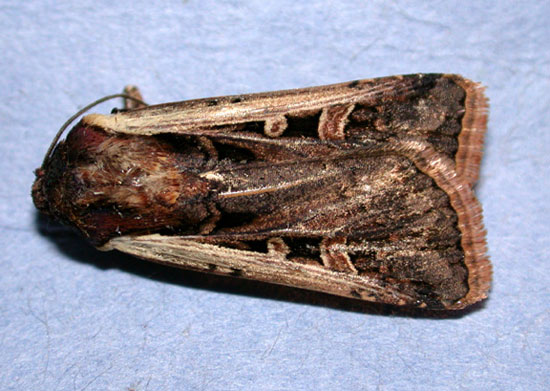
Indiana's first western bean cutworm.
Jon Leuck, superintendent of the Pinney-Purdue Agricultural Center, began his trap on Thursday, June 29. The next day, he called to report a suspect moth floating in the soapy water/antifreeze slurry. With a follow-up digital image sent to Marlin Rice, Iowa State University Extension Entomologist, it was determined to be a western bean cutworm. Congratulations to Jon, as his name will be on the label of this preserved specimen to reside in the Purdue Entomological Research Collection. Immediately following this past weekend, Larry Wickert, Wickert Crop Consulting, Bryan Overstreet, Jasper County CES, and Dan Ritter, Newton County CES all reported western bean cutworm moth captures. These and other cooperators will continue throughout the summer to monitor for the range and density of this new pest in Indiana.
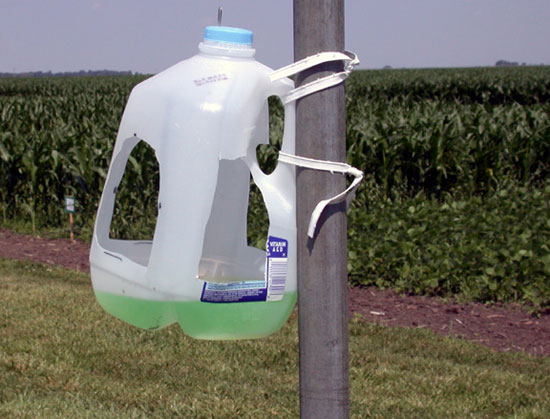
Milk jug pheromone trap for western bean cutworm.
Unlike many of the cutworm species, this pest’s biology and feeding habits are similar to corn earworm. Prior to tasselling, small larvae migrate to the whorl area and feed on the pollen in the tassel. After tassel emergence, the larvae either feed on developing florets and pollen and/or migrate to ears where they enter through the silk channel, or by boring through the husks. Young larvae entering the ear may feed on the silk causing poor pollination. As the larvae mature, they feed directly on developing kernels that causes the most damage in corn. Since the larvae are not cannibalistic, several cutworms can be observed on one ear. Because of this, western bean cutworm has been referred as corn earworm with an attitude.
Certainly it is of importance to note a new insect pest species in the state, but these moth captures must be kept in perspective. Our number of moths will pale in comparison to those captured in the western corn belt where damage is considered spotty. It is possible that larval damage may be noted in a few Indiana corn ears this season, but widespread devastation will not occur. You can track future Indiana, and other Midwestern state captures, via the Western Bean Cutworm Monitoring Network, at http://www.ent.iastate.edu/trap/westernbeancutworm/.
Late note: While getting ready to put this newsletter to bed, a black light trap from the Northeast Purdue Agricultural Center (Whitley County), superintendent Phil Walker, captured one western bean cutworm on June 29. Very interesting!

Rootworm Larval Damage Being Reported –(John Obermeyer, Christian Krupke, and Larry Bledsoe)
- Root damage and larvae are being found in central and northern counties.
- Rootworm feeding will continue for a while.
- Root damage + windstorms = a producer's worst nightmare.
Peak corn rootworm feeding has occurred, and so far most root damage is not apparent from above ground plant symptoms. However, pest managers out digging and inspecting root systems are finding some unpleasant surprises in many fields: damage and plenty of rootworm larvae. This is true in both untreated and insecticide-treated fields.
The worst-case scenario is that several factors will “collide” in the next week or two to cause significant lodging. First, much of the population are now full-sized larvae, which means they eat more and usually feed at the critical nodal root area. Nodal root systems are necessary for anchoring the plant, especially when rapid vegetative growth occurs just before pollination. The final X-factor is windstorms moving through the state, with or without rain. Reduced and poorly anchored root systems will cause plants to topple in fast-moving storm fronts. Lodging causes extreme physiological stress on plants, especially as they attempt to pollinate. In addition, root regrowth, the plant’s attempt to recover from feeding damage, pulls carbohydrates away from vital top and ear growth.
Click for Table.
Black Light Catch Report.

Growth Regulator Injury in Corn in 2006 – (Glenn Nice and Bill Johnson)
This year, 2006, we have received more samples than normal into the Plant & Pest Diagnostics Lab (P&PDL) which appear to be related to growth regulator herbicide injury. Growth regulator injury in corn can express itself in several ways. One such way is as “goose necked” corn stalks. This is a symptom where the corn stalk develops a kink in its growth then corrects itself to grow straight again resembling a “S” or a goose’s neck. In the cases that have been seen in the P&PDL, there have not been any “S” shaped stocks, but bowed stocks often with other signs of growth regulator injury (Figure 1 and 2). Injury from growth regulators in corn is not the norm, but unpredictable circumstances such as, weather, variable corn growth, and non-label applications can sometimes result in injury to corn.
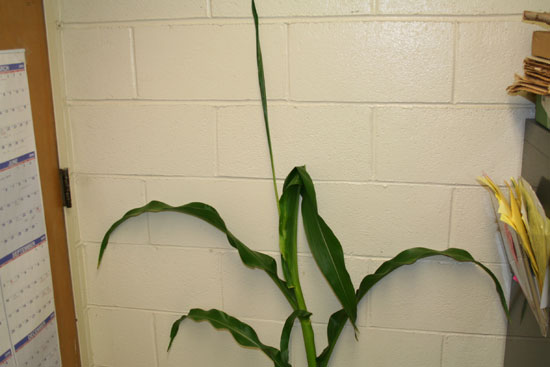
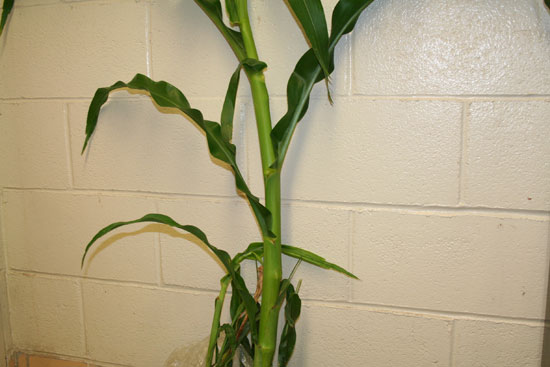
Figure 1 and 2.
Corn plant with a bowed stalk and a "rat tail", "onion leaf", "buggy whip" shaped leaves.
In some cases, injury can resemble symptoms that can be confused with chloroacetamide herbicides. Growth regulator herbicides that come in contact with corn seed, as can happen if the furrow is not properly closed at planting, can result in the germinating corn plant leafing out underground(1). In some cases the corn plant’s leaves do not properly unfurl, not allowing the new leaves to separate from each other. It is because of this that there is a preplant interval on many 2,4-D labels before corn can be planted. The preplant interval is at least 7 days after a 1 pint/A rate and 14 days if more than a pint is used for 2,4-D. It is always recommended that seed be planted at least 1.5 inches deep to avoid herbicide contact with either 2,4-D or dicamba. There are no preplant intervals listed on the dicamba labels implying it is safer to use for burndown weed control in corn production.
Postemergence applications of 2,4-D or dicamba can also induce a crop response. This will happen more frequently when high rates or concentrated amounts are placed in the whorl of the corn. In the case of dicamba, 0.5 lb. of acid (16 fl. oz./A of Clarity) can be used on fine and medium soils from emergence till corn is at the 5-leaf stage or at the most 8 inches or less tall. However, on coarse soils or when the corn is greater than 8 inches tall the rate allowed is reduced to 0.25 lb. of acid (8 fl. oz./A of Clarity). When using 2,4-D, applications are not recommended when the leaves have just unfolded and applications have to be made before corn is 8 inches tall.
In some cases, injury does not occur in every plant, but will show up on isolated plants in an irregular pattern. These situations can occur when boom height is too low or a partially plugged nozzle is dripping onto leaves that direct the droplet into the whorl. These concentrated jets don’t always hit the whorl, but can hit leaves that direct the herbicide into the whorl, giving a hit or miss injury pattern within the field. If this happens when the plant is young and developing a node’s brace roots, then often the brace roots can become fused (Figure 3). Also at that time, new leaves can be distorted or will not unfurl, as is the case with “buggy whip”, “rat tail”, or “onion leaf” appearances (Figure 1).
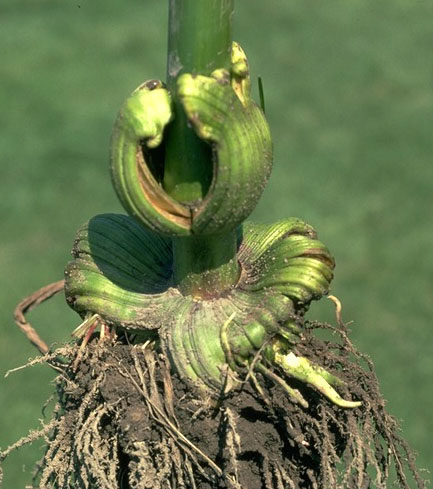
Figure 3. Brace roots severely damaged from growth regulator injury. In most cases the injury is not this severe.
When we go out to fields and see these symptoms the next question to follow is will they recover and what will this do to yield? In some cases where corn is injured by growth regulators the corn can become brittle and plants can lodge. Malformed brace roots can only exacerbate the problem. Plants that are lying on the ground can’t be harvested. In other cases the fused leaves in “rat tailed or onion leafed” corn emerging from whorl will inhibit tassling. Bob Hartzler of Iowa State University reported some fields in 1996 that exhibited this type of injury had 50% barren stalks(2). Injury to corn while in the V5 to V12, could result in a reduction of ear row, resulting in “beer bottle” ears (a symptom usually reserved for ALS injury); however, it is around the V17 stage that kernels per row is determined(3, 4).
Predicting the yield impact from any herbicide injury can be a precarious situation, especially when not knowing what the environmental conditions might be like for the rest of the year. Counting rows and kernels it is like counting life jackets after the Titanic has sunk. Herbicide injury is like any stress on a growing crop, it will have some impact on the plants performance. To reduce any possible injury situations read and follow labels carefully and be aware and rectify of any mechanical problems with the sprayer.
References:
Kevin Bradley. Accessed June 30, 2006. Preemergence Herbicide Injury Symptoms on Corn. Integrated Pest & Crop Management Newsletter, Univeristy of Missouri-Columbia. http://ipm.missouri.edu/ipcm/archives/v15n8/ipmltr2.htm
Bob Hartzler. Accessed July 3, 2006. Crop Response to Herbicides. Iowa State University. http://www.weeds.iastate.edu/mgmt/1996/ICM-1.htm
Bob Neilson. Accessed July 3, 2006. Blunt Ear Syndrome in Corn. Plant & Pest Digital Library, Purdue University. http://www.ppdl.org/dd/id/BES_corn.html
Peter Thomison. Accessed July 3, 2006. When is Corn Ear Size Determined. Ohio State University. http://corn.osu.edu/archive/2002/jun/02-19.html#linkc
Herbicide Resistance Screening Available at Michigan State University Diagnostic Services - (Steven Gower, Michigan State University and Bill Johnson, Purdue University)
Herbicide resistance in weeds is a growing concern for growers, due largely to the recent occurrence and spread of glyphosate-resistant horseweed and occasional failures to control giant ragweed and common lambsquarters in Roundup Ready crops. Currently, there are more than 180 weed species resistant to one or more herbicides in the world (Heap 2006). These weeds have developed resistance to very effective herbicides in field, vegetable and fruit crops, as well as tree plantations and nurseries.
Confirming herbicide-resistant weed populations is the first step of any resistance management program. Verification will provide producers with the knowledge to implement the best possible management strategies, with the ultimate goal of preventing or limiting the spread of herbicide-resistant weeds.
For 2006, Purdue University weed scientists will continue screening weed samples for tolerance to glyphosate, but not other herbicides. Samples can be sent to:
Bill Johnson or Glenn Nice
Department of Botany and Plant Pathology
Lilly Hall of Life Sciences
915 West State Street
West Lafayette, IN 47907
There is no charge for this service and the cost is covered by a grant from the Indiana Soybean Board for this year. In 2007, it is unlikely that we will be able to do this for free.
Sampling Procedures:
- Send either mature seeds or seedheads.
- Collect seed or seedheads from 20 to 40 widely plants through the field.
- Air dry seed/seedheads prior to packaging to prevent mold.
- Label the package containing the seed or seedheads with the sample reference, name, and location.
- Mail the samples and the survey form together to the address listed above.
This address will take you to a Herbicide Resistant Weed Screen form: http://www.btny.purdue.edu/weedscience/2003/Articles/sform9-2-03.pdf.
If herbicide resistance to herbicides other than glyphosate is suspected in any weed species, samples may be submitted to MSU Diagnostic Services for a resistance screen. In most circumstances, a whole plant pot assay established from seed will be the standard test for herbicide resistance confirmation. Mature, high quality seed or seedheads should be collected from suspicious plants in late summer or fall and submitted in a paper bag or envelope. Do not seal plants or seed in plastic!
Fees associated with herbicide-resistant weed testing for fields in Indiana are $75 per sample per herbicide site of action (i.e., ACCase inhibitors, ALS inhibitors, Photosynthesis inhibitors). Each additional site of action is $30 per sample. Samples submitted from Michigan producers are $50 per site of action and $20 for each additional site of action.
Please contact Steven Gower PH: 517-432-9693, sgower@msu.edu with any questions regarding resistance confirmation or sample collection. Samples can be mailed to:
Michigan State University
Diagnostic Services
101 Center for Integrated Plant Systems
East Lansing, MI 48824-1311
Attn: Steven Gower