


Pest & Crop Newsletter, Entomology Extension, Purdue University

- Conditions are Right for European Corn Borer in Tall, Non-GMO Corn
- Pest and Crop Development are Dealayed
- Black Light Trap Catch Report

Conditions are Right for European Corn Borer in Tall, Non-GMO Corn - (Larry Bledsoe, Christian Krupke, and John Obermeyer)
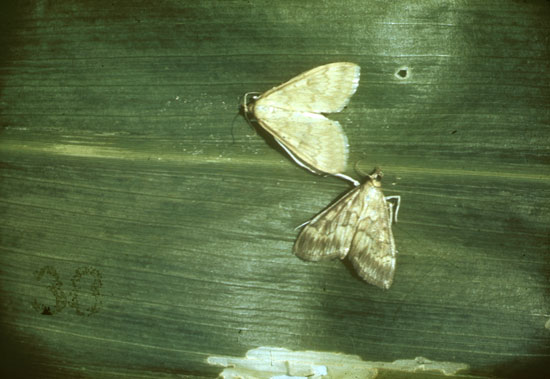
European corn borer moth adults
(top- female and bottom- male)
This spring there are many instances of significant, field-to-field corn height differences over most of Indiana. Corn planted during the unusually mild conditions in mid to late April is tending to be much taller than corn planted just before, or following, the extended period of cool, damp conditions that prevailed during the first half of May. Replant situations produced the most dramatic size differences. These situations create “trap crop” conditions for European corn borer where a field of a tall, non-resistant corn is surrounded by fields of any kind of shorter corn. This happens because moths are attracted to the tallest corn in a region to lay eggs and the subsequent larval survival increases substantially when plant height exceeds about 18 inches. The moths are nocturnal and mild, rainless nights with light winds are conducive to egg laying. Our statewide blacklight survey suggests that moth flight is well underway so if you are experiencing these weather conditions now, consider this a “heads up” to begin sampling in potential problem fields.
Here are summarized scouting procedures for first generation borers. Survey for the characteristic random “shot hole” damage pattern across the leaves of 20 consecutive plants in each of 5 areas of the field. Damage typically first occurs deep in the plant whorls and is evident later as the leaves emerge outward during growth. Carefully examine the leaves as some of the holes can be pin-hole size. Damage may also result from larvae entering the midribs of extended leaves. Look for translucent tunneling in the leaf midrib and plant material that resembles sawdust extruded from the entry hole. Record the number of plants showing leaf damage. Total the number of damaged plants to determine the percentage, and determine if borers are still present. Pull out, carefully unroll, and examine the whorl leaves from one plant showing damage in each 20-plant sample set, for a maximum of 5 plants in the entire field. Total the number of live borers found and determine the average number per plant.

Pest and Crop Development are Delayed - (Larry Bledsoe, Christian Krupke, and John Obermeyer)
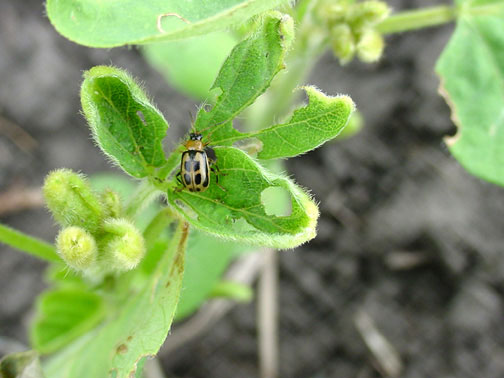
Bean leaf beetle damaging soybean leaves.
Insect development is, among other things, dependant on temperature. It is apparent that the low temperatures in May delayed the development of some prominent pests as well as crops. For example, we normally expect reports of over-wintering bean leaf beetle damage to soybean and armyworm damage to wheat, corn, and pastures in early spring. However, we are now approaching mid June and the calls just keep coming in. Crop managers should take this into account and adjust management schedules by extending the time that they would normally scout for key pests.
It is not too late in the season to scout for bean leaf beetle feeding damage to recently emerging soybean. The culprits are the adults that emerged from their winter habitat back in April and have been getting by on wild legumes. Damage to the soybean cotyledon, unifoliate leaf, and the growing point can stunt, deform, or kill the plant. For early season management determine the degree of cotyledon or stem damage and/or the average percentage defoliation level for plants in each of 5 areas of the field and note the number of beetles per plant. Also, note whether the growing point is being severely damaged or killed on any of the plants. Watch for areas where replanting may be necessary due to seriously damaged or dead plants. Use the table below to determine treatment threshold for VE-VC stage soybean. For management of V1 through R6 soybean stages see: http://extension.entm.purdue.edu/fieldcropsipm/insects/bean-leaf-beetle.php. For control products see http://extension.entm.purdue.edu/publications/E-77.pdf. The larvae live in the soil and feed on root nodules and are not known to economically impact soybean yield.
| For VE-VC soybean | |||||
Crop Value ($/bu) |
Control Cost $ |
||||
6.00 |
8.00 |
10.00 |
12.00 |
16.00 |
|
Beetles per plant |
|||||
5.00 |
3 |
4 |
5 |
6 |
8 |
6.00 |
3 |
4 |
5 |
5 |
7 |
7.00 |
2 |
3 |
4 |
4 |
6 |
8.00 |
2 |
3 |
3 |
4 |
6 |
| Treat when number of beetles equals or exceedsd the number for a particular crop value and control cost. Modified from the University of Nebraska. | |||||
Additionally, like the Energizer Bunny, reports of armyworm just keep on coming. Larvae of all sizes are still active across the state. (See previous week’s Pest&Crop Issue 10 for management details.) Normally, armyworm larvae are attacked by many parasites and predators in the spring and damage is fairly brief. However, the impact of these natural control agents is often diminished in cool and damp conditions and that may be partially responsible for the extended period of crop injury. Luckily, the numbers of moths recorded statewide seem to be falling (see Blacklight Survey results) and this indicates that the impact of the larvae will soon diminish. The second generation adults typically appear in early July and are much less of a concern due to the action of natural control agents.
Click for Table.
Black Light Catch Report.
Bug Scout
Don't worry, Bug Scout, it's much too pretty to be a corn borer!

Replanting Roundup Ready Corn – How to Kill the First Planting - (Bill Johnson, Glenn Nice, and Tom Bauman, Purdue University; Mark Loux, OSU)
Every management decision has consequences, and the decision to plant Roundup Ready corn is no exception. Among the positive consequences of Roundup Ready corn that include improved control of certain weeds and less risk of crop injury due to herbicides, there are potential negative consequences such as an increased risk of glyphosate-resistant weeds and volunteer Roundup Ready corn in Roundup Ready soybeans. As the acreage of Roundup Ready corn increased, it is natural that more producers would be faced with the situation where poor weather resulted in an inadequate initial Roundup Ready corn stand, just as they have faced this with conventional corn hybrids. Glyphosate has typically been used to control the first planting of conventional corn in replant situations, but will obviously not control Roundup Ready corn. So, how do we effectively and legally control a failed stand of Roundup Ready corn?
It appears that hundreds if not thousands of acres have been treated with postemergence grass soybean herbicides (Select, Assure II, etc) this year in an attempt to kill the existing Roundup Ready corn stand. Information from the WSSA’s Herbicide Handbook indicates that these herbicides have at least some soil residual activity, and thus will have the potential to injure replanted corn if the radical or coleoptile come into contact with a high enough concentration of herbicide. The soil half-lives of these herbicides are as follows: quizalofop (Assure II) - 60 days; sethoxydim (Poast) - 5 days; clethodim (Select) - 3 days; and for Fusion components, fluazifop -15 days and fenoxaprop – 9 to 30 days. While they can effectively control emerged corn, the labels for these herbicides do not support their use as a preplant treatment in corn, Roundup Ready or otherwise. Information from product labels that pertains to preplant use in corn:
- Poast and Poast Plus labels specifically state to not apply these products as a preplant or preemergence treatment before planting grass crops, such as corn.
- The Select label does not allow replanting sensitive rotational crops for 30 days, although corn is not mentioned specifically. The Select Max label indicates that it is only labeled for soybean and should not come into contact with sensitive crops such as corn.
- The Assure II label states that only specific crops (which do not include corn) can be planted within 120 days after application.
- The Fusion label states that it may only be applied before, during or after emergence of soybean.
So, although these products are effective at controlling volunteer corn, they are labeled only for the control of volunteer corn in a soybean crop, not in a corn replant situation.
Our assessment is that there are really only three effective and legal options to kill an existing stand of Roundup Ready corn in a replant situation – tillage, Gramoxone, or Liberty. Our experience has been that tillage will be the most reliable method, but not desirable for those in a long-term no-till situation. The second best options of using Gramoxone or Liberty may not always be 100% effective, but the labels for these products do allow this type of use. In University research trials, Gramoxone (2-3 pt/A) + Sencor (4-6 oz/A) or 32 to 34 oz/A of Liberty has been effective for control of small corn (V1 to V3). Application of Gramoxone alone, without the addition of Sencor, is likely to be less effective. Corn that has advanced past the V3 growth stage will generally be more difficult to control. A combination of Gramoxone plus Sencor is likely to be more effective than Liberty on this size corn, unless Liberty Link corn is planted and a follow-up treatment of Liberty can be used after emergence of the new stand to control plants that survived the first application.
Herbicide Resistance Screening Available at Michigan State University Diagnostic Services - (Steven Gower, Michigan State University and Bill Johnson, Purdue University)
Herbicide resistance in weeds is a growing concern for growers, due largely to the recent occurrence and spread of glyphosate-resistant horseweed and occasional failures to control giant ragweed and common lambsquarters in Roundup Ready crops. Currently, there are more than 180 weed species resistant to one or more herbicides in the world. These weeds have developed resistance to very effective herbicides in field, vegetable and fruit crops, as well as tree plantations and nurseries.
Confirming herbicide-resistant weed populations is the first step of any resistance management program. Verification will provide producers with the knowledge to implement the best possible management strategies, with the ultimate goal of preventing or limiting the spread of herbicide-resistant weeds.
For 2006, Purdue University weed scientists will continue screening weed samples for tolerance to glyphosate, but not other herbicides. Samples can be sent to:
Bill Johnson or Glenn Nice
Department of Botany and Plant Pathology
Lilly Hall of Life Sciences
915 West State Street
West Lafayette, IN 47907
There is no charge for this service and the cost is covered by a grant from the Indiana Soybean Board for this year. In 2007, it is unlikely that we will be able to do this for free.
Sampling Procedures:
- Send either mature seeds or seedheads.
- Collect seed or seedheads from 20 to 40 widely plants through the field.
- Air dry seed/seedheads prior to packaging to prevent mold.
- Label the package containing the seed or seedheads with the sample reference, name, and location.
- Mail the samples and the survey form together to the address listed above.
This address will take you to a Herbicide Resistant Weed Screen form: http://www.btny.purdue.edu/weedscience/2003/Articles/sform9-2-03.pdf.
If herbicide resistance to herbicides other than glyphosate is suspected in any weed species, samples may be submitted to MSU Diagnostic Services for a resistance screen. In most circumstances, a whole plant pot assay established from seed will be the standard test for herbicide resistance confirmation. Mature, high quality seed or seedheads should be collected from suspicious plants in late summer or fall and submitted in a paper bag or envelope. Do not seal plants or seed in plastic!
Fees associated with herbicide-resistant weed testing for fields in Indiana are $75 per sample per herbicide site of action (i.e., ACCase inhibitors, ALS inhibitors, Photosynthesis inhibitors). Each additional site of action is $30 per sample. Samples submitted from Michigan producers are $50 per site of action and $20 for each additional site of action.
Please contact Steven Gower (517-432-9693, sgower@msu.edu) with any questions regarding resistance confirmation or sample collection. Samples can be mailed to:
Michigan State University
Diagnostic Services
101 Center for Integrated Plant Systems
East Lansing, MI 48824-1311
Attn: Steven Gower
Free Yield Loss and Tank Mix Calculators Available Online – Courtesy of the WeedSOFT Development Team – (Glenn Nice and Bill Johnson)
The creators of WeedSOFT and your Purdue University Weed Science Team bring to you two new FREE tools to help in the world of weed management. The WeedSOFT Yield Loss Calculator and the WeedSOFT Tank Mix Calculator. With the postemergence spray season upon us, this valuable tool can be helpful in planning spray application timing.
WeedSOFT® Yield Loss Calculator
The WeedSOFT® Yield Loss Calculator is a tool to estimate early season and season-long yield loss for crops that are at a particular growth stage with a known weed infestation level. It will also estimate the additional yield loss that may occur if you delay treatment. This application allows you to enter crop growth stage, weed density and size, yield goal, and it will estimate yield and financial loss that has already occurred (if any) and yield loss if the infestation is left untreated. The tool can be found at this website: http://weedsoft.unl.edu/weedsoftApps.htm.
WeedSOFT Yield Loss Calculator.
Example, Figure 1.
Soybean is at the V4 stage. The estimated yield goal for this field is 48 bu/A which will be sold at $4.25. Weeds present include cocklebur at 2 / 100 ft2, giant foxtail at 100 / 100 ft2, and giant ragweed at 10 / 100 ft2. With a combination of those weeds it is estimated to result in a 1.8 bu/A loss through to the V4 soybean stage and 3.2 bu/A loss if not treated though the V5 stage. Not treating at all would result in a 19.9 bu/A yield loss and based on the entered selling price, a loss of $84.57/A.
WeedSOFT® Tank Mix Calculator
The WeedSOFT® Tank Mix Calculator is a tool to help you calculate the amount of herbicide needed for a field and the amounts to add per tank load (http://weedsoft.unl.edu/weedsoftApps.htm). Simply enter in the size of the field, tank, gallons per acre, and the herbicides and rates applied and it will calculate the amount to add to the tank.
WeedSOFT Herbicide Load Ticket.
Example, Figure 2.
The size of field is 150 acres, the size of the spray tank is 500 gallons. You want to apply Balance Pro at 1.88 fl oz/A + Atrazine 4L at 2 pt/A at a spray volume of 15 GPA. The output provided the number of tank loads that would be needed to treat the field at 4 with a 250 gallon partial tank load (figure 2). There would be 4 tank loads using 1.96 qt of Balance Pro per tank load and 8.33 gal of Atrazine 4 L per tank load. The partial tank load of 250 gallons would require 1.96 pt/A of Balance Pro and 4.17 gal/A of Atrazine 4L.
For more information on WeedSOFT and the Universities involved in the WeedSOFT project please see the following web site: http://weedsoft.unl.edu/
If you have any questions regarding these tools please feel free to contact Bill Johnson or Glenn Nice.

Recovery From Hail Damage to Young Corn – (R. L. (Bob) Nielsen)
- Yield loss from hail damage is based on reductions in plant population and leaf area.
- Allow a damaged field enough time to demonstrate the degree to which it may recover from hail damage.
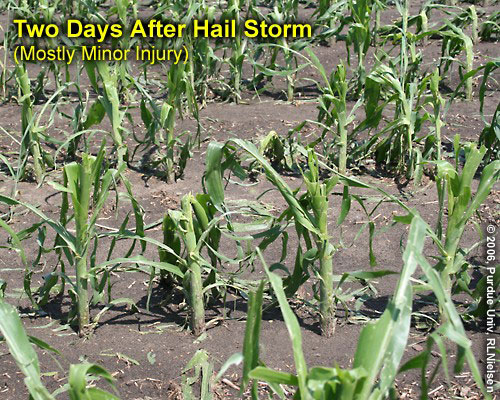
As is usual in Indiana, late spring thunderstorms rumbling across the state in recent weeks have often included a heavy dose of damaging hail. Looking out the kitchen window the morning after such a storm can be one of the most disheartening feelings in the world to a corn grower.
Yield loss in corn due to hail damage results primarily from 1) stand reduction caused by plant death and 2) leaf area reduction caused by hail damage to the leaves. Assessing the yield consequences of hail damage in corn therefore requires that the severity of each of these factors be estimated.
Click for Hail Damage Photo Gallery: http://www.agry.purdue.edu/ext/corn/news/timeless/HailDamageYoungCornGallery.html
Assessing Plant Survival
As with most early-season problems, evaluation of hail-damaged fields should not be attempted the day after the storm occurs because it can be very difficult to predict survivability of damaged plants by simply looking at the damage itself. Young corn has an amazing capacity to recover from early season damage but patience is required to allow the damaged plants enough time to visibly demonstrate whether they will recover or not. Damaged but viable plants will usually show noticeable recovery from the whorl within 3 to 5 days with favorable weather and moisture conditions.
One thing you can do shortly after the storm, however, is to evaluate the relative condition of the main growing point area of the stalk. The growing point, or apical meristem, of a young corn plant is an area of active cell division located near the tip of the pyramid-shaped top of the stalk tissue inside the stem of the plant (Nielsen, 2004b). The growing point region is important because it is responsible for creating all the leaves and the tassel of a corn plant.
Initially, the growing point is located below ground but soon elevates above ground beginning at about the 5th leaf collar stage. Slicing a stalk down the middle and looking for the pyramid-shaped upper stalk tissue can identify the vertical position of the growing point. If hail has damaged the growing point or cut off the stalks below the growing point, then those plants should be counted as victims and not survivors.
Remember that yield loss in corn is not directly proportional to the reduction in the number of plants per acre when the damage occurs early in the growing season (Table 1). The surviving plants surrounding an absent plant can compensate by increasing their potential ear size or by developing a second ear. A 25 percent reduction in plant population should reduce yield by less than 10 percent. A 50 percent reduction in plant population should reduce yield by less than 25 percent.
Assessing Defoliation Severity
Leaf damage by hail usually looks worse than it really is. Tattered leaves that remain green and connected to the plant will continue photosynthesizing. It takes a practiced eye to accurately estimate percent leaf death by hail. With that caution in mind, percent damage to those leaves exposed at the time of the hailstorm can be estimated and used to estimate yield loss due to defoliation alone.
The effects of leaf death on yield increases as the plants near silking, and then decreases throughout grain fill. Therefore, the grower needs to determine the leaf stage of the crop when the hail damage occurred. Remember that leaf staging for the purposes of hail damage assessment is slightly different than the usual leaf collar method. The yield loss estimates listed in Table 2 are based on leaf stages as defined by the “droopy leaf” method (Nielsen, 2004a).
If you are walking damaged fields many days after the storm, you can stage the crop that day and backtrack to the day of the storm by assuming that leaf emergence in corn occurs at the rate of about 1 leaf every 85 GDDs from emergence to V10 (ten fully visible leaf collars) or every 50 GDDs from V10 to the final leaf (Nielsen, 2004c). Given recent temperatures and the fact that little if any of Indiana’s corn crop is yet beyond leaf stage V10, this rate of leaf emergence translates to about 1 leaf every 4 to 6 days.
Once percent leaf damage and crop growth stage have been determined, yield loss can be estimated by using the defoliation chart provided in Table 2. This table is a condensed version of the season-long table published in the Purdue Extension publication ID-179, Corn and Soybean Field Guide or in NCH-1, Assessing Hail Damage in Corn (Vorst, 1993).
Assessing Consequences of Whorl & Stem Bruising
The eventual yield effects of severe bruising of leaf tissue in the whorl or the stalk tissue itself in older plants are quite difficult to predict. Consequently, it can be difficult to determine whether to count severely bruised plants as survivors or whether they should be voted off the field. The good news is that observations reported from an Ohio on-farm study suggest that bruising from hail early in the season does NOT typically result in increased stalk lodging or stalk rot development later in the season (Mangen & Thomison, 2001).
Early season bruising of leaf tissue or stem tissue may, however, have other consequences on subsequent plant development; the occurrences of which are hard to predict. Areas of bruised whorl leaf tissue often die and can then restrict continued expansion of whorl leaves, resulting in the type of ‘knotted’ whorl reminiscent of frost damaged plants. These same bruised leaves would be more susceptible to secondary invasion by bacteria contained in splashed soil that might have been introduced into the damaged whorls if the hailstorm was accompanied by driving rains.
If the plant tissue bruising extends as deep as the plant’s growing point, that important meristematic area may die; thus killing the main stalk and encouraging the development of tillers. If the plant tissue bruising extends into the area near, but not into, the growing point; subsequent plant development may be deformed in a fashion similar to any physical damage near the hormonally active growing point (stinkbug, stalk borer, drill bits used by malicious agronomists).
Example of Assessing Damage
Let’s say that your field of corn was at the 7-leaf stage (approximately V5 by the leaf collar method) when hail damage occurs. After walking the field several days later, you determine only 20,000 of your original 30,000 plants per acre will survive the hail damage. Let’s further assume that your original planting date was 25 April. Your surviving stand of 20,000 now has an upper yield potential of 92% of “normal” (Table 1). Therefore, the yield loss due to plant death itself would be about 8%.
Let’s also assume that you estimate the average percent leaf death by defoliation to be 50% (which to most of us would look devastating). The combination of leaf stage and percent defoliation would translate into an additional 2% yield loss (Table 2), resulting in a total estimated yield loss due to both stand reduction and defoliation of approximately 10%.
Related References
Mangen, Todd and Peter Thomison. 2001. Early Season Hail Damage in Corn: Effects of Stalk Bruising and Tied Whorls. Ohio State Univ. Cooperative Ext. Service Special Circular 179-01. Online at http://ohioline.osu.edu/sc179/sc179_16.html [URL verified 6/7/06].
Nielsen, RL (Bob). 2004a. Determining Corn Leaf Stages. Corny News Network, Purdue Univ. Online at http://www.kingcorn.org/news/articles.04/VStageMethods-0515.html [URL verified 6/7/06].
Nielsen, RL (Bob). 2004b. Growing Points of Interest. Corny News Network, Purdue Univ. Online at http://www.kingcorn.org/news/articles.04/GrowingPoints-0507.html [URL verified 6/7/06].
Nielsen, RL (Bob). 2004c. Use Thermal Time to Predict Leaf Stage Development in Corn. Corny News Network, Purdue Univ. Online at http://www.kingcorn.org/news/articles.04/VStagePrediction-0515.html [URL verified 6/7/06].
Vorst, J.J. 1993. Assessing Hail Damage to Corn. Purdue Univ. Cooperative Ext. Service Publication NCH-1. Online at http://www.ces.purdue.edu/extmedia/NCH/NCH-1.html [URL verified 6/7/06].
For other Corny News Network articles, browse through the CNN Archives at http://www.kingcorn.org/news/archive.html. For other information about corn, take a look at the Corn Growers’ Guidebook at http://www.kingcorn.org.