


Pest & Crop Newsletter, Entomology Extension, Purdue University


Winter Temperatures, Corn Flea Beetle Survival, and Potential for Stewart’s Wilt - (John Obermeyer, Larry Bledsoe, Christian Krupke, and Greg Shaner)
- Corn flea beetle winter survival is expected to be low in northern Indiana.
- Moderate survival is expected for central regions of Indiana.
- Southern counties of the state may have high survival.
- Snow cover may have benefited somme overwintering beetles.
- Corn flea beetle is a vector of Stewart's wilt of corn, which has two disease phasees.
- Management guidlines for low and high susceptible corn is given below.
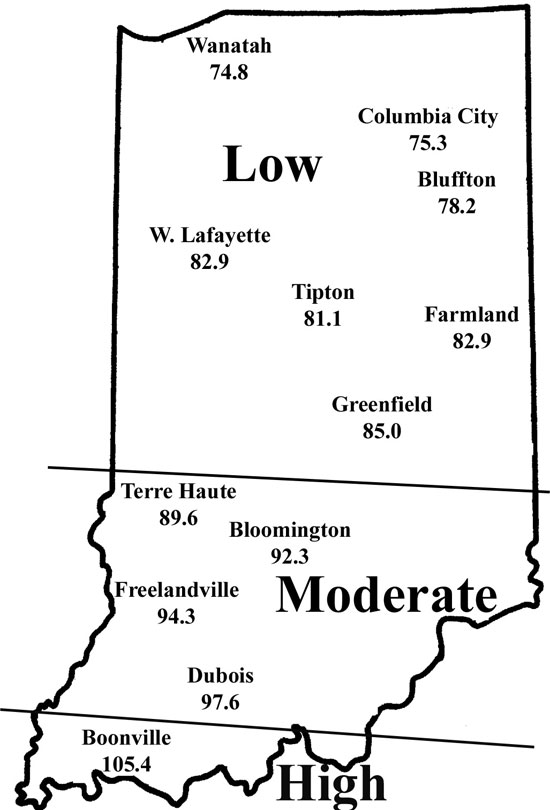
Corn flea beetle is a sporadic pest in Indiana. Winter temperatures in regions where beetles were abundant last season will determine if there is cause to be concerned this season. This is especially important since this insect can transmit the bacteria that cause Stewart’s disease in corn. The severity of the disease correlates well with winter temperatures because the bacterium survives in the gut of the overwintering beetles. Warmer temperatures result in higher beetle survival, and greater potential for Stewart’s disease. To determine the potential severity of Stewart’s disease, add the average daily temperatures for the months of December, January, and February. If the sum is below 90, the potential for disease problems to develop is low. If between 90 and 100, moderate disease activity is a possibility. Sums above 100 indicate a high probability that severe problems will develop for susceptible corn. To help you better gauge the potential for corn flea beetle activity in your area, and thus the potential severity of the threat of the disease, we have created the following state map. According to the temperature model, there is low probability of corn flea beetle activity and subsequent disease in northern Indiana, moderate activity in central counties. In all of southern Indiana, approximately south of Interstate 70, conditions were very favorable for beetle survival that may result in the appearance of Stewart’s wilt in sensitive hybrids/inbreds this spring.
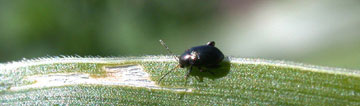
Close-up of corn flea beetle and leaf feeding scars.
This temperature model for corn flea beetle has been around many years and has been fairly accurate in predicting the activity of this pest the following spring. However one inherent flaw is that the model is based on ambient air temperatures, not temperatures under leaf litter and grass clumps where this pest overwinters. As well, snow cover, which can provide an excellent insulating blanket for the insect, may protect some beetles from winterkill. Even with this “disclaimer” statement, we think the 2004/2005 winter was cold enough to have negatively impacted overwintering beetles in northern Indiana. Also, flea beetle numbers have been low statewide, in general, for the last couple years.
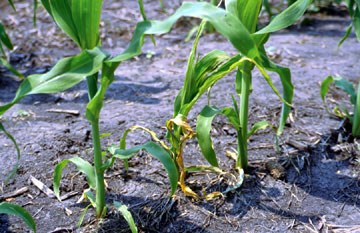
Stewart's wilt in seed corn.
There are two phases of Stewart’s disease: a wilt phase and a leaf blight phase. In the wilt phase, plants wilt rapidly, usually at an early stage of growth. Leaves emerging from the whorl of infected plants are often the first to wilt. Internal tissues at the growing point are discolored or hollowed out. Faint green to yellow streaks containing corn flea beetle feeding marks are visible on one or more leaves. If stalks of wilted plants are cut, it may be possible to see yellow, moist beads of bacterial ooze. Sweet corn hybrids are especially susceptible. Some dent corn inbreds, and occasional dent corn hybrids, and some popcorn lines are susceptible as well. Dent corn hybrids rarely wilt after growth stage V5. The leaf blight phase can occur at any time during the growing season, but often does not appear until after tasseling. Lesions are long and narrow, with pale green to yellow streaks and irregular or wavy-margins. Streaked areas die and become straw-colored. Severely infected leaves may die prematurely. Lesions on leaves of older plants may be confused with northern corn leaf blight. It is usually possible to see beetle feeding tracks in Stewart’s disease lesions.
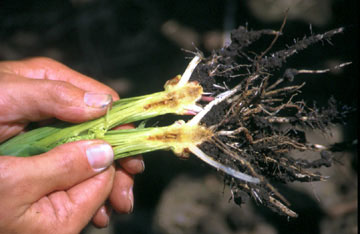
Dead growing point of Stewart's infected plant.
Management decisions made now, should be based on the corn’s susceptibility to the disease and anticipated risk. Low susceptibility/risk - pest managers should scout fields and apply a foliar rescue treatment after emergence if (1) beetle feeding damage becomes severe, (2) there are 5 or more beetles per plant, and (3) seedlings are growing slowly (e.g., cool temperatures). High susceptibility/risk - sample field edges and in-field areas of grass weed residue (i.e., overwintering sites) before planting to assess overwintering beetle survival and potential beetle movement to emerging corn plants. A sweep net is an ideal sampling tool for this pest. If any beetles are discovered at this time, an at-planting insecticide application is warranted. Furadan 4F and Poncho 1250 treated seed are systemic insecticides that should give good control of flea beetle. Furadan may require re-tooling the planter for liquid application. Poncho 1250 (and Gaucho Extra for inbred seed) must be applied to seed by commercial seed treaters. Poncho 1250 is labeled for flea beetle protection through the 5th leaf stage. If a systemic soil insecticide is not an option, foliar insecticides broadcasted at the time when corn spikes should provide 7 to 10 days of residual protection from beetle feeding. CAUTION: treating of field edges and waterways for beetle control may be an off label application. Avoid movement of insecticides, including soil-bound materials into aquatic environments.

Pheromone Trap Cooperators Have Detected Black Cutworm Arrival – (John Obermeyer, Christian Krupke, and Larry Bledsoe)
- This pest is beginning its annual invasion to the Midwest.
- Moths arriving in late April and beyond pose the greatest threat to crops.
- Heat unit accumulations fro time of intense capturers helps plan scouting activity.
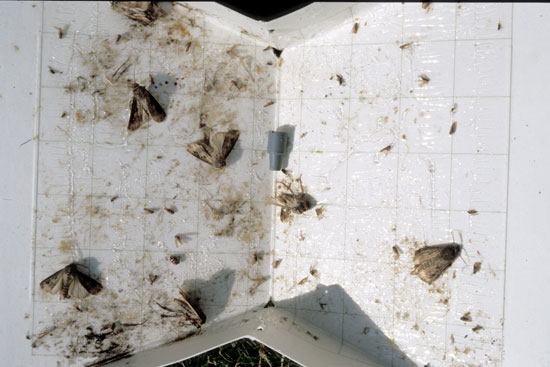
Captured black cutworm moths.
Although at low numbers, black cutworm are beginning their movement into the Midwest from sites in south Texas and northern Mexico (see following trap report table). Warm, moist air currents sweeping up from the Gulf Coast literally lifts these moths up into the upper atmosphere and carries them into Midwestern states. The direction that these weather systems track and the number of moths that are carried within them will determine whether they are brought into our area and whether or not they will pose a threat to our crops. Mike Hirsch, Gibson County producer, detected the first moth for 2005 following a rapidly moving storm front that moved through the state the evening of March 30.
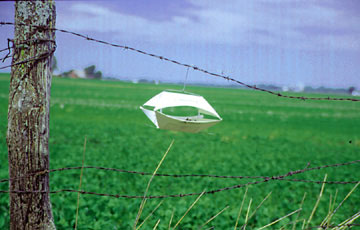
Black cutworm pheromone trap.
As in the past, black cutworm pheromone trap cooperators located throughout the state will monitor moth arrival. As we approach the more critical times for moth activity, that being later April and beyond, we will be watching for what we refer to as an “intense capture.” This is when 9 or more moths are caught in a trap over a two-day period. When and if this occurs, we will begin accumulating heat units (HU base 50°F) to determine when the first cutting of corn by the larvae should occur. This occurs approximately 300 HU after the intense capture. Watch for this information and Bug Scout’s alerts in future Pest&Crop’s Weather Update.
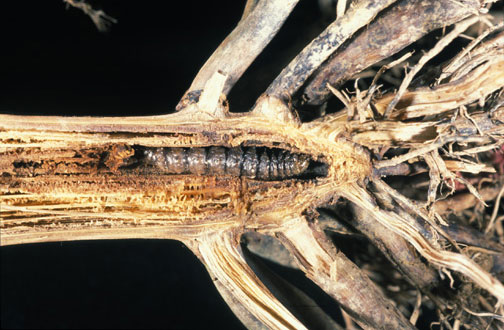
Dead Southwestern corn borer larva.
SWCB Spring Survey Update –
(Ric Bessin and Doug Johnson, University of Kentucky)
Southwestern corn borer spends the winter as larvae in galleries at the base of corn stalks. Stubble in cornfields can be checked during early spring for damaged plants and surviving borers. This can provide an indication of what the first generation may be like for 2005. A survey of southwestern corn borer damage and larval survival was conducted in Caldwell and Henderson counties on March 2 and 3, Daviess county on March 10. These counties were selected because of the past infestation and sampling history. The purpose was to estimate the extent of SWCB damage, as evidenced by basal stalk girdling. In addition, we wanted to estimate the survival of the overwintering larvae in the crowns of these damaged plants. In each county, four non-Bt corn fields were evaluated. Within each field, 10 groups of 10 plants were examined for girdling and an additional minimum of 50 girdled plants were examined for the presence of live SWCB larvae.
| 2005 SWCB Spring Survey Results | ||
Location |
Damaged plants |
Live SWCB recovered |
Caldwell County |
||
| Farm #1 | 3/100 |
0/50 |
| Farm #2 | 7/100 |
3/50 |
| Farm #3 | 6/100 |
5/50 |
| Farm #4 | 14/100 |
|
Henderson County |
||
| Farm #1 | 8/100 |
2/50 |
| Farm #2 | 4/100 |
2/50 |
| Farm #3 | 6/100 |
1/50 |
| Farm #4 | 8/100 |
4/50 |
Daviess County |
||
| Farm #1 | 1/100 |
2/14 |
| Farm #2 | 5/100 |
4/23 |
| Farm #3 | 5/100 |
2/58 |
| Farm #4 | 0/100 |
3/51 |
The information from Daviess, Henderson and Caldwell counties indicated that there was a low incidence of stalk girdling when compared with previous years, but the survival of those few larvae was higher than what we observed last year. As in past years in Caldwell county, there was high levels of what appeared as bird predation on the larvae.
So for the spring of 2005, we can conclude:
- Thanks to the cold winter, we found low survival levels of SWCB larvae in the counties surveyed, the numbers are very similar to what was observed in spring 2004.
- Birds seem to feed heavily on SWCB larvae during the winter.
- Winter conditions were not sufficient to eliminate SWCB larvae.
- We expect low first generation SWCB pressure for those areas surveyed.
- Date of planting is still important. Corn planted after May 10 could be at risk to late season SWCB activity.
Year |
Girdled stalks (%) |
Survival/ girdled |
Orall survival/stalk |
2005 |
5.58 |
5.12 |
0.29 |
2004 |
15.56 |
2.50 |
0.39 |
2003 |
26.57 |
4.25 |
1.13 |
2002 |
11.78 |
5.31 |
0.63 |
2001 |
0.58 |
9.66 |
3.92 |
2000 |
20.73 |
26.85 |
5.57 |
1999 |
35.89 |
10.14 |
3.64 |
Click for Table.
Black Cutworm Adult Pheromone Trap Report.

Spring Weed Control in Winter Wheat - (Bill Johnson and Glenn Nice)
Wheat is starting to green up across much of Indiana and now is good time to evaluate weed populations and whether or not control measures are needed. Most spring applied wheat herbicides should be applied before jointing to avoid crop injury and yield loss. To determine wheat growth stages refer to the previous issue of the Pest&Crop newsletter for an article written by Greg Shaner and Shawn Conley regarding proper wheat growth staging. In recent years, we have seen an increase in the number of products registered for use in wheat. The purpose of this article is to provide a brief review of some of the commonly used wheat herbicides and the importance of application timing, and best management practices for wild garlic.
It is also important to be aware that restrictions exist concerning application timing of these herbicides to avoid crop injury. Phenoxy herbicides, such as 2,4-D and MCPA, control a number of annual broadleaf weeds and are the least expensive of these herbicides to use. However, proper application timing of the growth-regulating herbicides 2,4-D, MCPA and Banvel is critical to avoid crop injury and possible yield losses. These herbicides can cause substantial crop injury and yield loss in small grains if applied before tillering begins or after development of the grain heads has been initiated.
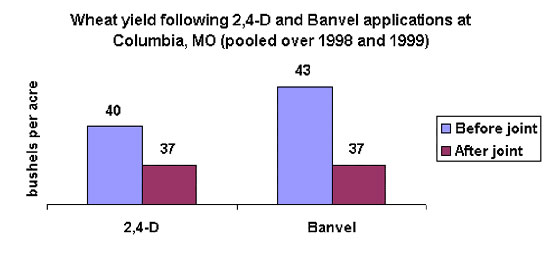
The exact time at which grain heads have been initiated is not easy to determine, but this event always just precedes stem elongation. The occurrence of stem elongation can be easily detected by the appearance of the first node or “joint” above the soil surface, commonly referred to as the “jointing stage.” Pinch a wheat plant stem at the base between the thumb and forefinger and slide your fingers up the stem. The presence of a node or joint will be felt as a hard bump about an inch above the soil surface. Slicing the stem lengthwise with a sharp knife will reveal a cross section of the hollow stem and solid node. If jointing has occurred, applications of 2,4-D, MCPA and Banvel should be avoided because crop injury and yield loss are likely. Research conducted while I was at the University of Missouri showed a 3- to 6-bushel per acre yield loss from 2,4-D and Banvel applications to wheat after the jointing stage.
MCPA alone at labeled rates should be applied before jointing. However, the amount of MCPA applied in Bronate, a combination of bromoxynil and MCPA, is low enough to permit later applications.
Many wheat fields in Indiana contain wild garlic and wild onion. Although not considered as strong competitors with a wheat crop, wild garlic (Allium vineale) and wild onion (Allium canadense) are both responsible for imparting a strong odor to beef and dairy products. Wheat producers and grain elevator operators are very familiar with dockages that occur with the presence of wild garlic or onion bulbs in their harvested grain. Found throughout Indiana, wild garlic is a native of Europe, while wild onion is native. Despite the fact that these perennials both occur in similar habitats, wild garlic occupies the majority of small grain settings, including wheat.
Control measures for wild onion and wild garlic will differ. Producers, consultants and industry personnel will want to make certain that they are able to distinguish between these two weed species. The vegetative leaves of wild garlic are linear, smooth, round and hollow (flowering stems are solid). A major difference with wild onion is that its leaves are flat in cross section and not hollow. Another varying feature are the underground bulbs. Wild garlic’s bulbs have a thin membranous outer coating while wild onion’s bulbs have a fibrous, net-veined coating.
Harmony Extra (thifensulfuron + tribenuron) is the herbicide most commonly used for control of garlic in wheat, plus it controls a relatively wide spectrum of other broadleaf weeds and possesses a fairly wide application window. Harmony GT (thifensulfuron) also has activity on wild garlic, but is considered to be slightly weaker than Harmony Extra. Peak is also labeled and effective on wild garlic in wheat, but it is fairly persistent in soil. The Peak label does not allow one to plant double crop soybean following wheat harvest in Indiana. Wild onion is controlled with 2,4-D. Keep in mind that both of these weeds are perennials and the full labeled rate is needed for adequate control.
In the last 3 years, three new herbicides have been registered that provide grass control in wheat. These products include Maverick, Olympus, and Osprey. Maverick (sulfosulfuron) is a product labeled for applications in the fall, but not the spring. Olympus and Osprey can be applied in the fall or in the spring. We have not tested these products in our field research program, so the information summarized here is from the manufacturers label. We will summarize the information for Olympus and Osprey since they would be the only grass herbicides labeled for use at this time.
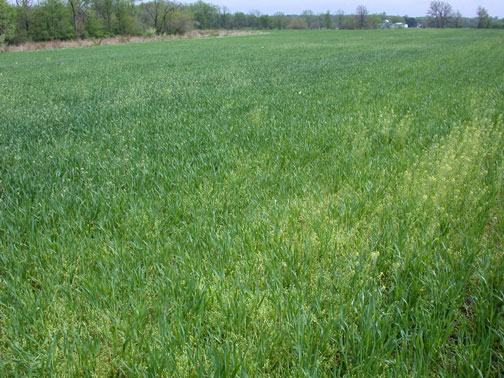
Weedy wheat.
Olympus is labeled for control of downy brome, cheat, and mustard species. It is an ALS inhibitor and must be applied before jointing. In can be applied with nitrogen solutions and requires the use of a nonionic surfactant as well. Temporary crop injury may occur if applied in a nitrogen solution. Do not plant other crops for at least 18 months following application. So, this product would not allow planting of double crop soybean in Indiana.
Osprey is labeled for control of annual bluegrass and annual ryegrass. It is also an ALS inhibitor and should be applied before jointing. Grass weeds should be in the 1-leaf to 2 tiller stage for best control. The label states that Osprey should be applied with water as the carrier, but up to 15% of the spray solution can be nitrogen fertilizer solution. Osprey requires the use of a methylated seed oil or nonionic surfactant plus ammonium sulfate or 28% UAN. Soybeans cannot be planted until 90 days after application.
Click for Table.
Herbicides to control boradleaf weeds in winter wheat.

Yellowing of Wheat - (Gregory Shaner)
- It's that time of year when wheat fields may show a yellow mosaic.
Each year at about this time I resurrect the story about two soilborne virus diseases of wheat: soilborne wheat mosaic and wheat spindle streak mosaic. Symptoms of these diseases appear when a period of warm weather is followed by cold weather. We are currently in a period of unusually warm weather, and the short-term weather forecast indicates these temperatures will persist for several more days. But, it’s still early April and we could experience some much cooler weather before spring really arrives. If that happens, symptoms of these virus diseases could show up in some Indiana wheat fields. Indeed, Purdue’s Plant and Pest Diagnostic Lab has already received one sample of wheat that shows symptoms of these diseases.
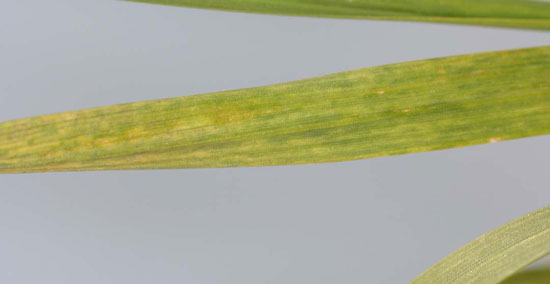
The viruses that cause these mosaic diseases—Soilborne wheat mosaic virus and Wheat spindle streak mosaic virus—cause a yellowing of foliage. Soilborne wheat mosaic virus infection results in development of narrow, pale green to yellow, wavy-margined streaks on the leaf blade. Symptoms caused by Wheat spindle streak mosaic virus infection are similar, but the streaks tend to taper at both ends, hence the name “spindle.” From a distance, fields or parts of fields are pale green or yellow, as though they are deficient in nitrogen.
The viruses persist in a common soilborne fungus, Polymyxa graminis. This fungus infects wheat roots in the fall. Infection by the fungus itself is of little consequence, but it does allow transmission of the viruses to the plant. Wetter areas of fields may show more intense symptoms because the fungus prefers moist conditions. Symptoms of virus infection don’t appear until the following spring. The timing of symptom development depends on weather. Intermittent periods of warm and cold weather favor symptom development.
It is very difficult to distinguish these two diseases based on symptoms. Both viruses may be found in the same field, and both viruses may infect a single plant. Wheat spindle streak virus tends to be more uniformly distributed throughout fields than is Soilborne wheat mosaic virus.
Most varieties of soft red winter wheat grown in Indiana have some degree of resistance to these viruses. They may show some yellowing during periods of fluctuating temperatures during the spring, but once the cold weather is past, these varieties tend to outgrow the symptoms on lower leaves and there is probably little damage. A few varieties are more susceptible. The intensity of yellowing is greater, and is accompanied by stunting, reduced tillering, and death of some plants in the field. These varieties will suffer economic damage from these diseases. Some varieties show a rosette symptom when infected by Soilborne wheat mosaic virus. They produce numerous, stunted tillers. There is no remedial action that can be taken at this stage. If a variety develops severe symptoms, don’t plant it again next year. There are plenty of varieties with good resistance.
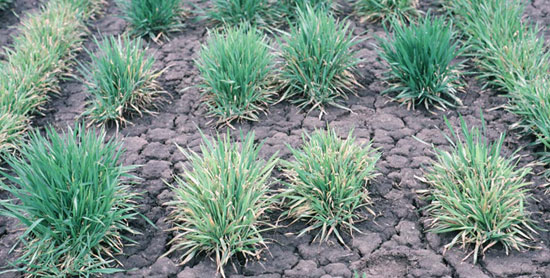
Differences in resistance to Wheat spindle streak mosaic virus and Soilborne wheat mosaic virus. The varieties in the lower left and upper right are highly resistant. The three varieties in starting at the right-hand side of the front row are susceptible. They are pale green and stunted. This degree of damage early in the season would probably result in some loss of yield.
Severe mosaic on a susceptible variety of wheat. Either virus, or both, could produce these symptoms.

Spring Wheat Injury and Shallow Planting - (Shawn Conley and Greg Shaner)
- Planting wheat too shallow can cause stand problems in the spring.
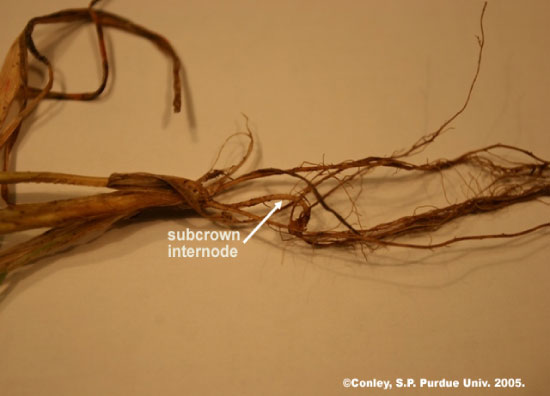
Image 1
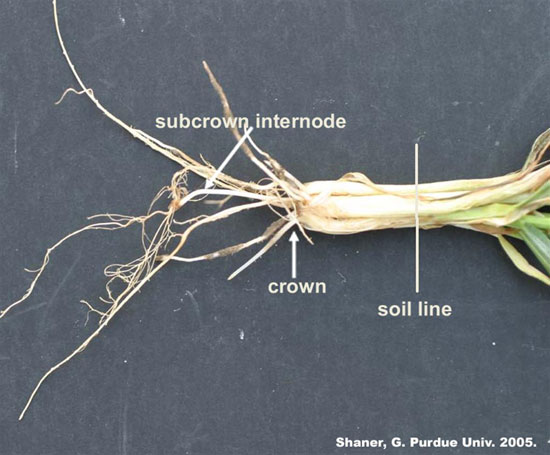
Image 2
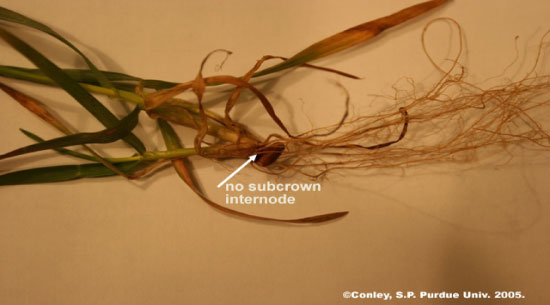
Image 3
Samples of wheat from three fields were submitted to the Purdue University Plant and Pest Diagnostic lab in the last week that all showed the same problem. In each field, spring regrowth has been delayed. Wheat in portions of these fields appeared to be growing normally, while plants in other areas showed little growth. These plants also had few tillers. Inspection of these samples revealed that seeding depth was most likely the reason for these symptoms. The seeding depth in each of these samples was less than ¼ inch. The growth habit in the poorest areas of the field also indicated that seed was placed directly on the soil surface. At a proper seeding depth a wheat plant will have a distinct subcrown internode (Image 1) that ranges from ¾ to 1.5 inches in length. The length of the subcrown internode reflects the depth of seeding (Image 2). None of the samples that we have received had a subcrown internode; the seed was attached directly to the crown. Wheat sown at less than 1 in. deep may have a very short subcrown internode, or none at all. When wheat seed is placed at an adequate depth, the crown and coronal roots will form about 1 inch below the soil surface (Image 3). If seed is at or near the soil surface, these structures will be correspondingly shallow.
Wheat plants that are seeded shallow often have delayed regrowth, develop slower, and tend to have decreased yield potential. These plants are also more susceptible to winterkill. When the crown develops at the soil surface, the roots that emerge from it are vulnerable to desiccation if they are exposed to the air or if the upper ¼ inch of soil becomes dry. The “good” samples that were sent were also planted shallow, but apparently somewhat deeper than the “bad” plants. The better regrowth of these plants may be due to slight differences in soil moisture, exposure to wind, or surface residue.
Fields that show poor regrowth should be examined to determine if seeding depth is the culprit. If stands appear inadequate it may be advisable to consider replanting the field with soybean, or corn if spring top-dress nitrogen has already been applied. Growers that have experienced a problem with wheat seed placement may want to check the depth settings on their drill.
