


Pest & Crop Newsletter, Entomology Extension, Purdue University

- Spider Mites Responding to Dry Conditions
- Soybean Aphid Updated
- Rootworm Larval Damage Being Reported, Could Get Worse
- Corn Earworm Activity
- Black Light Trap Catch Report

Spider Mites Responding to Dry Conditions - (John Obermeyer, Christian Krupke, and Larry Bledsoe)
- Spider mites can now be found in most soybean fields.
- Stressed ares of fields will show damage first.
- Consider many factors before treating spider mites.
- Spider mite control should not be comined with post-herbicides.
Jeff Phillips, Tippecanoe CES Educator, observed numerous spider mites in drought-stressed areas of a soybean field this week. This doesn’t come as a surprise when looking at the appearance of crops and lawns through many areas of the state; conditions have been exceedingly dry. The producer was soon to apply post-applied herbicides to this field and was asking about tank-mixing for spider mite control.
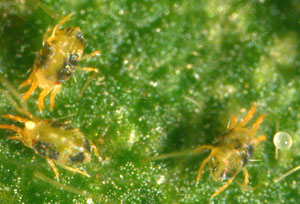
Greatly magnified twospotted spider mites on leaf.
Before considering control, it is very important that spider mites are identified as the source of yellowish or bronzed plants in a field. Shake some discolored soybean leaves over a white piece of paper. Watch for small dark specks moving about on the paper. Also look for minute webbing on the undersides of the discolored leaves. Once spider mites have been positively identified in the damaged areas of the field, it is essential that the whole field be scouted to determine the range of infestation. Sample in at least five different areas of the field and determine how far the spider mites have moved into the field from the grassy borders by using the “shake” method.
Stressed plants actually provide a more nutritionous feast for spider mites than healthy plants do. Thus they thrive and quickly colonize large areas or whole fields. The best spider mite control is to eliminate plant stress, which is easier said than done. Sandy, high clay, or compacted soils will exacerbate moisture stress in plants, with or without the presence of spider mites. Other stresses on soybean include pests such as soybean cyst nematode or nutritional imbalances, such as manganese deficiency. Obviously the best plant stress reliever under dry conditions is rain. Significant rain doesn’t control spider mites but helps the soybean plant become more vigorous and healthy, which in turn makes the “juices” of the plant less nutritious to the mites.
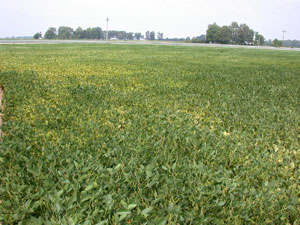
Stressed areas of field showing early spider mite damage.
The most severe damage occurs when the infestation starts in the early stages of plant growth and builds throughout the season (extended drought). Before applying controls carefully consider that, depending when damage is noted, multiple insecticide/miticide applications may be necessary. This is because surviving spider mites are able to repopulate a field much more quickly than their natural predators, which are usually also wiped out by these chemical applications. If extensive leaf discoloration is apparent, spider mites are positively identified as the culprit, and hot, dry conditions are expected to persist, it is recommended that a control be considered.
If a control is warranted, two pesticides are recommended for use. These include dimethoate (Dimethoate 400 and 4 EC) and chlorpyrifos (Lorsban 4E). Proper placement of these pesticides is the key to successful control results. Nozzle pressures of 40 psi with fine to medium droplet size and 30-40 gallons of water per acre for ground application helps distribute the pesticide throughout the foliage. Because this is NOT the proper application for glyphosate and good weed control without drift, tank mixing with herbicides is discouraged.

Soybean Aphid Update – (John Obermeyer, Christian Krupke, and Larry Bledsoe)
- Aphid numbers are slowly but surely building in numbers.
- Fields entering into reproductive growth stage require diligent monitoring.
- Newly-revised "Soybean Aphid" publication available online.
Researchers and pest managers inspecting soybean aphid have been reporting low, but growing, populations in most fields. Though some individual plants have been observed loaded with aphids, they are far and few between and not at the ≥250 aphids/plant threshold (see treatment guidelines below). Reports from other states in the upper Midwest are much the same. We strongly advocate continual scouting of the fields, especially as plants enter the critical reproductive growth stages and continue to be stressed by drought conditions. As outlined above for mite populations, soybean aphids thrive on stressed soybean plants. See the treatment threshold guide.
Extension publication “Soybean Aphid,” E-217 has just been revised and is available in PDF format for download at www.entm.purdue.edu/entomology/ext/targets/e-series/fieldcro.htm.
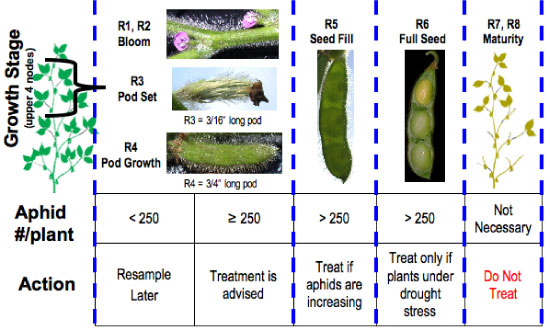
Soybean aphid treatment threshold guide.
Rootworm Larval Damage Being Reported, Could Get Worse –(John Obermeyer, Christian Krupke, and Larry Bledsoe)
- Root damage and larvae are being found in cenral and northern counties.
- Rootworm feedings will continue for 2-3 weeks.
- Root damage + dry soils and windstorms = a producer's worst nightmare.
Peak corn rootworm feeding is occurring, and so far most root damage is not apparent from above ground plant symptoms. However, pest managers out digging and inspecting root systems (see last week’s Pest&Crop) are finding some unpleasant surprises in most fields: damage and plenty of rootworm larvae. This is true in both untreated and insecticide-treated fields.
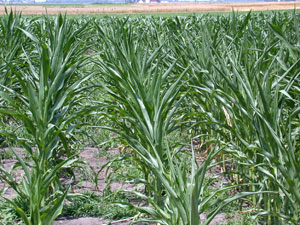
Rootworm damaged corn may show moisture stress first.
The worst-case scenario is that several factors will “collide” in the next week or two to cause significant lodging. First, much of the population are now full-sized larvae, which means they eat more and usually feed at the critical nodal root area. Nodal root systems are necessary for anchoring the plant, especially when rapid vegetative growth occurs just before pollination. Secondly, continual dry soils will restrict root penetration and growth. Root regrowth, the plant’s attempt to recover from feeding damage, is restricted when moisture is lacking. In addition, root regrowth pulls carbohydrates away from vital top and ear growth. The final X-factor is windstorms moving through the state, with or without rain. Reduced and poorly anchored root systems will cause plants to topple in fast-moving storm fronts. Lodging causes extreme physiological stress on plants, especially as they attempt to pollinate.
Corn Earworm Activity – (John Obermeyer and Rick Foster)
- Early-market sweet corn should be monitored for earworm moth activity.
- Several insecticide applications at silking may be necessary for "worm" free corn.
Our black light trap counts of corn earworm moths have been fairly low, but it is possible that recent tropical storm Arlene deposited earworm moths here from the southern states. High-value, host crops - especially early-market sweet corn that is pollinating now or soon will be - may be at risk.
Pest managers need to carefully monitor their corn earworm pheromone and/or black light traps to determine moth numbers. The proper strategy for managing earworms is to apply insecticides to fresh, green silks when moths are flying. Two or three applications of approved insecticides spaced 4-5 days apart will usually provide adequate control. Experience has shown that more applications at lower rates provide better control that fewer applications at higher rates, even when the same total volume of insecticide is used.
Click for Table.
Black Light Catch Report

Indiana’s Top Ten Most Problematic Weeds - (Glenn Nice and Bill Johnson)
Weed control practices often have an effect on the weeds we deal with on a year by year basis. Before the development of herbicides, growers relied heavily on tillage as a tool for controlling and suppressing weeds. Once herbicides became a valuable tool, some of the problem weeds found in predominantly tillage based management practices began to fade and new problematic weeds began to fill the gap. I often am caught saying, “nature finds a way”. As our habits change, specific weeds will exploit the new niches we create and become the more dominant species. This can be exemplified in the development of herbicides resistant weeds. As we use herbicides we apply selection pressure for the development of resistance or for the shift into species that have natural tolerance for the herbicides we choose to use. This can and does apply to any strategy we may come up with.
Several people who work in weed science take an interest in weed distributions and how they change over time. Understanding why particular problems arise in complex plant communities is a difficult but essential process. One way in which weed shifts are studied is to survey weed problems in different weed management practices. This can be done by sending written surveys to consultants, coops, county educators, or producers. Another way weed shifts are studied is by the physical counting of weeds in selected fields.
| Table 1. Top 10 Problematic Weed Lists | |||
| Rank | 1996 | 2000 | 2004 |
| 1 | Giant Ragweed | Giant Ragweed | Giant Ragweed |
| 2 | Canada Thistle | Canada Thistle | Lambsquarter |
| 3 | Hemp Dogbane | Johnsongrass | Canada Thistle |
| 4 | Lambsquarter | Lambsquarter | Cockebur |
| 5 | Horseweed | Shattercane | Velvetleaf |
| 6 | Johnsongrass | Hemp Dogbane | Horseweed |
| 7 | Burcucumber | Burcucumbere | Waterhemp |
| 8 | Shattercane | Velvetleaf | Burcucumber |
| 9 | Giant Foxtail | Common Ragweed | Chickweed |
| 10 | Fall Panicum | Cocklebur | Dandelion |
Written surveys were conducted in 1996, 2000, and 2004 in the state of Indiana by Purdue University Extension weed scientists. The survey in 2004 was sent out to 3000 people and 612 responses were received. The majority of responses (69 to 84% depending on district) listed weeds as their primary crop pest1. The survey requested the participant to list their top five of the most problematic weeds in corn and soybean production. The responses were compiled and used to develop a top 10 problematic weed lists.
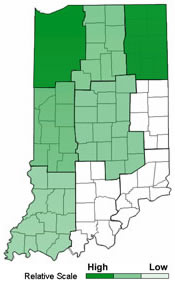
Figure 1. Relative distribution of growers who consider velvetleaf among the top 5 most problematic weeds. Highest reponse is 20%
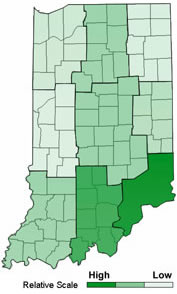
Figure 2. Relative distribution of growers who consider horseweed among the top 5 most problematic weeds. Highest response is 21% for a summer annual and 44% as a winter annual (not shown).
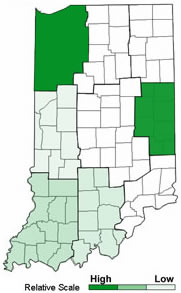
Figure 3. Relative distribution of growers who consider waterhemp among the top 5 most problematic weeds. Highest response is 13%.
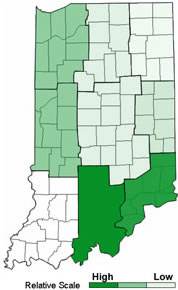
Figure 4. Relative distribution of growers who consider burcucumber among the top 5 most problematic weeds. Highest reponse is 14%.
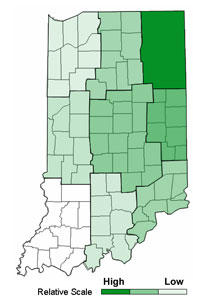
Figure 5. Relative distribution of growers who consider dandelion among the top 5 most problematic weeds. Highest reponse is 39%.
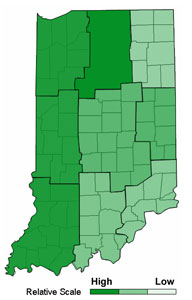
Figure 6. Relative distribution of growers who consider chickweed among the top 5 most problematic weeds. Highest response is 52%.
Most Problematic Weeds in 1996, 2000, and 2004
Giant ragweed, Canada thistle, lambsquarters, cocklebur, and horseweed (marestail) are problematic weeds that show up on the top 10 list in 1996, 2000, and 2004.
Giant ragweed has been ranked the most problematic weed over the three surveys. It was ranked among the top five most problematic weeds and the most common in a 1992 survey2. Again there is no surprise there; Indiana is the giant ragweed national forest. Giant ragweed’s adaptive germination, tolerance to herbicides due to rapid growth rates, resistance to ALS herbicides, and persistence has made this plant one of the most common and problematic weeds.
Waterhemp was rated seventh as a rapidly increasing weed in the 1996 survey2, but did not make the top 10 most problematic list in 1996. It first appeared in the top 10 list in the 2004 survey as the number seven most problematic weed. Migrating from the West it is most prevalent in the northwest, southwest, and central districts of Indiana.
Chickweed and dandelion did not appear in the top 10 list in previous surveys. However, with reduced use of residual herbicides, and the move to earlier planting dates, these weeds are now major problems and have lead to increased interest in fall herbicide applications.
Another noticeable difference between the 1996 and 2004 surveys is the lack of grass weed species in the 2004 survey. Giant foxtail and fall panicum were listed ninth and ten, respectively, in 2000 and do not appear on the list in 2004. The introduction of Roundup Ready soybean production systems has done a great job controlling annual and perennial grasses and been a major contributor to reducing grass weed problems. However, weeds difficult to control with glyphosate alone such as waterhemp, chickweed, and horseweed have increased in importance over the last couple of years. Surveys conducted in Kentucky also saw a decline in Johnsongrass prevalence, but increased prevalence of horseweed3.
Geographic Distribution of Specific Weeds
Responses were also geographically variable, some of the responses appearing to have patterns, yet others not. The following information was compiled from the 2004 survey data. For this survey the state of Indiana was divided up into nine extension reporting regions. In Figures 1 through 6, the shade of green indicates the percent of responses in each region relative to the highest percent of responses that deemed a specific weed to be in their top five most problematic weeds. The darkest green indicates the weed is thought to be most problematic in that region. No green shading meant that the weed was not considered among the most problematic. The highest percent response is given in the figure caption.
Responses regarding giant ragweed were fairly uniform across the state (data not shown). Velvetleaf appeared to be more problematic in the northern and western regions of the state (Figure 1). As expected, due to the frequency of glyphosate resistant horseweed in the southeast portion of the state, these regions tended to rank horseweed as a problematic weed (Figure 2). Furthermore, horseweed was also deemed to be a problem in several different regions. Waterhemp was problematic in the northwest and east central regions, to a lesser extent in southwest Indiana (Figure 3). Burcucumber was problematic in similar regions as horseweed (Figure 4). Dandelion is well known as one of the most problematic weeds in the northeast of the state (Figure 5). Finally, the winter annual weed chickweed was deemed the most problematic winter annual and made it into our top ten list in 2004. It is considered problematic throughout the state, although the western regions tend to have higher levels of concern that the eastern regions (Figure 6).
As this survey shows, some weed problems such as giant ragweed, Canada thistle, common lambsquarter and burcucumber are consistent from year to year regardless of production practices. Other weed management issues, such as dandelion, common chickweed, and waterhemp emerge in response to changing management practices, while others, specifically grass weeds, decline in importance. This survey shows that unique weed problems occur throughout Indiana. This poses challenges to growers, consultants, and county educators and makes it unlikely that a weed management program that relies on a single herbicide will be sustainable in the long-term.
1 David Hillger, Kevin Gibsion, and Bill Johnson. 2004. Weed Management Survey of Indiana Corn and Soybean Producers. North Central Weed Science Proceedings 59:70.
2 Dan J. Childs, Tom N. Jordan, and Ron L. Blackwell. 1996. Survey of Problem Weeds in Indiana: 1996. Purdue University Cooperative Extension Service. WS-10 (out of print).
3 T. Saphangthong, M.W. Marshall, J.D. Green, and J.R. Martin. 2004. Field Survey of Weeds Observed in Kentucky Before and After Widespread Adoption of Glyphosate-Tolerant Soybeans. North Central Weed Science Proceedings 59:20.

What’s Wrong with my Soybean Leaves? - (Shawn Conley and Gregory Shaner)
- Brown spot, sunburn, and Mn deficiency. Oh My!
With the threat of rust this year, soybean leaves are probably being scrutinized more carefully than ever before. Although no rust has been detected in Indiana, there are some other diseases and disorders that are producing symptoms on soybean leaves. Probably the most common disease on soybean leaves is brown spot. Historically, this disease occurs in virtually every soybean field. Owing to the dry weather of the past few weeks, brown spot is less severe than usual, but some infection can be found in many fields. Brown spot is caused by a fungus, Septoria glycines. Symptoms appear first on the unifoliolate leaves, and sometimes even on the cotyledons. As the season progress, symptoms move to upper leaves, but usually do not reach the upper leaves until late in the season as the plants begin to mature. Under our conditions, brown spot is thought to cause little or no damage to soybean.
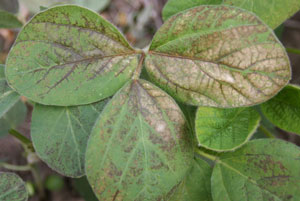
Image 1.
When brown spot lesions first appear, they are small, purple-black spots. At this stage they may be confused with the initial symptoms of rust, before pustules erupt. As brown spot lesions mature, the necrotic area fills the area between small veins, giving the lesions an angular outline. A yellow halo develops around the necrotic spot. An article about soybean rust in last week’s issue of Pest&Crop (issue 13) contains images of young and mature brown spot lesions. Often, many infections develop on a leaf and as these lesions mature, they coalesce to produce large dead spots with yellow halos. By the time lower leaves show these symptoms, leaves above will often show the small spots indicative of more recent infection. This year, we are seeing brown spot more commonly in fields that were planted early. Many later planted fields (after the first week of May) show no brown spot at this time.
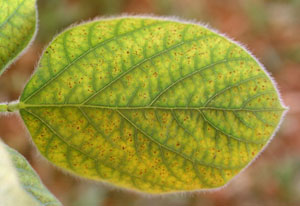
Image 2.
Another problem that is showing up is sunburn (Image 1). There have been many days of intense sunshine during the past couple of weeks. Sunburn symptoms are expressed as a bronzing of either surface of upper leaves. We are seeing symptoms mainly on the tips of leaves, and on only a small percentage of plants. These symptoms bear some resemblance to Cercospora leaf blight, but this disease does not usually appear until pods are well developed at upper nodes (R4), during periods of high humidity and prolonged dew periods. As sunburned tissue ages, it becomes dry and cracks.
Some fields are also showing symptoms of manganese (Mn) deficiency. Mn deficiency usually appears first in younger (new) soybean leaves. The symptomology includes intervienal chlorosis (Image 2), plant stunting, necrotic brown spots, and early leaf drop. Mn deficiency is usually favored in high pH soils and/or in soils with high organic matter (organic sands, peats, and mucks). The increased number of calls regarding Mn deficiency in 2005 is most likely due to the dry conditions we have experienced in different regions across the state. Two common problems that may be confused with Mn deficiency are SDS and Roundup flash. SDS symptoms normally do not appear until the soybean R2 growth stage or later and Roundup flash is usually expressed as streaks where spray patterns overlap or at soybean end rows.

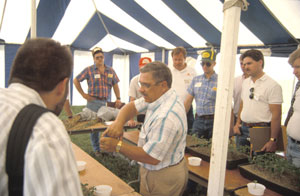
Donald H. Scott
July 11, 1934-June 11, 2005
We regret to inform you that Don Scott has recently passed away. Don was a long time contributor to the Pest&Crop newsletter as well active with the Purdue Diagnostic Training Center, Crop Management Workshops, and numerous IPM activities and publications. To most of Indiana’s agribusiness, Don will be long remembered as key member of the “Bugs, Burs, and Blights” team.
Don was named professor emeritus at Purdue in 1998, after serving as a professor of plant pathology for 30 years. He received the Crop and Soil Merit Award from the Indiana Crop Improvement Association in 1990; the Frederick L. Hovde Award of Excellence in Education Service to Rural People of Indiana in 1995; the Distinguished Service Award from the Midwest Regional Turf Foundation in 1996 and the North Central Division of the American Phytopathological Society in 1998; the Indiana Farm Bureau Award for his agricultural extension service in 1998; and in 1999, the Certificate of Distinction from the Agricultural Alumni Association for outstanding service.
Dr. Scott had photographed hundreds of barns across Indiana, which began as a hobby and resulted in the publication of two books, Barns of Indiana and Barns of Indiana, Volume II.
Thanks Don, you sure made field crop diseases understandable and a lot of fun!