


Pest & Crop Newsletter, Entomology Extension, Purdue University

- Nematode Updates
- Diagnosing a "Short Corn, Tall Corn" Field
- European Corn Borer Mots Flying
- Japanese Beetle Expected Soon
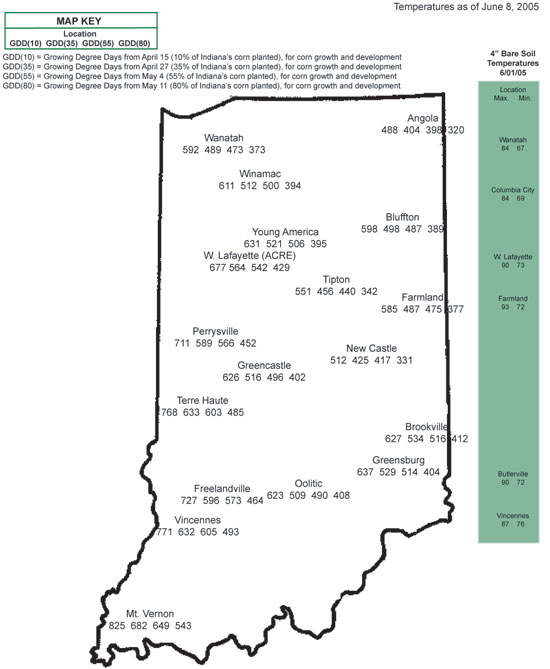
- Black Light Trap Catch Report

Nematode Updates – (Jamal Faghihi and Virginia Ferris)
- Corn nematodes slow down as soil temperatures increase.
- Soybean cyst nematode females now visible on roots.
- Contact information for nematode questions and/or samples given below.
In our last article, we suggested that because of warm temperatures corn nematodes might not be a problem this year. For the most part corn nematodes did not appear to be a significant problem, despite cooler temperature in later part of May. As the temperatures increase, corn nematodes should become inactive and less of a problem. However, if the temperature in your area has not been too high and you have had adequate moisture, there might still be time to test for corn nematode. Samples should be taken by digging out the root system with surrounding soil and placing it a plastic bag. The samples must not be exposed to high temperatures and may be sent to our laboratory for analysis. A comparative sample from a “good” plant will help with the analysis. There is $10 charge for each corn nematode analysis.
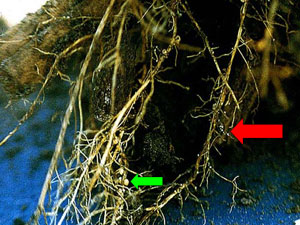
Females or cysts (red arrow) compared to nodules (green arrow) on roots
The first generation of soybean cyst nematode have completed their life cycle on early-planted soybeans. The white to light yellow females should start appearing on young soybean roots. If soybean cyst nematode has been a problem or is suspected to be a problem, the whole root system, with the surrounding soil, can be placed in a bucket of water to dislodge the soil from roots. The young white females will be visible with naked eye or with slight magnification. If you have planted a resistant soybean cultivar in your field, the next month or so might be the best time to find out how resistant the cultivar truly is. Even though resistance to soybean cyst nematode is stated on the label, the cultivar might not show resistance. By observing the white females you can determine this. We urge you to start monitoring your fields for presence of soybean cyst nematode. If you have not sampled for SCN in the past, or have used resistant soybean for several years, you need to sample for this nematode. As in previous years, Indiana Soybean Board is paying the processing fees for Indiana growers, up to 10 samples/grower/year. Soil samples taken from depth of 4-6 inches can be sent to our laboratory for analysis.
If you have any question about these or any other kinds of nematode, you can call 765-494-5901 or send an email to jamal@purdue.edu. Soil samples for nematode analysis can be sent to: Nematology Laboratory, Purdue University, Department of Entomology, Smith Hall, 901 W. State Street, West Lafayette, IN 47907-2089.

Diagnosing a “Short Corn, Tall Corn” Field – (John Obermeyer, Christian Krupke, and Larry Bledsoe)
- Diagnoses of a field problem requires a hunger for knowledge.
- Patience and thorough analysis may pinoint to specific or multiple interacting factors.
- Experienced gained in challenging fields will be beneficial in the future.
“Eliminate all other factors, and the one which remains must be the truth,” Sherlock Holmes by Sir Arthur Conan Doyle. This is easier said than done when dealing with poorly growing corn in areas of a field. Symptoms often include stunting, discoloration, and leaf rolling. As one begins to investigate, the possibilities seem endless.
Grubs, wireworms, cutworms, stalk borers, etc. can easily be implicated when found associated with damaged plants. However, this time of the year, it is not uncommon for multiple factors, with or without insects, to “collide” to cause great consternation to those attempting to diagnose the problem. Crop consultants and farmers with years of field experience certainly helps make a diagnosis, but even they can leave fields befuddled.
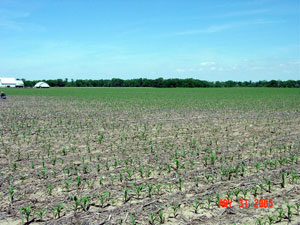
View of damaged area of field.
A recent “case” was a seed company agronomist “sleuthing” the classic short corn/tall corn within an area of a field. The initial diagnosis made by producer and fertilizer dealer was grape colaspis damage. This seasoned agronomist used many tools in the field, including a cell phone and digital camera, along with the mandatory spade and knife. While the agronomist was in the field, calls were made to us to help confirm grape colaspis identification and current life stage. No grape colaspis grubs and only one pupa were found in the soil near damaged plants. The next most likely problem in this no-till field with significant surface crop residue was the abundance of millipedes in and around the soil. It was tempting to implicate the millipedes for causing a reduced root system and stunted plants, but their favored food of decaying plant material was plentiful and made for a weak case.
The undeterred agronomist sent plant and soil samples to both Purdue’s Plant and Pest Diagnostic Lab www.ppdl.purdue.edu/PPDL/ and Nematology Lab and field pictures to extension specialists to “eliminate” other possibilities. Results: positive for seedling blight, needle nematode, and symphylans. Specific information for each of these pests can be found on-line at the Field Crops IPM web page www.entm.purdue.edu/entomology/ext/fieldcropsipm/cd.htm. Go to the occasional and non economic pests link to find the Garden symphylan.
The agronomist should be applauded for the diligent effort in diagnosing this field problem. Unlike Sherlock Holmes’ success at the end of a mystery, there is no smoking gun because, more possibilities have been uncovered as causing the short corn/tall corn symptoms. These identified pests may be working independently or concurrently to cause the field damage. Still other factors, such as soil fertility, soil compaction, past herbicide history, planting date, hybrid tolerances, environmental conditions, millipedes feeding on diseased plant tissue, etc. may be working against the plant’s vigor in this part of the field.
Though this field diagnosis doesn’t have a happy ending, the agronomist’s experience and skills have been increased. Their new gained knowledge of possible causes for these field symptoms will be useful in the future. Happy Scouting!
European Corn Borer Moths Flying – (John Obermeyer)
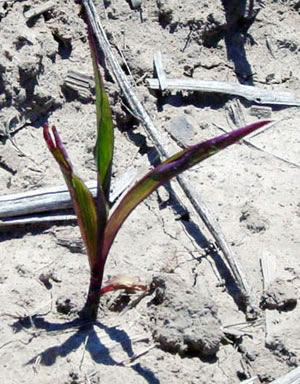
Stunted and discolored plants.
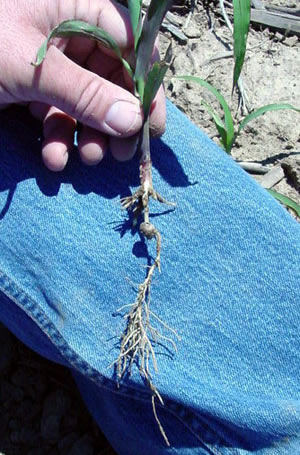
Damaged root system.
The first ECB moths were captured in the southern Indiana black light traps last week. It is too early to draw any conclusions from this first occurrence for the season. Soon it will be time to inspect the tallest corn in the area for corn borer eggs and moth activity in grassy areas surrounding these fields. More on this pest in future issues of the Pest&Crop.
Japanese Beetle Expected Soon – (John Obermeyer)
The University of Kentucky has reported emergence of Japanese beetle in their western counties. If not already present, they will likely soon be spotted in southern portions of Indiana. Because we have heard very little about field crop white grub problems this spring, it will be interesting to see how large this season’s beetle population will be and where in the state it reaches pest status. More on this pest in future issues of the Pest&Crop.
Click for Table.
Black Light Catch Report
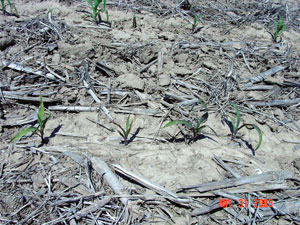
Wilted and purplish plants

Pokeweed Control – (Glenn Nice, Bill Johnson, and Tom Bauman)
- Control of pokeweed in emerged soybeans.
- Control of pokeweed in emerged corn.
- Control of pokeweed in pastures and non-cropland.
Similar to the last couple of years, we have observed a number of fields where common pokeweed really took off in early June. During this part of the growing season it is becoming a familiar sight of to see pokeweed and its red stems and large leaves standing like botanical sentries in our fields. By mid July however, we typically observe the brown to black corpses of common pokeweed after the postemergence herbicides have been applied…if herbicide treatments were made in a timely manner. However, since the weed is a perennial, it might be premature to claim victory on pokeweed at that point. You have probably won the battle, but not the war. The root balls of this perennial weed can be very large, as large as a bowling ball, making control of this weed fairly difficult with single postemergence herbicide treatments. Many of the healthy plants we see this year are new growth from root balls that persist from year to year. Another thing that makes pokeweed a management challenge is the fact that seeds can be dispersed by birds. The ripe fruit are eaten by birds and the seed pass though the birds and are dispersed wherever the birds decide to leave their mark.
Control of pokeweed in emerged soybeans. Field studies by researchers at Southern Illinois University reported that glyphosate controlled pokeweed 88% or higher1. Control was increased when glyphosate was tank mixed with Firstrate or Synchrony STS in soybean. Firstrate and Synchrony STS alone provided 68 and 38% control. So, specific recommendations would include the following:
In Roundup Ready soybeans use at least 0.75 lb ae/A applied when pokeweed plants are at least 8 inches tall. Make a second application if necessary. In soybeans that are not Roundup Ready, use Synchrony STS (0.5 oz/A) or Classic + Harmony GT tankmixes. FirstRate seemed to provide similar control in the SIU studies, but we don’t have quite as much experience with FirstRate on pokeweed than we do with Classic + Harmony GT.
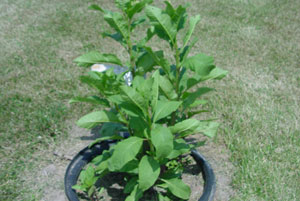
Common pokeweed
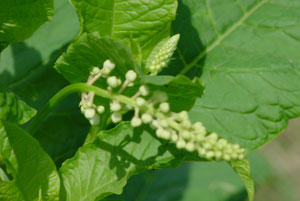
Developing fruit. June 8th
Control of pokeweed in emerged corn. In the same SIU report common pokeweed control in corn with Lightning; dicamba [Banvel, Clarity, Sterling]; Celebrity Plus; and Callisto (3 oz/A) was 90% or better. So specific recommendations would include the following: In Roundup Ready corn, use glyphosate (0.75 lb ae/A) when plants are at least 8 inches tall and make a second application if necessary. Other effective treatments for non-transgenic corn include Northstar, Yukon, dicamba (1 pt/A) and Distinct (4 to 6 oz/A), dicamba + Spirit, Callisto (3 oz/A). Apply when plants are less than 12 inches tall if possible.
Control of pokeweed in pastures and non-cropland. Pokeweed in pastures or on non-crop areas can also be a problem. Pokeweed can be toxic to cattle, sheep, humans, turkeys, swine, and horses. For more information on pokeweed toxicity see the following web page (http://www.vet.purdue.edu/depts/addl/
toxic/plant40.htm). In the same study mentioned above, glyphosate at 0.75 to 1 lb ae/A was used on 6, 12, 24, and 48 inch tall pokeweed. All treatments provided above 95% control but obviously would kill most other species including desirable grass forages. For grass pastures, Crossbow can provide the equivalent of 80% control with a 1.5% v/v mixture or 4 qt/A rate2.
Since pokeweed is a perennial, the most effective technique for control will be to include fall herbicide applications in addition to in-crop treatments. Apply glyphosate + 2,4-D in the fall before the ground freezes if green leaf tissue is present to absorb the spray solution.
Reference:
1 Scott A. Nolte, Bryan G. Young and Gordon K. Roskamp. 2002. Common Pokeweed Control in Corn and Soybean. North Central Weed Science Society Abstracts 57:122.
2 Mark M. Loux, Jeff M. Stachler, Bill Johnson, Glenn Nice, and Tom Bauman. 2005. Weed Control Guide for Ohio and Indiana. Ohio State University.

Yellow Tops and Twisted Whorls - (Bob Nielsen)
Scattered plants with distinctly yellow-green upper leaves are evident in some fields of early-planted corn while driving down the road at 60 mph. Closer examination of these fields reveals other plants with tightly wrapped whorls similar to what is sometimes referred to as “onion leafing”.
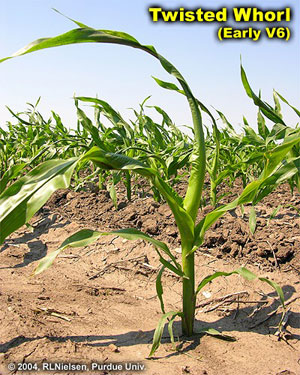
The cause of twisted whorls can be herbicide-related; particularly from post-emergence application of growth regulators like dicamba or 2,4-D. Recovery from these causes of twisted whorls depends on the severity of the actual herbicide injury to the plant.
Just as frequently, twisted whorls occur in some hybrids as the plants transition from young pre-V5 seedlings to the rapid growth phase. The exact reason for the twisted and wrapped whorls is not known, but the good news is that the whorls of affected plants eventually unwrap with minimal, if any, effects on the yield of the plants. The younger leaves that had been trapped inside the twisted upper leaves emerge fairly yellow because they had been shaded for quite some time. By the time the affected plants reach waist to chest-high, the only evidence that remains of the previous twisted whorls is the crinkled appearance of the most-affected leaves.
For more descriptions and images of this curiosity, revisit the articles I wrote last year (Nielsen, 2004a & 2004b).
Related References
Nielsen, R.L. (Bob). 2004a. Twisted Whorl Symptoms in Corn. Corny News Network, Purdue Univ. Available online at www.kingcorn.org/news/articles.04/TwistedWhorl-0607-Gallery.html [URL verified 6/5/05].
Nielsen, R.L. (Bob). 2004b. Wrapped & Twisted Whorls in Corn. Corny News Network, Purdue Univ. Available online at www.kingcorn.org/news/articles.04/TwistedWhorl-0607.html [URL verified 6/5/05].
For other Corny News Network articles, browse through the CNN Archives at www.kingcorn.org/news/archive.html. For other information about corn, take a look at the Corn Growers’ Guidebook at www.kingcorn.org.

Purdue Booklet Speaks Volumes About Soybean Rust – (Steve Leer, Ag Answers)
WEST LAFAYETTE, Ind. - A new booklet developed by Purdue University Extension does for soybean growers what CliffsNotes does for literature students.
“Preparing for Asian Soybean Rust” covers the foliar disease from initial infection to yield loss prevention - all in a handy, 15-page volume.
The booklet is available through county offices of Purdue Extension and Purdue’s Media Distribution Center. Farmers also can order and download the publication online.
“Preparing for Asian Soybean Rust” is loaded with color photographs and instructions for submitting leaf samples to Purdue’s Plant and Pest Diagnostic Laboratory for rust analysis, said Shawn Conley, Purdue Extension soybean specialist and one of the publication’s authors.
“What we were trying to develop was a small, all-inclusive publication that growers can take to the field and determine whether their crop might have soybean rust,” Conley said. “We’ve also included the steps to follow if growers suspect they have Asian soybean rust in their fields.”
Although the booklet is small, it doesn’t skimp on important details, Conley said.
“This publication takes into account the soybean plant itself - the agronomic aspects; disease management - the pathology aspects; and the economic side, such as crop insurance,” he said. “Those points are laid out in a concise, but precise, manner.”
Thumbing through the booklet is easy, Conley said. Color-coded tabs take the reader right to the seven main sections:
- “What is Asian soybean rust?”
- “What does it look like?”
- “How does it spread?”
- “How can it be managed?”
- “How should fungicides be used?”
- “Can cultural practices help? - Will crop insurance cover my losses?”
- “What if I suspect I have soybean rust? - Where can I find more information?”
Much of the booklet’s content is based on the soybean rust experiences of South American farmers, said Greg Shaner, a Purdue Extension plant pathologist and contributing writer.
Soybean growers in the continental U.S. have never faced a rust threat. The disease was first detected in southern states this past November.
“In this publication, we attempted to bring together our best estimates of how this disease is going to develop and how the pathogen will behave here,” Shaner said. “It was written with an emphasis on soybean here in the Midwest but certainly is applicable across the Corn Belt and even points further north.
“Because we haven’t yet gone through a growing season with the disease, we’re relying on what we know about other rust diseases on small grains and corn. We’re also relying on what people in Brazil and Africa have dealt with.”
Shaner and Conley have seen rust impact firsthand.
“Shawn and I went to Brazil in mid-February, specifically to look at soybean rust,” Shaner said. “Much of what we saw there, in terms of symptoms and recognition of the pathogen, when it arrives here, we’ll see the same sorts of things.”
Several soybean rust photographs from the Brazil trip appear in the booklet.
Single copies of “Preparing for Asian Soybean Rust,” Purdue Extension Publication ID-324, are free and available at county offices of Purdue Extension. Bulk orders are available in packages of 25 for $5 by logging onto the Purdue Extension Education Store www.ces.purdue.edu/new/ or by contacting the Media Distribution Center. To reach the Media Distribution Center or for the Extension office near you, call the toll-free Purdue Extension hotline at 1-888-398-4636 (EXT-INFO).
The booklet also can be downloaded as a pdf file www.ces.purdue.edu/extmedia/ID/ID-324.pdf.
Others who contributed content and/or photos for the publication included Corinne Alexander, Craig Dobbins, Chris Hurt and George Patrick, Purdue Extension agricultural economists; Ellsworth Christmas, Purdue Extension agronomist; Karen Rane and Gail Ruhl, Purdue Plant and Pest Diagnostic Laboratory; Alvaro Almeida, Embrapa Soja, Londrina, Brazil; and Kevin Black, GROWMARK. The Indiana Soybean Board provided financial support for the printing costs.