Pest & Crop Newsletter



 |
|||||||||||||||||||||||||||||||||||||||||||||||||||||||||
|
|||||||||||||||||||||||||||||||||||||||||||||||||||||||||
 |
|||||||||||||||||||||||||||||||||||||||||||||||||||||||||
Smidgen of Field Crops Insect Damage– (John Obermeyer and Larry Bledsoe)
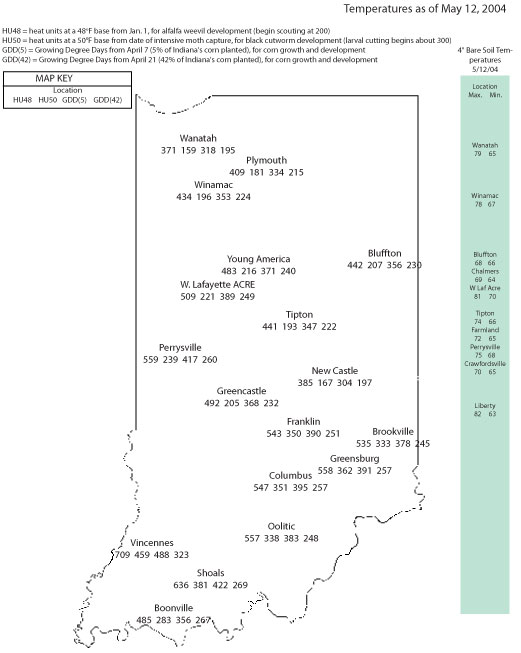
The few phone calls that we have received suggest that insect related problems in field crops have been sporadic. Alfalfa weevil had its way in some southern county forage fields earlier this spring, but fewer concerns have been reported further north in the state. Those planting corn or soybean into fields with burned-down weeds or cover crops have had some stand reductions from slugs. And other than a few dingy cutworm and wireworm observations, insect pressure has been light. So far, so good for 2004! Generally one would think that earlier planting of crops would equate to more “secondary” insect (e.g., grubs, wireworms, etc.) problems. This certainly is true in years when the seed and/or sprout germination and growth are slow. However, comparatively warm temperatures and sufficient soil moisture in most of the state has allowed for quick crop emergence and growth. Essentially, the grubs and wireworms, if present, have damaged fewer plants because of the shorter amount of time that plants have been vulnerable. Earlier than normal tillage and/or burn-down herbicides this year seems to have reduced the establishment of black cutworm larvae on winter annual weeds. Again, black cutworm growth hasn’t kept up with the phenomenal crop development. Do not become lulled into believing that the seed-applied insecticides have been the main reason for lack of early season insect problems this spring. There is no question that these short-lived systemic insecticides can help with early insect pressure, but one should not get a false sense of security about them in the future. From the amount of dingy cutworm damage (leaf feeding) we heard about where these seed treatments were used, it’s obvious that the above-ground protection is limited. Generally mid-May is when insect problems really get notice as producers begin scouting their fields. Therefore we encourage pest managers to scout and prove us wrong with the above assessment of this spring’s insect pests. Please don’t call about cicadas, yes they are annoying but they will NOT hurt field crops!
Stalk Borer Soon to Migrate– (John Obermeyer and Larry Bledsoe)
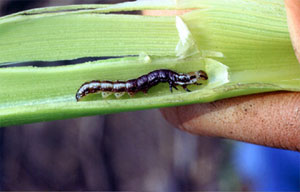
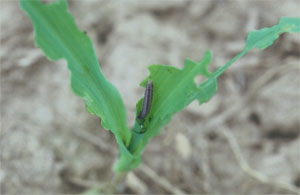
Stalk borer damage occurs in certain fields because of the attractiveness of certain plants in the fall to stalk borer moths for egg deposition. Plants favored for egg laying include grass-type cover crop species (rye, wheat, etc.) and certain weeds (foxtails, giant ragweed, etc.) within fields, waterways, ditches, fence rows, etc. In the spring, the larvae hatch and begin their search for suitable plants to infest. Stalk borer larvae are easily identified by the purple band or “saddle” around the middle of their bodies and the white longitudinal stripes at their anterior (front) and posterior (rear) ends.
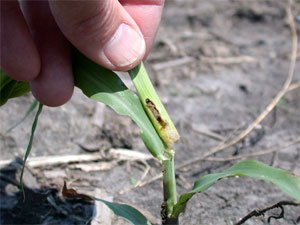
Initial infestation by small larvae has already occurred throughout the state. Usually about half of infested corn plants are able to grow out of this early damage. Larger migrating larvae, which will occur soon, can severely damage plants by tunneling into the stalk. Unfortunately, once inside the plant, stalk borers are well protected from insecticides. Research conducted at Iowa State University shows that once stalk borer has tunneled and dead leaves appear (“dead heart”) in the corn, grain yield reductions are 59% for primary plants (first plant infested) and 74% for secondary plants (second plant infested). The damage obviously intensifies as the larvae increase in size. The borers are susceptible to insecticides when they are moving from plant to plant or are in the corn whorl However, timing of such treatments is critical to increase the probability of success (see following chart). For a listing of recommended insecticides refer to extension publication E-219-W - Corn Insect Control Recommendations - 2004 (Revised 1/2004) at www.entm.purdue.edu/entomology/ext/targets/e-series/fieldcro.htm.
Inspect Alfalfa New Growth for Weevil Damage - (John Obermeyer and Larry Bledsoe) Producers that have or soon will be taking the first cutting should examine their alfalfa a few days after to determine if the weevils are present and actively feeding. Occasionally, weevils will retard the new growth to the point that economic damage occurs. If weevils are present and new growth is not apparent or if 50% of the new growth shows feeding activity and weevils are present, a stubble spray may be needed.
Model Predicts Western Corn Rootworm Hatch – (Larry Bledsoe and John Obermeyer) A western corn rootworm development model that appears on the Indiana Weather and Climate Synopsis by County web site (www.agwx.ca.uky.edu/ldm-images/wcracc.gif) is predicting that egg hatch is occurring over the southern two thirds of the state. Larvae would be extremely small at this point and very difficult to see embedded in the roots. Evaluations of product performance and/or the assessments of rootworm abundance should be possible in a few weeks when larvae and root damage become visible. We try to document the actual initiation of egg hatch each year in Tippecanoe County by microscopic search of untreated corn roots and will alert you when larvae are found.
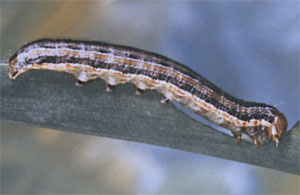
Impressive Armyworm Moth Flight in NE Indiana – (John Obermeyer) Over the last couple of weeks, armyworm moth flights have been catching our attention, especially in northeastern Indiana (see “Black Light Catch Report”). High-risk fields, i.e., wheat and corn no-tilled into a grassy cover/weeds, should be scouted for the larvae and damage. Scouting and management guidelines in wheat are given in last week’s Pest&Crop. In corn, armyworm feeding gives corn a ragged appearance from the leaf margin toward the midrib. If more than 50% of the plants show feeding and larvae are less than 1-1/4 inches long then a control may be necessary. For a listing of recommended insecticides refer to extension publication E-219-W - Corn Insect Control Recommendations - 2004 (Revised 1/2004) at www.entm.purdue.edu/entomology/ext/targets/e-series/fieldcro.htm.
|
|||||||||||||||||||||||||||||||||||||||||||||||||||||||||
 |
|||||||||||||||||||||||||||||||||||||||||||||||||||||||||
Weed Management Considerations in Corn in a Warm, Windy, Dry and Now Wet Spring? – (Bill Johnson and Glenn Nice) This year’s crop season is off to a great start. Recent reports indicate that we are well ahead of long-term averages in terms of planting progress and crop development. However, a real concern we have at this point in time relates to weather conditions we had during the corn planting season in April and recent rainy weather. During the period in April when most of the corn was planted, windy conditions prevented timely applications of soil applied herbicides. More recently, wind speeds have been lower, although still occasionally high enough to prevent spraying and we have had periods of rain showers which have also prevented spray applications. Finally, some areas of Indiana have not had enough precipitation to activate soil herbicides if they were applied. As you are well aware, these conditions have not been uniform across Indiana, so in isolated pockets in the state, we either have corn which has not received soil applied herbicides for various reasons or fields which have not had enough rain to activate soil applied herbicides. As a result we will likely have corn fields with weed escapes. Below is a summary of various things to consider in these situations. First, if soil applied herbicides have been applied to a field and dry conditions have followed, you have three options.
If you have not been able to apply soil applied herbicides, the good news is that many of the soil applied herbicides for corn can be applied on emerged corn. Soil applied herbicides which cannot be applied to emerged corn are Axiom, Balance Pro, Epic, and Sencor. Maximum corn size for post application for all specific corn herbicides can be found on page 75 of the Weed Control Guide for Indiana and Ohio or at this website : www.btny.purdue.edu/Pubs/WS/WS-16/CornRainfast04.pdf or summarized briefly below. In addition, soil applied corn herbicide premixes that contain at least 1 lb. ai/A of atrazine will also provide some foliar activity on weeds that have emerged. They won’t control large weeds, particularly grasses, but generally speaking can burn back grasses less than 1 inch tall and broadleaf weeds less than 4 inches tall. Most of the atrazine premixes are formulated to provide 1 to 2 lb. ai/A of atrazine at the full labeled rate for a given soil type. If you have small emerged weeds when these treatments are applied, add crop oil concentrate to the premix. Specific precautions to consider:
|
|||||||||||||||||||||||||||||||||||||||||||||||||||||||||
 |
|||||||||||||||||||||||||||||||||||||||||||||||||||||||||
Update on Risk of Fusarium Head Blight of Wheat in Southern Indiana - (Gregory Shaner) The predicted risk of Fusarium head blight of wheat, assuming a flowering date of 3 May 2004 depends on whether there is corn residue in a wheat field. Where there is no residue, the risk is low throughout Indiana. Where corn residue is present, the model shows moderate risk in a roughly rectangular area bordered on the west by Greene Co., on the east by Bartholomew Co., on the south by Washington Co., and on the north by Johnson Co. It is unlikely that any wheat in this area is flowering yet. Some wheat in far southwest Indiana may be flowering, but in that area the model indicates low risk. The model can be viewed at www.wheatscab.psu.edu.
|
|||||||||||||||||||||||||||||||||||||||||||||||||||||||||
 |
|||||||||||||||||||||||||||||||||||||||||||||||||||||||||
Growing Points of Interest- (Bob Nielsen)
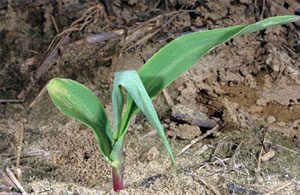
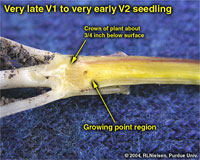
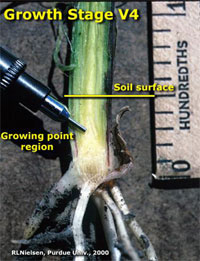
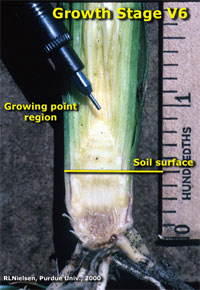
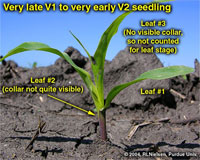
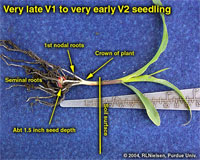
There is something about 30 mph winds and sand/grit/soil blasting across corn fields at seedling height that makes one curious about the ability of corn to recover from early season damage. The same can be said following a thunderstorm accompanied by strong winds and damaging hail. Whenever corn is damaged early in the growing season, growers are sometimes faced with the decision of whether or not to replant the field. One of the most important, and most difficult, steps in making a replant decision is estimating the surviving plant population in the field. Corn is remarkably resilient to aboveground damage early in the season, yet growers often underestimate the ability of corn to recover from such damage. Consequently, much of the replanting that occurs each year is a waste of money and effort. Use the worksheet in my replant publication (AY-264-W <www.agry.purdue.edu/ext/pubs/AY-264-W.pdf>) to estimate yield and dollar returns to corn replanting. The health and condition of the corn plant’s growing point (apical meristem) plays a major role in determining whether a damaged corn plant will recover or not. A plant damaged aboveground but with a healthy, undamaged growing point will usually survive. However, damage to the growing point area will either kill the plant or severely stunt its recovery. The growing point is that meristematic area of the corn plant where leaves and, eventually, the tassel are initiated. Morphologically, the growing point area is located at the top of the young plant’s stalk tissue. Prior to stalk internode elongation, the growing point is initially located 1/4 to 3/4 inch below the soil surface, near the crown of young seedlings at growth stages VE (emergence) to about V4 (four leaves with visible leaf collars).
The growing point remains belowground until V5 to V6. Stalk internodes begin to elongate shortly before V5, eventually elevating the growing point above the soil surface. From this point forward, the growing point becomes increasingly exposed and vulnerable to aboveground damage. Prior to V6, while the growing point is belowground, corn can tolerate quite a bit of aboveground injury from “single event” damage by frost, hail, wind, cutworm feeding, sandblasting, tire traffic, 28% N solution burn, etc. However, repeated injury to young plants (e.g., multiple days of sandblasting) or extended periods of sub-optimal temperatures (i.e., “darned” cold weather) and cloudy conditions following the damage may prevent photosynthetic recovery (renewal of green leaves) long enough to eventually kill the plant even though the growing point is technically not injured. While corn younger than V6 can tolerate a fair amount of aboveground frost damage to exposed leaf tissue, lethal cold temperatures (28°F or less for several hours) can “penetrate” the upper soil surface (especially dry soils) and damage or kill the growing point of a young corn plant. Corn younger than V6 is also susceptible to belowground damage from soil insects, disease, and flooding or ponding. Human nature being what it is, most growers can’t avoid walking damaged corn fields the day of, or the day following, the injury to begin assessing the consequences of damage to their corn field. Unfortunately, most of the time a fair assessment of the recovery potential of damaged plants cannot be made that soon. Damaged corn fields need to be left alone for several days, sometimes up to a week, after the damage occurs to give the plants some time to exhibit visible recovery. Splitting open a damaged corn plant is a time-honored practice when assessing the consequences of early-season damage to corn. The stalk tissue near the growing point region should remain firm and yellowish-white, as should the growing point region itself. Discolored or mushy tissue near the growing point usually spells trouble for the injured plant. Injury that occurs close to the growing point area (e.g., hail damage, stinkbug feeding) may alter normal hormonal activity and eventually cause deformed regrowth of stalk or leaf tissue. Visible recovery of leaf development from the whorl of surviving plants will be evident within 3 to 10 days after a damage event, depending on temperature and soil moisture conditions. Warmer temperatures and adequate soil moisture encourage rapid recovery, while cooler temperatures and/or drought stress slow the rate of recovery. Given sufficient time, surviving corn plants will exhibit new leaf tissue expanding from the whorls, while dead corn plants will still look, well... dead. Select References: Nielsen, R.L. (Bob). 2003 (rev.) Estimating Yield and Dollar Returns to Corn Replanting. Purdue Univ. Coop. Ext. Service Pub. No. AY-264-W. Available on the Web at www.agry.purdue.edu/ext/pubs/AY-264-W.pdf. (Verified 5/4/04).
The Roots of the Matter- (Bob Nielsen)
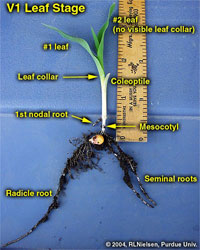
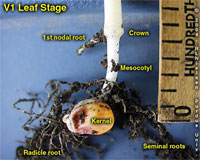
Successful emergence (fast & uniform) does not guarantee successful stand establishment in corn. The next crucial phase is the establishment of a vigorous nodal root system. Success is largely dependent on the initial nodal root growth from about 2-leaf to 6-leaf stages of development. Corn is a grass and has a fibrous type root system, as compared to soybeans or alfalfa that have tap root systems. Stunting or restriction of the nodal root system during this time period (dry soil, wet soil, cold soil, insect damage, herbicide damage, sidewall compaction, tillage compaction) can easily stunt the entire plant’s development. In fact, when you are attempting to diagnose the cause of stunted corn early in the season, the first place to begin searching for the culprit is belowground. To better understand rooting development and problems associated with root restrictions, it is important to understand that root development in corn can be characterized by root position relative to the seed. The Seminal (Seed) Root System A young corn seedling depends primarily on the energy reserves of the kernel until permanent (nodal) roots develop. These energy reserves are translocated from the kernel through the connecting mesocotyl “pipeline” to the young stalk and leaf tissues. Therefore, a healthy kernel, seed roots, and mesocotyl are vital until nodal roots are well established. If damage occurs to seminal roots or the mesocotyl before the later-developing permanent roots become established, stunting or death of the plant will occur. Examples of such damage include salt injury from excessive rates of starter fertilizer, seedling diseases, herbicide injury and insect feeding damage.
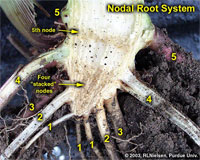
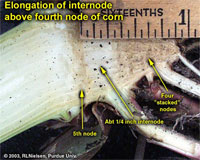
Individual sets of nodal roots develop sequentially over time at each belowground stalk node plus one or more aboveground nodes. By growth stage V6, five sets of nodal roots are typically well established and have completely taken over the sustenance of the plant. Stalk elongation begins at approximately leaf stages V4 to V5. Elongation of the internode above the fifth node usually elevates the sixth node aboveground. Subsequent elongation of higher-numbered stalk internodes will result in higher and higher placement of the remaining stalk nodes. Sets of nodal roots that form at aboveground stalk nodes are referred to as “brace” roots, but function identically to those nodal roots that form belowground. If surface soil conditions are favorable (moist and not excessively hot), brace roots can successfully penetrate the soil, proliferate, and effectively scavenge the upper soil layers for water and nutrients. A split stalk of an older plant will typically reveal a “woody” triangle of stalk tissue at the bottom of the corn stalk. This triangle is comprised of four stalk nodes, one on top of the other, whose associated internodes never elongate. The first internode to elongate is the one above the fourth node, which elongates about 1/4 to 1/2 inch, above which is found the fifth node (usually still below or just at the soil surface). Consequently, five sets of nodal roots will usually be detectable belowground (one set for each of the belowground stalk nodes). Damage or stress to the first few sets of developing nodal roots (from about V1 to V5) can severely stunt or delay a corn plant’s development. In particular, damage to the initial one or two sets of nodal roots forces the young seedling to continue its dependence on kernel reserves longer than is optimum. Typical stresses that can stunt initial nodal development include fertilizer salt injury, seedling diseases, herbicide injury, insect feeding damage, excessively wet or dry soils, soil compaction (tillage or planter).
"Silver Leaf" Symptom in Young Corn- (Bob Nielsen)
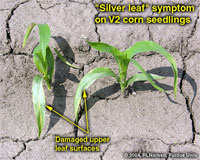
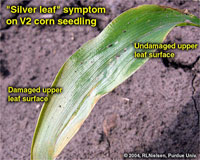
Early morning temperatures were quite chilly around parts of Indiana early last week. Some areas of northern Indiana experienced frost and even near lethal (28°F or less) temperatures. Other areas reported temperatures in the mid to high 30’s with no frost. If you’ve been out walking your early-planted cornfields recently, you may have noticed a curious leaf symptom that may remind you of freezer burn. Rapid heat loss from terrestrial surfaces to the atmosphere (i.e., radiational cooling) can occur on clear, dry (low humidity), calm nights with temperatures in the low 40’s°F or cooler. Minor levels of radiational cooling can damage the outer surfaces of corn leaves that are positioned horizontally or parallel to the night sky. The subsequent symptom of such minor chilling injury is often referred to as “silver leaf” in corn. The “silver leaf” symptom indeed appears as a silvery or dull gray leaf surface. Any portion of a leaf that was not horizontal to the sky or that was protected by another leaf or plant part will not exhibit the symptom. The effect of this type of minor leaf damage is negligible, if any. The leaves will not die abruptly as will genuinely frosted leaf tissue. Continued expansion of the whorl will not be restricted in any way. New leaves that expand from the whorl will be normal in appearance. This symptom is more of a curiosity than a nuisance.
Effects of Flooding or Ponding on Young Corn - (Bob Nielsen) Recent intense rainfall events (technically referred to as “toad stranglers” or “goose drownders”) in southern Indiana have caused flooding of low-lying corn fields or ponding in poorly drained swales within fields. Other areas within fields, while not technically flooded or ponded, may remain saturated for lengthy periods of time. What are the prospects for recently planted or emerged corn? For corn that has been recently planted, but is not yet emerged, the obvious risk is with surface soil crusts that may develop following a severe downpour. The risk is particularly high for conventionally tilled fields. Corn emergence can be especially challenging when a dense surface crust “sets up”. The resistance of a crust to coleoptile penetration often results in corkscrewed mesocotyl elongation below the surface and eventual leafing out underground if coleoptile emergence is delayed long enough. Monitor high-risk fields where corn emergence has not yet occurred and be prepared to use a rotary hoe if necessary to break up the crust and aid emergence. Don’t dawdle on using the rotary hoe until the crust has baked dry into “concrete”. Operate the hoe at a good speed and do not worry about the occasional corn seedling that is flipped out of the soil. A side benefit to breaking a dense soil crust is the resulting enhanced soil aeration. The “wet feet” caused by flooding or ponding creates other risks for corn that has already emerged, primarily because soil oxygen is depleted after about 48 hours of soil saturation. Without oxygen, the plants cannot perform critical life sustaining functions; e.g., nutrient and water uptake is impaired and root growth is inhibited. The growth stage of a corn crop greatly influences whether ponding or saturated soils kills, severely stunts, or mildly stunts the corn plants. Plants younger than V6 (six visible leaf collars) are susceptible to damage for two reasons. First of all, the growing point is at or below the soil surface from VE to about V6 (Nielsen, 2004) and therefore is directly subject to the stress of oxygen-depleted conditions. In plants older than V6, the growing point may be above the water level and the likelihood for survival improves greatly. Secondly, plants younger than V6 are in the process of trying to successfully establish a vigorous root system. Stunting or death of roots by oxygen-depletion can be a major stress for a plant that is not yet fully established. Prior to leaf stage V6, corn can survive only two to four days of flooded or ponded conditions. If temperatures are warm during that time (mid-70s°F or higher) such young plants may not survive 24 hours. Cooler temperatures prolong survival. The likelihood of crop injury is less where the flooded or ponded conditions last less than 48 hours. To confirm plant survival, check the color of the growing point and look for new leaf growth three to five days after water drains from the field. Healthy growing points will be firm and yellowish-white, not mushy and discolored. Plants older than V6 will tolerate ponding or saturated soils longer for essentially the opposite reasons. As plants develop beyond V6, rapid stalk elongation elevates the growing point region above the soil surface and, thus, away from the direct stress of flooded soils. Secondly, an older crop’s root system will simply be larger and consequently the crop can tolerate a certain amount of root death without dying or dramatic stunting. Nonetheless, extended periods of saturated soils plus warm temperatures will take their toll on the overall vigor of the crop. Some root death will occur and new root growth will be stunted until the soil dries to acceptable moisture contents. As a result, plants may be subject to greater injury during a subsequently dry summer due to their restricted root systems. Concomitant (I found a new word in the dictionary!) with the direct stress of saturated soils on a corn crop, flooding and ponding can result in significant losses of soil nitrogen through the processes of denitrification and leaching of nitrate N. Significant loss of soil N will cause nitrogen deficiencies and possible additional yield loss. Brouder & Joern (1998) offer guidelines in estimating the amount of nitrogen loss due to saturated soils and making decisions on application of additional nitrogen fertilizer to fields once ponded. Lengthy periods of wet soil conditions favor the development of seedling blight diseases, especially those caused by Pythium fungi (Ortiz-Ribbing, 2001). Poorly drained areas of fields are most at risk for the development of these diseases and so are also at most risk for potential replant operations if significant stand loss occurs due to seedling blight outbreaks. Certain diseases, such as common smut and crazy top, may also become greater risks due to flooding and cool temperatures (Bissonnette, 2002). The fungus that causes crazy top depends on saturated soil conditions to infect corn seedlings. The common smut fungal organism is ubiquitous in soils and can infect young corn plants through tissue damaged by floodwaters. There is limited hybrid resistance to either of these two diseases and predicting damage is difficult until later in the growing season. Select References: Bissonnette, Suzanne. 2002. Odd Plant Diseases Due to Odd Season. Univ. of Illinois Pest & Crop Bulletin, 6/21/02. Online at www.ag.uiuc.edu/cespubs/pest/articles/200213j.html [URL verified 5/7/04]. Brouder, Sylvie and Brad Joern. 1998. Predicting Early Season N Loss. Purdue Univ. Online at www.kingcorn.org/news/articles.98/smb9802.html [URL verified 5/7/04]. Farnham, Dale. 1999. Corn survival in wet conditions. Iowa State Univ. Integrated Crop Management Newsletter, 5/24/1999. Online at www.ent.iastate.edu/ipm/icm/1999/5-24-1999/wetcorn.html [URL verified 5/7/04]. National Soil Survey Center. 1996. Soil Quality Indicators: Soil Crusts. USDA- Natural Resources Conservation Service. Online at http://soils.usda.gov/sqi/files/sq_sev_1.pdf [URL verified 5/7/04]. Nielsen, R.L. (Bob). 2004. Growing Points of Interest. Corny News Network, Purdue Univ. Online at www.kingcorn.org/news/articles.04_GrowingPoints-0507.html. (URL verified 5/7/04). Ortiz-Ribbing, Loretta. 2001. Seedling Blights Caused by Pythium spp. Univ. of Illinois Pest & Crop Bulletin, 5/4/2001. Online at www.ag.uiuc.edu/cespubs/pest/articles/200106g.html [URL verified 5/7/04]. Thomison, Peter. 1995. Effects of Flooding and Ponding on Corn (AGF-118-95). Ohio State Univ. Online at www.ag.ohio-state.edu/~ohioline/agf-fact/0118.html [URL verified 5/7/04]. Don’t forget, this and other timely information about corn can be viewed at the Chat ‘n Chew CafÈ on the Web at www.kingcorn.org/cafe. For other information about corn, take a look at the Corn Growers’ Guidebook on the Web at www.kingcorn.org.
Check Corn Fields For Emergence Problems – (Peter Thomison, Ohio State Univ.) A number of factors contribute to poor emergence in corn. The following is some information adapted from a newsletter article by Dr. Greg Roth, my counterpart at Penn State, which addresses this topic. With corn emergence nearly complete in many fields in western Ohio, this is the time to take stand counts, scout fields, and troubleshoot emergence problems. Diagnosing emergence problems early is critical in identifying solutions and developing successful replant plans. Here’s a list of a few common things to look for if you encounter an emergence problem in corn this spring.
Note patterns of poor emergence. At times they are associated with a particular row, spray width, hybrid, field or residue that may provide some additional clues to the cause. Often two or more stress factors interact to reduce emergence where the crop would have emerged well with just one present. Also, note the population and the variability of the seed spacing. This information will be valuable in the future.
|
|||||||||||||||||||||||||||||||||||||||||||||||||||||||||
 |
|||||||||||||||||||||||||||||||||||||||||||||||||||||||||
|
|||||||||||||||||||||||||||||||||||||||||||||||||||||||||