Pest & Crop Newsletter



 |
||||||||||||||||||||||||||||||||||||||||||||||||||||||||||
|
||||||||||||||||||||||||||||||||||||||||||||||||||||||||||
 |
||||||||||||||||||||||||||||||||||||||||||||||||||||||||||
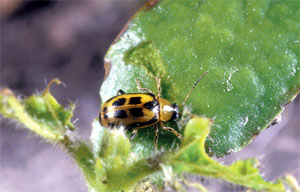
Bean Leaf Beetle Looking for First Emerging Soybean– (John Obermeyer and Larry Bledsoe)
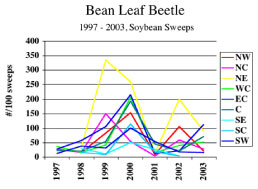
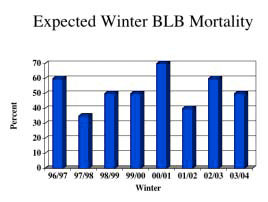
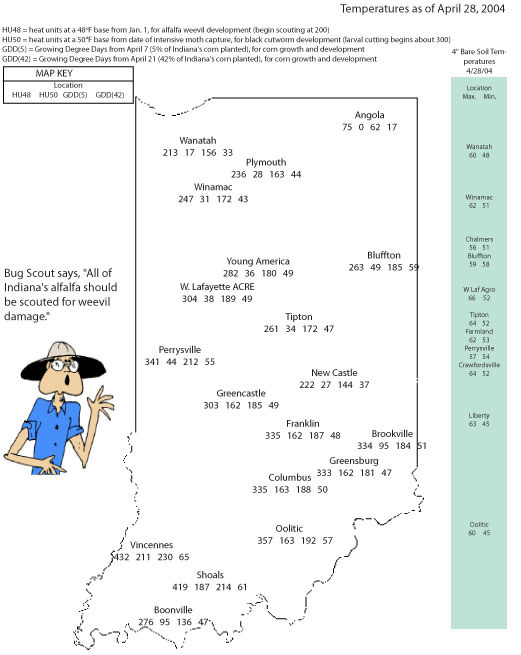
A small percentage of soybean has been planted and is beginning to emerge. Emerging plants in these fields may serve as “trap crops” for the bean leaf beetle. Beetles that have overwintered are seeking legumes to feed on. Bean leaf beetle is quite mobile and able to find emerging soybean seedlings at quite some distance. Fortunately our soybean sweep counts last summer shows that bean leaf beetle numbers were relatively low through most of the state, see graph 1. In addition, a winter survival model for the bean leaf beetle (developed at Iowa State University) indicates that the expected mortality from winter temperatures is about 50%, graph 2. One of the most critical times for soybean damage is from emergence through the establishment of the first trifoliolate. If cotyledons are being destroyed before the unifoliolate leaves fully emerge or if the growing point is severely damaged, reduced yields are likely. However, once trifoliolate leaves have unrolled, soybean can tolerate up to about 40% defoliation without yield loss. For cotyledon- and unifoliolate-stage soybean, refer to the following threshold values:
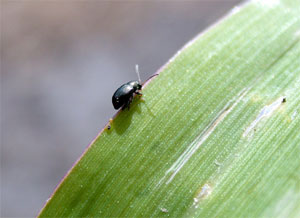
Corn Flea Beetle Looking for First Emerging Corn– (John Obermeyer and Larry Bledsoe)
This tiny (1/16”), shiny black beetle feeds on corn leaves by stripping off the top layer of plant tissue. This feeding leaves gray to brown lines or “tracks” etched on the leaf surface. Heavily infested plants may appear gray as their leaves shrivel and die. This is most critical should cooler temperatures set-in while corn is just emerging. As the beetle continues to feed, the plant must rely on underground carbohydrates (i.e., seed) until enough green leaf tissue is able to manufacture its own. Sustained beetle feeding during slow growth can stunt and/or kill the seedling.
On seedling dent corn, control may be necessary if 50% of the plants inspected show severe corn flea beetle feeding damage (plants begin to look silvery or whitish, or leaves begin to die), approximately 5 or more corn flea beetle per plant are found, and poor growing conditions are causing slow corn growth (e.g., cool temperatures, dry soils, herbicide damage). Normally, once a corn plant reaches the growth stage V5, it is no longer susceptible to significant corn flea beetle damage. Therefore, sampling for corn flea beetle typically will not be necessary once the plants have 5 leaves. Corn flea beetle may also transmit the bacterium that causes Stewart’s wilt as it feeds. This can be a serious problem, especially on sweet corn and seed corn inbreeds. In sweet corn, the disease may result in ears that are smaller than normal, or some infected plants may die. In seed production fields, severe leaf blight may cause lightweight chaffy ears, plus increase the likelihood of stalk rots. The beetles alone are seldom severe enough to kill plants although in combination with the disease, such as noted above for sweet corn, they may. In seed production fields where highly susceptible inbreeds are utilized, treatment is probably justified if corn flea beetles are noted.
|
||||||||||||||||||||||||||||||||||||||||||||||||||||||||||
 |
||||||||||||||||||||||||||||||||||||||||||||||||||||||||||
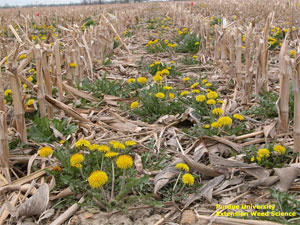
Dandelions Everywhere! – (Bill Johnson and Glenn Nice) During our trip to Davis Purdue Ag Center this week, we noticed a number of fields with heavy infestations of flowering dandelions in the central part of the state, just north of Indianapolis. In addition, our conversations with farmers and agronomists in Indiana would indicate that this is a relatively widespread problem throughout a good portion of the eastern half of Indiana. The purpose of this article is to summarize some of treatments one can use if they have dandelions that need treatment before planting. In general, dandelions are typically tougher to control in the spring than they are in the fall. In addition, they are tougher to control in the early part of the spring (March) than they are in the latter part of the spring (late April – Early May). The reason is that herbicide activity is typically less when daytime air temperatures do not regularly get above 50°F. Why if the plant is not actively growing (or is dormant), it will not translocate herbicide to active meristematic sinks. The result is that the herbicide is metabolized or inactivated in the plant and can not do it’s work at the target site. A second reason is that by mid-April, dandelions have flowered at least once and many physiological processes in the plants change after the onset of reproductive growth.
In OSU and Purdue trials, the best control for late spring treatments is usually obtained with a combination of 2,4-D (1 lb. ai/A) and glyphosate (0.75 lb. ae/A). Keep in mind that use of this rate of 2,4-D usually will require 30 day preplant interval before planting soybean and a 7 to 14 day preplant interval before planting corn. However, there are a number of 2,4-D products available and the preplant interval varies by product. If you feel you cannot wait the required interval before planting, then one can use at least 0.75 lb. ae/A of glyphosate and plant anytime after application. In Purdue trials conducted in 2003, we evaluated glyphosate applied at 0.75 lb. ae/A and 1.125 lb. ae/A and found that control ranged from 60 to 70% at 19 days after treatment, and 93 to 97% control at 37 days after treatment. Both treatments then received another postemergence treatment of of 0.75 lb. ae/A of glyphosate. On July 12, dandelion control with 0.75 followed by 0.75 lb. ae/A was 77%, while control with 1.125 ae/A followed by 0.75 lb. ae/A was 91%. It appeared that utilization of a higher rate of glyphosate in the initial treatment was beneficial in weakening the plant so it could be controlled better by the followup application. So keep in mind that it is unlikely that complete control will be obtained by a single application in the spring, but utilization of a followup application of glyphosate in RR soybeans and Distinct or 2,4-D in corn will help provide additional control or suppression of dandelions.
|
||||||||||||||||||||||||||||||||||||||||||||||||||||||||||
 |
||||||||||||||||||||||||||||||||||||||||||||||||||||||||||
Wheat Foliar Disease Development - (Gregory Shaner) I have not had reports of widespread problems yet with foliar diseases of wheat. It’s a bit early for many of these, but not for powdery mildew or the early stages of Septoria leaf blotch. Powdery mildew is a disease that typically gets started early in the spring. It is easily recognizable by the white, powdery fungal growth on leaf blades and sheaths. Powdery mildew may not be visible on the upper leaves, but can be severe down in the canopy. I have not seen this disease in my plots near Lafayette or in Jennings County, but I received a call about severe powdery mildew in a field in north-central Indiana. Wheat cultivars differ in resistance to powdery mildew. Most cultivars grown in Indiana appear to have fair to excellent resistance. On cultivars with moderate resistance, there will be some mildew, but usually not enough to cause serious damage. An occasional cultivar may be more susceptible. On these, powdery mildew will cover much of the foliage down in the canopy, and if weather is cloudy, it will move up to the flag leaf and heads. Application of a fungicide can halt the development of powdery mildew. Several labeled fungicides are effective. Information compiled from numerous trials on wheat around the country indicates that products that contain propiconazole are the most effective. If a fungicide is used, it should be applied between the jointing stage (Feekes stage 6) and emergence of the flag leaf (Feekes stage 8) for best control. High rates of nitrogen fertilizer promote development of powdery mildew. A cultivar that has adequate resistance when “normal” rates of N are applied may have a lot more powdery mildew if a high rate of N is applied. Septoria leaf blotch is present on lower leaves of wheat in my plots near Lafayette, but not in plots at Jennings County. Phil Schmidt reports that there is some leaf blotch in wheat in the Spencer County area. Septoria leaf blotch is recognized by tan, somewhat elliptical lesions that contain numerous black dots (these are spore-bearing structures—pycnidia—embedded in the leaf). The disease is favored by wet weather. Night temperatures above 45°F and periods of 2 or more sequential days with rain are required for the disease to become severe. Lesions first appear on the lower leaves and then spread upward. Splashing rain disperses spores. Long periods of leaf wetness are needed for the spores to germinate on the leaf surface and infect. Several fungicides are effective against Septoria leaf blotch. The best time to apply these is between flag leaf emergence and heading. If a fungicide is used, check the label carefully regarding cut-off growth stages, pre-harvest intervals, and other restrictions.
Risk of Fusarium Head Blight of Wheat in Southern Indiana - (Gregory Shaner) In last week’s issue of Pest&Crop, I described a weather-based risk model for Fusarium head blight of wheat www.wheatscab.psu.edu/. We are approaching the time when the model will be relevant for Indiana. Jon Neufelder (Posey County) and Phil Schmidt (Spencer County) report that wheat in their area is just starting to head out. On 28 April, most entries in a wheat variety trial in Jennings County were in early boot. When I ran the no-corn residue model for a flowering date of 29 April, the risk for southern Indiana was low. The corn-residue model indicated a few areas of higher risk in southern Indiana. The corn-residue model is expected to show a higher risk because this means that inoculum of Fusarium graminearum is present within the field. Wheat in southern Indiana will not be flowering for several days yet, so the model will need to be run again early next week to obtain an updated forecast.
|
||||||||||||||||||||||||||||||||||||||||||||||||||||||||||
 |
||||||||||||||||||||||||||||||||||||||||||||||||||||||||||
Forage Day 2004 – (Keith Johnson) – This year’s forage day will be held on June 10 at the Southern Indiana-Purdue Agricultural Center located near Dubois, IN. Forage Day is sponsored by the Purdue Cooperative Extension Service and the Indiana Forage Council. Forage Day combines educational workshops with equipment demonstrations. Presentations cover various topics in the production, utilization and marketing of forages. Forage Day is the only annual event in the state where one can see a live demonstration of harvesting equipment. For more information on Forage Day 2004 please view our website at: www.agry.purdue.edu/forageday/
|
||||||||||||||||||||||||||||||||||||||||||||||||||||||||||
 |
||||||||||||||||||||||||||||||||||||||||||||||||||||||||||
|
||||||||||||||||||||||||||||||||||||||||||||||||||||||||||