Pest & Crop Newsletter



 |
||||||||||||||||
|
||||||||||||||||
 |
||||||||||||||||
Western Corn Rootworm Beetles Have "Hopped" the I-70 "Fence" into Soybeans– (John Obermeyer and Larry Bledsoe)
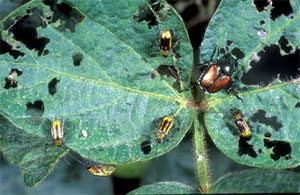
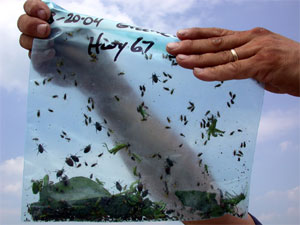
Recent soybean sweeps in southern Indiana counties has revealed that western corn rootworm beetles are present, and in some fields, numbers are quite alarming. For years folks near or south of Interstate-70 have seen little to no damage from the western corn rootworm variant. That may change, as considerably high numbers of these beetles are being detected in soybean fields as far south as Lawrence County (Bedford, IN). This may dramatically effect future insecticide decisions in southern Indiana’s first-year corn. Unfortunately we have not had the time to sort through the samples and count the beetles that have been taken to date. Though actual sweep numbers are not available, visually it is obvious that the variant has “found” southern Indiana. It is real impressive to walk by patches of giant ragweed, the plants are alive with beetles feeding on the foliage. As producers know in northern counties, these beetles lay eggs in the soybean fields that may lead to significant root damage to next year’s corn. We highly recommend that pest managers throughout the state monitor for the presence of western corn rootworm beetles in soybean fields. Though you will get wet, morning hours are the best for visual monitoring, as the beetles are near the top of the soybean canopy. Sticky trap monitoring (Pest&Crop #18) or sweep-net sampling is more accurate in assessing the variant population. But certainly getting out and just observing is a big step in becoming informed about your potential rootworm risks for next year. We will attempt to get beetle counts posted in future issues of the Pest&Crop. Happy scouting!
Mexican Bean Beetle Appearing in Southern County Soybean Fields– (John Obermeyer and Larry Bledsoe)
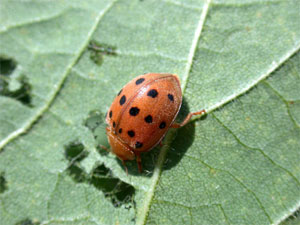
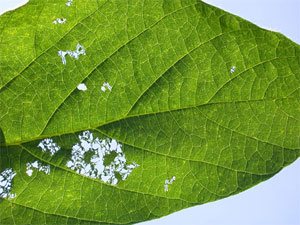
While conducting soybean sweeps for the western corn rootworm variant, adult Mexican bean beetle and their damage are quite evident in some fields south of Interstate-70. With the amount of mating observed, it is obvious that soon the larvae will be present for another generation. Larvae in high numbers can quickly defoliate soybean, so much that the fields appear frosted almost overnight. The Mexican bean beetle is actually a ladybird beetle, one of the few destructive species of this primarily beneficial family of insects. The adult is oval shaped and copper colored, with 16 black spots on its back. It is about 5/16 inch long and 1/4 inch wide. Females lay yellow, oval-shaped eggs in clusters on the underside of bean leaves. From these eggs, hatch yellow larvae with branched spines that cover their soft bodies. There are 4 larval stages, the final one reaching a length of 1/3 inch, before transforming into a bright yellow pupae. The pupae are usually found attached to the underside of leaves. Soybean plants can be severely defoliated by both the adult and larval forms of the Mexican bean beetle, though typically, the larvae are more damaging. Larvae strip away the top layer of leaf tissue between the veins, giving the leaves a skeletonized appearance. Adults consume all leaf tissue between major veins, producing a distinctive lacy appearance to the foliage. The leaf veins remaining after Mexican bean beetle feeding often fall out due to wind or rain action, resulting in large, ragged holes in the foliage. At mid pod fill, consider treatment when defoliation exceeds approximately 15 to 20% and the Mexican bean beetle is still present and actively feeding. More precise defoliation threshold guidelines are given in last week’s Pest&Crop to determine if treatment is justified.
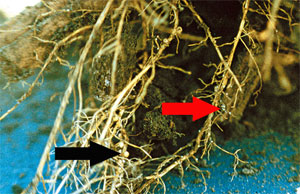
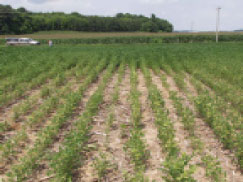
Soybean Cyst Nematode Update - (Jamal Faghihi and Virginia Ferris) Soybean cyst nematode continues to be one of the major pests of soybean in Indiana. This perennial pest of soybean may be showing as patches of yellow stunted soybean resembling nutrient deficiency. At this time of the year the white and yellow females on the root of soybean should be visible. In order to see these young cysts you need to dig the whole root of soybean plant, with the surrounding soil, and place it in a bucket of water to let the soil separate from roots. The white and yellow females, about the size of a grain of salt, will be noticeable with the naked eye or a slight magnification of a hand lens. Cysts are much smaller than the Rhizobium nodules.
Those of you who have planted “resistant” soybean in the infested fields should be aware that currently available SCN resistant cultivars might not be totally resistant. Different cultivars with the same source of resistance might act differently toward the same population of SCN. Constant monitoring of fields with history of SCN infestations is necessary. As they have done previously, this year Indiana Soybean Board is paying for the processing cost of up to 10 samples per grower per year. If you are submitting samples on behalf of the growers, ISB will cover the cost of processing these samples as well. However, you need to provide us with the name and address of the growers so they can receive a copy of the results. Samples for SCN and other nematode analysis can be send to the Nematology Laboratory, Department of Entomology, Smith Hall, 901 W. State Street, West Lafayette, IN 47907-2089. For more information about SCN you may visit the following website www.entm.purdue.edu/Entomology/ext/targets/e-series/EseriesPDF/E-210 or contact Jamal Faghihi, Purdue Extension Nematologist in the Department of Entomology by phone 765-494-5901 or email jamal@purdue.edu.
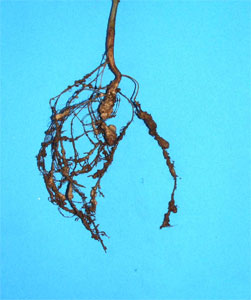
Root Knot Nematodes in Soybean - How Widespread is the Problem? – (Andreas Westphal, Daniel Egel, and Gregory Shaner) Soil-borne disease problems of soybean typically begin to appear during midsummer. Damage caused by plant-parasitic nematodes also typically shows up at this time. Soybean cyst nematode is of major concern in the Midwest. Other plant-parasitic nematodes, foremost the root knot nematodes, Meloidogyne spp., are a problem in vegetable crops, but so far have not received much attention from soybean producers in Indiana. Field visits in the southern part of the state have identified root knot nematodes in soybean in fields with vegetable rotation. More recently, we found these nematodes in a soybean field that has been on a strict corn-soybean rotation, with no history of vegetable production. Most soybean varieties suitable for cropping in Indiana (maturity groups 2, 3, and 4) are expected to be susceptible to root knot nematodes. In southern states, large screening programs provide information on resistance to this nematode, but these are directed at varieties of higher maturity groups. Efforts are being initiated in our program at Purdue University supported by the Indiana Soybean Board to test commercial varieties for their resistance status.
Root knot nematodes are obligate parasites: they need the living plant to complete their life cycle. Like the well-known cyst nematode, they invade soybean roots when soil temperatures are favorable for their activity. Once in the root, the nematodes become sedentary. The nematodes change the root to “make their home.” Root cells are changed to feeding sites and the nematodes start to feed. After several molts, the nematode females start producing eggs. Under favorable soil temperature conditions of 70 to 75°F, one nematode life cycle is completed within one month. The newly hatched nematodes will infect more root tissue. As a result of infection, swellings, so-called galls, appear on the affected roots. These root galls should not be confused with Rhizobium nodules. These beneficial nodules are more or less spherical and typically attached on the outside of the root. In contrast, nematode-induced galls form within the root and are an integral part of it. When root knot nematode infection is heavy, the entire root system is distorted and severely compromised in function. Water transport and nutrient uptake are impeded. Infected plants grow poorly and are almost always stunted and, in most severe cases, killed. Current management strategies for soybeans, in infested regions of southern states, are based on the selection of less susceptible soybean varieties for fields with known infestation of root knot nematodes. Information on which Indiana cultivars offer some resistance is forthcoming. No record exists on how widespread root knot nematode infection on soybean is. Efforts to document how widespread this problem is in soybean are currently underway. If you suspect root knot nematode damage, please contact the Plant and Pest Diagnostic Laboratory www.ppdl.purdue.edu or Dr. Westphal, ph: (765) 496-2170, email: westphal@purdue.edu for help in identifying the problem.
Click for Table.
|
||||||||||||||||
 |
||||||||||||||||
Winter Annual Weeds Emerging in Mid-Summer? – (Bill Johnson) As recently as July 26, we have observed marestail and cressleaf groundsel emerging in our soybean research plots at the Southeast Purdue Ag Center near North Vernon, IN. These emergence events are occurring well after postemergence treatments of glyphosate have been applied. So the question becomes, would it be worthwhile to treat production fields having the same problems? Many of the phone calls I receive during this time of the year center on late-season weed control, especially in full-season soybean. Weeds such as giant ragweed, giant foxtail, fall panicum, and common cocklebur emerging through the soybean canopy in late July and early August cause growers to question the overall effectiveness of their weed management practices. More recently, late-season escapes of marestail have generated a lot of attention, particularly in southeast Indiana. Many of the marestail escapes in this area are due to poor control with glyphosate (populations with enhanced tolerance or resistance to glyphosate have been identified in 19 counties in greenhouse screening trials). However, field observations alone may overestimate the number of cases of glyphosate resistant populations. If you suspect you have a true case of glyphosate resistance in your field, please see an article we wrote last year on this topic www.btny.purdue.edu/weedscience/2003/Articles/horsetail7-23-03.pdf and if you are still convinced, you can use the following link to get directions to send samples to us for screening www.btny.purdue.edu/weedscience/2003/Articles/sform9-2-03.pdf. Screening efforts this year are supported in part by a grant from the Indiana Soybean Board. Now, back to the question of what to do now about the two winter annuals mentioned earlier. Soybeans can tolerate some weed competition during the first 4 to 6 weeks after emergence and not suffer any yield loss. Yield losses typically occur in soybean when weeds are not controlled for 6 weeks or more after emergence. To manage weeds in soybean, most growers use a combination of soil-applied herbicides and/or glyphosate postemergence weed management practices during the first 3 to 6 weeks after planting. We then rely on the crop canopy to suppress weeds for the remainder of the growing season. So a question to be addressed is, “How much yield loss do I suffer from late emerging weeds if I don’t control them?” There are several factors to consider when addressing this question. First, when one can see weeds above the soybean canopy, they are usually in excess of 3 feet tall. Most herbicides are labeled for use on weeds that are less than 1 foot tall, and applications to large weeds are mostly ineffective. Second, high temperatures and limited soil moisture reduce the ability of the plant to absorb the herbicide, which will reduce herbicide effectiveness. Third, weeds that have emerged above the soybean canopy have already exerted their competitive effect on the soybean. My previous research indicates that light infestations of late emerging weeds do not impact yield if there was at least a 6 week weed-free period earlier in the season starting no later than 3 weeks after planting. So, it is unlikely that the late emerging marestail and cressleaf groundsel will have any impact on soybean yield. However, the marestail in this case is behaving as a summer annual and will produce seed by the time soybean is harvested. Postemergence treatments of herbicides (glyphosate, FirstRate/Amplify, or Classic) might be warranted to minimize seed production if you are certain that the field does not contain glyphosate or ALS (FirstRate/Amplify or Classic) resistant populations and soil moisture conditions are optimal for plant growth and herbicide activity. However, you will have to weigh the benefits of reducing weed seed production against some stand loss due to driving a sprayer through tall soybeans. At this point we don’t know if the cressleaf groundsel will produce seed this year or next spring. Stay tuned - each week we seem to learn more about winter annual weeds in southeast Indiana!
|
||||||||||||||||
 |
||||||||||||||||
Soybean Sudden Death Syndrome– (Andreas Westphal, Charles Masfield, and Gregory Shaner)
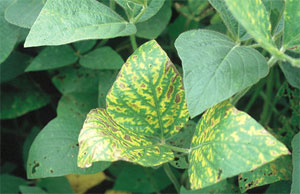
Sudden death syndrome is starting to show up in Indiana soybean fields. It has been observed in some fields in northern Indiana. Foliar symptoms of SDS are also evident across most of southwest Indiana. Symptoms are seen in early-planted full season beans, but so far not in double cropped fields. Soybeans in fields with SDS are in growth stages R4 to R5 (pods are beginning to fill on the lower part of the plant but are still small on the upper nodes). Sudden death syndrome is caused by the soil-borne fungus Fusarium virguliforme (previously known as Fusarium solani f. sp. glycines). Foliar symptoms are initially expressed as yellowing between the major veins. This tissue rapidly turns brown, then the leaflets die and shrivel. In severe cases they drop off, leaving the petioles (leaf stalks) attached. Brown stem rot has similar foliar symptoms, but the leaflets tend to remain attached to the petioles. Brown stem rot is distinguished from SDS by symptoms in the plant stem. Brown stem rot darkens the pith but not the cortex. In contrast, the lower stem and taproot of a plant with SDS will exhibit a dark-brown cortex, but white, maybe tan, pith. If a plant with symptoms of SDS is dug from moist soil, there may be small, light-blue patches on the surface of the taproot. These are spore masses of the SDS fungus. As the plant dries, this color will fade, but when it is seen, in conjunction with the other symptoms, a diagnosis of SDS is strongly indicated. Early planting into cool soils favors SDS. In 2004, some fields were planted in mid to late April; others were planted much later, depending on rain patterns this spring. The early-planted fields are at highest risk for SDS. Fusarium virguliforme colonizes the root systems of susceptible plants and can be detected in soybean seedlings as early as one week after planting. The fungus may cause some root necrosis, but foliar symptoms occur only after mid-season. Heavy rains during reproductive stages seem to be a critical predisposing factor for SDS. Under these conditions the fungus starts producing toxins in the root system that are transported upwards in the plant. The toxins disrupt the leaf physiology and lead to the foliar symptoms while the fungus remains restricted to the root system.
It is likely that yield will be reduced in affected fields because once foliar symptoms are expressed it is an indication that the plant’s root system has been significantly compromised and is not functioning well. Uptake of water and nutrients is diminished. At that time, the toxin from the invading fungus is transported to the leaves causing them to decline and fall off. The amount of yield reduction depends on the growth stage of the soybean during disease outbreak. The earlier the plants succumb to SDS the greater the yield loss. If diseased early, entire pods may fall off; if later, seeds within retained pods may abort, and seeds that do develop may be small, all of which will result in reduced yield. The amount of yield reduction will also depend on how much of the field is affected. Grain yield reductions from SDS can range from 20 or 30% to as high as 80%. The disease was first identified in the southwest corner of Indiana in the mid 1980s. It is now widespread in Indiana. The distribution of past outbreaks suggests that the disease may show up in virtually any area of Indiana, when conditions are favorable. If fields show SDS, there is no remedy for the current crop. However, it is important to make careful note of where the disease occurs (which fields, the pattern of the disease within a field, and symptom severity). This information will be valuable in making future management decisions. In future plantings, the avoidance of extremely early planting, choosing varieties less susceptible to SDS, and any cultural methods that reduce excessive soil moisture, e.g., breaking of compaction layers or improved drainage, will help to manage SDS.
|
||||||||||||||||
 |
||||||||||||||||
Mark Your Calendars for the Purdue Agronomy Field Day- (Bob Nielsen) The 2004 Purdue Agronomy Field Day will be held Tuesday, September 14 at the Purdue Agronomy Center for Research and Education www.agry.purdue.edu/arc/arcdesc.htm. Tours will focus on a) genetic technologies for corn insect & weed management, b) crop variety testing and on-farm research, c) grain quality assurance programs, d) yield monitor calibration techniques, and e) auto-steer technologies & high accuracy GPS systems. Field day registration (free) will begin at 8:00 a.m. The first round of tours will be offered at 8:30 a.m. Check out the tour schedule www.agry.purdue.edu/FieldDay/tours.html for specific tour departure times. For more information about the 2004 Agronomy Field Day, check out the Web site at www.agry.purdue.edu/FieldDay. You may also download a PDF-formatted field day informational flyer at www.agry.purdue.edu/FieldDay/flyer.pdf. Bug Scout
I don't think the corn's genetic resistance will prevent that type of shot-hole damage!
|
||||||||||||||||
 |
||||||||||||||||
|
||||||||||||||||