Pest & Crop Newsletter



June 25, 2004- Issue 15
 |
||||||||||||||||||||||
|
||||||||||||||||||||||
 |
||||||||||||||||||||||
Western Corn Rootworm Beetles Emerging– (John Obermeyer and Larry Bledsoe)
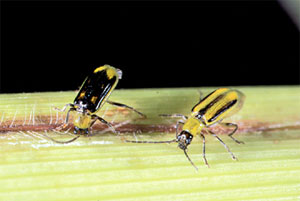
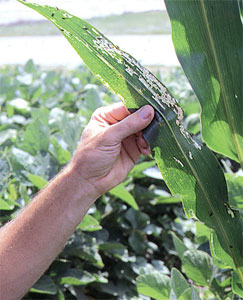
Frankie Lam, Southwest Indiana Pest Management Specialist, observed western corn rootworm beetles in a Knox County field on Monday, June 21. This was expected as pupae in the soil are being found in west central Indiana. Generally the first beetles to emerge are males, female emergence begins a few days later. Once the females emerge, feed, and mate, they may disperse to other fields. Beetle emergence , mating, and egg laying will continue through most of the summer. After emerging, beetles will begin to feed on corn leaves if pollen is not available. This leaf feeding damage can look dramatic in small areas of a field, but is usually of no economic importance. This year’s replanting of wet areas will cause some fields to pollinate much later than most. These fields will act as “magnets” for the beetles and need to be watched for silk clipping. If beetles are present and feeding on corn silks, an insecticide application should be considered only if 50% of the silks are being cut off to less than 1/2 inch before 50% pollination has taken place. Note, this threshold is NOT based on beetles per plant.
Corn Earworm Activity – (John Obermeyer and Rick Foster)
Our black light trap counts of corn earworm moths have been fairly low, but some pest managers in the Midwest are reporting significant moth activity. This could indicate that high-value, host crops are vulnerable to earworm attack earlier than normal. An example would be early market sweet corn that is now or soon to be pollinating. Pest managers need to carefully monitor their corn earworm pheromone and/or black light traps to determine moth numbers. The proper strategy for managing earworms is to apply insecticides to fresh, green silks when moths are flying. Two or three applications of approved insecticides spaced 4 to 5 days apart will usually provide adequate control. Experience has shown that more applications at lower rates provide better control that fewer applications at higher rates, even when the same total volume of insecticide is used.
Click for Table.
|
||||||||||||||||||||||
 |
||||||||||||||||||||||
Flooding and Very Wet Soil Conditions Equals Soybean Re-Planting- (Ellsworth P. Christmas)
June rainfall reported across west-central Indiana as of June 21 has been in the range of 6 to 12 inches. These very heavy rains resulted in significant flooding of river and stream bottoms with the resulting death of most of the corn and soybean planted in these low areas. In addition, some upland areas experienced significant ponding, for more than two days, which also resulted in crop loss. Delayed planting or re-planting has less effect on the yield of soybeans than on corn. Unlike corn, which requires a certain number of growing degree days to mature, soybeans are sensitive to day length and as the day length shortens later in the growing season, maturity speeds up. As a general rule of thumb, for each three days planting is delayed, after May 20, harvest is delayed one day. Below is a comparison of the yield reduction experienced by corn and soybeans as planting is delayed.
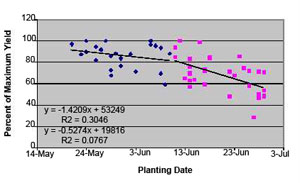
As yield levels of soybeans have increased over the past ten years or so, the percentage yield loss has increased slightly. For example, data from a recent study, given in the graph below, indicates that the reductions in yield for May 20 and June 10 are about 0.5%per day. Yield losses for the period from June 11 to June 30 are about 1.4 percent per day for each day of delay after June 10. We are approaching the date when consideration should be given to changing maturity groups. It is advisable to stay with a full-season variety of soybeans for your particular area until about June 15 in the northern one-fourth of Indiana, June 20-25 for the central one half of Indiana and June 25 in southern Indiana one-fourth of the state. Full season soybeans will almost always give a higher yield than shorter season varieties for a given geographic area even when planting is modestly late. Once these dates have been reached, producers should move from a full season variety of soybeans to a mid season variety for their respective area. This will equate to a change of one-half maturity group assuming that a full season variety is being grown. Additionally, seeding rates should be increased by 15 to 25 percent to promote shading and taller plants to increase podding height and nodes per acre. A commonly used rule of thumb for a cutoff date to stop planting soybeans is 90 days prior to the first 32 degree frost for a given area within the state. Using a 25% probability, or one in four years of a 32 degree or lower temperature, the magical date for the Bluffton area in northeastern Indiana is June 30, while in the Lafayette area it is July 5. Soybean planting should cease in most of the southern half of Indiana by July 10 except for the southwest corner where planting can occur up to July 15. Soybean Response to Planting Date 1991-94
|
||||||||||||||||||||||