Pest & Crop Newsletter



 |
||||||||||||||||||||||||||||||||||||||||||||||||||||||||||||||||
|
||||||||||||||||||||||||||||||||||||||||||||||||||||||||||||||||
 |
||||||||||||||||||||||||||||||||||||||||||||||||||||||||||||||||
Corn Rootworm Hatch is Underway– (John Obermeyer and Larry Bledsoe)
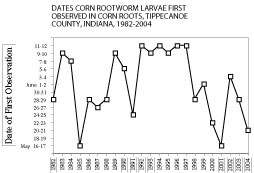
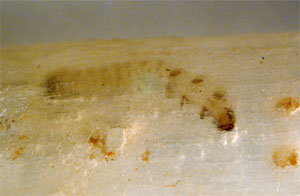
The mild spring temperatures have resulted in the appearance of rootworm in corn roots about a week earlier than what was observed last year, see yearly comparison below. A rootworm larva was collected from V4 corn on May 24 near Lafayette in Tippecanoe County. Because the larva was an early second instar, it is likely that it hatched 3-5 days earlier. Hatch in southern Indiana counties has occurred several days earlier while hatch in northern counties is just beginning. Eggs will continue to hatch for several more weeks with the peak hatch at early to mid June. Anyone still planting or replanting corn during the next two weeks should consider using a soil insecticide to protect the roots of emerging plants.
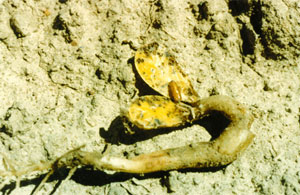
It is too soon to sample for rootworms, as the larvae are very small and inside the roots. About mid June, sampling will give an indication of the performance of a soil/seed insecticide, if one was applied at planting, or those waiting to determine the need for a soil insecticide at cultivation. This requires digging up and breaking the soil away from the roots of several plants in a field. Roots and surrounding soil must be carefully examined for rootworm larvae. Small (1/8 to 1/2 inch in length), slender, white larvae with brown head and tail sections. More on this sampling will be in a future issue of the Pest&Crop.
Seedcorn Maggots in Soybean– (John Obermeyer and Larry Bledsoe)
Seedcorn maggot larvae have been reported feeding on the seeds of soybean. Replanting has been considered for whole or portions of fields. Seeds planted in high crop residue, weedy growth, and/or where animal manure was applied are most often subject to attack by this pest. Seedcorn maggots are small, yellowish-white maggots up to 1/4 inch long. They are the larval stage of a fly that is attracted to areas with decaying organic matter to lay their eggs. When the eggs hatch, the larvae move to the germinating seeds or very young plants. They tunnel into the seeds or underground portion of plants and feed. The damage is usually first observed as skips in the row where plants do not emerge, or if they emerge, die back.
In soybean it is important to remember that unless very wide skips in rows are noted, plants have a tremendous ability to compensate for missing plants. Skips of less than 2 feet generally have little effect on yield. Areas where skips from 2 to 3 feet are observed may result in 6 to 13% yield reduction (see chart below for effect of skips). Date of replanting is not quite as critical this time of year for soybean as it is for corn (see chart below for effect of delayed planting). Full season soybean varieties replanted on May 30 will produce approximately 94% of a normal yield. A mid-season variety will yield 96% of normal. Yields do not drop off dramatically until after June 10. As with corn, there are unknowns relative to crop establishment after replanting. Weather conditions are difficult to predict and will impact stand establishment and plant growth.
When replanting, it is possible yet unlikely, that the maggots will damage the newly planted seed. Finding small, light brown, oval pupa cases during your inspection indicates that the maggots are nearing completion of their life cycle and the damage is done. Also, light tillage before replanting should expose and kill many maggots. If one wants to be certain of no further damage, a seed treatment (e.g., Kernel Guard Supreme) may be applied at planting.
Repeat Alert: Armyworm Damaging Wheat in NE Indiana – (John Obermeyer and Larry Bledsoe) After some impressive armyworm moth catches in the black light trap located at the Northeast Purdue Ag Center (Whitely County), we’ve received a call from Allen County reporting high numbers of 1/2 to 1 inch long larvae in wheat. Ken Hoffman, crop consultant, reported that armyworm numbers were especially high where fungicides were used and foliage is lush. Pest managers should examine wheat plants in different areas of a field, especially where plant growth is dense. Look for flag leaf feeding, clipped heads, and armyworm droppings (excrement) on the ground. Shake the plants and count the number of armyworm on the ground and under plant debris. On sunny days, the armyworm will take shelter under crop residue or soil clods. If counts average approximately 5 or more per linear foot of row, the worms are less than 1-1/4 inches long and not parasitized or diseased, and leaf feeding is evident, control may be justified. If a significant number of armyworm are present and they are destroying the leaves, or the heads, treat immediately.
Should treatment be necessary, the following products are recommended:
Click for Table.
|
||||||||||||||||||||||||||||||||||||||||||||||||||||||||||||||||
 |
||||||||||||||||||||||||||||||||||||||||||||||||||||||||||||||||
Wheat Diseases Are on the Move – (Gregory Shaner)
On Tuesday (25 May), I rated diseases in a wheat cultivar trial at the SW Purdue Ag Center near Vincennes. Stagonospora leaf blotch, leaf rust, yellow dwarf, powdery mildew, and Fusarium head blight were present. Leaf rust is more severe than it has been for several years. On some cultivars, rust covered 25% of the flag leaf area. Most cultivars had less rust than this, probably because they have some resistance. A few cultivars were completely resistant. Leaf rust can be identified by the presence of small (<2 mm diameter), orange pustules on the upper surface of the leaf. There may be hundreds of pustules on a leaf of a susceptible cultivar. Resistant cultivars will have fewer and smaller pustules, if they have any at all. Leaf rust is capable of rapid build-up in a susceptible cultivar. Kernels of most cultivars at SWPAC were in the mid to late milk stage so there is plenty of time for more rust to develop. Many cultivars of wheat grown in Indiana have some degree of resistance, but some are evidently susceptible, and these may sustain damage before grain is fully developed. Rust reduces yield and test weight. Severity of Stagonospora leaf blotch likewise varied among cultivars. Lesions were on the flag leaves of susceptible cultivars, and the leaves below were all severely diseased. On more resistant cultivars the flag leaf and leaf below were still free of disease, but lesions were on lower leaves. If leaf blotch progresses to the upper two leaves before grain is physiologically mature, test weight can be reduced substantially. Stagonospora nodorum can also infect heads—this phase of the disease is referred to as glume blotch. Glume blotch symptoms were just starting to appear on heads of some cultivars. Powdery mildew was not severe on any cultivar, but some cultivars were clearly more susceptible than others. Some powdery mildew was on the flag leaves of susceptible cultivars. Even on these cultivars, however, the amount of disease was probably not enough to reduce yield much. There were a few pustules of stripe rust on some cultivars. This disease has historically been a problem in the Pacific Northwest, but in recent years has raised havoc in the southern US. It has occurred in each of the past several years in Indiana, but not severe enough to cause damage. Stripe rust thrives in cool weather, and by the time wheat in Indiana is in the grain filling stage it is usually too hot for stripe rust. This is certainly the case this year. Yellow dwarf was present on scattered plants throughout the plots. Flag leaves of infected plants were erect and yellow, with red streaks. Aphids probably spread the virus to plants this spring. For leaf rust, Stagonospora blotch, and powdery mildew it is too late to apply a fungicide for disease control. Nonetheless, it’s a good idea for growers to check their fields. This can at least avoid some unpleasant surprises at harvest time. Also, if a cultivar is severely damaged by any of these diseases, this information can be used in making decisions about cultivars to grow next year. We are starting to see Fusarium head blight, both at Lafayette and at Vincennes. It can probably be found in other areas. As discussed in earlier issues of Pest&Crop, a weather-based risk model indicated only low to moderate risk for much of the state. This model looks at weather for 7 days prior to flowering. Mother Nature may have thrown us a curve ball this year. There were not a lot of hours of rain during the week prior to flowering of much of the wheat in Indiana, but since then we have had a lot of rain. We do know that, although flowering is the most vulnerable period for infection, the fungus can infect wheat after flowering, on into the late milk stage of grain development. Post-flowering infection may have been widespread this year. It is too early to say how much head blight there will be, or where in the state the disease will be most severe, but I suspect many fields will have at least some head blight. At both Lafayette and SWPAC, about 4% of the heads are showing blight symptoms. Right now, blight is confined to just a few spikelets. On most heads the blighted spikelets are at the tip, but on a few heads the blighted spikelets are at the middle or base of the head. Over the next few days blight symptoms on these heads will extend to all spikelets. It is also likely that more heads will start to show symptoms over the next several days. Given the persistent rainy weather of the past several days, growers should monitor their fields for head blight. I will continue to monitor wheat trials throughout the state, but would appreciate hearing from anyone who sees a major problem developing.
|
||||||||||||||||||||||||||||||||||||||||||||||||||||||||||||||||
 |
||||||||||||||||||||||||||||||||||||||||||||||||||||||||||||||||
|
||||||||||||||||||||||||||||||||||||||||||||||||||||||||||||||||