Pest & Crop Newsletter



 |
||||||||||||||||||||||||||||||||||||||||||||||||||||||||
|
||||||||||||||||||||||||||||||||||||||||||||||||||||||||
 |
||||||||||||||||||||||||||||||||||||||||||||||||||||||||
Survey of Overwintering European Corn Borer and Management Considerations for 2004– (John Obermeyer and Larry Bledsoe)
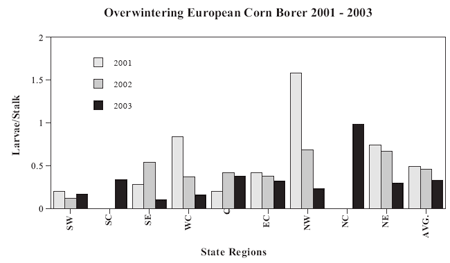
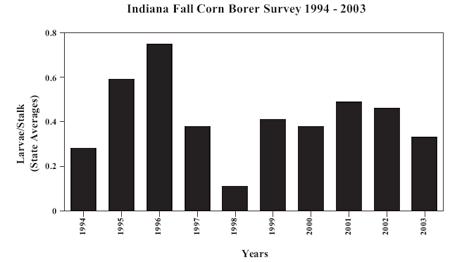
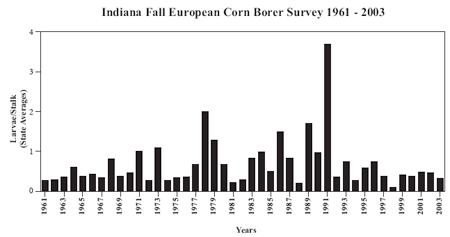
The annual survey of overwintering European corn borer (ECB) is complete and according to the results, statewide corn borer numbers and damage were rather unimpressive (see accompanying table and graphs). These data correlate with low moth flights and damage reports that we received throughout the season. High numbers of stalk cavities and borers found in north central counties brought up the state average. It is not uncommon to have an area of the state to support higher populations in a given year. Statewide, it seems as though ECB did not do well with the downpours of 2003. What implications will this have for 2004? ECB larvae are now either nestled in crop and weed residue or in the stalks of yet to be harvested corn and will form the bulk of next year’s threat to Indiana corn. However, environmental factors during the growing season, more than anything else, will determine whether this insect becomes a serious threat in 2004. It is very difficult to accurately predict if an insect such as ECB will reach its biotic potential. Because under optimal environmental conditions, each female moth can produce over 400 eggs spread over many plants and fields. This type of damage potential was seen during the 1991 growing season, our last major outbreak year. What about using Bt-ECB corn in 2004 to protect from yield losses? A major drawback with using this excellent pest management technology is that producers, in order to realize economic gain, must anticipate significant corn borer damage before the corn crop is even planted. Therefore, in order to benefit from using Bt corn, it is best to assess the potential field risk to ECB moth attraction, egg laying, and subsequent larval damage. In other words, make an informed pest management decision. First brood ECB females are generally attracted to the tallest, greenest corn for egg laying – normally early-planted corn. This, coupled with conventionally tilled and rotated fields and adequate soil fertility levels increase the risk of first generation attack. Many producers traditionally plant certain fields first, e.g., fields close to the farmstead, well drained fields, etc. If these fields are ahead in their growth and development compared to neighboring corn during the first week in June, then there is a greater likelihood of return on investment in Bt corn. Predicting second generation populations and damage is impossible due to an extensive list of variables that occur during next year’s growing season. Our advantage when dealing with second generation ECB is that we understand the pest’s behavior enough to know that the later flights are most attracted to actively pollinating corn – thus late-planted or late-maturing corn. For late-planted fields, Bt may be a good investment. Many of this year’s badly damaged fields appeared to be from later generation ECB, likely due to later planting. Let’s not forget insect resistance management! According to a National Agricultural Statistics Service July, 2003 report (“Corn and Biotechnology Special Analysis”) Indiana had the highest compliance (87%) of the EPA required 20% refuge of non-Bt corn when compared with ten other corn producing states in 2002. That’s the good news! The disturbing news is that 13% of Indiana’s Bt acreage is planted with too little (1%) or no refuge (12%). Over planting of Bt corn will likely hasten insect resistance to this technology. This is bad enough. The worst result would be the public’s perception of producer’s refusal to follow simple guidelines with an already “sensitive” issue, GMOs! Specific information on resistance management is available from seed companies. Click for Table.
Estimated Economic Losses from European Corn Borer in 2003– (John Obermeyer and Larry Bledsoe) The following chart is an attempt is to estimate the economic losses to Indiana’s corn from European Corn Borer (ECB) damage in 2003. This uses the 2003 fall ECB survey information taken from non-Bt cornfields throughout the state. This is an attempt to make plant entry data from the fall survey more meaningful to Indiana’s producers. This chart shows the wide range of potential economic impact that occurred within specific areas and averaged for the entire state. The dollar losses below are calculated from estimated physiological stresses due to ECB larvae boring into the plant. It cannot be stressed enough that corn hybrids differ greatly in their reaction to ECB damage. The estimated dollar loss should be compared to the expense of preventing or lowering ECB damage with Bt corn or insecticides. From the data below, many areas in 2003 didn’t warrant preventive measures unless on the high end of the damage range. If nothing else, this data supports the need for scouting and determining infestation levels in each field.
Soybean Aphid, What's the Scoop. Please Show Us– (John Obermeyer and Larry Bledsoe)
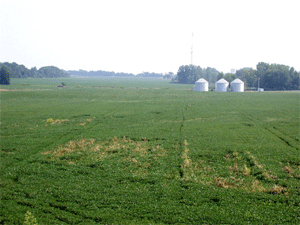
Many of us are being visually reminded of the summer’s soybean aphid infestation with the massive number of Asian lady beetles crawling in and around our homes and businesses. Excellent examples of insect population dynamics! If you dealt with soybean aphid this summer, then you certainly experienced confusion and frustration while trying to get a “unified” treatment threshold from university specialists. Some of this anxiety is being renewed as soybeans are being harvested with disappointing yields; please refer to Why Were My Soybean Yields Soooo Low??? in “Agronomy Tips.” We, just as all other Midwestern Land-Grant Universities, are requesting your gathered information from plots treated for soybean aphid. Providing specifics, other than just yield comparisons, certainly would be beneficial. In addition to yield data, items such as soybean growth stage, date of application, and an approximation of aphid numbers would be very helpful. Yes, the aerial photos and GPS generated yield maps are appreciated. Please e-mail (obe@purdue.edu), FAX (765-494-2152), or phone (765-494-4563) this information to John Obermeyer. We appreciate your help!
|
||||||||||||||||||||||||||||||||||||||||||||||||||||||||
 |
||||||||||||||||||||||||||||||||||||||||||||||||||||||||
Why Were My Soybean Yields Soooo Low???- (Ellsworth P. Christmas and Steve Leer) The 2003 growing season was anything but normal. Average yields on early-maturing Indiana soybeans were as dreary as the weather that pounded the crops all season. Farmers harvesting Group II soybeans report yields ranging from 11 bushels per acre to more than 50 bushels per acre, with most between 25 bushels and 35 bushels an acre. A typical yield for Group II soybeans would be around 45 bushels per acre. Group II soybeans are grown in northern Indiana counties while Group III and IV soybeans, which mature later, are produced in central and southern Indiana. Since they develop on a different timetable than later-maturing soybeans, Group II varieties were hardest hit by ill-timed storms and dry weather in August. Two things contributed to the Group II soybeans yielding significantly less than they’ve yielded in the past. The torrential rain on the Fourth of July weekend saturated soils over much of the northern two-thirds of the state, resulting in deteriorated root systems on these soybean plants. The nodules disintegrated or rotted; two to three weeks were required for the nodules to re-establish to the extent that they could fix an adequate supply of nitrogen for the plant. Cooler air and soil temperatures also beset waterlogged soybean crops. Many plants failed to produce adequate carbohydrates to support the root system during this period. Another major cause of reduced yields is related to seed size. Group II soybeans had reached late R-6 growth stage by the August dry period. As a result, the plant did not abort pods or seed but developed much smaller seed. A number of producers have reported seed size ranging from 4,000 to 4,400 seeds per pound. An example of this impact on yield would be to compare a normal seed size to a very small seed size. For this example, lets look at a soybean variety with a normal seed count of 3,000 seeds per pound and a yield of 45 bushels per acre. If you had the same number of seeds per acre but a seed count of 4,000 seeds per pound, then the yield would be about 33.75 bushels per acre – or more than an 11 bushel per acre reduction in yield as a result of the reduction in seed size. The yield of Group III soybean is a little higher. The culprit is the same wet-then-dry growing season that hurt Group II varieties. The very dry conditions in late July and August occurred at a time when pods of Group III soybeans were fully developed (late R-4 or early R-5). The plant, in an attempt to survive, aborted the seed. So we have some Group III fields with fully developed pods and no seeds within those pods. One field that I examined, more than two-thirds of the pods were fully developed with no seed within the pod. Harvest of Group III and IV varieties is well under way in central and southern Indiana. Most of these fields are yielding better than Group II varieties, but many farmers are reporting that the yields are still off 10 to 15 bushels from normal. Southern Indiana soybeans were expected to give higher yields than last year. Many of these soybeans were either planted late or are double-crop soybeans and were severely damaged by the frost of October 2 and 3. Some of these fields will not be harvested as a result of the freeze. In addition to the cold/wet soils early followed by excessive rains and then a dry-hot period in late July and early August, the soybean plant suffered from other stresses. A number of diseases were present across Indiana in a number of fields and included; root rot diseases, soybean cyst nematode, sudden death syndrome, white mold and charcoal rot. Additionally, many soybean fields were infested with the soybean aphid, which caused additional stress to an already stressed plant. However, early results indicate that tillage system had no impact on soybean yield this year. This year’s soybean yield situation perhaps could best be summarized by stating that weather extremes resulted in compromised root systems in most soybean fields which were further stressed by a number of other factors. In other words, anything that could have gone wrong with soybeans occurred this year sometime during the growing season. Compound stresses always have a more pronounced impact on yields than a single stress.
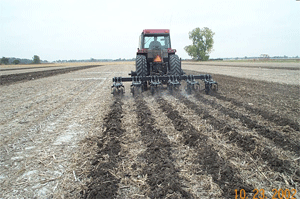
Strip Tillage Gains Ground and Planting Flexibility for Corn Producers- (Tony J. Vyn) Introduction: Strip tillage is being performed on more fields in the Eastern Corn Belt region this fall. For most farmers, strip tillage is being done only on fields intended for corn in 2004, but a few are also using strip tillage before wide-row soybean production. For some farmers, fall strip tillage is being done on long-term no-till fields with the objectives of improving corn stands and (or yields) while keeping residue cover on the surface. For other farmers, strip tillage represents a switch from their former conventional tillage systems to a system that they hope will result in comparable corn yields at less cost (i.e., time, fuel, equipment, and soil). Either way, strip tillage is gaining ground in both small and large farm operations. The growth of this practice is attracting attention – and new questions. Perhaps my research experiences with strip tillage over the last 10 years can provide some perspectives on the feasibility of, and best management practices for, this evolving tillage alternative.
Equipment perspective: New developments in the equipment industry have certainly added to the capability of strip tillage to perform well in a wide variety of situations. Relative to 10 years ago, more commercial companies manufacture the equipment, and they are generally better at building a reasonably level ridge of soil (berm) in the fall, at achieving an assortment of depths (or degrees of soil loosening), at dealing with high residue cover without plugging, at maintaining shank depth at selected levels in variable soils, and in permitting fertilizer banding. In addition, the advent of GPS guidance systems (such as automatic steering systems for tractors) with from 1” to 4” accuracy have really opened the window for farmers to comfortably plant in the center of the trips the following spring - even in the dark of night – and for farmers with very wide planters to do strip tillage with units that are only half the width of their row crop planters. Advantages of fall strip tillage compared to no-till: The most important benefits of strip tillage versus no-till for corn are that:
Advantages of strip-till relative to conventional tillage: The most important benefits of strip-till compared to continued conventional tillage for corn are that:
Management tips for users: Like any farm operation, attention to details helps to ensure success. Some of my recommendations for strip-till farmers are the following:
Summary: Strip tillage is continuing to gain new ground, sometimes at the expense of disturbance of long-term no-till soils and sometimes to replace more erosive tillage systems. If farmers are already successful at no-till corn production, are always growing corn in rotation with soybean, and can normally complete their corn planting operations during the optimum period, there is little reason to switch to strip tillage because there is no corn yield benefit from doing so. However, for those corn farmers that are currently losing soil with costly conventional tillage operations, there is ample reason to seriously consider strip tillage. Although the latter group has been reluctant to adopt no-till, fall strip tillage offers the opportunities for more flexibility at planting time, deep nutrient banding, and higher yields than no-till corn on poorly drained soils – particularly when corn doesn’t follow corn in rotation. There are some timing, conversion cost, and implement width constraints with the strip tillage systems, but new technologies and appropriate management decisions are resulting in more successful transitions to strip-till corn in the Eastern Corn Belt. Acknowledgments and Post-script: Since 1998, our tillage research team in Indiana (including Terry West, Missy Bauer, Ann Kline, and Jason Brewer) has benefited from the loans or gifts of strip tillage equipment (commercial or prototype) from Case-DMI, John Deere, Yetter, and Remlinger manufacturing companies that enabled us to conduct direct comparisons of various strip tillage systems with no-till, other stale seedbed planting systems, and with conventional tillage. I will also readily acknowledge that there is still some uncertainty regarding optimum nutrient placement and soil sampling strategies in strip tillage production systems. In future years, I hope to provide additional perspectives on nutrient placement issues with strip tillage if sufficient research funding becomes available.
|
||||||||||||||||||||||||||||||||||||||||||||||||||||||||
 |
||||||||||||||||||||||||||||||||||||||||||||||||||||||||
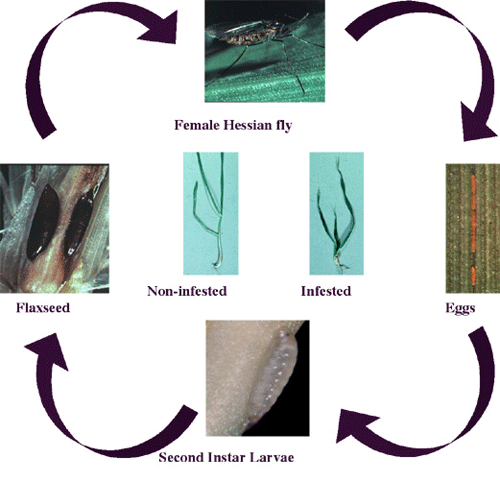
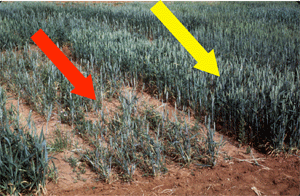
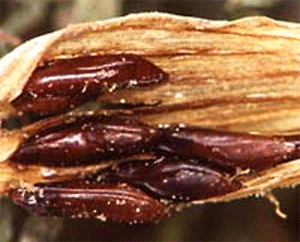
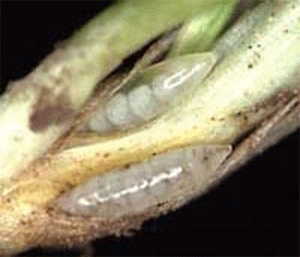
Samples Needed for Hessian Fly Geographic Distribution Study- (Brandi Schemerhorn) Hessian fly, Mayetiola destructor, is the most common destructive pest of wheat in the United States but often times goes undiagnosed due to the lack of information currently unavailable to extension offices. Despite cultural practices (fly free dates) and resistant wheat cultivars used to ward off the fly, this small insect is still responsible for millions of dollars in crop damage each year. With two generations a year, Hessian fly damages both spring and winter wheats. Fall infestations are the easiest to spot. The infested wheat seedlings will appear stunted (smaller than the uninfested plants) and their leaves will be dark green in color. Spring infestations are harder to identify since larvae lodge at the base of the highest node present when the eggs were laid. Here at our West Lafayette, Indiana research facility, we strive to better understand how Hessian fly inflicts its damage. Current research projects include mapping virulence genes in Hessian fly, isolating resistance gene products from wheat, identifying enzymes expressed during the first four days of feeding, and assessing lineage and distribution of populations across the United States. Our most recent project involves studying populations of Hessian fly across the United States. We continually monitor heavy infestation areas and are interested in new outbreaks of Hessian fly anywhere in the United States. Collections of Hessian flies are an invaluable resource in staying one step ahead of this insect. We are currently in need of population samples from your region of the United States. If you believe a farm in your area has a Hessian fly problem, please contact us. We will be able to give you further information to determine if indeed it is Hessian fly. In return, we ask that you provide us with a sample of the material. Collect infested plant material from the field. Wrap it in newspaper, box it, and ship it to us at USDA-ARS CPPC Unit, ATTN: Brandi Schemerhorn, 170 South University Street, West Lafayette, Indiana, 47907.
|
||||||||||||||||||||||||||||||||||||||||||||||||||||||||