Pest & Crop Newsletter



 |
|||||||||||||
|
|||||||||||||
 |
|||||||||||||
Likely Too Late for Soybean Aphid Treatments– (John Obermeyer and Larry Bledsoe)
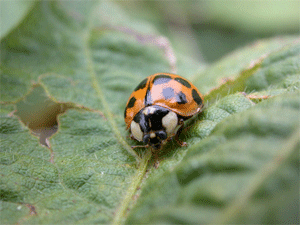
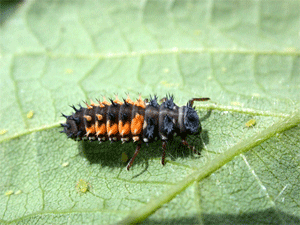
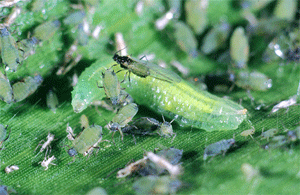
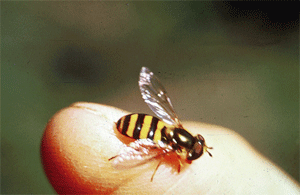
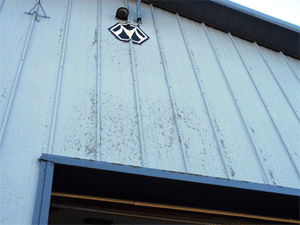
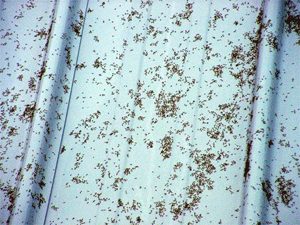
Many interacting biological and environmental factors determine soybean aphid infestations and their affects on soybean yield. Unfortunately, we don’t completely understand them. We and workers in other states have been providing treatment guidelines and aphid updates in newsletters and media releases as best we can. While university scientists and others pursue the development of economic thresholds through research, some companies are exploiting this “data gap” by promoting insecticide use that is often unjustified. We trust that Indiana pest managers will see through this marketing strategy. Some have attributed yellowing of soybeans to soybean aphid damage. Yellowing of soybean foliage is caused by many factors this time of year. The primary causes that we’ve seen for discoloration are diseases (sudden death syndrome, white mold, and others) and manganese deficiency. Jeff Nagel, Agriliance, has made us aware of a few soybean fields that were formally hay fields that were possibly yellowed from a combined effect of soybean aphid feeding and potassium deficiency. This year, probably because of plentiful soil moisture, most heavily infested fields showed very little foliage discoloration. Several factors lead us to believe that we are nearing the end of soybean aphid activity. We have received reports from Minnesota of aphid populations crashing from epizootics (fungal diseases). One research field there had a decrease of over 80% of the aphids in a two-week period. In Indiana, we have been observing an increase in the incidence of diseased aphids in all soybean fields, and we feel that it is just a short time before a rapid population decline begins. Predators are becoming quite prevalent in infested fields. Asian lady beetle adults and larvae are obvious in many infested fields as they crawl over the leaves and stems. Information from the USDA indicates that larvae of the Asian lady beetle can consume 600 to 1200 aphids during the larval stage, and adults may consume 90 to 270 aphids per day. The syrphid fly, another predator of the aphid that is not so evident on the plant, has become annoying to some people living near soybean fields. Syrphid larvae are small yellow to green maggots that insert their pointy mouthpart into an aphid and suck out the body fluids. The adult syrphid is also known as the hover fly. These flies normally feed on nectar and pollen, but probably are feeding on aphid honeydew on the plant leaves. They are often confused with sweat bees as they swarm around us attempting to land and sponge-up (not bite or sting) our perspiration. There have been several reports of swarming winged aphids. The most publicized swarm interfered with a Cubs baseball game at Wrigley Field in downtown Chicago a couple weeks ago. At the time, the “credit” was given to swarming midges, but an alert Purdue entomology student who happened to be nearby, collected specimens and had them positively identified. Swarms have now been reported in Indiana. Phil Walker, NE Purdue Agricultural Center Superintendent, noticed that on Monday, August 18, one of his buildings had a mass of winged aphids on it in the morning. This recent movement of winged aphids in Indiana corresponds well with many pest managers in the northern counties telling us that aphid populations have declined recently. Nearly all Indiana soybean fields are now at R5 growth stage (beginning seed) or beyond and most soils have ample moisture to help fill the pods. This, and the factors given above, lead us to believe that insecticide treatments are no longer justified. Any yield reductions from the soybean aphid occurred a week or two ago when plants were most vulnerable to pod abortion. Treating at this time, is truly revenge. In addition, one ag/chem dealer estimated 3-4 bushel/acre yield reduction would occur by driving through the fields and breaking over plants while treating.
Click for Table
|
|||||||||||||
 |
|||||||||||||
Crazy Top of Corn- (Gregory Shaner)
Back in mid May, I wrote an article about the possibility of crazy top in corn this year (Pest & Crop No. 9, May 16). The fungus that causes crazy top, Sclerophthora macrospora, produces spores when soil is saturated. Infection is thought to be favored if corn is under water for a day or two. Considering conditions during May, it seemed likely that we might see a lot of crazy top this summer. Crazy top gets its name from a conspicuous symptom on the tassels. Although infection occurs when corn plants are young, the major symptom does not show up until tassels emerge. Instead of producing tassels, infected plants produce a proliferation of small leaves. Infected plants may also tiller profusely, and ears may have leaf structures on them (phyllody). I have seen some crazy top recently, but only in a few plants in an area that was under water briefly this spring. Growers may want to look at corn in low-lying areas that flooded some time after planting. Assuming the plants survived, some of them may now be showing crazy top symptoms. Normally, crazy top does not affect a large number of plants. But, given the extent flooding this year, crazy top might be a greater problem than usual in some fields. If many plants are infected, yield may be significantly reduced.
White Mold- (Gregory Saner, Scott Abney, and Andreas Westphal)
White mold has appeared in soybeans in northeast Indiana during the second week of August. Greg Bossaer, County Educator in White Co., reports that white mold has shown up there, also. White mold, also known as Sclerotinia stem rot, has not been a major problem in Indiana for several years. However, the pathogen, Sclerotinia sclerotiorum, has a broad host range and can persist for several years in the absence of host plants, so whenever weather conditions are conducive for infection, the disease will appear. Although the fungus can be found throughout the state, white mold is only a problem on soybeans in the northern part of the state. This probably has to do with weather during the latter part of the flowering period. Sclerotinia sclerotiorum infects senescent flowers at lower nodes. In Indiana, late June through July, depending on the stage of plant development, is the time when infection occurs. Production of spores and infection of plants are favored by cool, moist conditions at the soil surface and in the lower plant canopy. During late flowering, these conditions are more common in northern Indiana than in the south. Temperatures in northern Indiana were somewhat above normal during the last week of June and first week of July, but night temperatures were cool and rainfall was frequent. The remainder of July was cooler than normal with several days of rain each week. Once a senescent flower has been infected, the fungus moves into the stem. It produces a lesion that begins at the node, where the flower is attached, and then spreads both up and down the stem. Lesions may eventually girdle the stem. When this happens, movement of water and nutrients to the upper portion of the plant is restricted. Wilting and death of upper leaves are often the first symptom that draws attention to the problem. Inspection of plants will reveal a bleached lesion somewhere on the lower stem. Often there is a white, fluffy growth of fungal mycelium on the surface of the lesion. Later, dark sclerotia can be seen embedded in this mycelium. If the stem is split open, sclerotia can be seen in the stem cavity. These sclerotia are hard masses of fungal tissue, and they can survive in soil for several years. In the spring, sclerotia in the upper 2 inches of soil produce fruiting bodies. Spores produced on the surface of these fruiting bodies infect soybeans and other host plants. White mold became a problem in Indiana soybeans when growers started planting in narrow rows. The plant canopy closes earlier in narrow-row beans than in beans planted in 30-inch rows. If the canopy has closed by the time of flowering, which often occurs in narrow-row beans, then the soil surface and lower canopy will more likely be cool and moist, conditions that favor infection. However, when abundant inoculum is in a field and weather conditions are very favorable for infection, the disease will develop as readily in beans planted in wide rows as in narrower rows.
|
|||||||||||||
 |
|||||||||||||
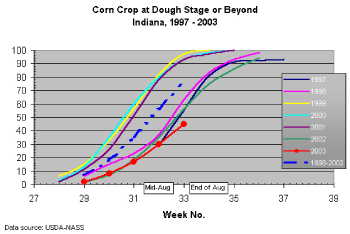
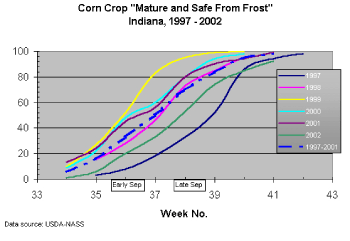
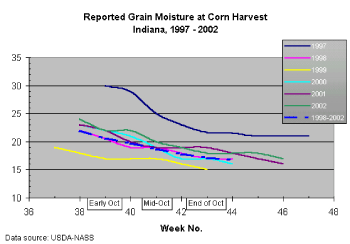
Corn Grain Moisture Outlook-2003- (Bob Nielsen) Progress of the 2003 Indiana corn crop continues to lag behind the average pace of the past five years according to the Indiana Agricultural Statistics Service (8/18/03). Compared to the period 1998-2002, the current crop is moving through the dough stage of kernel development approximately 10 to 14 days behind “schedule”. The slow statewide progress of this year’s corn crop is due to the slow finish of the planting season (especially southern Indiana), the cooler than normal month of May that delayed initial progress of the early planted crop, and generally cooler than normal temperatures throughout the summer that further delayed plant development. The regulars down at the Chat ‘n Chew Cafe are keenly aware of the slower than desirable crop progress, especially in terms of the potential for wetter grain at harvest and higher grain drying costs this fall. Corn hybrids generally reach physiological maturity (kernel black layer development) approximately 65 days after silking. The silking-to-maturity period for early to mid-June planted corn is remarkably only a few days longer than for corn planted in late April to early May (Brown, 1999). The reason is that late-planted corn typically matures in significantly fewer heat units than early-planted corn (Nielsen & Thomison, 2003). The remainder of the season will influence actual maturity date of the crop, but will more greatly influence the rate of grain moisture drydown prior to harvest time. Warmer than normal temperatures through September would help the crop mature more quickly and encourage faster grain drying rates in the field (Nielsen, 2000a). Unusually cool temperatures, on the other hand, would exacerbate the already delayed crop, further delay grain maturity, and slow in-field grain drying rates. Let me illustrate with a few examples from the past five years.
The currently reported percent of crop at dough stage or beyond (45% as of 8/17/03) is slightly behind that of several other delayed seasons in recent history: 1997, 1998, and 2002. The 1997 season finished unusually cool, further delaying the crop maturity, and resulted in the wettest grain at harvest reported during the five-year period 1997-2002. Last year’s crop (2002) finished slightly wetter than the 1998 crop, but both were significantly drier at harvest than 1997 even though all three season’s crops were at about the same stage of progress in mid-August. Another interesting statistic is that even though the 1999, 2000, and 2001 crops were all 7 to 10 days AHEAD of normal relative to the timing of the dough grain fill stage, only the 1999 crop finished with harvest grain moistures significantly drier than average. The bottom line in this discussion is that while we can be fairly certain that grain moistures this fall will not be drier than normal, it is far less certain that they will be dramatically wetter than normal simply because the crop is behind schedule in mid-August. Based on recent history, it is probably fair to say that Indiana growers can expect grain moistures to be 2 to 3 points wetter than average if growing conditions remain fairly normal from here on out. If temperatures for the remainder of August and September take a nosedive, then crop maturity and field drydown will be further delayed. Regardless of whether this year’s grain will be wet or really wet; take the opportunity between now and harvest to check over your grain drying operation (Brook & Maier, 1994; Maier & Bartosik, 2002) to ensure maximum potential drying efficiency this fall. Remember, as Yogi Berra once said, “It’s not over until it’s over.” Brook, Roger and Dirk Maier. 1994. Last Minute Grain Dryer Checks (GQ-19). Purdue Univ. Coop. Extension Service. Available online at <http://www.agcom.purdue.edu/AgCom/Pubs/GQ/GQ-19.pdf>. [URL verified 8/14/03]. Brown, Greg. 1999. Influence of Delayed Planting on Growing Degree Day Requirements of Corn (Zea mays L.) Hybrids During Grain Fill and Maturation. M.S. Thesis, Purdue Univ., W. Lafayette, IN. Indiana Agricultural Statistics Service. 18 August 2003. Indiana Crop & Weather Report. Available online at <http://www.nass.usda.gov/in/cropweat/2003/we3303.pdf>. [URL verified 8/18/03]. Maier, Dirk and Ricardo Bartosik. 2002. Optimizing Grain Dryer Operations (GQ-15). <http://www.agcom.purdue.edu/AgCom/Pubs/GQ/GQ-15.pdf>. [URL verified 8/14/03]. Nielsen, R.L. (Bob). 2002a. Grain Drydown in the Field After Maturation. Purdue Univ. Corny News Network. Available online at <http://www.kingcorn.org/news/articles.02/Grain_Drydown-0911.html>. [URL verified 8/14/03]. Nielsen, R.L. (Bob). 2002b. Grain Fill Stages in Corn. Purdue Univ. Corny News Network. Available online at <http://www.kingcorn.org/news/articles.02/Grain_Fill-0723.html>. [URL verified 8/14/03]. Nielsen, R.L. (Bob) and Peter Thomison. 2003. Delayed Planting & Hybrid Maturity Decisions (AY-312-W). Purdue Univ. Coop. Extension Service. Available online at <http://www.agry.purdue.edu/ext/pubs/AY-312-W.pdf>. [URL verified 8/14/03]. Don’t forget, this and other timely information about corn can be viewed at the Chat ‘n Chew CafÈ on the Web at <http://www.kingcorn.org/cafe>. For other information about corn, take a look at the Corn Growers’ Guidebook on the Web at <http://www.kingcorn.org>.
|
|||||||||||||
 |
|||||||||||||