Pest & Crop Newsletter



 |
||||||||||||
|
||||||||||||
 |
||||||||||||
Rootworm Insecitcide Failure?– (John Obermeyer and Larry Bledsoe)
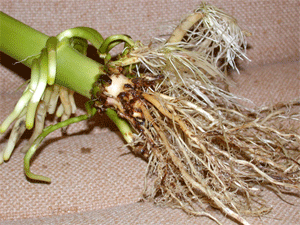
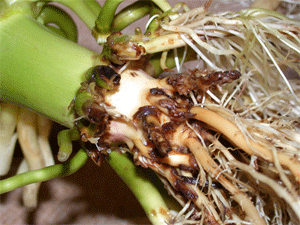
Tremendous storms have clobbered central and northern Indiana this past week. Saturated, or flooded soils have provided little foothold for corn roots when tested by high winds. Inspections of some lodged areas of these fields have revealed rootworm damage where a full rate of insecticide was used at planting. Should rootworm insecticides, if applied correctly, prevent root damage and subsequent plant lodging? Is this rootworm insecticide failure? Corn plants that have lodged should be dug, not pulled, washed and then inspected for root feeding scars. Pay particular attention to the nodes of roots just below and above the soil surface. Rootworm insecticides are designed to protect the roots in approximately a 7-inch band. Nodal and brace roots in this zone are critical for keeping the plant upright. If a complete nodal ring of roots or more is destroyed by rootworms, then plant lodging is likely. We have always said that at best, rootworm insecticides will control 80% of the rootworm larvae in the root zone. Because last year’s rootworm beetles concentrated their egg laying in certain areas of the field (i.e., clumped distribution), it is reasonable to expect more surviving larvae in these areas. Therefore, even if the insecticide worked, lodging of plants in spots of a field is not unusual. Certainly date of planting needs to be considered. Many cornfields were planted in central and northern Indiana before mid-April. Rootworm insecticides do not kill eggs (overwintering stage) and hatch did not occur until late May this year. Expecting an insecticide to remain at full strength for that duration, especially with this year’s soil conditions, is unrealistic. Wet soil conditions this spring resulting in the movement of the soil insecticide out of the zone of rootworm activity, may have also caused this situation to develop in some fields. It is not hard to imagine that excessive moisture may have either physically moved the insecticide off target with erosion or caused deeper movement into the soil. Other factors such as rapid microbial degradation of insecticides or the sun’s UV rays degrading insecticide exposed on the surface of the soil may add to the problem. The items above are valid reasons why an insecticide may not work to expectations. However, there are no disclaimers on product labels addressing these variables as reasons for poor product performance.
Rootworm-Like Larvae Feeding on Soybean Roots– (John Obermeyer and Larry Bledsoe)
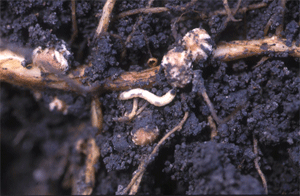
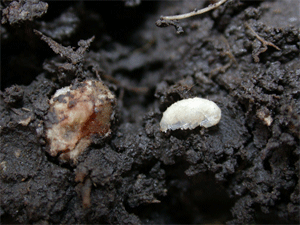
Some observant pest managers have seen what appears to be rootworm larvae feeding on soybean roots. They look very much like rootworms, but they are NOT rootworms! These are the larvae of the bean leaf beetle that were active early this spring. The overwintering beetles, after feeding and mating, laid eggs in the soil that produced these larvae. The bean leaf beetle larva is white and distinctly segmented, with a brown head and brown hardened area at the posterior end of its body. To the naked eye, it looks identical to the corn rootworm larva. It feeds on soybean nitrogen fixing nodules and, to a lesser degree soybean roots. This damage has not been shown to significantly reduce yields. Bean leaf beetle pupae, which also look like rootworm pupae, are being found in the soil with these larvae. This indicates that the first-generation adults will soon be or are already emerging throughout the state. These beetles will be found feeding on soybean leaves throughout most of July. During that time they will once again lay eggs in the soil. These eggs will give rise to the second generation adults, that once emerged, will feed on soybean foliage and pods until the crop is mature. When late fall temperatures arrive, the beetles will find a suitable site to spend the winter.
Caterpillars in Late Planted Corn– (John Obermeyer)
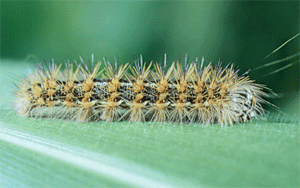
Dubois County Co-op called about several whorl stage cornfields having numerous caterpillars feeding on the leaves of corn. The worm has been identified as the cattail caterpillar, Simyra henrici. The larva of this insect, often mistaken for a woollybear caterpillar, is black and dotted with orange spots and stiff bristles. It ranges in length from 1/4 to 1-1/2 inches. Both fore and hind wings of the adult moth are creamy-white and expand to 1-1/4 to 1-3/4 inches when fully open. These caterpillars may be observed in cornfields in the summer feeding on leaves and occasionally in the whorl of late-planted corn. They are not considered an economic threat to corn. Hail adjuster’s charts, available on pages 27-28 of the Corn and Soybean Field Guide, 2003 Edition (ID-179) can be used to assess potential losses from their feeding. From this chart, in order to expect a 5% yield loss, it would require 45% leaf defoliation in 10-leaf corn. In, 12, or 15-leaf corn it would require 40, and 30% defoliation respectfully for a 5% yield loss. It is unlikely that cattail caterpillars will cause this much damage.
Click for Table
|
||||||||||||
 |
||||||||||||
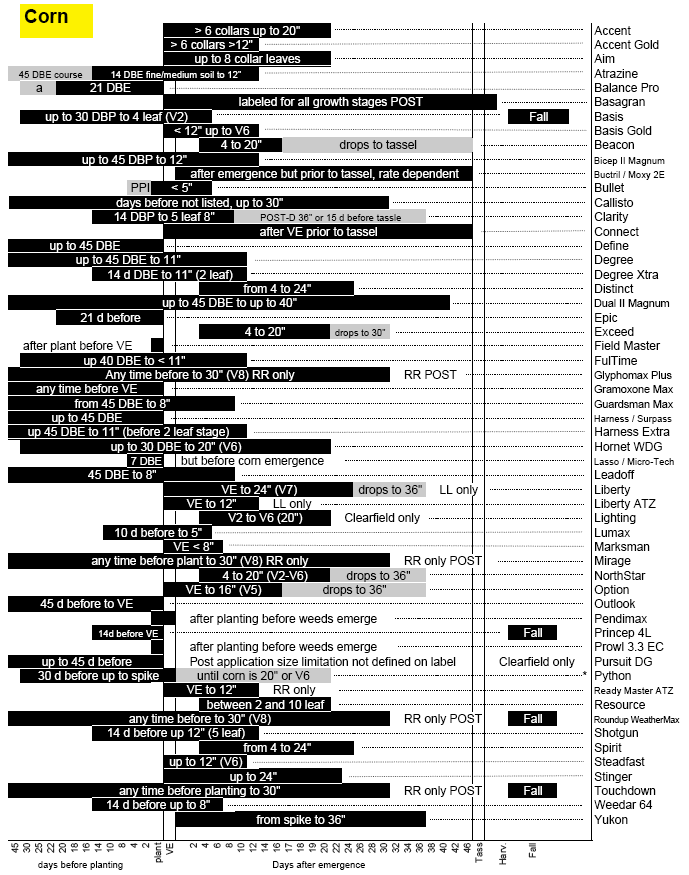
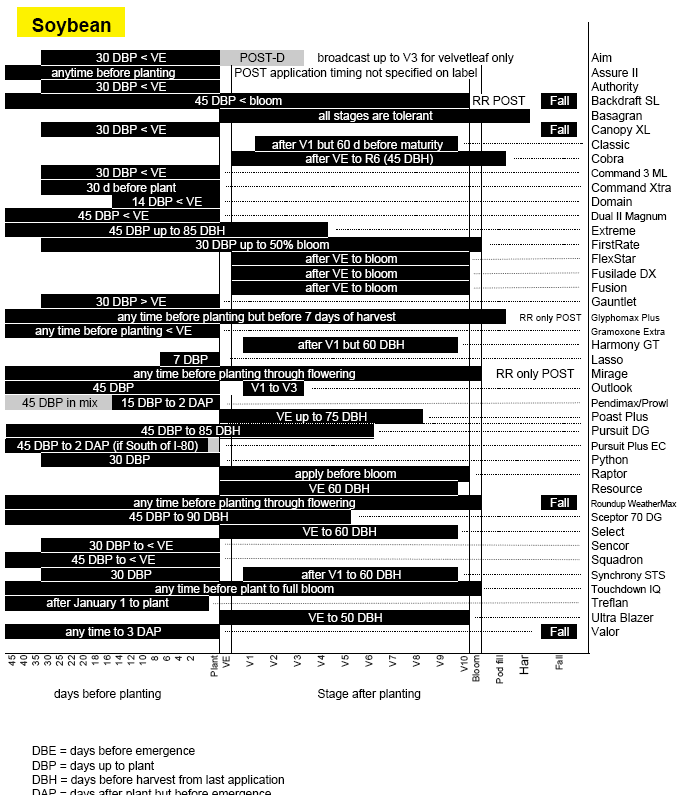
Herbicide Application Timing for Corn, Soybean, Wheat- (Glenn Nice) Herbicides are chemicals designed to interfere with a plant’s natural physiology. Some herbicides disrupt carotenoid production (clomozone and mesotrione), others form highly energized molecules called ‘free radicals’ by disrupting the electron transport chain (paraquat and diquat). Other herbicides,like the ALS inhibitors (chlorimuron, nicosulfuron, glyphosate), disrupt specific enzyme function. In addition other herbicides can mimic natural growth hormones like the phenoxy acids (2,4-D, MCPA) or the pyridine acids (picloram or clopyralid). These disruptions and the byproducts produced are what can kill a plant. However we also know that some plants survive herbicide applications. This is referred to as herbicide selectivity. It is this selectivity that makes a herbicide have value or lose value. A herbicide might lose value when there is a difficult weed that needs to be controlled and the herbicide in question does not control this weed. A herbicide has value in the fact that it does not kill the crop. Plants can survive herbicide applications by many different ways. Leaf structure and surface may inhibit the absorption of the herbicide into the plant. In some cases cuticular waxes on the leaf surface may inhibit the absorption. In other cases it is the physiological differences of a plant’s specific enzyme system that either make a herbicide ineffective or effective. Some plants can metabolize or degrade a herbicide thus also making it inactive. Timing of herbicide application is very important to maximize activity on weeds and minimize injury potential to crops. Most labels provide application times for two reasons. One is that the labeled herbicide does in fact have some slight activity on the crop. An example of this is the use of 2,4-D as a burndown before soybeans. If 1 pt/A is used you must wait 7 days before planting, if 2 pt/A is used the wait is 30 days before planting. This time interval is to assure that the herbicide has dissipated to safe levels before the susceptible soybean is planted. The second reason is that when the physiology of a crop plant changes, as it does when reproduction starts, the crop may be more susceptible to the herbicide and thus cause damage that can end up in yield effects. The following are quick reference charts of the labeled application timing for several herbicides used in corn, soybean, and wheat.. The herbicide name is on the left axis and the crop height and growth stage is on the bottom.
|
||||||||||||
 |
||||||||||||
Soybean Sudden Death Syndrome- (Andreas Westphal and Gregory Shaner)
Sudden death syndrome has been a problem in many Indiana soybean fields in recent years. Since the disease was first identified in the southwest corner of Indiana in the mid 1980s, it has spread to affect fields in nearly all of the state. Surveys in Illinois show that SDS has increased steadily over the last 5 to 6 years, with the exception of 2002. The distribution of past outbreaks suggests that the disease may show up in virtually any area of Indiana, where conditions are favorable. Sudden death syndrome is caused by the soil-borne fungus Fusarium solani f. sp. glycines. This fungus can be isolated from roots of soybean seedlings as early as 1 week after emergence. It colonizes the root systems of susceptible plants. While the fungus can colonize soybean root tissue early on, it is only at mid-season and thereafter that aboveground symptoms of SDS occur. Leaf symptoms usually do not appear until pods are starting to develop, any time from mid July through mid August. Heavy rains during reproductive stages seem to be a critical predisposing factor for SDS. Under these conditions the fungus starts producing toxins in the root system that are translocated within the plant and lead to foliar symptoms. In affected plants, leaf tissue between the major veins turns yellow, then brown. Soon, the leaflets die and shrivel. In severe cases they drop off, leaving the petioles (leaf stalks) attached. Brown stem rot may cause similar foliar symptoms, but the leaflets tend to remain attached to the petioles. Brown stem rot can be distinguished from SDS by symptoms in the plant stem. When split, the lower stem and taproot will exhibit a dark cortex, but white pith in plants with SDS. In brown stem rot, the pith is dark, but the cortex is not much discolored. If a symptomatic plant is dug up when soil is moist, there may be small, light-blue patches on the surface of the taproot. These are spore masses of the SDS fungus. As the plant dries, this color will fade, but when it is seen, in conjunction with the other symptoms mentioned above, a diagnosis of SDS is strongly indicated. Some confusion still exists as to the importance of the soybean cyst nematode in the development of SDS. Often in SDS-affected fields, the soybean cyst nematode is also found. However, infection by the nematode is not required for SDS development. There is some indication that the cyst nematode increases the severity of SDS, but details of the interaction are still not understood. Cyst nematodes are most easily seen on the root surface when they first emerge as white females. These females turn yellow, and eventually turn into brown cysts, at which time they are more difficult to see without magnification. The females or cysts are smaller than a pinhead and are easily distinguished from the much bigger Rhizobium nodules. As of this week in test plots at the Purdue Diagnostic Training Center near Lafayette, female nematodes are well developed and easy to see. Management of SDS should include use of less susceptible soybean cultivars. Cultural practices, e.g., any operations that reduce the time of soil saturation (pretty difficult this year!) have shown some reduction of SDS. The involuntary late planting of much of Indiana’s soybean in 2003 might reduce the risk for SDS since early planting into cold soils increases the risk for SDS. The soybean crop of 2003 is delayed in its development, but beans are now starting to set pods at lower nodes. In addition, some fields were planted early. While some fields are flooded entirely, many more have saturated soil. The SDS fungus is present in many Indiana fields and with this year’s highly disease-conducive conditions; we may see symptoms of SDS in soybean fields over the next 2 weeks. It is always good practice to keep field records of soil-borne diseases. Fields severely impacted with SDS in 2003 should be earmarked for a late planting date when they are schedule for soybean planting in the future. Such fields also lend themselves for planting soybean cultivars with field resistance or tolerance to SDS as they hopefully become available.
Phytophthora Root Rot of Soybean- (Andreas Westphal, Gregory Shaner, and Scott Abney)
Current weather patterns increase the risk for soil-borne diseases of soybean. The accompanying article discusses sudden death syndrome, but the wet conditions are also favorable for another culprit. We will probably see more Phytophthora root rot than in recent years. The causal organism, Phytophthora sojae, is a fungus-like plant pathogen that thrives in wet soil conditions. This plant pathogen has a unique life history. Although direct infection of the soybean root can occur from vegetative growth of the pathogen, the more typical inoculum is a motile spore, the zoospore. When free water is available in the soil these spores are released by the pathogen and can swim to seek out host plant tissue. The active swimming distance is probably less than 1 inch. However, once in suspension these spores can be passively transported with the soil water and remain infective for some time. The pathogen can infect different plant parts. Frequently, spores will remain in soil and infect soybean roots. Soybean plants are hosts to infection by P. sojae at any stage of development. Much earlier in the season, right after planting, the pathogen can lead to damping-off and seed rots. Most soybean fields in Indiana have probably grown out of this critical phase. The plants do remain susceptible to the pathogen. At later developmental stages, root rot develops when the pathogen is present and the soil is saturated. When roots of older plants are infected, the first indication of a problem is often leaf yellowing between the veins and along the leaf margin. The plant has an overall wilted, “droopy”, appearance. When lifted from the soil root systems will show a watery decay and be dark in color. Lateral roots, and in severe cases taproots, are destroyed by the time foliar symptoms call attention to a problem. While less severe cases might not result in plant death there still might be yield loss due to a compromised root system. Depending on when the disease develops yield losses can be limited or severe, the latter being the case when disease develops early. The pathogen survives as robust spores, thick-walled oospores, which are either imbedded in host tissue or released to the soil environment as the plant tissue withers away. The life history of this pathogen makes management with crop rotation impractical, since spores can easily survive several years without a soybean crop. Purdue research has shown the presence of this pathogen in virtually all Indiana soybean fields. Chemical controls are available but do not provide full season protection as pesticides decompose while exposed to the soil environment and lose activity as the growing season progresses. The more practical management of the disease is host plant resistance. Two types of resistance are recognized: partial resistance is slowing down disease development; race specific resistance is effective against particular populations of the pathogen. Under current extreme weather conditions partial resistance might not provide sufficient protection from the disease. To take advantage of race specific host plant resistance it is critical to know the race of P. sojae present in a particular field. Once the race is determined a soybean background that is resistant to this particular race can be identified. Care needs to be taken because the pathogen can adapt to resistance, particularly when soybeans with the same resistance gene are grown repeatedly in a field. Less than 50% of currently available commercial cultivars in northern states have this type of resistance. In 2003, some plant death, tentatively called “water damage” might turn out to be the result of Phytophthora root rot instead.
Leaf Blights and Rust of Corn- (Andreas Westphal and Gregory Shaner)
We are approaching the time of year when corn leaf diseases start to develop. Several leaf blights are common in corn: gray leaf spot, northern corn leaf blight, northern corn leaf spot, and eyespot are often seen in Indiana fields. The fungi that cause these leaf blights survive the winter on corn residue. They produce spores on this residue the following summer. Wind and rain disperse these spores; those that happen to land on corn leaves can infect and initiate disease. Leaf wetness is necessary for infection, so the persistently wet weather of recent days has probably allowed a lot of infection to occur. Once infection occurs, a lesion will develop. As the lesion matures, the fungus will produce spores on the necrotic tissue; these spores can cause more infections. If weather continues to be favorable for disease, these infection cycles will repeat several times, leading to premature death of much of the plant’s leaf area. Fortunately, most hybrids have fair to good resistance to leaf blights. The resistance of most hybrids is partial, meaning that the pathogens can infect, but the resulting lesion is smaller than on a susceptible variety and fewer spores are produced. This is important because spores produced on lesions provide the secondary inoculum that drives an epidemic. Even under favorable weather conditions, the rate of blight development on a partially resistant variety is slow enough to allow the plant the time to produce grain before leaves are severely blighted. Some hybrids, however, may be susceptible to one or more leaf blights, and may sustain enough leaf damage to reduce yield and grain quality. Of the leaf blights mentioned above, gray leaf spot is the one most likely to cause problems on field corn, because breeders have not been dealing with it as long as they have with the other leaf blights. Gray leaf spot emerged as major leaf blight in the corn belt in the early 1990s and caused extensive damage because most hybrids grown at that time were susceptible (or very susceptible). Since then, corn breeders have made progress in improving resistance to gray leaf spot and now many hybrids are rated in seed company catalogs as having partial resistance. Indiana is a major producer of seed corn. Inbreds used in these seed fields are particularly at risk. Many of them are more susceptible to leaf blights than are the hybrids they produce. For this reason, disease often shows up earlier and is more severe on inbreds than on hybrids. Accordingly, disease activity in seed corn fields is a good indicator of what may be in store for the less susceptible hybrids. We have already seen mature gray leaf spot and northern corn leaf spot lesions on lower leaves in seed corn fields. There are also numerous flecks on upper leaves, which are probably young lesions. This indicates that weather has been favorable for some time for leaf blight development. We have also seen a few rust pustules on lower leaves of seed corn. These appear to be pustules of common rust, not southern rust. At this stage, the pustules have erupted on only one surface of the leaf, which is normally an indication of southern rust, but microscopic examination of the spores indicates the pathogen is the common rust fungus (Puccinia sorghi).
|
||||||||||||
 |
||||||||||||
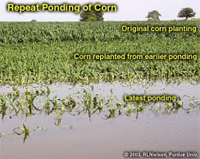
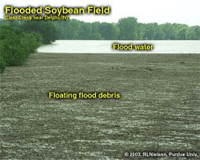
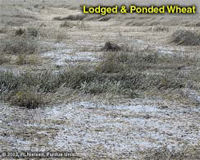
Rain, Hail, Wind: What Next?- (Bob Nielsen) Frequent and heavy rainfall in recent days has caused record and near-record flooding of rivers, creeks, and streams throughout much of Indiana. Large ponded areas exist in fields distant from floodwaters. The rains have often been accompanied by damaging winds and hail that have caused additional damage to the state’s corn, soybean, and wheat crops. The consequences to grain yield and quality from the damage caused by the flooding/ponding and wind are difficult to pinpoint with much accuracy because little research exists that addresses these chance-occurring yield-limiting factors. Risks and expectations, however, can be outlined.
Rules of thumb suggest that corn and soybean crops inundated by standing water may only survive a few days with the 90-degree temperatures that have been prevalent during this epic rainfall episode. Oxygen deprivation quickly results in significant deterioration and death of above- and below-ground plant tissue. Further physical crop damage (soil erosion, washing away of plants, lodging of plants, and plant tissue damage) occurs from the force of the flowing water on land adjacent to flooded creeks and rivers as well as from any debris caught up in the floodwaters. Severe lodging of wheat yet unharvested will result in yield loss due to mechanical harvesting difficulties and/or reduction in grain quality due to weathering and sprouting of grain (Lipps et. al., 2003). The quality of wheat straw harvested from these ponded areas will also be lower. Deposits of sediment and crop residues often remain on crop plants once the water recedes that either outright smother any surviving plants or greatly reduce their ability to capture sunlight and photosynthesize carbohydrates. Mud and crud that cakes the leaves and stalks encourage subsequent development of fungal and bacterial diseases in damaged plant tissue. When Deer Creek (Carroll County) flooded severely in August of 1998, adjacent fields of corn that were in the initial stages of pollination subsequently developed severe bacterial ear rots following inundation by flood waters at or above the ear level of the plants (Nielsen & Ruhl, 1998). Crops that survive less severe bouts of ponding and saturated soils will nonetheless suffer significant damage to their root systems. The immediate effects will be stunting of plant development. In the longer term, root systems compromised by ponding and saturated soils now will be less able to sustain the crops IF drought conditions would develop later in the growing season. For corn, damage to its root system now will predispose the crop to the development of root and stalk rots later by virtue of the photosynthetic stress imposed by the limited root system during the important grain filling period following pollination. Monitor affected fields later in August for the possible development of stalk rots and modify harvest-timing strategies accordingly. Loss of soil nitrate nitrogen in saturated soils due to denitrification or leaching processes is undoubtedly occurring at significant rates. Estimates of nitrate-N loss due to waterlogged soil conditions are at least five percent per day given the current warm soil temperatures (Hoeft, 2002). Many cornfields in the affected area are still in their rapid growth phase prior to pollination when nitrogen uptake rates are at their peak. Consequently, some of these fields currently enduring soggy soil conditions may ultimately develop nitrogen deficiency symptoms without additional fertilizer applications. Where estimated nitrogen loss is significant (60 lbs. or greater) in fields not yet tasseling and yield potential is still reasonable, corn may respond to an additional 50 – 80 lbs. of applied fertilizer N up to or shortly after tasseling (Hoeft, 2001). Assessing the effects of hail damage to corn can be challenging. Important factors include the amount of defoliation and stalk bruising caused by the hail stones relative to the growth stage of the crop. While hail damage can result in severe yield losses in corn, most of the time the human eye perceives greater damage than truly exists. Browse the two references listed below (Nielsen, 2001; Vorst, 1993) on hail damage assessment for more information.. Wind damage to corn has occurred either as stalk breakage (aka “green snap”) or root lodging (plants uprooted and laying nearly flat to the ground). The yield effect of “green snap” damage depends on the percentage of field affected and whether the stalk breakage occurs above or below the ear, but is usually serious regardless. Obviously, stalk breakage below the ear results in zero yield for that plant. Stalk breakage above the ear results in significant yield loss due to the loss of upper canopy photosynthesis capacity for that plant. Root lodged corn will recover or straighten up to varying degrees depending on the growth stage of the crop. Generally, younger corn has a greater ability to straighten up with minimal “goose-necking” than older corn. Yield effects of root lodging depend on whether soil moisture remains adequate for root regeneration, the severity of root damage due to the uprooting nature of root lodging, and the degree of “goose-necking” that develops and its effect on the harvestability of the crop.
|