Pest & Crop Newsletter



 |
|||||||||||
|
|||||||||||
 |
|||||||||||
Western Corn Rootworm Beetles Emerging– (John Obermeyer and Larry Bledsoe)
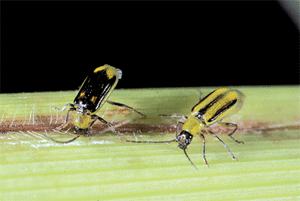
A male western corn rootworm beetle was trapped at the Throckmorton Agricultural Research Center, Tippecanoe County, on July 2. It is likely that these beetles have been emerging throughout southern Indiana for over a week. Generally the first beetles to emerge are males, female emergence begins a few days later. Once the females emerge, feed, and mate, they may disperse to other fields. Beetle emergence will continue for several weeks to come. After emerging, beetles will begin to feed on corn leaves if pollen is not available. This leaf feeding damage is usually of no economic importance. This year’s staggered planting will cause some fields to pollinate much sooner than others. These fields will act as “magnets” for the beetles and need to be watched for silk clipping. If beetles are present and feeding on corn silks, an insecticide application should be considered only if 50% of the silks are being cut off to less than 1/2 inch before 50% pollination has taken place. Note, this threshold is NOT based on beetles per plant.
It's That Time for Corn Lodging– (John Obermeyer and Larry Bledsoe)
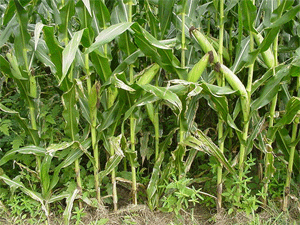
Thanks to Dwain Rule, Midland Co-op, and Steve Dlugosz, Agriliance, for calling and sharing about their recent rootworm digs. Just over a week ago rootworms were difficult to find; now it seems as though the warmer weather has not only spurred corn growth but rootworms as well. Dwain and Steve found a mix of rootworm sizes and damage in the dug roots. Typically around July 4th, a mix of rapid plant growth, rootworm feeding, and rain storms with gusty winds combine to topple corn plants with reduced roots. Damage is typically spotty in fields and is often associated with the lower, darker soils. If damage isn’t seen in the end-rows to bring attention to the situation, producers may have a surprise for them this fall as they harvest. Now would be an optimal time to walk and inspect fields. Corn plants that have tilted or lodged should be dug, not pulled, and then inspected for root feeding scars. Pay particular attention to the nodes of roots just below and above the soil surface, these may have been completely destroyed. Those producers that used full rates of rootworm insecticides should be contacting their dealer or manufacturer’s representative for further investigations. Fields with significant root damage may also have a tremendous number of beetles as they emerge from the soil.
Corn Blotch Leafminer or Why Are Corn Leaves Turning White?– (John Obermeyer and Larry Bledsoe)
Admittedly it’s been a slow season for insect problems. Devoting a whole newsletter article to an obscure insect such as corn blotch leafminer may be interpreted as desperation for a story. However, it has been said that our legislatures consider an item of extreme importance if three or more letters/calls are received. Applying that same logic to insect pests in Indiana, corn blotch leafminer is being seen with enough frequency to warrant the following information.
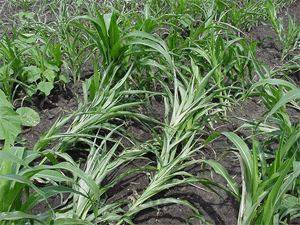
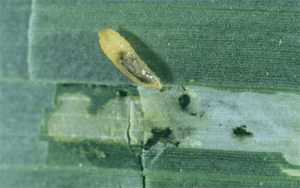
Corn blotch leafminer, Agromyza parvicornis, is a leaf-feeding insect normally considered “occasional or non-economic.” The adult is a gray to brown fly 1/4 inch in length. In the early spring, adults insert eggs in either the upper or lower leaf surface of corn. The larva, or maggot, is yellowish and about 1/4 inch long when full grown. The larva pupates in a damaged leaf, or in the soil. Although there are several generations in a season, damage to only certain corn leaves indicates that infestations occur once per season. Larvae eat out the leaf interior leaving a transparent area or “mine.” Often many mines appear and sometimes merge on a single leaf. This can be quite an eye catcher, as leaves may appear completely bleached resembling herbicide damage. There are no sampling methods or economic thresholds for corn blotch leafminer. The damage from this pest is believed to be of little economic importance as only a few leaves per plant are usually damaged. It has been suggested by colleagues at the University of Nebraska that the hail adjuster’s charts can be used to estimate potential losses from the leafminer damage. This data is available on pages 27-28 of the Corn and Soybean Field Guide, 2003 Edition (ID 179). From this chart, in order to expect a 5% yield loss, it would require 70% leaf defoliation (mining) in 7-leaf corn. In 10, 12, or 15-leaf corn it would require 45, 40, and 30% mining respectfully for a 5% yield loss. Even if a control were attempted, it would likely fail because the larvae are protected within the corn leaves. Treatments would have to target the adult flies, which would be difficult with one insecticide application. It is possible that foliar insecticides may worsen the damage. An early investigator of this insect, W. J. Phillips wrote in 1914: “With such a host of ... constantly on the watch, we need not concern ourselves seriously with remedies so long as conditions continue as they are now. In the event that a combination of circumstances should occur that would restrain the parasites and give free rein to their host, the blotch miner would undoubtedly prove a pest very difficult of control. This species seems to furnish an instance in which only the barrier of parasites stands between the farmer and what may easily become temporarily at least, a very serious pest.” Speculation as to why there is an “outbreak” of corn blotch leafminer points to either unique environmental conditions, which includes many variables, or practices that are inhibiting the natural parasites (e.g., multiple broadcast pesticide applications).
Click for Table
|
|||||||||||
 |
|||||||||||
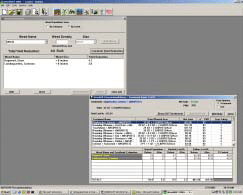
Using WeedSOFT ADVISOR for Managing Sparse Weed Infestations in Soybean- (Bill Johnson) Indiana soybean growers are nearing the time in which they will be making decision on whether or not to respray Roundup Ready soybeans for escaped or newly emerging weeds. I have received a few of questions on the utilization of Indiana WeedSOFT 2003 (see this website for more information <http://weedsoft.unl.edu/>) to assist in the decision making process choice for weeds that have escaped previous treatments. In this article I will outline a few items related to the WeedSOFT ADVISOR module that assists the user in sorting out management tactics to employ based on the information entered. Advisor uses information entered by the user to suggest weed management practices based on the estimated crop yield loss from the weed species and their densities, the efficacy of those treatments and the net gain from controlling these weeds. Advisor calculates yield loss by multiplying the density of each weed by the competitive index of that specie and summing this over all weeds entered. This value is called the total competitive load. The yield loss model in ADVISOR assumes that each unit change in total competitive load will cause small, incremental yield losses up to about a 30% yield loss. The equation becomes more complex with yield losses that exceed 30% and each unit increase in total competitive load results in progressively less yield loss. The yield loss calculation in ADVISOR is also based on modifiers that adjust the yield loss based on crop row spacing, crop growth stage and weed stage, plant water status when postemergence treatments will be applied. ADVISOR will also show the weed control efficacy of the various tactics chosen and the yield loss due to the uncontrolled weeds. Here is an example of an output from WeedSOFT. In this scenario, I assumed that I had not used a soil-applied herbicide at planting and expected to get 50 bu/A under weed-free conditions. I applied the full labeled rate of a glyphosate product 3 weeks ago and now am scouting for weed escapes. The soybeans are about 16 inches tall and moisture conditions are adequate. The weeds present included giant ragweed (5 per 100 sq ft, 18 inches tall), and common lambsquarter (5 per 100 square foot, 12 inches tall). Pictured below is the output from ADVISOR. In the upper left hand corner of the output, you can determine the yield loss that these weeds would cause if left untreated for the rest of the season. In the lower right hand corner is the treatment recommendations. You can sort treatment recommendations by either net gain or percent maximum yield. In this example, I have sorted them by percent maximum yield. Choosing this option sorts treatments by the ones that provided the best control of the weeds, regardless of the cost of the treatment. One can also sort treatments by net gain. Sorting treatments by net gain will rank treatments based on expected yield losses after treatments and cost of the tactics chosen.
In this example, there are several treatments one could choose that are very similar in their activity on these weeds and in the predicted yield loss. To show how you can determine how efficacious a specific treatment is on the chosen weeds, I randomly highlighted 1 treatment in the output, a glyphosate product used alone. If you look at the bottom of the output screen below, you will see the weed population before treatment and after treatment, bushels lost before and after treatment due to weed interference, and dollars lost due to weed interference before and after treatment. And finally, the last column shows the percent control that this treatment will provide on each weed. If one was interested in determining herbicide efficacy with other treatments, you could simply highlight another treatment in the upper part of the screen and the efficacy and yield loss numbers would appear in the lower part of the screen. Unfortunately, none of the treatments will provide very good control of these large weeds and some yield loss will be incurred, although it is less than if the weeds were not treated. However, the software did indicate that this relatively low infestation of weeds was worth treating with the appropriate herbicides to avoid more yield loss. You still have to time to purchase Indiana WeedSOFT 2003 if you haven’t already done so. WeedSOFT is easy to use. If you are familiar with running Windows on your system you will find WeedSOFT easy to install and operate. System Requirements:
To order WeedSOFT: The initial purchase of WeedSOFT 2002 will cost $195 including shipping and handling. Annual upgrades will be available for a nomimal fee. Access the WeedSOFT website at <http://weedsoft.unl.edu> or send a check payable ($195) to WeedSOFT 2002 to Bulletins, P. O. Box 830918, Lincoln, NE 68583-0918.
|
|||||||||||
 |
|||||||||||
New Director of the Purdue Crop Diagnositc Training and Research Center- (Sandy Spitznagle)
|
|||||||||||
 |
|||||||||||
|
|||||||||||