Pest & Crop Newsletter



 |
||||||||||||
|
||||||||||||
 |
||||||||||||
What's Up With Grubs?– (John Obermeyer and Larry Bledsoe)
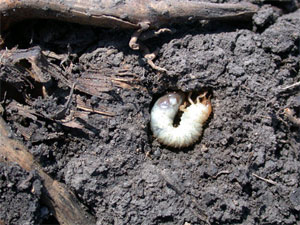
When over a quarter of the state’s corn was planted in the first few weeks of April, we began to speculate and fear-monger about soil-dwelling insect problems, especially grubs. History tells us that grub problems increase with early planting, especially when the seedlings sit and wait for warm temperatures and sunshine. Certainly 2003 was set to be the year of the grub. Well, if there is a grub disaster in progress, we haven’t seen it and nobody has called to tell us about it.
Japanese beetle is the predominant grub species in cultivated cropland in Indiana. It overwinters several inches deep in the soil attempting to escape freezing temperatures. Soil temperatures, both degree and depth, have an impact on grub survival. Last winter, Indiana’s soils at the four-inch level were cold (see graph in Pest&Crop #1). This required grubs to burn more energy to survive, and the small and weak likely perished. Likely we had fewer surviving larvae for this season. Usage of soil insecticides at planting this spring may have had an influence on grub damage. Interest with rootworm damage was heightened after last year, especially in areas of moderate risk to first-year corn rootworm damage. Though exact soil insecticide usage for this spring is not known, most perceive it to be higher. Since soil insecticides have fair activity against grubs, this may have reduced some feeding damage this spring. A word of caution, no soil insecticide gives excellent control of grubs. Fields with high grub populations can receive severe stand reductions, even with properly, and timely, placed soil insecticides. Japanese beetle grubs feed-on both living and dead material when they crawl to the upper soil profile in the spring. Should you visit a field with suspected grub damage, be certain to dig between rows as well as underneath crop residues. There you will likely find as many, if not more, healthy grubs. Soils low in organic matter and crop residues will encourage grubs to move horizontally in the soil profile until suitable food sources are found. Corn or soybean roots within their “grasp” certainly will be fed on. It isn’t over yet! Grub damage has been known to continue until mid-June. Crops recently planted are certainly vulnerable to damage for a couple more weeks. Hopefully, the grubs present in fields will remain content to feed on dead and decaying matter. Then soon we will have everybody’s favorite insect flying around, the beautiful Japanese beetle!
Watch Emerging Soybeans for Bean Leaf Beetle– (John Obermeyer and Larry Bledsoe)
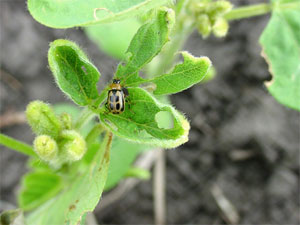
Bean leaf beetle have been observed in early-planted bean fields in several areas of the state. Although a limited number of fields were planted early, those that were probably have beetles present. The general rule, “the damage looks worse that is really is,” applies to this insect’s feeding. Refer to Pest&Crop #5 for management guidelines and discussion about bean pod mottle virus. Bottom line…it takes tremendous damage to the soybean seedling to affect stand and yield. Good news concerning this beast! The beetle population will soon, if not already, be decreasing. These overwintering beetles have now fed, mated, laid eggs, and now will be naturally dying. If new plant growth is not being damaged, this probably indicates the end of these beetles for now. We will see them back sometime mid-summer, stay tuned to future Pest&Crop’s.
Stalk Borer Making Their Presence Known– (John Obermeyer and Larry Bledsoe)
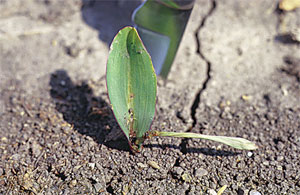
Ron Blackwell’s pest survey this week in north central counties revealed that stalk borer larvae are beginning their host migration. The small larvae were leaving host plants and moving into corn. The 2-3 leaf corn plants were showing the typical “dead-heart” appearance, i.e., bottom leaves healthy and whorled leaf(ves) wilting. Once the stalk borer has either outgrown or killed one plant, they will then move onto another. Research conducted at Iowa State University had shown that leaf feeding by early instar larvae had an insignificant effect on yield. However, once the stalk borer had tunneled, grain yield reductions were 59% for primary plants (first plant infested) and 74% reductions for secondary plants (second plant infested) sustaining dead-heart damage. The damage obviously intensifies as the larvae increase in size. If corn seedlings are being killed by stalk borers, the application of a insecticide with good residual activity may be beneficial to control the worms as they move from dying plants to new hosts. However, timing of such treatments is critical to increase the probability of success. Spot treatments where damage is prevalent, such as along waterways or where giant ragweed has been a problem, often controls further movement.
Corn Rootworm Hatch is Underway– (John Obermeyer and Larry Bledsoe)
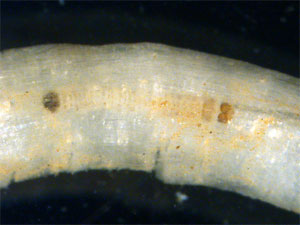
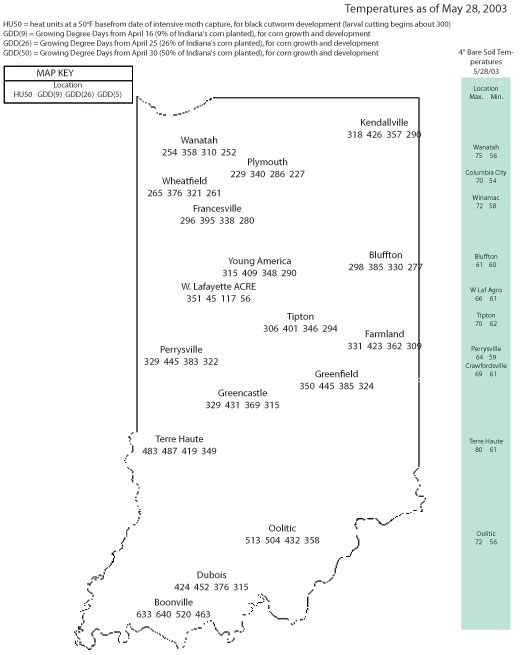
Roots from 2-leaf corn collected on May 29 near Lafayette in Tippecanoe County revealed rootworm larvae. Hatch probably began around May 25. Hatch in southern Indiana counties occurred several days earlier, while hatch in northern counties will soon be occuring. Depending on soil temperatures, hatch will continue for a while. It is too early to sample corn roots for the presence of larvae, as the worms are inside the roots. In a couple weeks, it will be possible to dig up and inspect for larvae and feeding scars on the roots. More on this in a future issue of Pest&Crop.
Click for Table
|
||||||||||||
 |
||||||||||||
Purdue University Weed Science Web Page- (Glenn Nice and Bill Johnson) The web can be a useful tool, but as it grows it can seem like you sink in a sea of information. In trying to make information readily available to you concerning weed science, the Purdue Weed Science Extension team has developed a web page that will bring you the weed science expertise from four different departments, Agronomy, Botany & Plant Pathology, Forestry, and Horticulture, at Purdue. The Weed Science page will serve as a central location for weed science information for Indiana. The sites address is www.btny.purdue.edu/weedscience/. Like some of the large commercial web sites, the Purdue Weed Science page will be sectioned into cells. The contents of these cells may change, but we will try and keep the cells consistent. At present, there are 11 cells. To find out who is presently working in the discipline of weed science at Purdue, the ‘Faculty’, ‘Staff’, and ‘Graduate Students’ cells will allow you to get in contact with most people dealing with weed science. Links to weed science related sites including other universities, other Purdue sites, label information, and publications from other sources will be maintained. The ‘Featured People’ cell will high light a new graduate student or show case a member of the weed science team. ‘News and Notes’ will give and archive news and notes that address questions or relevant problems in the State of Indiana. The ‘Other News and Notes’ cells will provide links to newsletters at other universities. Announcements’ will provide information on events and educatational products that are relevant to weed science. The ‘Tools’ cell will provide the 2003 Indiana Weed Control Guidelines, Weed Control for Gardens & Landscapes, WeedSOFT 2003 for Indiana, information on herbicides, toxic plants, and eventually show case presentations and posters relating to weed science. The web was designed to be able to change. This web site also will change to meet the needs of the people who will use it. We welcome suggestions that would make this site more useful to you. If you have any suggestions please direct them to Glenn Nice (gnice@purdue.edu) or Bill Johnson (wgjohnso@purdue.edu).
|
||||||||||||
 |
||||||||||||
Root Development is Key to Corn's Success- (Bob Nielsen)
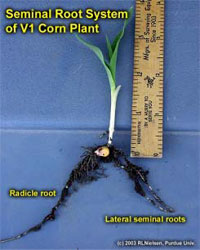
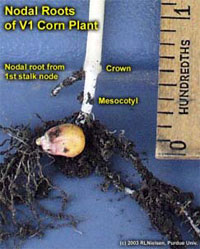
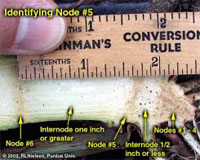
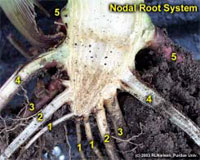
Corn is a grass and has a fibrous type root system, as compared to soybeans or alfalfa that have tap root systems. Successful establishment of the corn plant’s root system helps ensure successful establishment of the crop itself. In fact, when you are attempting to diagnose the cause of stunted or otherwise poor-looking corn early in the season, the first place to begin the search is below ground. One of the more critical periods for successful root establishment occurs from emergence to about the six-leaf collar stage of development (V6). Stunting or restriction of the root system during this time period (e.g., dry soil, wet soil, cold soil, insect damage, herbicide damage, sidewall compaction, tillage compaction) can easily stunt the entire plant’s development. To better understand rooting development and problems associated with root restrictions, it is important to understand that root development in corn can be characterized by root position relative to the seed. Seminal roots originate near the seed and are comprised of the radicle and lateral seminal roots. The seminal root system anchors the young plant and absorbs small amounts water and nutrients for the first two to three weeks. Seminal roots cease new growth shortly after the coleoptile emerges at the soil surface. Within a few days after the emergence of the coleoptile and first true leaf, the nodal root system begins to develop from the crown area of the seedling and is distinctly visible by growth stage V1. An individual set of nodal roots forms at each stalk node belowground plus one or more aboveground nodes. By growth stage V6, these nodal roots are typically well established and have completely taken over the sustenance of the plant. The “woody” triangle of stalk tissue visible at the lower end of a split corn stalk usually represents four stalk nodes with no spaces (internodes) between them. The internode above the fourth node elongates about 1/2 inch, above which is found the fifth node (still below or just at the soil surface). Consequently, five sets of nodal roots will usually be detectable below ground (one set for each below ground stalk node). Elongation of the internode (1-inch or greater) above the fifth node elevates the sixth node above ground. Continued elongation of subsequent stalk internodes will result in higher and higher placement of the remaining stalk nodes. Additional sets of nodal roots that form at above ground stalk nodes are usually assigned the “fancy” name of brace roots, but are functionally identical to those nodal roots that form below ground. If surface soil conditions are suitable (moist and not excessively hot), brace roots can successfully enter the soil, proliferate and effectively scavenge the upper soil layer for water and nutrients. Because a young corn seedling depends primarily on the energy reserves of the kernel until the nodal roots develop, damage to the seminal roots or the mesocotyl prior to successful nodal root formation will cause stunting or death of the plant. Examples of such damage include salt injury from excessive rates of starter fertilizer, seedling blight, herbicide injury and insect feeding damage. Cool soils slow the development the development of nodal roots and prolongs the seedling’s dependence on the dwindling kernel reserves. Such delayed plant development extends the vulnerability of the seedling to damaging soil-borne pathogens, insects or pesticides prior to successful nodal root establishment. Cool soils that have been saturated for lengthy periods during the first 30 days after planting, coupled with numerous cloudy days and lower photosynthetic rates, naturally result in early-planted fields of corn whose appearance can be most politely described as pathetic. The prognosis for such fields is greatly dependent on weather conditions over the next several weeks as the crop tries to move along into the rapid growth period (knee-high to pre-tassel). A return to warm temperatures with decent, but not excessive, rainfall will do wonders for many of the early-planted cornfields around Indiana this year. Related References
Delayed Corn Planting Issues for Southern Indiana- (Bob Nielsen) Technically, corn planting in Indiana is beginning to wind down with 73% of the state’s crop in the ground as of May 25 (Indiana Agricultural Statistics Service). Unfortunately, the planting progress in southern Indiana continues to lag behind that of the rest of the state, where only 39% of the intended corn acres are planted. Folks are naturally beginning to worry about issues like hybrid maturity choices and when to consider switching to soybean as planting is further delayed. Yield potential for late-planted corn is always a concern among farmers. Conventional wisdom says that corn yields drop by about 1 bushel/acre/day during the last half of May and up to 2 bushel/acre/day during June. Experience tells us that late-planted corn yields can be all over the map, including being exceptionally good. The bottom line is that planting date is but one of many yield-influencing factors and late planting, by itself, does not guarantee disastrously low yields. As corn planting is delayed, folks naturally worry about the increased risk of fall frost damage if the grain does not mature prior to a killing fall frost. Indeed, the growing season is becoming increasingly shorter with every passing day, but there is little agronomic reason to consider switching to soybean in southern Indiana until late June. Furthermore, many southern Indiana farmers will not even need to consider switching to earlier maturity corn hybrids until later in June. Based on historical heat unit accumulation (aka GDD, HU, GDU) from selected planting dates until expected average dates of killing fall frosts, one can estimate the “thermal” length of the remaining growing season for various time periods. That estimate can then be coupled with previous research on the effects of delayed planting on hybrid GDD responses (Nielsen & Thomison, 2003) to arrive at the following hybrid maturity guidelines for southern Indiana corn growers.
Farmers should consider the use of Bt corn hybrids for such unusually late plantings because of the increased risk of infestation by European corn borer and Southwestern corn borer, but only if they are certain that marketing grain from such biotech hybrids will not be a problem for them. Growers should also verify that the hybrids to planted have acceptable levels of disease tolerance because of the greater risk of leaf diseases with late-planted corn (Vincelli, 2003). Farmers should continue with their usual seeding rates. There is no need to consider changing seeding rates for corn simply because planting is delayed. Optimum seeding rates for most growers’ fields range from 28,000 to 33,000 seeds per acre. Lower rates (low to mid-20’s) are suitable for fields with yield levels historically near or below 100 bushels per acre. Nitrogen fertilizer rates (Brouder et al., 2003), for those fields yet to receive nitrogen, should be adjusted downward accordingly to match the farmer’s estimate of yield goal for the delayed planting of corn. Sidedress rates of N can be adjusted further downward anyway because of the greater efficiency of use with late N applications. In a corn/soy rotation, farmers can lower their N rates by about 10% for sidedress compared to preplant N applications. Related References Indiana Ag. Statistics Service. 2003 (May 27). Indiana Crop & Weather Report. U.S. Dept of Ag. Available online at http://www.nass.usda.gov/in/cropweat/2003/we2103.pdf. [URL verified 5/28/03]. Nielsen, Bob, John Obermeyer, and Tony Vyn. 2003. Delayed Planting Considerations for Corn. Purdue Univ. Corny News Network. Available online at http://www.kingcorn.org/news/articles.03/DelayPlant-0512.html. [URL verified 5/28/03]. Nielsen, Bob and Peter Thomison. 2003 (rev). Delayed Planting & Hybrid Maturity Decisions. Purdue Univ. Cooperative Extension Service publication AY-312-W. Available online at http://www.agry.purdue.edu/ext/pubs/AY-312-W.pdf. [URL verified 5/28/03]. Vincelli, Paul. 2003. Risk of Leaf Disease in Late-Planted Corn. Kentucky Pest News. Univ. of Kentucky. Available online at http://www.uky.edu/Agriculture/kpn/kpn_03/pi030519.htm. [URL verified 5/28/03].
Silver Leaf Symptom in Corn- (Bob Nielsen)
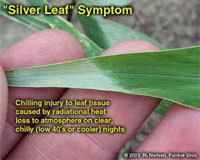
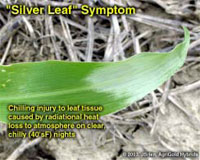
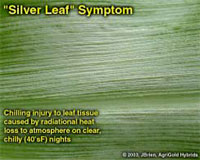
Nighttime temperatures have been quite chilly around parts of Indiana for the last week or so. While there have been no reported instances of frost, there have been a number of early mornings with air temperatures in the low 40's °F. If you’ve been out walking your cornfields recently, you may have noticed a curious leaf symptom that may remind you of freezer burn. Rapid heat loss from terrestrial surfaces to the atmosphere (i.e., radiational cooling) can occur on clear, dry (low humidity), calm nights with temperatures in the low 40’s°F or cooler. Minor levels of radiational cooling can damage the outer surfaces of corn leaves that are positioned horizontally or parallel to the night sky. The subsequent symptom of such minor chilling injury is often referred to as “silver leaf” in corn. The “silver leaf” symptom indeed appears as a silvery or dull gray leaf surface. Any portion of a leaf that was not horizontal to the sky or that was protected by another leaf or plant part will not exhibit the symptom. The effect of this type of minor leaf damage is negligible, if any. The leaves will not die abruptly as will genuinely frosted leaf tissue. Continued expansion of the whorl will not be restricted in any way. New leaves that expand from the whorl will be normal in appearance. This symptom is more of a curiosity than a nuisance. Don’t forget, this and other timely information about corn can be viewed at the Chat ‘n Chew Café on the Web at http://www.kingcorn.org/cafe. For other information about corn, take a look at the Corn Growers’ Guidebook on the Web at http://www.kingcorn.org.
|
||||||||||||
 |
||||||||||||
Time to Shift from Corn to Soybeans? – (Christopher Hurt, Agricultural Economics) Southern Indiana has had a second year of extreme delays in spring planting. As of their release on May 27, the Indiana Agricultural Statistics was reporting that only 39 percent of the corn had been planted in Southern Indiana and a mere 11 percent of the soybeans. The spring of 2002 was even more delayed as only 29 percent of corn and 8 percent of soybeans were reported planted in the corresponding week for this region a year ago. While Southern Indiana has once more faced the wrath of another wet spring, the rest of the state has faired much better. Corn planting in Northern Indiana is now 85 percent complete compared to only 54 percent last year at this time with 78 percent planted in the central region compared to 39 percent last year. Should Southern Indiana farmers be considering shifting from intended corn over to soybeans? As June approaches, the economics grow in favor of considering increased soybean acres. The first consideration is whether nitrogen fertilizer has already been applied to unplanted land intended for corn production and if any corn herbicides have been applied that would prohibit soybean production in those fields. Under both of these cases, corn should continue to planted as long as the remaining length of the growing season is not an issue, or the field is declared to be “prevented plantings” for potential insurance claims. The impact of late planting on corn and soybean yields is critical. For this evaluation it is assumed that corn yields decline one bushel per day in May for planting after May 10th, and then two bushels per day in June. Soybean yields are assumed to drop one-half-of-one percent per day from May 21 to June 10, and then one percent a day after June 10. Late May soybean seedings provide a valuable alternative to intended corn acres if there are no added yield losses from planting a larger amount of soybeans. As an example for average quality Indiana soils with normal corn yields of 140 bushels per acre and 47 bushel soybean yields, the returns above variable costs (based upon Purdue’s Id-166-2003 Crop Budgets and current new crop prices in Southern Indiana) are only $16 per acre lower than corn planted at the optimum planting time. However, shifting to more soybeans will mean that more beans will be planted on land that was planted to soybeans last year. Purdue agronomists point out that planting beans-on-beans may allow buildup of soybean diseases, weeds, or other pest. Therefore, they suggest taking an additional 10 percent yield reduction when estimating yields on fields that have beans-on-beans. With this additional assumption, the economics would suggests shifting from corn to soybeans in the very late May or the first few days of June. Insurance will also become an important consideration in the coming week. The “prevented planting” date for intended corn acres is after June 5 and after June 20th for intended soybean acres. Farmers are strongly encouraged to check with their crop insurance agents both for the qualifications for “prevented plantings” and for the exact dollar amount of potential insurance payments. Last year, the southern crop reporting districts in Indiana reduced their corn acres by 190,000, increased soybean acres by 60,000, but also had about 130,000 “prevented planted” acres. Those taking “prevented plantings” this year may be as large or larger as they recall the weather pattern last year that turned from spring floods to summer drought, dropping corn yields 20 to 30 percent below normal.
|
||||||||||||
 |
||||||||||||
|
||||||||||||