Pest & Crop Newsletter



 |
||||||||||||||||||||||||||||
|
||||||||||||||||||||||||||||
 |
||||||||||||||||||||||||||||
High Alfalfa Weevil Numbers and Damage Noted– (John Obermeyer, Rich Edwards, and Larry Bledsoe)
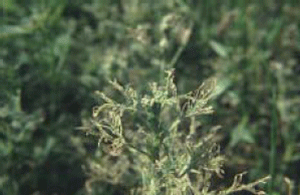
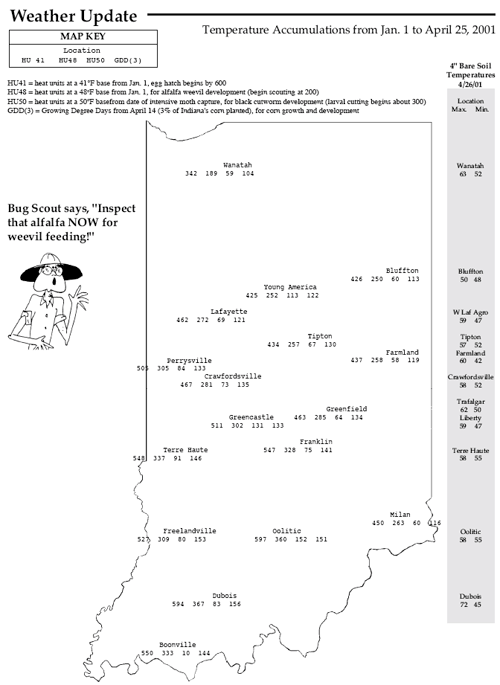
Surveys of west central Indiana alfalfa fields this past week (see “Alfalfa Weevil Larval Survey”) reveal that weevil feeding has reached very high levels in most fields. The number of plants with tip feeding has reached as high as 88% (range 24 to 88%). Weevil damage and subsequent populations are progressing quicker than anticipated given heat unit accumulations. This should be a warning to growers throughout northern counties as damage will rapidly progress northward with warming temperatures. Reports from pest managers in central and north central Indiana confirm the extremely high tip feeding percentages and larval populations. Most have or will soon apply insecticides. If possible, insecticides should not be applied until 400 heat units (base 48°F) have accumulated (see “Weather Update”). This will ensure that most weevil eggs have hatched and the majority of larvae are controlled. If treatments are necessary before then, use products and/or rates that will give long residual control, while carefully considering harvest restrictions. Refer to the recommended insecticides for alfalfa weevil larval control in last week’s Pest&Crop.
Stalk Borer Hatch, Migration, and Damage– (John Obermeyer, Rich Edwards, and Larry Bledsoe)
Stalk borer infestations may occur in fields where similar cropping or weed growth patterns occur. There is often a history of stalk borer damage in these fields. This happens due to the attractiveness of stalk borer moths in the fall to certain plants for egg deposition. Plants favored for egg laying include grassy-type cover crops (rye, wheat, etc.) and weeds (foxtails, giant ragweed, etc.) within fields, and grassy-type plants in waterways, ditches, fencerows, etc. The fall-laid eggs remain in the egg stage throughout the winter. In the spring, the larvae hatch and begin their search for suitable plants to feed on. Stalk borer larvae are easily identified by the purple band or “saddle” around the middle of their bodies and the white longitudinal stripes at their anterior (front) and posterior (rear) ends. As the name implies, these larvae bore into the stem of their host plants and feed within, although small larvae may feed on the leaves or in the whorl of corn plants before tunneling into the plant. In corn, infestations are usually not noted until the borers are already in the stalks. The first sign of damage is often “dead hearted” plants, with the center leaves wilting. Unfortunately, once inside the plant, stalk borers are well protected from insecticides. Thus, managing stalk borers can be difficult. A method that could assist one in determining if the application of a control is needed is to follow degree-day accumulations to determine when scouting for larvae should occur. According to the Iowa State University stalk borer developmental model, approximately 10 to 50% of the larvae will move out of the plants they initially infest after hatch once 1,400 to 1,700 degree days (base 41°F) have accumulated. Therefore, it is recommended that fields be scouted at 1,300 to 1,400 degree-days. For information on when this will occur in your region of Indiana, refer to the “Weather Update.” The initial hatch of the larvae occurs at about 600 degree days (base 41°F), which should be occurring in southern Indiana. Normally, the first host is the cover crop or grassy-type weeds located near the egg-laying site. However, they may also attack corn, if present. This is referred to as the initial infestation, and if on small corn, the corn is normally able to out grow the damage. As noted above, the later larval infestation, which occurs during the period from 1,400 to 1,700 degree-days, is when corn can be severely damaged by the larger larvae. If stalk borers or their damage are observed in a cover crop or on grassy-type weeds in the field prior to cover crop or weed destruction, or during early post weed control, an insecticide for the borers can be applied as part of a herbicide application (check labels for use and compatibility information). Additionally, if stalk borers are noted in the whorls or on the leaves of corn, a spot treatment with an insecticide in the infested area and adjacent areas should prevent the infestation from spreading. Remember that stalk borer will move from one plant to another, if their host is killed or if they kill and/or outgrow their present host plant. The borers are susceptible to insecticides when they are moving from plant to plant or are in the corn whorl.
|
||||||||||||||||||||||||||||
 |
||||||||||||||||||||||||||||
Predicting Leaf Stages in Corn– (Bob Nielsen)
Phenology: A branch of science dealing with the relations between climate and periodic biological phenomena (Webster’s New Collegiate Dictionary, 1973)
Predicting when a field of corn will reach particular leaf stages can be useful for planning post-emergence applications of certain herbicides and sidedress N fertilizer, especially if your farming operation is so large that field inspections are difficult to work into your busy schedule. Recent research by one of my former graduate students helps fine-tune our ability to predict the portion of corn phenology that we call leaf stage development. Review of Concepts. For a refresher on how corn leaf staging is done, be sure to read the accompanying article “What Exactly Do You Mean by ‘Leaf’?”. Another topic that probably needs reviewing is the concept of heat units (HUs) or growing degree days (GDDs). The concept is important because corn phenology is very dependent on temperature. Heat unit or GDD calculation for corn phenology is described in an accompanying article “What Exactly Do You Mean by ‘Growing Degree Day’?. Predicting Corn Phenology. Given an understanding of corn leaf stage development and heat unit calculation, you are now prepared to predict what leaf stage of development a particular field is at given its planting date and temperatures since planting. It is useful if you know when the crop emerged, but if not you can estimate that event also. Corn emergence typically requires 100 to 150 GDDs. Based on my former graduate student’s research (Kirby Wuethrich. 1997. Vegetative and Reproductive Phenology of Fourteen Hybrids of Dent Corn (Zea mays L.). Purdue Univ.), we now know that corn leaf developmental rates can accurately be described in two phases. From emergence to leaf stage V10 (ten visible leaf collars), leaf emergence occurs approximately every 85 GDDs. From leaf stage V10 to the final leaf, leaf emergence occurs more rapidly at approximately one leaf every 50 GDDs. Example 2: A field was planted on April 28, but you do not know exactly when it emerged. Since planting, approximately 785 GDDs have accumulated. If you assume that the crop emerged in about 125 GDDs, then the estimated leaf stage for the crop would be between V7 and V8. The estimation stems from first subtracting 125 from 785 to account for emergence, then dividing the result (660) by 85 to equal 7.8. Example 3: A field was planted on April 28 and emerged on May 5. Since May 5, approximately 1200 GDDs have accumulated. Your experience with these calculations tells you that the crop is likely beyond V10 (equal to 10 x 85 or 850 GDDs). First subtract 850 from 1200 (knowing the crop is at least at V10). Divide the result (350) by 50 to equal 7 additional leaves for a total estimated leaf stage of V17. Keep in mind that estimates of leaf stage development are only that, estimates. One of the factors that most influences the accuracy of these estimates is the existence or not of other growth-limiting stresses. However, what I have described here will put you in the proverbial ballpark in determining which fields are at which leaf stages.
What Exactly Do You Mean by "Leaf"?– (Bob Nielsen)
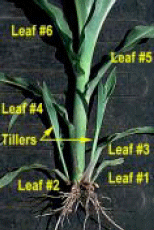
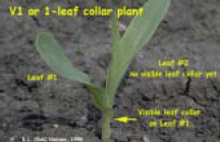
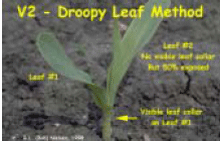
Growth staging in corn can be confusing; some even claim it’s a shell game. The confusion exists because there is no universally accepted method to stage corn. Agronomists have their method, hail insurance adjusters have theirs, and herbicide labels are in between the two. Leaf Collar Method. Agronomists determine leaf stage in corn by counting the number of leaves on a plant that have visible leaf collars, including the first short rounded-tip leaf. The leaf collar is the light-colored ‘band’ visible at the base of an exposed leaf blade. ‘Droopy’ Leaf Method. Hail insurance adjusters also begin counting with the first short leaf, but continue counting beyond the uppermost visible collar to that leaf which is 40 to 50 percent exposed. In knee-high corn or older, the tip of this leaf is typically also pointing downward, hence the name ‘droopy’ leaf method. The few post-emergence corn herbicide labels that refer to corn leaf stage typically use the ‘droopy’ leaf method, except that the first short leaf is not counted. Leaf Collar vs. Droopy Leaf. Up to the 5- to 6-leaf collar stage, the leaf collar method will typically result in a leaf stage that is one less than the ‘droopy’ leaf method. After corn reaches 18 to 24 inches in height, the leaf collar staging method will typically result in a leaf stage that is two less than the ‘droopy’ leaf method.
As corn plants develop, the lower few leaves typically die or are ripped from the stem by expansion of the stalk or by developing roots. Consequently, growth stage identification can be difficult on older plants when you aren’t sure which leaves to begin counting first. But, not to worry, growth staging can still be accomplished! First, dig or pull a plant without breaking the stalk. With a knife, split the stalk down the middle, completely through the root ball. Look for the first noticeable internode (the whitish area between the ‘woody’ horizontal stalk nodes) above the triangular ‘woody’ base of the stalk. This internode’s length is typically only 1/2 to 3/4 inch. Carefully determine which leaf’s sheath attaches to the node immediately above the first noticeable internode. This leaf is usually Leaf #5. Once Leaf #5 is identified, then stage the plant by counting the remainder of the leaves up the plant that have visible leaf collars. If you want to determine growth stage in order to use a defoliation/yield loss chart, then remember to add 2 to that number to equal the ‘droopy’ leaf method. The usefulness in understanding the differences between the leaf collar and ‘droopy’ leaf methods lies in the fact that the defoliation/yield loss chart used by hail insurance adjusters depends on the ‘droopy’ leaf method. That chart is reproduced in Purdue’s Corn & Soybean Field Guide, Extension publication # ID-179. Severe hail damage often limits your ability to spot true ‘droopy’ leaves, whereas leaf collars are often still identifiable. Thus, you can usually stage a damaged crop by the leaf collar method, then add one or two more leaves to the count in order to use the defoliation chart.
What Exactly Do You Mean by "Growing Degree Day"?– (Bob Nielsen)
Growth and development of corn are strongly dependent on temperature. Corn develops faster when temperatures are warmer and more slowly when temperatures are cooler. For example, a string of warmer than normal days in late spring will encourage faster leaf development than normal. Another example is that a cooler than normal grain filling period will delay the calendar date of grain maturity. The phrases “string of warmer than normal days” and “cooler than normal grain filling period “ can be converted mathematically into measures of thermal time by calculating the daily accumulations of heat. Commonly used terms for thermal time are Growing Degree Days (GDDs) or heat units (HUs). Different methods exist for calculating heat units depending on a) the crop or biological organism of interest and b) the whim or personal preference of the researcher. In Purdue’s Pest&Crop <http://www.entm.purdue.edu/Entomology/ext/targets/newslett.htm>, you will often see more than one type of calculated GDD or HU reported depending on the insect or crop of interest. The calculation method most commonly used in the U.S. for determining heat unit accumulation relative to corn phenology is the formula first suggested by the National Oceanic and Atmospheric Administration in 1969 and labeled as the ‘Modified Growing Degree Day’ formula in 1971. This method calculates daily accumulation of GDDs as the average daily temperature minus 50°F. The ‘modification’ refers to the limits imposed on the daily maximum and minimum temperatures allowed in the calculation. Daily maximums greater than 86°F are set equal to 86 in the calculation of the daily average temperature. Similarly, daily minimums less than 50°F are set equal to 50 in the calculation. Example 1: If the daily maximum temperature was 80°F and the minimum was 55°F, the GDD accumulation for the day would be ((80 + 55)/2) – 50 or 17.5 GDDs. Example 2 (Illustrating the limit on daily maximums): If the daily maximum temperature was 90°F and the minimum was 72°F, the GDD accumulation for the day would be ((86 + 72)/2) – 50 or 29 GDDs. Example 3 (Illustrating the limit on daily minimums): If the daily maximum temperature was 68°F and the minimum was 41°F, the GDD accumulation for the day would be ((68 + 50)/2) – 50 or 9 GDDs. Don’t forget, this and other timely information about corn can be viewed at the Chat ‘n Chew Café on the World Wide Web at <http://www.kingcorn.org/cafe>. For other information about corn, take a look at the Corn Growers’ Guidebook on the World Wide Web at <http://www.kingcorn.org/>.
|
||||||||||||||||||||||||||||
 |
||||||||||||||||||||||||||||
You Can Track Heat Units for Black Cutworm in Your Area– (John Obermeyer and Rich Edwards)
We are often asked how we track heat units for black cutworm development from the time of an intensive moth flight (9 or more moths caught over a 2-night period) until larvae are big enough to cut plants. This information helps you better time scouting visits to cornfields during this busy time of the year. Of course, we already do this for 17 weather stations in every issue of Pest&Crop (see “Weather Update”). There are limitations as to the timeliness of what we present in Pest&Crop; one being the time from when the heat unit accumulations are computed (Wednesday) to the time you are able to view this newsletter (Thursday on the Web or a mailed copy on Saturday or Monday). The other limitation is that the cutworm information for your area may be different from what comes from our cutworm-trapping cooperators. Follow these steps for current heat unit accumulations (base 50°F) in your area:
|
||||||||||||||||||||||||||||
 |
||||||||||||||||||||||||||||
|
||||||||||||||||||||||||||||