Pest & Crop Newsletter



 |
||||||||||||||||||||||||||||||||||||||||||||||||||||||||||||||||||||||||||||||||||||||||
|
||||||||||||||||||||||||||||||||||||||||||||||||||||||||||||||||||||||||||||||||||||||||
 |
||||||||||||||||||||||||||||||||||||||||||||||||||||||||||||||||||||||||||||||||||||||||
Cold Hasn't Stopped Alfalfa Weevil– (John Obermeyer, Rich Edwards, and Larry Bledsoe)
Several cooperators have kept us abreast of alfalfa weevil activity in their areas of southern Indiana and our thanks go out to Wesley Shupe, Dave Osborne, and Richard Huntrods. Their surveys reveal that percent tip feeding ranges from 16 to 100%. Several fields in Gibson County have already been treated due to severe weevil damage. The below freezing temperatures on April 17 and 18 may cause some frost damage to show up on the alfalfa, but the weevils were well protected in leaf buds. Although weevils cease their feeding activity when temperatures dip below 48°F, they are quite cold hardy and will survive just fine nestled among the folded alfalfa leaves.
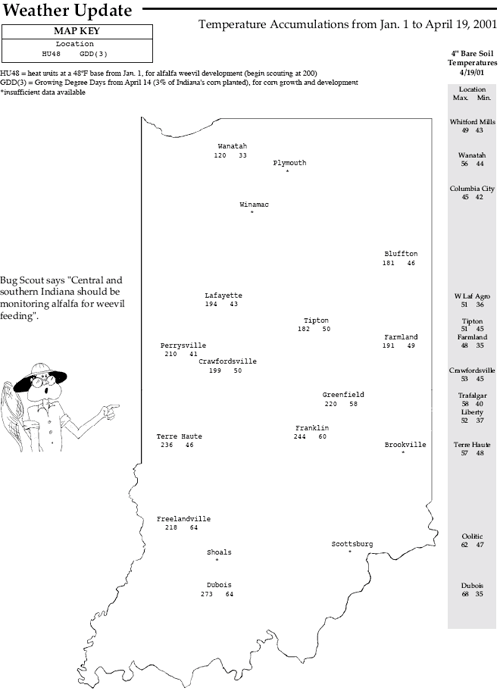
Field scouting for alfalfa weevil damage should begin when approximately 200 heat units, base 48°F, have accumulated from January 1 (see “Weather Update”). Sampling a field to determine the extent of alfalfa weevil damage is best accomplished by walking through the field in an “M-shaped pattern.” Five alfalfa stems should be examined in each of 5 areas of the field, for a total of 25 stems from the entire field. Each stem should be examined for 1) tip feeding by alfalfa weevil larvae, 2) presence of healthy larvae, and 3) maturity of the stem, i.e., pre-bud, budding and/or flowering. The average size (length) of weevil larvae should also be considered. Large alfalfa weevil larvae are relatively easy to find. Small larvae are difficult to see. Thus, very close examination of leaves may be required to detect “pin-hole” feeding and small larvae. By utilizing heat unit accumulation data to determine when sampling should begin and when a management action should be taken, producers can obtain the greatest economic return. If the application of an insecticide is required early in the weevil season, producers have the option of using a material that has good residual activity. Later in the season, short residual insecticides should be used and producers should pay close attention to harvest restrictions. The following management guidelines have proven to be very effective in determining when alfalfa weevils should be controlled in southern Indiana. The times for sampling and the need for and timing of controls are based on accumulated heat units (HU) at a base temperature of 48°F and percentage tip feeding. Watch for HU information in each week’s Pest&Crop “Weather Update.” This HU information will help you determine when management steps should be taken.
Black Cutworm Update– (John Obermeyer, Rich Edwards, and Larry Bledsoe)
From April 7 to April 15, several black cutworm intensive captures (9 or more moths caught over 2-nights) occurred throughout the state. This correlated well with warm temperatures that moved into Indiana with a weather front from the Southwest. This system brought black cutworm moths into Indiana from Mexico and Texas. However, the freezing temperatures Indiana experienced April 17 and 18 likely killed many of the arriving moths and any eggs that had already been laid. What does this mean? It means that we will wait for a new flush of arriving moths before we begin tracking heat units to determine larval development and subsequent plant damage. This is quite normal, as the moth flights of late April are usually the ones we carefully monitor. New arriving moths will be looking for the perfect place, i.e. winter annual weeds, for egg laying. Fields that are covered in chickweed, mustards, etc., are at highest risk for cutworm damage. Remember, corn and soybean are not the black cutworm’s food of choice. These are normally the only plants remaining by the time larvae have hatched and weeds are dead. Research has shown that cutworm larvae starve if weeds are destroyed 2-3 weeks before corn emergence. This says something for considering the use of early burn-down herbicides in the management of this pest. Look for updated pheromone trap captures and heat unit tracking of cutworm development in future issues of the Pest&Crop.
Black Cutworm Adult Pheromone Trap Report
|
||||||||||||||||||||||||||||||||||||||||||||||||||||||||||||||||||||||||||||||||||||||||
 |
||||||||||||||||||||||||||||||||||||||||||||||||||||||||||||||||||||||||||||||||||||||||
The Verdict from a 15 Year Study at Purdue- (Michael V. Hickman and Case R. Medlin) The majority of Indiana’s (and for that matter the Midwest’s) cropland is planted to a corn-soybean rotation system. There are plenty of reasons why including, avoiding insect problems, managing weed resistance problems, limiting risks from market fluctuations, reducing tillage operations, improving soil quality, etc. But have you ever wondered, “what if I kept that back 40 acres in continuous corn” or “what if I added wheat into the rotation” or “what if I changed my tillage or herbicide practice(s)?” For 15 years, researchers at Purdue have been evaluating those questions. In 1981, Dr. Marvin Schreiber established nearly 40 acres of plots to determine the effects of long-term tillage, crop rotation combinations, and weed management levels on corn and soybean yields. In 1990, Dr. Mike Hickman took over the plots and has used them to examine the effects of weed management levels on residual weed populations. The plots were established on the Agronomy Research Center near West Lafayette, IN. Tillage systems included a) fall moldboard plowing, b) fall chisel plowing, and c) complete no-till. Crop rotations were a) continuous corn, b) continuous soybeans, c) a 2-year corn-soybean rotation, and d) a 3-year corn-soybeans-wheat rotation. Weed management levels were a) moderate [representing average ( i.e., labeled) herbicide rates], b) minimum (representing reduced herbicide rates) compared to the moderate level, and c) maximum (representing maximum labeled rates). For 15 years the same tillage-rotation-weed management system was imposed on individual plots. Environmental variations across years, particularly precipitation, resulted in large differences in corn and soybean yields over the life of the study. Generally, the lowest yielding seasons were years of low moisture during the growing season, April to September. Highest yields for both corn and soybean occurred in 1982 and 1994 which were years of above average rainfall and favorable seasonal growing conditions that supported optimum production.
Corn and soybean yields were always greatest in the crop rotation systems compared to the monoculture systems ( i.e., continuous corn or continuous soybean). The 15-year average corn yields were best in the corn-soybean rotation, lowest in the continuous corn rotation, and intermediate in the corn-soybean-wheat rotation (Table 1). Although corn yields increased with crop rotation, when corn was planted after wheat, corn yields were frequently lower than in the corn-soybean rotation. The yield depression associated with wheat in the rotation may have been caused by allelopathic interactions between the wheat and the corn. Wheat is known to be allelopathic to many other species. While soybean yields were always better in the corn-soybean rotation than in the continuous soybean system, soybean yields tended to increase further by the addition of wheat into the rotation (Table 1). These data closely agree with other reports for corn grown on poorly drained soils. Tillage practice generally had less effect on yield than crop rotation, but fall moldboard plowing was the highest yielding tillage for both corn and soybeans, followed by fall chisel plowing, and no-till, respectively (Table 1). These results agree with other researchers who have reported reduced corn yields from continuous no-till systems and poorly drained soils. Tillage, rotation, and weed management intensity all significantly effected residual weed populations. As expected, the maximum labeled rates reduced weed populations the most, followed by the moderate ( i.e., labeled) herbicide rates, and the reduced herbicide rates (Table 2). The weed management levels also impacted corn and soybean yields. Generally plots treated with the maximum herbicide rates yielded the highest, but often corn yields from plots treated with the moderate or maximum herbicide rates were statistically the same (Table 1). Intensive weed control practiced over a long-term reduces residual weed populations regardless of tillage or rotation. In 1992, Dr. Schreiber reported that giant foxtail populations were able to recover very rapidly when the management system was disrupted. Disruptions were as simple as poor herbicide efficacy due to drought or reduced crop stands that permitted weeds to compete more fully in a season. So, due to the ability of weeds to respond quickly to optimum growing conditions and their ability to produce large quantities of seed relatively quickly, the benefits generated by long-term weed control can be quickly lost.
Generally, crop rotations resulted in lower weed populations in corn and soybean crops than a continuous corn-corn or soybean-soybean cropping system (Table 2). Long-term application of tillage, either moldboard plowing or chisel plowing in corn, reduced residual weed populations to 46% and 42% of continuous no-till weed populations. For soybeans, moldboard plowing or chisel plowing resulted in 72% or 50% few weeds than continuous no-till. To sum it all up. Increasing tillage from no-till to either chisel plowing or moldboard plowing resulted in significant yield increases for corn and soybeans coupled with reductions in residual weed populations over the life of the study. Crop rotation was effective in improving yield and reducing residual weed populations. Weed management intensity above the reduced herbicide rates generally improved yield and reduced weed populations, and although the cost will be more, the yield increases are unlikely to offset the increased herbicide input costs. Keep in mind, there are many other factors to consider in your production system including; soil erosion, herbicide resistant weeds, soil tilth, etc. Also, these results are from one location, one soil type, and may not be applicable to your conditions. So before you change your production system, be sure and look at the whole picture.
|
||||||||||||||||||||||||||||||||||||||||||||||||||||||||||||||||||||||||||||||||||||||||
 |
||||||||||||||||||||||||||||||||||||||||||||||||||||||||||||||||||||||||||||||||||||||||
The Impact of Cold Temperatures on the Wheat Plant– (Ellsworth P. Christmas and Charles W. Mansfield)
Low temperature during the morning hours of April 17 were 260F at Wanatah, 250F at Columbia City, 260F at Farmland, 260F at Terra Haute, 280F at the Purdue Agronomy research Center, 290F at Butlerville and 310F at Oolitic. The Wednesday morning low temperatures were a little higher in northeastern Indiana and a little lower in southwestern Indiana. Columbia City, Dubois, Oolitic and Wanatah recorded low temperatures of 280F with Greencastle, New Castle, and Wheatfield coming in at 250F. The Agronomy Research Center and Butlerville had low temperatures of 270F and all other stations reporting had temperatures of 290F or above. We must remember that the reported temperatures are taken at 4.5 feet above the soil surface. On a clear-still night, temperatures at the top of the canopy of the wheat crop can be 2 to 5 degrees colder. Once wheat has begun to joint, temperatures at or below 240F for a period of two or more hours can result in freeze damage to the wheat plant. The wheat in northeastern Indiana has not yet jointed (Feekes 5), while the wheat at the Agronomy Research Center has jointed with the head approximately 2.5 to 3 inches above the soil surface (Feekes 6). From the temperatures cited above, it appears that the temperatures during the morning hours of April 17 and 18, 2001 were not low enough to cause widespread damage to the wheat crop across the northern one-half of Indiana where the temperatures were the lowest. There may be some burning or discoloration of the exposed leaf tissue but very little additional damage. Should the temperatures at the wheat canopy drop below 250F for two or more hours, damage can occur. If temperatures were low enough either morning to cause serious damage to the stem or head, the damage cannot be positively diagnosed for 5 to 7 days. The type of damage that could occur includes death of the growing point (head), lesions on the lower stem, or splitting of the stem. To identify freeze damage, the stems must be split open and examined. If the growing point or head is a very light tan color and is soft, it is dead. Stem damage is a little more difficult to identify. Again take a stem and begin to remove the leaves beginning with the lower-most leaf and look at the portion of the stem just above the node. This portion of the stem is the youngest and is most vulnerable to injury. The stem should be white or very light green and have a shine to it. If the stem has a rough appearance or has a very light tan color it has been damaged by the low temperatures. Usually the roughened stems will go ahead and develop a head but may lodge later in the growing season as a result of the weakened stem. Table 1 gives a summary of the temperature required to cause freeze injury to the wheat plant at various stage of growth and the symptom most likely to be present.
Frost & Low Temperature Injury to Corn and Soybean– (Bob Nielsen & Ellsworth Christmas)
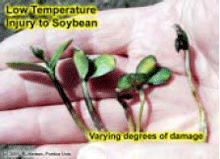
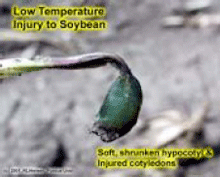
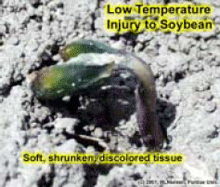
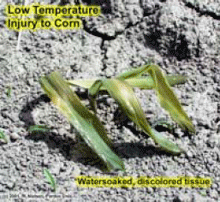
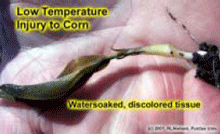
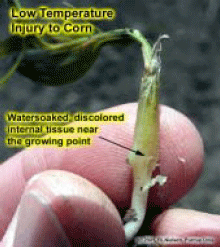
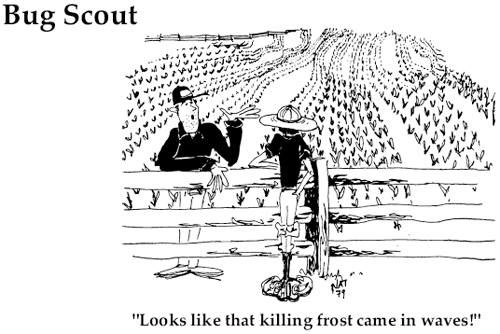
Potentially lethal low temperatures (relative to corn and soybean) occurred in locations throughout Indiana during the past several nights. Low temperatures during the morning hours of April 17 were 26°F near Wanatah, 25°F near Columbia City, 26°F near Farmland, 26°F near Terre Haute, 28°F near West Lafayette, 29°F near Butlerville and 31°F near Oolitic. The Wednesday morning low temperatures were a little higher in northeastern Indiana and a little lower in southwestern Indiana. Columbia City, Dubois, Oolitic and Wanatah recorded low temperatures of 28°F with Greencastle, New Castle, and Wheatfield coming in at 25°F. West Lafayette and Butlerville had low temperatures of 27°F and all other stations reporting had temperatures of 29°F or above. Remember that official reporting stations measure temperatures at 4.5 feet above the soil surface. On a clear-still night, temperatures at the soil surface can be 2 to 5 degrees colder. Early planted corn and soybean plants were examined at the Agronomy Research Center, near West Lafayette, at noon on Wednesday to determine the extent of the freeze damage. Soybean plants at the VE and VC stages of development were examined. Nearly all of the growing points were frozen and about 2/3 of the plants had frozen hypocotyls. The region of the hypocotyl just below the cotyledonary node had already lost turgor pressure and was becoming soft and shrunken. Within two or three days, these plants will shrivel to point that only the cotyledons will be identifiable. It was not possible to determine so soon after the damage the fate of those plants without frozen hypocotyls but with possibly frozen growing points. Corn plants at the VE to V1 stages of development were severely damaged above ground, with leaves already drooped over and turning greenish-black. Such damaged leaves will slowly bleach to a straw color as the tissue dries out. As the frosted leaf tissue in the whorl dries, the whorl will often develop a constricted ‘knot’ that may restrict expansion of the undamaged whorl tissue later on. Usually, knotted corn plants will successfully recover as the expanding whorl tissue breaks these knots. Once in a great while, it may be necessary to mow a frosted corn field to cut off severely knotted leaf tissue. The key to deciding whether to mow or not is to allow the damaged field three to five days to show you how well it is recovering. As with most early-season injuries to corn, the recovery of frosted corn depends greatly on whether the internal growing point region was damaged. The good news is that the growing point region of corn younger than growth stage V6 (six leaves with visible leaf collars, roughly knee-high) is below the soil surface and protected from aboveground frost damage. Inspection of the growing point regions of the plants at the Agronomy Research Center was inconclusive, although there was evidence of external tissue damage to the pseudo-stem (the rolled leaves that constitute the ‘stem’ on such young plants). The uncertainty is due to whether the temperature at the growing point dropped to lethal levels. The bottom line on diagnosing the severity of frost or low temperature injury to corn or soybean is that you generally need to wait three to five days after the weather event before you can accurately assess the extent of damage or recovery. Injury to either crop can look very serious the day after the event, but recovery may be possible if the growing points are not damaged. These three to five days will be better spent continuing to plant the remainder of your crop acres, assuming that most growers are not yet finished with corn and soybean planting. After three to five days, surviving corn plants should be showing new leaf tissue expanding from the whorls, while dead corn plants will still look dead. Yield loss to frost damage in corn younger than V6 is related primarily to the degree of stand loss, not to the degree of leaf damage. Surviving soybean plants will show new leaves emerging from one or both nodes at the cotyledons, while dead plants will still look dead. If recovery is evident after three to five days, then replanting is not justified. If a significant proportion of the population is obviously dead after this same period of time, then replanting may be justified.
Corn Replant Decision Making– (Bob Nielsen)
While the coffeeshop talk was lively, little corn was actually planted throughout the state during the early weeks of April. Nonetheless, the current talk down at the Chat ‘n Chew Café centers around those early plantings that may require replanting. Recent cold snaps have resulted in potentially thin or uneven stands and nervous thoughts on the farmer’s part. When do you pull the trigger on corn replanting? As usual, it depends on a few things. First Consideration: While a field may warrant replanting, let’s remember to keep things in perspective this year. If you still have most of your acreage yet to plant, I doubt that it makes good economic sense to spend the time to replant an early-planted field until you have finished planting the rest of the crop. Keep an eye on the suspect field, line up the replant seed, but hold up on the actual replanting for a while. Required Information: The following information is required to make a well-reasoned decision about replanting a field suffering from poor stand establishment. For more details, read my Extension publication, AY-264, Estimating Yield and Dollar Returns from Corn Replanting, a worksheet-style decision guide that describes the information required and provides a step-by-step procedure for determining whether replanting can be economically justified. This publication is available at your local Purdue Extension office or on the Web at <http://www.agcom.purdue.edu/AgCom/Pubs/AY/AY-264.html >.
Be On the Lookout for Corkscrewed Corn Seedlings– (Bob Nielsen)
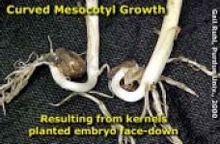
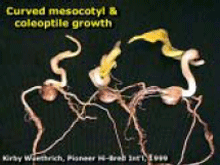
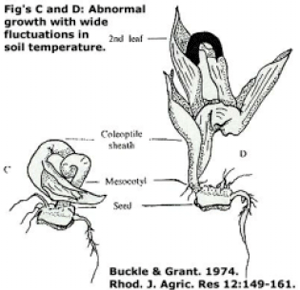
The potentially damaging cold temperatures earlier this week caused obvious above ground damage to corn that had already emerged (see related article). In a recent conversation with Chuck Niccum of Niccum Seeds, I was reminded that another consequence of unusually cool temperatures may manifest itself in fields where seedlings had not yet emerged by the time the cold temperatures hit. Often, following such episodes of cold snaps, reports will come in of incomplete corn emergence with accompanying descriptions of mesocotyls and coleoptiles that are twisted, corkscrewed, spiraling, and otherwise ‘messed up’ below the soil surface. The end result of such spiraling sub-surface seedlings is either underground leaf emergence or eventual death of the seedling. As is usual with crop problems, several culprits, including cold temperatures, can cause this symptom and afflicted growers need to identify which is the most likely cause in their situation. Kernel Position in Furrow: The position of the kernel in the furrow with respect to the embryo face directly influences initial location where the plumule emerges. The plumule, which later differentiates into the mesocotyl and coleoptile, emerges from the embryo side of the kernel, initially elongating toward the dent end of the kernel. If the kernel lands embryo face down in the furrow, the plumule emerges on the bottom side of the kernel, elongates horizontally until the mesocotyl ‘clears’ the end of the kernel, then finally begins its upward ascent. Restricted Emergence: Corkscrewed mesocotyl/coleoptile development often results when the coleoptile encounters resistance as the mesocotyl elongates. Severe soil crusting, a naturally dense soil surface, or cloddy soil surfaces can cause such resistance. A combination of severe sidewall compaction plus press wheel compaction over the furrow can also restrict coleoptile emergence. Herbicide Injury: Certain herbicides, notably cell growth inhibitors, can affect seedling shoot development especially if weather or soil conditions are not conducive for rapid growth. Quite often when herbicide is part of the blame, significant soil crusting is also a major factor. Temperature Response: Some years ago, I came across an article from Rhodesia (Buckle & Grant. 1974. Rhod. J. Agric. Res. 12: 149-161) that described the same phenomenon and attributed it to large fluctuations between day and night soil temperatures. Abnormal mesocotyl and/or coleoptile development occurred most frequently when soil temperatures fluctuated from daytime highs of about 80°F to nighttime lows of about 55°F. The data also suggested that extended periods of cold temperatures stunted and distorted seedling growth. Don’t forget, this and other timely information about corn can be viewed at the Chat ‘n Chew Café on the World Wide Web at <http://www.kingcorn.org/chatchew.htm>. For other information about corn, take a look at the Corn Growers’ Guidebook on the World Wide Web at <http://www.kingcorn.org/>.
|
||||||||||||||||||||||||||||||||||||||||||||||||||||||||||||||||||||||||||||||||||||||||
 |
||||||||||||||||||||||||||||||||||||||||||||||||||||||||||||||||||||||||||||||||||||||||
|
||||||||||||||||||||||||||||||||||||||||||||||||||||||||||||||||||||||||||||||||||||||||