Pest & Crop Newsletter



 |
|||||
|
|||||
 |
|||||
Soybean Foliar Insecticides, Perhaps a Big Mistake– (John Obermeyer, Rich Edwards, and Larry Bledsoe)
Foliage defoliating insects, e.g., Japanese beetle, grasshoppers, bean leaf beetle, are active in most soybean fields throughout the state. Some fields, but mostly areas of fields, are looking pretty tattered and producers may desire to put an end to this attack on their crop that has gone on for weeks. We are aware that some seed producers are treating soybean fields for western corn rootworm beetles to reduce the rootworm threat to next year’s inbred corn. Applying insecticides from now until crop maturity may lead to devastating results.
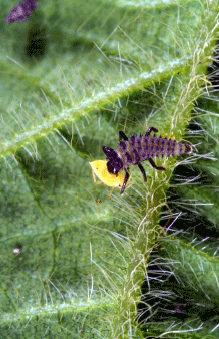
Lurking in most soybean fields are spider mites and soybean aphid. Most populations of spider mites have been subdued with the recent rains and high humidity of recent weeks. This was addressed in Pest&Crop #16. Soybean aphid continues to be found with regularity in northern Indiana, albeit low populations. Reports concerning soybean aphid continue to substantiate that natural predators, mainly lady beetles, are keeping this potential pest in-check. Treating soybean with an insecticide for the remainder of the season may tip the balance in the favor of spider mites and/or soybean aphid. In other words, natural enemies (a.k.a., good bugs) recover slowly from broad-spectrum insecticides compared to mites and aphids. In general, toxic levels of insecticide are absorbed by ingestion (eating treated leaves) and/or contact (walking over treated areas). Mites and aphids are both sucking insects and ingest only internal plant fluids. Except for mature females, they are relatively stationary on the bottom sides of leaves; obviously a difficult location to get thorough coverage. As well, surviving mites and aphids can repopulate fields at break-neck speed, certainly outpacing natural enemies. Even if a field is at or approaching a treatment threshold, carefully consider the impact on other potential pests and their natural enemies. Gee, this advise sounds like integrated pest management. Happy scouting!
Potato Leafhopper Numbers High, Natural Reductions Are Possible– (John Obermeyer, Rich Edwards, and Larry Bledsoe)
Potato leafhopper populations have been high in most alfalfa fields this summer. Hopefully pest managers have been carefully monitoring leafhopper numbers before yield and quality have been lost. Yellow alfalfa indicates poor management of this pest! Good news may be forthcoming. With “cooler” temperatures forecasted after this stifling spell of heat and humidity, insect disease may come to our rescue. The fungal pathogen Zoophthora radicans is favored by cool and wet conditions to multiply and spread throughout leafhopper populations. Once the environment favors the disease, leafhopper populations may crash within days. Typically the conditions that favor this pathogen occur in later July or August. Watch for discolored and/or slow moving leafhoppers while obtaining sweep counts. Should you suspect the presence of diseased leafhoppers, consider holding off treatment and re-evaluating in a couple days.
|
|||||
 |
|||||
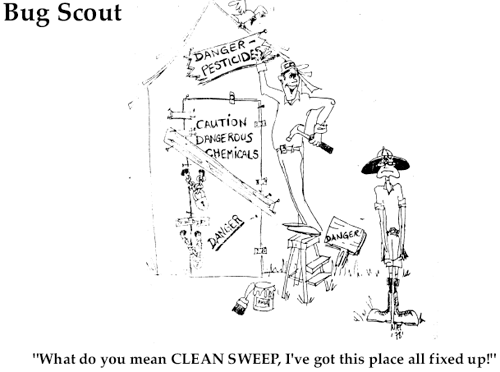
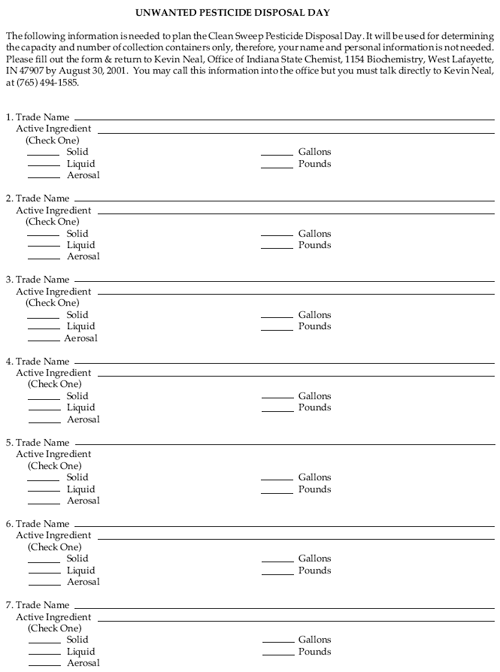
Indiana Pesticide Clean Sweep Project– (Kevin Neal, Office of Indiana State Chemist) On Thursday, September 6, 2001, licensed pest control operators, golf courses, ag facilities and farmers will be given the opportunity to dispose of unwanted, suspended, or cancelled pesticides through a program sponsored by the Office of Indiana State Chemist (OISC) through a grant provided by the U.S. EPA. The Indiana Pesticide Clean Sweep project will accept any currently registered, cancelled/suspended, opened, unopened, usable, unusable herbicides, insecticides, rodenticides, fungicides or miticides. You should only bring containers which are labeled, leak-free, and safe to transport. Materials should be left in their original containers - DO NOT mix materials. In case of an emergency, we ask that you bring a list of products you are carrying and phone number of a responsible party to be contacted. Pesticides brought in leaking and unlabeled containers will not be accepted. To assist in planning, we are requesting information on the type and volume of materials you will be delivering to West Apple Orchard located at 9470 County Road 500 West in Brazil, Indiana. Directions to West Apple Orchard: North off of State Road 340 on County Road 500 West. Orchard is located 1.5 miles north of State Road 340 on west side of the road. We will accept deliveries between 9:00 a.m. and 3:00 p.m. We must have your form returned by August 30th to the Office of Indiana State Chemist attention Kevin W. Neal. This service is provided free of charge up to 200 pounds. Over 200 pounds there will be a $2.00 per pound charge up to 250 pounds. If you were to dispose of 250 pounds of pesticide on your own the charge would be approximately $2,500.00. The most you will pay under the “Clean Sweep” program is $100.00. This is a great opportunity for you to dispose of unwanted products at little or no cost. If you have any questions please call me at (765) 494-1585.
|
|||||
 |
|||||
|