Pest & Crop Newsletter



 |
|||||||||||||||||||||||||||||||||||||||||||||||||
|
|||||||||||||||||||||||||||||||||||||||||||||||||
 |
|||||||||||||||||||||||||||||||||||||||||||||||||
Cutworm Damage Continues Northward– (John Obermeyer, Rich Edwards, and Larry Bledsoe)
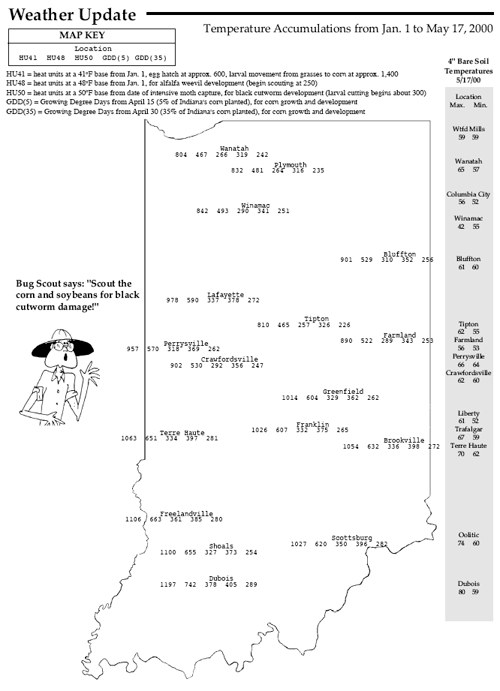
Ron Blackwell, IPM Survey Specialist, has been busy inspecting fields in central and west central counties for black cutworm damage. What he found is that fields showing the remains of weedy growth this spring are prime candidates for damage. As reported last week, cutworms of all sizes are being found. That is, larger larvae are cutting plants and smaller worms are leaf feeding. We appreciate those that have called to confirm similar findings. We’ve also received a report from extreme northern Indiana of cutworms (probably not black cutworm) damaging soybeans as they emerge. Ample soil moisture in most fields has aided rescue insecticide efforts. If the worms are an inch or more below ground due to dry conditions, an insecticide may not give acceptable control. To increase the probability that adequate control will be achieved when dry soil conditions are noted, a rotary hoe or cultivator may prove useful. Hopefully, these will disturb the soil enough that the cutworms will move around, thus increasing the likelihood that they will contact the insecticide. Additionally, the use of a higher rate of the insecticide in 20 gallons or more water per acre may help the level of control. On no-till fields, which obviously cannot be tilled, applying the insecticide in the early evening may increase control. It is not uncommon for the worms to move toward the soil surface to feed during the evening and nighttime hours. Follow the management guidelines and suggested foliar insecticides for black cutworm given in the previous issue of the Pest&Crop.
Bean Leaf Beetle in Soybean– (John Obermeyer, Rich Edwards, and Larry Bledsoe)
Numerous calls have come in concerning bean leaf beetle feeding on soybean seedlings. As well, some areas received hail with recent storms, which really made it difficult to assess for beetle damage. The general rule, “the damage looks worse that is really is,” applies to this insect’s feeding. Refer to Pest&Crop #6 for management guidelines. Bottom line…it takes tremendous damage to the soybean seedling to negatively affect stand and yield. Good news concerning this beast! The beetle population will soon, if not already, be decreasing. These overwintering beetles have now fed, mated, laid eggs, and now will be naturally dying. If new plant growth is not being damaged, this probably indicates the end of these beetles for now. We will see them back sometime mid-summer, stay tuned to future Pest&Crop’s.
Seedcorn Maggots in Soybean– (John Obermeyer, Rich Edwards, and Larry Bledsoe)
Seedcorn maggot larvae have been reported feeding on the seeds of soybean throughout Indiana. Replanting has been considered for many of these fields. Seeds planted in high crop residue, weedy growth, and/or where animal manure was applied are most often subject to attack by this pest. Seedcorn maggots are small, yellowish-white maggots up to 1/4 inch long. They are the larval stage of a fly that is attracted to areas with decaying organic matter to lay their eggs. When the eggs hatch, the larvae move to the germinating seeds or very young plants. They tunnel into the seeds or underground portion of plants and feed. The damage is usually first observed as skips in the row where plants do not emerge, or if they emerge, die back. In soybean it is important to remember that unless very wide skips in rows are noted, plants have a tremendous ability to compensate for missing plants. Skips of less than 2 feet generally have little effect on yield. Areas where skips from 2 to 3 feet are observed may result in 6 to 13% yield reduction (see chart below for effect of skips). Date of replanting is not quite as critical this time of year for soybean as it is for corn (see chart below for effect of delayed planting). Full season soybean varieties replanted on May 30 will produce approximately 94% of a normal yield. A mid-season variety will yield 96% of normal. Yields do not drop off dramatically until after June 10. As with corn, there are unknowns relative to crop establishment after replanting. Weather conditions are difficult to predict and will impact stand establishment and plant growth.
When replanting, it is possible yet unlikely, that the maggots will damage the newly planted seed. Finding small, light brown, oval pupa cases during your inspection indicates that the maggots are nearing completion of their life cycle and the damage is done. Also, light tillage before replanting should expose and kill many maggots. If one wants to be certain of no further damage, a seed treatment (e.g., Kernel Guard Supreme) may be applied at planting.
Corn Borer Moths Beginning to Fly– (John Obermeyer) Black light trap cooperators are beginning to catch European corn borer moths (see “Black Light Trap Catch Report”). Although we are not too concerned about these early catches, this does mark the beginning of the corn borer season throughout much of the state. As time passes, we will issue advisories if threatening populations exist.
Potato Leafhoppers... They're Here– (John Obermeyer) Potato leafhoppers have arrived with recent weather systems from southern states. Although these leafhoppers are of no significance at this time, it does indicate the beginning of the 2000 population. As the season progresses, populations will increase and may reach economic levels. As if alfalfa weevil wasn’t enough for the alfalfa crop this year already! Stay tuned.
|
|||||||||||||||||||||||||||||||||||||||||||||||||
 |
|||||||||||||||||||||||||||||||||||||||||||||||||
Fluctuating Weather conditions May Cause Weed Control Difficulties– (Case R. Medlin)
During the last two months, weather conditions in Indiana have fluctuated severely. At the first of the summer, we were expecting drought conditions; now many of us are wanting the rain to let up so we can finish planting. These unpredictable rainfall conditions have been combined with temperatures ranging from over night lows in the mid 20’s to daytime highs in the mid 80’s. Add to these scenarios the windy conditions and what do you have… “unpredictable conditions for weed control.” These changing weather patterns can and have impacted herbicide performance. Soil applied herbicides sprayed on the early-planted fields may be a concern due to insufficient rainfall for activation. Producers need to closely monitor the weed pressures in those early-planted fields to ensure the soil-applied herbicides were activated. Although weed emergence is not as severe without timely rainfall, some weeds can emerge from below the herbicide treated soil, grow through the treated soil, and compete with the crop. Generally, once these weeds are established, the soil-applied herbicide will not control them. We then must rely on postemergence herbicides or cultivation for control. The key then is catching the weeds before they get too big. Postemergence herbicide sprays work best when the weeds are experiencing good growing conditions. In the anticipation of drought-like conditions this summer, timely herbicide applications will be essential. Applications should be made when the weeds and the crop are actively growing. Spraying a stressed crop with some herbicides can result in severe crop injury. Likewise, herbicide application to drought stressed weeds can result in poor weed control. So if the summer shapes up to meteorologists’ expectations, stay aware of your weed problems and spray them once the opportunity presents itself. Luckily, most of Indiana has gotten activating rainfall events over the last few weeks. Fields planted and treated with soil-applied herbicides during this time should have good performance from those herbicides. Unfortunately, a few counties have experienced excessive cool-wet conditions and, as a result, they have experienced crop injury problems due to their soil-applied herbicide program. Generally the injury is short lived and normal growth resumes after a few days of good growing conditions. Usually these herbicides are very safe to the crop, but placing the biochemical systems of plants under stress from cool-wet conditions and the herbicide can have an adverse affect on the most tolerant crop. As with any year, herbicide drift is a major concern. Some effective ways of alleviating this concern are:
Although these practices are easily discussed, they are not always easy to implement. One thing you can control without much hassle is the time of days certain fields are treated. Treat fields bordering other crops and fields near urban areas early in the morning before the wind picks up. Any step toward reducing drift will be appreciated by your neighbors and by your pocketbook.
|
|||||||||||||||||||||||||||||||||||||||||||||||||
 |
|||||||||||||||||||||||||||||||||||||||||||||||||
Consistent Variability: An Oxymoron or a Requirement for Precision Farming– (Bob Nielsen)
Variable: adj: 1 a: able or apt to vary: subject to variation or changes b: fickle, inconstant 2: characterized by variations. (Merriam Webster’s Collegiate Dictionary [10th ed.]) The topic for discussion at the weekly gathering of the Precision Farmers Coffee Club (PFCC) uptown at the Lantern Café this past Friday had to do with the frustrations that some of the members were having regarding yield maps that seemed to be illustrating different patterns of yield variability from year to year in the same field. Some have been mapping yield for some time now, but the low-yielding spots and high-yielding spots have not been occurring in the same spots every year. Needless to say, this inconsistent pattern of yield variability throughout a field puts a damper on the use of such information to plan future management strategies. The upshot of the PFCC discussion at the Lantern Café was that yield variability in a field needs to be consistent from year to year in order for precision farming strategies to be developed to address that variability. But, the term “consistent variability” seems to be an oxymoron. What gives? A couple of articles were published in agricultural research journals in recent years that support the observations of these early adopters of yield monitoring technology. Research led by John Lamb <jlamb@soils.umn.edu> at the University of Minnesota (Lamb, et al. 1997. Spatial and Temporal Stability of Corn Grain Yields. J. Prod. Ag. 10:410-414) supports the notion that spatial (field position) variability in corn grain yield is not consistent from year to year. Yields within a 4.4 acre research area varied considerably each year of a 5-year study (high - low differences ranged from 44 to 72 bushels per acre during the five years), but were not spatially consistent from year to year. What this means is that historical yield data from a particular spot in the field could not predict future yields in that same spot very reliably. Another recently reported study (Eghball & Varvel. 1997. Fractal Analysis of Temporal Yield Variability of Crop Sequences: Implications for Site-Specific Management. Agron. J. 89:851-855) offered similar evidence that temporal variability (variability over time) in yields of several crops was more important than spatial variability. The data for their analyses were generated from a long-term cropping systems study involving seven crop rotations evaluated during the years 1975 - 1995 in eastern Nebraska. Bottom Line: If you are frustrated with the inconsistent variability demonstrated by multiple-year yield maps, there is good reason. What the guys uptown at the Lantern Café are experiencing is the result of weather (climate) patterns interacting with other yield limiting factors. The most intuitive example of such an interaction is that piece of wet ground that yields with the best of them in a somewhat dry year, but drowns out in a rainy year. Ditto, but reversed, for that piece of sandy ground. Perennially-occurring yield limiting factors (e.g., soil pH) can be easily identified and managed with site-specific technology simply because they exist every year in pretty much the same areas of a field. However, site-specific technology will help identify sporadic yield limiting factors when they occur, but not necessarily prevent their reoccurrence since one cannot reliably predict the timing of their reoccurrence. Don’t forget, this and other timely information about corn can be viewed at the Chat ‘n Chew Café on the World Wide Web at <http://www.kingcorn.org/chatchew.htm>. For other information about corn, take a look at the Corn Growers’ Guidebook on the World Wide Web at <http://www.kingcorn.org/>.
Spiraling Sub-Surface Seedlings– (Bob Nielsen)
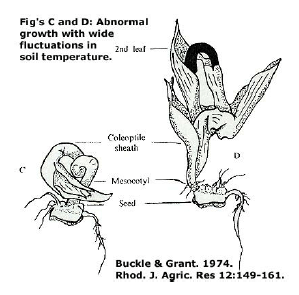
More than one report of incomplete corn emergence has been received with accompanying descriptions of mesocotyls and coleoptiles that are twisted, corkscrewed, spiraling, and otherwise ‘messed up’ below the soil surface. The end result of such spiraling sub-surface seedlings is either underground leaf emergence or eventual death of the seedling. As is usual with crop problems, several culprits can cause this symptom and afflicted growers need to identify which is the most likely cause in their situation.
Kernel Position in Furrow: The position of the kernel in the furrow with respect to the embryo face directly influences initial location where the plumule emerges. The plumule, which later differentiates into the mesocotyl and coleoptile, emerges from the embryo side of the kernel, initially elongating toward the dent end of the kernel. If the kernel lands embryo face down in the furrow, the plumule emerges on the bottom side of the kernel, elongates horizontally until the mesocotyl ‘clears’ the end of the kernel, then finally begins its upward ascent. Restricted Emergence: Corkscrewed mesocotyl/coleoptile development often results when the coleoptile encounters resistance as the mesocotyl elongates. Such resistance can be caused by severe soil crusting, a naturally dense soil surface, or cloddy soil surfaces. A combination of severe sidewall compaction plus press wheel compaction over the furrow can also restrict coleoptile emergence. Herbicide Injury: Certain herbicides, notably cell growth inhibitors, can affect seedling shoot development especially if weather or soil conditions are not conducive for rapid growth. Quite often when herbicide is part of the blame, significant soil crusting is also a major factor. Temperature Response: Some years ago, I came across an article from Rhodesia (Buckle & Grant. 1974. Rhod. J. Agric. Res. 12: 149-161) that described the same phenomenon and attributed it to large fluctuations between day and night soil temperatures. Abnormal mesocotyl and/or coleoptile development occurred most frequently when soil temperatures fluctuated from daytime highs of about 80°F to nighttime lows of about 55°F. The data also suggested that extended periods of cold temperatures stunted and distorted seedling growth.
Silver Leaf Symptom in Corn– (Bob Nielsen)
While recent mornings have been quite chilly, there have been few reported instances of significant frost and its accompanying damage to young corn. However, if you’ve been out walking your corn fields recently, you have probably noticed a curious leaf ‘symptom’ that somewhat resembles frost damage or you may think of freezer burn. Radiational cooling of leaves on clear, calm nights with temperatures in the mid- to upper 30’s can result in damage to the outer surfaces of corn leaves that are positioned horizontally or parallel to the night sky. The subsequent symptom of such minor damage is what many refer to as ‘silver leaf’ in corn. The ‘silver leaf’ symptom indeed appears as silvery or dull gray leaf surfaces. Any portion of a leaf that was not horizontal to the sky or that was protected by another leaf or plant part will not exhibit the symptom. Bottom Line The effect of this type of minor leaf damage is negligible, if any. The leaves will not die abruptly as will severely frosted leaf tissue. Continued expansion of the whorl will not be restricted in any way. New leaves that expand from the whorl will be normal in appearance. This symptom is more of a curiosity than a nuisance.
|
|||||||||||||||||||||||||||||||||||||||||||||||||
 |
|||||||||||||||||||||||||||||||||||||||||||||||||