Pest & Crop Newsletter



 |
||||||||||||||||||||||||||||||||||||||||||||||||||||||||||||||||||||||||
|
||||||||||||||||||||||||||||||||||||||||||||||||||||||||||||||||||||||||
 |
||||||||||||||||||||||||||||||||||||||||||||||||||||||||||||||||||||||||
Bean Leaf Beetle and Pod Feeding– (John Obermeyer, Larry Bledsoe, and Rich Edwards)
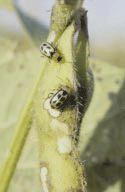
Reports of bean leaf beetles feeding on soybean pods have been received. Considering the number of beetles observed in some fields, this does not come as a surprise. Soybeans grown for seed should especially be monitored. Bean leaf beetle scar the surface of the pod, but only occasionally feed through the pod to the developing beans. During pod maturation, this scar often cracks leaving an entry hole for air borne plant pathogens which may cause discolored, moldy, shriveled, and/or diseased beans.
It is important for pest managers to be able to predict whether economic damage will occur based on the types and numbers of beetles that are present and the stage of pod development (i.e., green, yellow, yellow-brown, or brown pods). Once the pods turn yellow to yellow-brown, they become less attractive and less susceptible to damage. Control is normally not warranted from this point on. See the table on the following page. Randomly select 2 plants in each of 5 areas of the field and count the number of pods per plant and the number that show damage (10 total plants). Figure the percentage of damaged pods per plant for the field as a whole. Note if the pods are green, beginning to turn yellow, or are yellow/brown. Also determine the number of beetles per sweep using an insect sweep net. Take 5 sets of 20 sweeps in the field. Determine the number of bean leaf beetles per sweep. Additionally, note whether beetles are still actively feeding while surveying the field. Use the following table to determine when a treatment may be necessary.
Harvest Restrictions for Soybean Insecticides– (John Obermeyer, Rich Edwards, and Larry Bledsoe) The following listing includes many of the insecticides registered for soybean insect control, including rate per acre and harvest restrictions (refer to the label for insects controlled and specific rates):
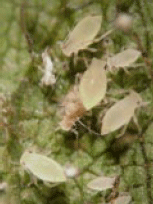
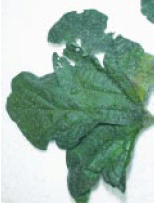
New Soybean Insect Damaging Fields in Southern Wisconsin and Northern Illinois– (George Gallepp, Editor, College of Agricultural and Life Sciences, University of Wisconsin, Madison) This article is being reproduced with permission from the editor, George Gallepp at the University of Wisconsin. Purdue University entomologists would appreciate your call (765 494-4563) if soybean plants in Indiana counties are suspected to be infested with this aphid. A new soybean pest has appeared in fields scattered across Wisconsin during the past month, according to University of Wisconsin-Madison scientists. The soybean aphid also has turned up in northern Illinois and may soon be reported from Michigan. “This is an unprecedented situation,” says David Hogg, who chairs the Department of Entomology in the College of Agricultural and Life Sciences. “The soybean aphid is a native of China and hasn’t been reported from the United States until now.” “We just haven’t seen aphid problems on soybeans before,” says John Wedberg, a UW-Madison extension entomologist who has studied the insect problems of Wisconsin’s corn and soybean crops since 1978. The researchers say it is too early for them to predict how the new pest will affect yields this year. “Although we’ve seen some fields that are severely affected, it does not seem to be causing widespread losses this year,” Hogg says. “We’re trying to learn as much as we can from the problem now because we are concerned the situation may become more serious in coming years.” “Most soybean fields appear to be tolerating the soybean aphid populations,” Wedberg adds. “As you drive by many of these fields with aphids you wouldn’t notice major plant symptoms. But in extreme infestations — often where the soybeans were planted late in the season — the plants develop crinkled or cupped leaves and they may yellow.” The soybean crop has become an increasingly important part of Wisconsin’s diverse agricultural economy. Growers in the state harvested 1 million acres of soybeans for the first time in 1997. Experts predict this year’s harvest will exceed 1.4 million acres. In mid-July, Wedberg and plant pathologist Craig Grau began seeing soybean plants covered with aphids in some of their research plots. Soon farmers and pest scouts began reporting similar problems. At first Wisconsin seemed to be the only state with aphid-infested soybean fields. But then researchers from Illinois and Michigan found soybean plants covered with aphids. Based on its wide distribution, the soybean aphid probably has been living in the Midwest for several years, according to Wedberg. It may have emerged as a problem now because the conditions this summer have been favorable to many aphid species, he says. To the UW-Madison researchers, the insects looked like cotton/melon aphids, a common aphid that feeds on a broad range of crops. But as the outbreak persisted and intensified, and its scope widened, the researchers decided to send samples of the aphids to David Voegtlin at the Illinois Natural History Survey and Manya Stoetzel at the USDA Systematic Entomology Laboratory in Beltsville, Md. On Aug. 15, the experts confirmed that the insects are indeed soybean aphids (Aphis glycines), and not cotton/melon aphids. The two species look so much alike that a high-powered microscope is needed to see the tiny structures scientists use to tell them apart. In Wisconsin, soybean plants with aphid problems have now been reported from Grant, Rock and Kenosha Counties across the south to as far north and east as Waushara and Sheboygan Counties. Since the soybean crop is nearly mature, Wedberg says growers should look at insecticides as a last resort. “The good news is that aphid populations have begun to go downhill in most fields. We hope that biological control has begun to kick in,” he says. “Aphids have a number of predators and parasites that help control them. The most effective aphid killer is usually a fungal disease that starts to catch up with them about now.” Growers who are considering chemical controls need to weigh the costs of those treatments against the uncertainty surrounding how they will perform. Wedberg suggests growers not consider insecticides unless their fields show yellowed or cupped leaves. Because the soybean aphid is new to the United States, there are no insecticides registered for it, Wedberg says. In fact, no insecticide is labeled for control of aphids in soybeans. However, it is legal to apply insecticides that are registered for other insect species that attack soybeans. Growers and crop scouts can find detailed management recommendations for possible insecticide treatments at the Wisconsin Crop Manager web site, http://ipcm.wisc.edu/wcm/, which is sponsored by the UW-Extension.
Growers also are concerned about soybean aphids transmitting diseases to the crop. “Although the soybean aphid may transmit plant diseases, it’s too late for growers to begin spraying insecticides to limit disease transmission by aphids. At this point, any damage has already been done,” Grau says. Like the soybean plant itself, the soybean aphid is a native of China. In China the aphid only attacks soybean plants and buckthorn, a woody shrub. “Since the soybean aphid has not been a problem here before, Western scientists know very little about it,” Hogg says. Scientific articles about the aphids are written in Chinese. A faculty member who reads Chinese has helped translate some of that information. In Asia, the aphids overwinter as eggs on buckthorn plants, according to Hogg. The soybean aphids hatch in spring and spend several weeks feeding on buckthorn before dispersing to soybean fields and feeding on the plants. As the soybeans begin to dry in late summer the newborn aphids don’t grow as large, and they move down the plants. The insects then produce winged forms that fly to buckthorn plants, mate and lay eggs before winter. There’s a great deal the researchers don’t know about the soybean aphid and what will happen to it in Wisconsin and the Midwest. But they should begin to get some answers by fall. In a study supported by the Wisconsin Soybean Marketing Board, a College of Agricultural and Life Sciences team that includes agronomist John Gaska, entomologists Wedberg and Hogg, and plant pathologist Grau has set up field plotswhere they control insects that might transmit viral diseases to soybeans. “This study was designed to detect possible viral diseases of soybeans,” Grau says. “These trials will help us find out if the soybean aphid is carrying viruses that affect soybeans.” Wedberg believes the study also will give the team a better idea of the damage associated with aphid feeding. The work on the soybean aphid was supported by state funding to the UW-Madison College of Agricultural and Life Sciences and the UW-Extension Cooperative Extension Service, and a grant from the Wisconsin Soybean Marketing Board.
|
||||||||||||||||||||||||||||||||||||||||||||||||||||||||||||||||||||||||
 |
||||||||||||||||||||||||||||||||||||||||||||||||||||||||||||||||||||||||
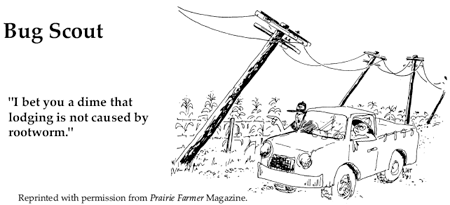
Impact of Root Lodging on Corn Yield– (Peter Thomison, Ohio State University) Strong winds (as high as 50-60 mph in some areas) and heavy rains associated with thunderstorms last week (Aug. 7) caused varying degrees of lodging in northern Ohio corn fields. Although these lodging problems may be related to rootworm injury in some cases, early season saturated soil conditions and soil compaction may have inhibited good nodal root formation and predisposed corn plants to such wind injury. Strong winds can pull corn roots part way out of the soil, a condition referred to as root lodging. If root lodging occurs before mid-grainfill, plants usually recover at least partly by “kneeing up.” This results in the characteristic goose-neck bend in the lower stalk with brace roots providing above ground support. Plants exhibiting these symptoms are sometimes referred to as “sled runners.” Although hybrids differ in their ability to resist root lodging, the major factor influencing yield response to root lodging is the developmental stage during which the root lodging injury occurs. If this stalk bending takes place before pollination, there may be little effect on yields. If it occurs later in the season, there may be some yield decrease due to partial loss of root activity. According to University of Wisconsin study, hand harvested yield reductions were generally 10% or less when wind lodging was simulated at or before the mid-vegetative growth stages, but losses increased up to 15-30% with lodging at late vegetative or early reproductive stages. Combine harvest speed may also need to be reduced to minimize harvest losses if the root lodging occurred after tasseling when stalk curvature will likely be more pronounced and ear heights reduced.
|
||||||||||||||||||||||||||||||||||||||||||||||||||||||||||||||||||||||||
 |
||||||||||||||||||||||||||||||||||||||||||||||||||||||||||||||||||||||||

 Damaged soybean leaves