Pest & Crop Newsletter



 |
||||||||||||||||||||||||||||||||||||||||||||||||||||||||||||||||||||||||||||||||||||||||||||||||||||
|
||||||||||||||||||||||||||||||||||||||||||||||||||||||||||||||||||||||||||||||||||||||||||||||||||||
 |
||||||||||||||||||||||||||||||||||||||||||||||||||||||||||||||||||||||||||||||||||||||||||||||||||||
Soybean Defoliators Busy In Some Fields– (John Obermeyer, Larry Bledsoe, and Rich Edwards)
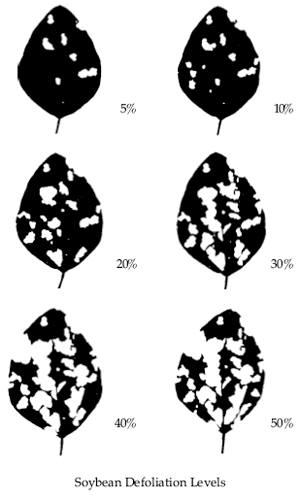
The primary insect pest feeding on the soybean leaves at this time is the beloved Japanese beetle. As it has been said many times and many ways…their feeding damage looks terrible, their effect on yield is often little to none. Impact on soybean yield from defoliators is greatest during pod set and fill. At this stage, consider treatment when defoliation exceeds 20%. Remember, one should determine the average defoliation level throughout the plant, not just in the tops of plants where most of the damage is noted. Where areas of fields are being damaged, spot treatments is all that might be necessary. As we discussed in a past article (Pest&Crop #15), numerous Japanese beetles in portions of a soybean field may cause concentrated egg laying. This may develop into a heavy grub infestation in next year’s corn that even labeled insecticides won’t be able to control. For the most part, this is only true in areas of the state that have consistent white grub problems. This consideration should encourage those producers to evaluate for beetle populations and damage now. Controlling beetles now will NOT prevent egg laying, but rather reduce the grub threat for next year’s corn.
Corn/Weed Pollen and Rootworm Beetles– (John Obermeyer, Larry Bledsoe, and Rich Edwards)
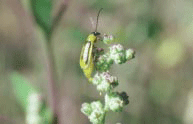
Portions of the state have many corn fields with plants ranging from whorl stage to silking. Though producers may have given up on the delayed plants, rootworm beetles may find these areas of fields appealing for its late season pollen and silk source. For soybeans, this is true for the drowned out areas that are beginning to support a healthy weed population or fields that never received a post-applied herbicide. We have seen many times that extremely late or delayed crops may attract large numbers of corn rootworm beetles. Remember, the rootworm beetles are pollen feeders, and not just corn pollen (e.g., foxtails, ragweeds, lambsquarters, pigweeds, etc.). Numerous beetles that may congregate in these spots is not a concern for this year, but if egg laying should take place in this “trap” crop, significant rootworm damage may occur on next year’s corn roots. Investigations of these areas during August will help one make informed decisions for next year (i.e., rootworm insecticides).
|
||||||||||||||||||||||||||||||||||||||||||||||||||||||||||||||||||||||||||||||||||||||||||||||||||||
 |
||||||||||||||||||||||||||||||||||||||||||||||||||||||||||||||||||||||||||||||||||||||||||||||||||||
Late-Season Weed Control In Soybeans– (Mark Loux, Ohio State University) Most of the soybeans have been treated at least once with postemergence herbicides at this point, except some of the last fields to be planted. Soybean stands remain thin and variable in many fields, and we can expect some new weed emergence in the thin areas where soybeans fail to shade the ground. It is important to recognize that it may be impossible to obtain excellent weed control in areas where soybeans are thin. In past years, most of us have observed the weeds at the end of season in areas of fields where crop stands are thin or nonexistent. However, a second postemergence application within the next several weeks may also go a long way toward preventing major weed problems in these areas. There is a great reduction in the emergence of new weeds as we progress from late June through late July. Postemergence herbicides should probably be applied by mid July when newly emerged weeds are still small, rather than waiting until weeds are observed growing above the soybeans. Keep in mind the recrop restrictions and preharvest intervals when applying postemergence herbicides this late. Large giant ragweed plants can be observed in many fields where weed control is otherwise good. A late postemergence application may not kill the giant ragweed, but will often injure them to the point that they do not greatly interfere with harvest. Making herbicide recommendations for control of these giant ragweed that have escaped earlier preemergence or postemergence ALS herbicide treatments (FirstRate, Synchrony, Classic, Raptor, etc) can be difficult, since their survival may indicate resistance to ALS inhibitors. If an ALS inhibitor was used in the field previously this year or resistance is suspected, we strongly recommend applying a diphenylether (Cobra, Flexstar) rather than an ALS inhibitor (except in Roundup Ready soybeans where glyphosate is the obvious choice). Cobra has the most flexibility with regard to late applications, since it has a 45 day preharvest interval and no recrop restrictions. The Flexstar label states that application should be made before soybeans bloom. If there is little chance that the ragweed are ALS-resistant based on herbicide history, than herbicide choices include FirstRate, Classic, or Cobra. Of these, FirstRate is the most effective on plants that are not ALS-resistant. However, expectations of FirstRate performance on large ragweed are sometimes too optimistic, and it does not always provide amazing control. Where the possibility of ALS resistance cannot be determined, we would still recommend either a diphenylether or a mixture of Classic or Firstrate with a diphenylether. When trying to control large giant ragweed, we suggest labeled rates and use of adjuvants that optimize herbicide performance. C.O.R.N. 21 - Crop Observation and Recommendation Network, C.O.R.N. 2000-21, July 10 - July 16, 2000. C.O.R.N. is a summary of crop observations, related information, and appropriate recommendations for Ohio Crop Producers and Industry. C.O.R.N. is produced by the Ohio State University Extension Agronomy Team and State Specialists at The Ohio State University and Ohio Agricultural Research and Development Center. Visit our web site at: <http://www.ag.ohio-state.edu/~corn/agcrops.html>.
|
||||||||||||||||||||||||||||||||||||||||||||||||||||||||||||||||||||||||||||||||||||||||||||||||||||
 |
||||||||||||||||||||||||||||||||||||||||||||||||||||||||||||||||||||||||||||||||||||||||||||||||||||
Take The Time To Wander Crop Variety Plots– (Bob Nielsen) County fairs, field days, vacations and other activities are taking their toll on the number of patrons down at the Wander Inn. Hopefully, some of those ‘other’ activities include wandering through crop variety plots. Crop variety test plots offer all sorts of information to growers, only part of which is reflected in the yield results book that is handed out at the conclusion of the growing season. Wandering plots now gives you an opportunity to look over other variety characteristics important to your variety selection decisions. Any signed crop variety test plot is fair game. The fact that the seed company took the time and effort to put up variety signs tells you that they encourage visitors. Take along a notepad to take notes on. If you have a copy of the company’s current variety description brochure, bring it along too. Compare the relative heights (both plant and ear) among corn hybrids. High ear placement increases the risk of stalk lodging later because of the higher center of gravity. Compare the relative stalk size among corn hybrids. Thicker stalks are generally correlated with better standability later on. Split a few stalks and check the thickness of the rind. Again, thicker stalk rinds are generally correlated with better standability later on. If you walk variety test plots closer to harvest, you can also make comparative notes among hybrids for their relative stalk health and integrity. By late August or so, you can pinch lower stalk internodes and check for stalk rot development. Hybrid differences for stalk rot development often reflect differences for tolerance to stresses in general. Compare the relative leaf health among corn hybrids. This year in particular has been conducive for the development for a number of leaf diseases, most notably common rust. In no-till test plots, pay particular attention for hybrid differences for gray leaf spot infestation. If you find a disease you are not familiar with, ask a local Extension educator, crop consultant, or industry agronomist to identify the causal organism for you. Another facet of leaf health is the so-called ‘stay green’ characteristic that reflects a hybrid’s ability to simply remain viable longer than others. Generally speaking, ‘stay green’ hybrids have a higher tolerance to stress factors than others. If little leaf disease is visible, yet some hybrids’ leaves are ‘shutting down’ while those of comparable hybrid maturities are remaining green, the latter are likely ‘stay green’ hybrids. Shuck a few ears and compare the relative ear size among corn hybrids. Kernel row number is strongly determined by a hybrid’s genetics. Number of kernels per row (ear length) is more influenced by ‘environmental’ factors and can indicate a hybrid’s tolerance to various stress factors. Obviously, we would all like to shell 30,000 ears with 22 kernel rows each and 40 kernels long. Genetically, kernel row number may vary from as few as 12 to as many as 22. Numbers of kernels per row may vary from the low 20’s to the mid-40’s, some of which is genetically determined, some of which reflects a hybrid’s response to growing conditions. Happy Wandering!
Scrambled Silks, Anyone?– (Bob Nielsen)
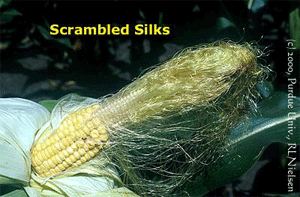
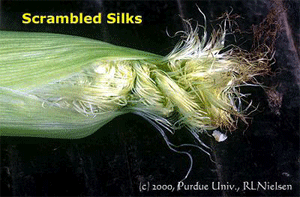
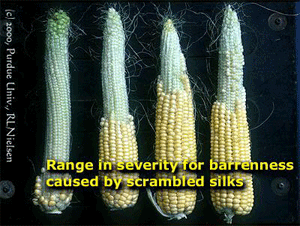
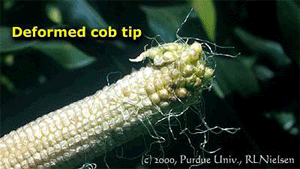
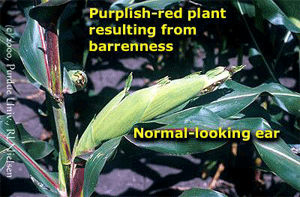
This article is admittedly fearmongering on the part of your friendly neighborhood corn specialist, but I figure it is my prerogative and responsibility to do so when I believe conditions are ripe for the development of a potential crop problem. If the problem does not occur, then growers will be relieved and they will forget I said anything about it. If the problem does occur, then I will look pretty smart for having forecast its development. The potential problem of which I speak is a phenomenon traditionally called ‘silk balling’. I prefer the name ‘scrambled silks’ because I think it is more descriptive. The problem is one in which silk elongation, prior to their emergence from the husk leaves, is interrupted or altered, resulting in a mass of scrambled silks near the tip of the cob that never fully emerge from the husk. Obviously, any silks that fail to emerge from the husk will not be exposed to any pollen and consequently will not contribute to the formation of kernels on the cob. The net result is some degree of barrenness on the cob and, consequently, lower yield. Scrambled silks is a relatively infrequent problem and its causes are not well understood. Some believe that the occurrence of cool nights (low 60’s or cooler) prior to silk emergence plays a role in the development of scrambled silks. Others believe that rapid changes in temperature patterns (e.g., very warm to very cool) prior to silk emergence encourages the problem. Hybrids with naturally tighter husks seem to be more susceptible to developing scrambled silks. Given these opinions on temperature factors that may contribute to the problem, one could speculate (some would say fearmonger) that recent unusually cool nights throughout the central and northern parts of Indiana, plus the current forecast for more of the same, may lead to an increased occurrence of scrambled silks this year. Unfortunately, there is nothing you can do about preventing or avoiding the problem. Nonetheless, it would be prudent to walk some of your fields during or after pollination and look for evidence of the problem. Typically, the severity of the resulting poor kernel set is low and concentrated near the tip end of the cob. However, I’ve seen situations in the past where scrambled silks resulted in severe barrenness in nearly 1/3 of the plants in a field. If you don’t have time to walk your fields right now, any affected plants will likely raise red flags later on in the grain filling process. By this, I mean that any plants severely afflicted with barrenness will develop purpling or reddening of leaf midribs, leaf sheaths and other plant parts. The reasons for this discoloration are similar to those for purple corn earlier in the growing season. An otherwise healthy plant whose ear is highly barren of kernels is a plant that is overproducing photosynthate (source) relative to the demands of existing kernels (sink). The excess sugars in the leaves and stalk trigger the formation of anthocyanin pigments in the plant tissues, especially in those hybrids with quite a few of the purpling genes. The similarity to early season purple corn is in the connection between excess plant sugars and anthocyanin production. Early in the season, excess plant sugars often result when root development is hindered for some reason. A photo gallery of scrambled silks and their effects on kernel set is available on the Web at <http://www.kingcorn.org/news/articles.00/SilkBalling-0718-Gallery.html>. Don’t forget, this and other timely information about corn can be viewed at the Chat ‘n Chew Café on the World Wide Web at <http://www.kingcorn.org/cafe>. For other information about corn, take a look at the Corn Growers’ Guidebook on the World Wide Web at <http://www.kingcorn.org/>.
|
||||||||||||||||||||||||||||||||||||||||||||||||||||||||||||||||||||||||||||||||||||||||||||||||||||
 |
||||||||||||||||||||||||||||||||||||||||||||||||||||||||||||||||||||||||||||||||||||||||||||||||||||
Area Planted With Transgenic Crops Up In 1999- (Pesticide Action Network Updates Service, June 29, 2000) The area planted with genetically engineered (GE) crops worldwide jumped to 39.9 million hectares in 1999, an increase of 44%, according to a new brief by the International Service for the Acquisition of Agri-biotech Applications (ISAAA). The report, “Global Review of Commercialized Transgenic Crops: 1999,” details trends in GE crop use. Today’s 39.9 million hectares of GE crops is up more than twenty fold from the 1.7 million hectares planted in 1996. The ISAAA says this adoption rate is the highest for any new technology by agricultural industry standards. Twelve countries grew GE crops in 1999. They are presented in the following table.
Three countries, Portugal, Rumania and Ukraine, planted GE crops for the first time. Industrial countries accounted for 82% of the total, less than in 1998 (84%), with 18% grown in developing countries (mostly Argentina). As in 1998, the biggest GE growing countries had the largest increases in 1999: the U.S. (8.2 million hectares), Argentina (2.4 million hectares), and Canada (1.2 million hectares). Seven GE crops were grown in 1999. There are presented in the following table.
GE soybean and corn continued to be the biggest GE crops in 1999. Cotton and canola shared the third ranking position in 1999, each accounting for about 9% of global area. The principal GE traits were roughly the same in 1998 and 1999, with herbicide tolerance still the most common, at 71% in both 1998 and 1999. Although insect resistant (Bt) crops decreased from 28% in 1998 to 22% in 1999, crops that are both insect resistant and herbicide tolerant increased from 1% in 1998 to 7% in 1999. The remaining less than 1% was accounted for by virus resistance traits in potatoes, squash and papaya in both 1998 and 1999. Looking at both crop and GE trait, 82% of all GE crops in 1999 were accounted for by three GE varieties: Herbicide tolerant soybean (54%), Bt corn (19%) and herbicide tolerant canola (9%). Revenues for GE crops have grown about thirty fold from 1995 to 1999. Sales were estimated at US$75 million in 1995, $235 million in 1996, $670 million in 1997, $1.6 billion in 1998 and $2.1 to 2.3 billion in 1999. ISAAA says that the area planted to GE crops is expected to grow but will likely begin to level off in 2000 given high adoption rates so far. There is also some uncertainty about whether U.S. growers will be influenced by concerns about GE crops, with 2000 being considered “an important test.” ISAAA works to transfer biotechnology to developing countries. A preview of their report is available online at <http://www.isaaa.org/Global%20Review%201999//briefs12cj.htm>. Source: ISAAA. 1999. Global Status of Commercialized Transgenic Crops: 1999. ISAAA Briefs No.12: Preview. ISAAA: Ithica, NY.
|
||||||||||||||||||||||||||||||||||||||||||||||||||||||||||||||||||||||||||||||||||||||||||||||||||||
 |
||||||||||||||||||||||||||||||||||||||||||||||||||||||||||||||||||||||||||||||||||||||||||||||||||||